
CHANGES DUE TO MECHANICAL VENTILATION, along with exam ready viva points
Reading File
Now let me search the library for mechanical ventilation content in parallel.
Finding Sources
Finding Sources
Good. Now let me do targeted searches for the specific physiological changes and also read the most relevant sections in parallel.
Finding Sources
Finding Sources
Finding Sources
Now let me read the key sections - the Rosen's physiology of positive pressure breathing section and the Current Surgical Therapy mechanical ventilation section, plus search for more specific changes.
Reading File
Reading File
Finding Sources
Finding Sources
Excellent data collected. Now let me read the diaphragm dysfunction section and the VILI section from Murray & Nadel, plus the Harrison's ventilatory support section.
Reading File
Reading File
Finding Sources
Now let me read the Miller's renal effects section and fetch a key VILI diagram image for visual context.
Reading File
Loading Image
I now have comprehensive data from multiple authoritative textbooks. Let me compile the complete answer.
Changes Due to Mechanical Ventilation
A. Cardiovascular Changes
Mechanical ventilation (MV) fundamentally reverses normal respiratory physiology: spontaneous breathing creates negative intrathoracic pressure; MV creates positive intrathoracic pressure. This reversal drives all cardiovascular effects.
1. Decreased Venous Return (Preload Reduction)
- Positive pressure during inspiration raises intrathoracic pressure, compressing the great veins and right atrium
- Venous return from the systemic circulation falls
- Right ventricular (RV) filling decreases -> RV stroke volume falls
- Left ventricular (LV) preload consequently falls after 1-2 beats (pulmonary transit time)
- Net result: Cardiac output (CO) falls
2. Increased Pulmonary Vascular Resistance (PVR)
- Lung inflation compresses alveolar capillaries
- PVR rises, increasing RV afterload
- Can cause acute RV strain or failure, especially at high PEEP
3. Hypotension
- Reduced CO + decreased left ventricle-to-aorta pressure gradient -> systemic hypotension
- Particularly dangerous in hypovolemic patients or those with vasodilatory states (e.g., sepsis, spinal anesthesia)
- Can occur immediately after initiation of MV
4. LV Afterload Effects (Unique Benefit)
- Increased intrathoracic pressure paradoxically reduces LV afterload (transmural pressure falls)
- This can actually benefit patients with LV failure - MV can improve CO in cardiogenic pulmonary edema by unloading the failing LV
5. Pulse Pressure Variation (PPV) and Stroke Volume Variation (SVV)
- These cyclic respiratory-induced changes in arterial waveform are exaggerated in hypovolemia
- PPV >13% during controlled MV predicts fluid responsiveness
- Used as a dynamic measure to guide fluid resuscitation
Viva Point: "Why can initiating MV cause cardiovascular collapse?" Answer: PPV reduces venous return and CO; if the patient is already hypovolemic or vasodilated (e.g., sepsis), this reduction unmasks haemodynamic instability. Always pre-load the patient before intubation if possible.
B. Pulmonary Changes / Ventilator-Induced Lung Injury (VILI)
VILI is additional lung damage caused by mechanical ventilation itself. Four mechanisms are classically described:
1. Barotrauma
- Definition: Injury from excessive airway pressure (high peak inspiratory pressure [PIP] or plateau pressure)
- Manifestations: Pneumothorax, pneumomediastinum, subcutaneous emphysema, pneumopericardium
- Key threshold: Plateau pressure >30 cmH₂O significantly increases risk
- Volume-limited ventilation (vs. pressure-limited) is associated with decreased barotrauma incidence
2. Volutrauma
- Definition: Injury from excessive tidal volume causing alveolar overdistension
- More closely linked to VILI than barotrauma alone
- ARDSNet trial showed 6 mL/kg predicted body weight (PBW) tidal volumes reduced mortality vs. 12 mL/kg PBW
3. Atelectrauma
- Definition: Injury from repeated opening and closing (recruitment-derecruitment) of unstable alveoli with each breath cycle
- Creates shear stress at the interface of open and collapsed lung units
- PEEP is the primary strategy to prevent atelectrauma by keeping alveoli open at end-expiration
- The safe "window" lies between the lower inflection point (above which alveoli stay open) and the upper inflection point (above which overdistension begins) on the pressure-volume curve
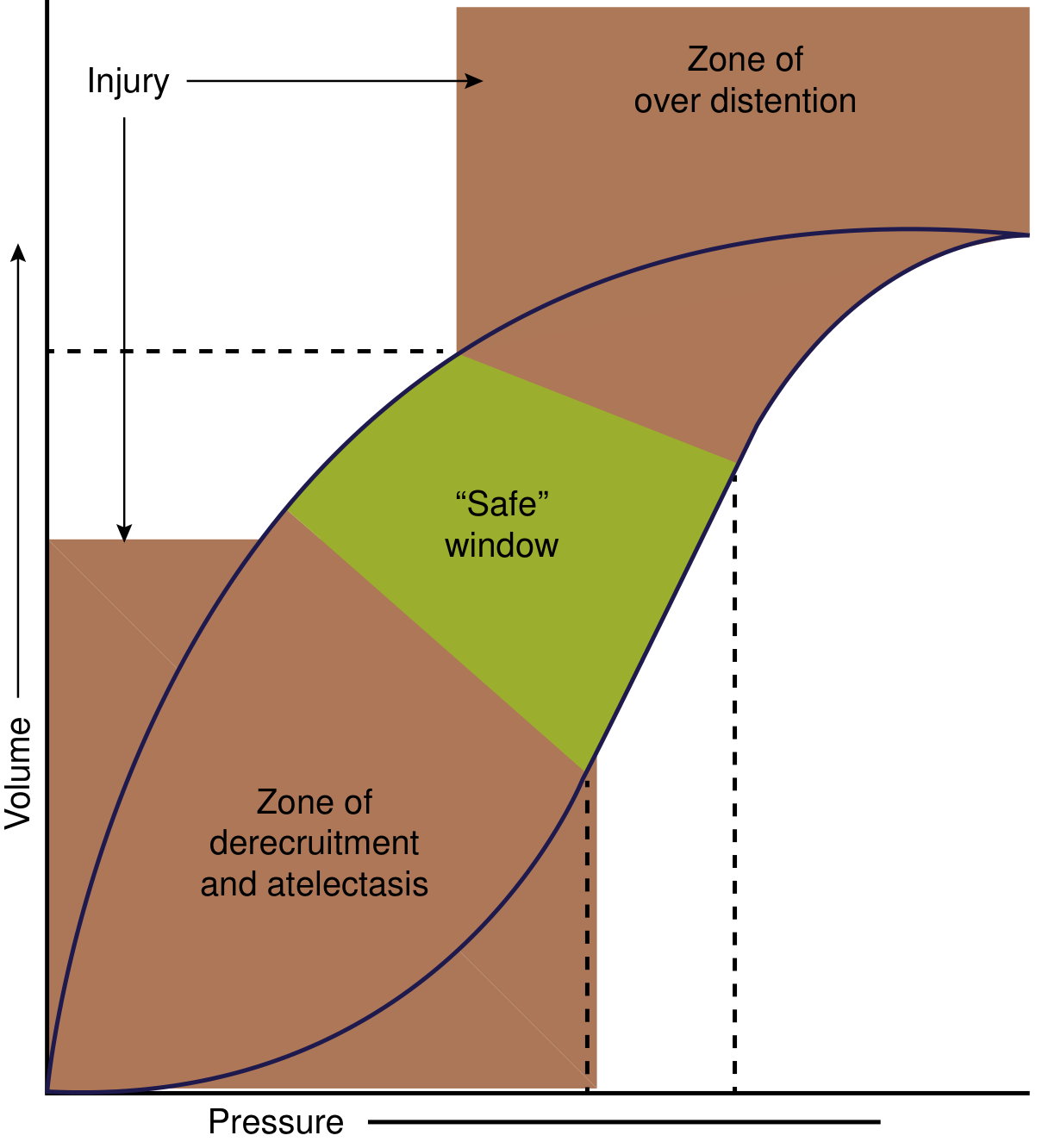
Pressure-volume curve: the green "safe window" lies between the zones of derecruitment/atelectasis (too low PEEP) and overdistension (too high pressure). - Current Surgical Therapy 14e
4. Biotrauma
- Cyclic stretching of lung parenchyma releases pro-inflammatory cytokines: IL-1, IL-6, IL-8, TNF-alpha, MIP-2
- Activates phospholipase A2 -> degrades surfactant
- Causes neutrophil accumulation in lung -> pulmonary edema, hyaline membrane formation, cellular infiltration
- Can lead to systemic inflammatory response (SIRS) and multiorgan failure
- Volatile anaesthetics (sevoflurane, isoflurane) attenuate VILI partly via anti-inflammatory effects
5. Oxygen Toxicity
- FiO2 >0.5-0.6 sustained over time -> reactive oxygen species (ROS) generation
- Causes alveolar injury indistinguishable from ARDS
- Also causes absorptive atelectasis: high FiO2 washes out nitrogen that normally acts as a "splint" for alveoli
Viva Point: "Name the 4 mechanisms of VILI." Answer: Barotrauma (pressure), Volutrauma (volume), Atelectrauma (shear from cycling), Biotrauma (cytokine release). Collectively these are avoided by lung-protective ventilation: tidal volume 6 mL/kg PBW, plateau pressure <30 cmH₂O, adequate PEEP.
C. Ventilator-Induced Diaphragm Dysfunction (VIDD)
Mechanism:
- Controlled MV suppresses diaphragm activity completely
- Within 12 hours of initiating controlled MV, diaphragm atrophy commences
- Reduced diaphragm activity -> reactive oxygen species (ROS) production -> mitochondrial dysfunction
- ROS activates proteolytic pathways: calcium-dependent enzymes, ubiquitin-proteasome pathway, autophagy
- Proteolysis exceeds protein synthesis -> progressive myofibrillar atrophy and disarray
- Diaphragm-specific atrophy (peripheral skeletal muscle is relatively spared in the early phase)
Clinical consequences:
- ~50% of patients develop at least 10% diaphragm atrophy within the first few days of MV
- These patients are at much higher risk of: prolonged MV, reintubation, tracheostomy, and ICU morbidity
- Creates a vicious cycle: acute respiratory failure -> MV -> VIDD -> diaphragm weakness -> prolonged ventilator dependence
Prevention:
- Maintaining some spontaneous respiratory effort (even partial) preserves diaphragm structure
- SIMV, pressure support modes preserve drive better than pure CMV/controlled modes
- Too much pressure support also causes atrophy - optimal level uncertain but must exceed a minimum activity threshold
Viva Point: "When does VIDD begin?" Answer: Within 12 hours of initiating controlled mechanical ventilation. This is why early spontaneous breathing trials and minimising over-sedation are emphasised in modern ICU care.
D. Renal Changes
Mediated primarily through hemodynamic and neurohumoral mechanisms:
| Mechanism | Effect |
|---|---|
| Increased intrathoracic/intrapleural pressure | Decreased venous return -> decreased cardiac output |
| Decreased CO + systemic BP | Carotid/aortic baroreceptor activation -> increased renal sympathetic tone -> renal vasoconstriction |
| Increased inferior vena caval pressure | Increased renal venous pressure -> increased peritubular capillary pressure -> increased tubular Na⁺ reabsorption |
| Decreased atrial filling | Reduced ANP secretion -> less natriuresis |
| RAAS activation | Renin -> angiotensin II -> aldosterone -> Na⁺ and water retention, oliguria |
| ADH (AVP) release | Volume receptors sense low atrial stretch -> increased ADH -> free water retention |
Net result: Decreased RBF, decreased GFR, oliguria, sodium retention, and increased risk of AKI - particularly with high PEEP levels.
Viva Point: "How does PEEP affect the kidneys?" Answer: PEEP reduces cardiac output and venous return, activates the RAAS and sympathetic nervous system, increases ADH, reduces ANP - resulting in oliguria, sodium retention, and reduced GFR. The extent depends on mean airway pressure.
E. Haemodynamic Monitoring Changes
- PEEP elevates measured central venous pressure (CVP) and pulmonary capillary wedge pressure (PCWP) artifactually - these readings must be corrected for intrathoracic pressure
- Pulse pressure variation (PPV) and stroke volume variation (SVV) are reliable dynamic preload indices only during controlled MV with regular tidal volumes
- During PPV, measurement of plateau pressure (a surrogate of transpulmonary pressure) is critical to guide lung-protective strategy
F. Other Systemic Changes
Intracranial Pressure (ICP)
- Positive pressure MV impedes cerebral venous drainage (raises jugular venous pressure)
- Can raise ICP, especially at high PEEP
- In head injury patients, brief hyperventilation (PaCO2 30-35 mmHg) remains a temporising measure to reduce ICP by cerebral vasoconstriction - but chronic hyperventilation is harmful
Gastrointestinal and Hepatic
- Reduced CO and splanchnic vasoconstriction impair gut perfusion
- Increased risk of stress ulcers -> stress ulcer prophylaxis is standard in ventilated ICU patients
- Hepatic venous congestion from raised right heart pressures
Ventilator-Associated Pneumonia (VAP)
- Defined as pneumonia developing >48 hours after intubation
- ETT bypasses upper airway defences; pooled secretions above cuff aspirate into lower airways
- Common organisms: Pseudomonas aeruginosa, Klebsiella, MRSA (late onset)
- Prevention bundle: head-of-bed elevation 30-45°, daily sedation holds, oral chlorhexidine, subglottic suctioning, early extubation
Summary Table - Exam Quick Reference
| System | Key Changes | Mechanism |
|---|---|---|
| CVS | ↓CO, ↓venous return, hypotension | ↑intrathoracic pressure compresses great veins |
| CVS (LV) | ↓afterload (beneficial in LVF) | ↑intrathoracic pressure reduces transmural LV pressure |
| Pulmonary (VILI) | Barotrauma, volutrauma, atelectrauma, biotrauma | Pressure/volume injury + cytokine release |
| Diaphragm (VIDD) | Atrophy within 12h; 50% lose >10% mass | Disuse -> ROS -> proteolysis (ubiquitin-proteasome) |
| Renal | ↓GFR, oliguria, Na⁺ retention, AKI | ↓CO -> RAAS + sympathetic activation + ↓ANP |
| ICP | ↑ICP (especially high PEEP) | Impaired cerebral venous drainage |
| Infectious | VAP | Aspiration of pooled secretions; ETT bypasses defences |
| GI | Stress ulcers | Splanchnic hypoperfusion |
High-Yield Viva Points (Master List)
-
Why does MV reduce cardiac output? PPV raises intrathoracic pressure -> compresses venae cavae -> reduces venous return -> reduces RV preload -> reduces CO (Frank-Starling). Also raises PVR, increasing RV afterload.
-
When is reduced CO from MV actually beneficial? In acute LV failure/cardiogenic pulmonary oedema - raised intrathoracic pressure unloads the LV (reduces afterload) and helps reverse the failure.
-
Define the 4 types of VILI: Barotrauma (pressure), Volutrauma (volume/overdistension), Atelectrauma (shear from cycling), Biotrauma (cytokine/inflammatory mediator release).
-
Target settings for lung-protective ventilation: Tidal volume 6 mL/kg PBW, plateau pressure ≤30 cmH₂O, titrated PEEP, permissive hypercapnia acceptable (pH >7.2).
-
When does VIDD begin? Within 12 hours. ~50% of patients lose >10% diaphragm mass in the first few days. Mechanism: disuse -> ROS -> ubiquitin-proteasome and autophagic proteolysis.
-
How does MV affect the kidneys? Via three routes: hemodynamic (↓CO -> ↓RBF), neurohumoral (RAAS, sympathetic, ADH), and direct venous congestion (↑renal venous pressure -> ↑Na reabsorption). Result: oliguria, Na retention, risk of AKI.
-
What is atelectrauma? Shear injury from repeated opening and closing of unstable alveoli with each breath - prevented by adequate PEEP above the lower inflection point of the P-V curve.
-
Define biotrauma: Release of cytokines (IL-1, IL-6, TNF-alpha) from mechanically stressed lung tissue causing systemic inflammation that can drive multi-organ failure.
-
What is VAP? How prevented? Pneumonia >48h post-intubation. Prevention: semi-recumbent positioning (30-45°), daily sedation breaks, subglottic suctioning, early weaning.
-
PPV effect on CVP/PCWP measurements: Both are artifactually elevated by positive intrathoracic pressure - must interpret with caution; end-expiratory values are most accurate.
Sources: Rosen's Emergency Medicine; Current Surgical Therapy 14e; Murray & Nadel's Textbook of Respiratory Medicine; Miller's Anesthesia 10e; Fishman's Pulmonary Diseases and Disorders
Increased intrathoracic pressure paradoxically reduces LV afterload (transmural pressure falls) How
Great question - this is one of the most conceptually tricky points in cardiovascular physiology. Let me give you a quick answer then pull the textbook explanation.
Quick answer: LV afterload is not determined by aortic pressure alone - it is determined by the transmural pressure across the LV wall (intracavitary pressure minus intrathoracic/pericardial pressure). When intrathoracic pressure rises (as in PPV), the LV doesn't have to generate as much wall tension to eject blood, even if aortic pressure is unchanged. The pressure gradient the LV must overcome is reduced.
Searching sources...
Finding Sources
Finding Sources
Excellent - multiple textbooks confirm this. Let me read the detailed Fishman's section with the diagram.
Reading File
Reading File
All the textbook data I need is in hand. Here is a thorough but clear explanation:
How Does Increased Intrathoracic Pressure Reduce LV Afterload?
The Core Concept: Transmural Pressure
Afterload is not aortic pressure. Afterload is transmural pressure.
Transmural pressure = Intracavitary pressure - Surrounding (intrathoracic/pericardial) pressure
This is the pressure difference across the LV wall - the net outward force the myocardium must overcome to eject blood. This is what determines wall tension (by the Law of Laplace: T = P × r / 2h).
Step-by-Step Physiology
During Spontaneous Breathing (normal)
- Intrathoracic pressure is negative (e.g., -5 cmH₂O at rest, -20 to -30 during distress)
- LV sits inside this negative pressure environment
- To eject blood into the aorta (which is outside the thorax at atmospheric pressure), the LV must generate pressure from, say, -5 to +120 mmHg
- Transmural pressure the LV must overcome = Aortic pressure - Intrathoracic pressure = 120 - (-5) = 125 mmHg equivalent
- The more negative the intrathoracic pressure (e.g., laboured breathing in cardiogenic pulmonary oedema), the greater this gradient the LV must overcome
During Positive Pressure Ventilation
- Intrathoracic pressure becomes positive (e.g., +10 cmH₂O)
- The positive pressure transmits through the pleura into the pericardium, surrounding the LV
- The LV cavity pressure and the aortic pressure both see a rise in their surrounding reference pressure
- Transmural pressure = Aortic pressure - Intrathoracic pressure = 120 - (+10) = 110 mmHg
- The LV now has to generate less net wall tension to eject the same stroke volume
- This is the afterload reduction
Analogy to Understand It
Imagine squeezing a toothpaste tube (the LV) inside a pressurised chamber:
- Normally you squeeze against atmospheric pressure outside
- If the chamber is already pressurised, you need less effort to squeeze the same amount of paste out, because the external pressure is already "helping" push from outside
The LV is that toothpaste tube. Positive intrathoracic pressure "helps" push blood out by compressing the LV from the outside, reducing the net pressure gradient the myocardium itself must generate.
The Reverse is Also True (and Clinically Critical)
Large negative swings in intrathoracic pressure INCREASE LV afterload.
In cardiogenic pulmonary oedema (CPE) or severe obstructive breathing:
- The patient makes huge inspiratory effort against obstruction
- Intrathoracic pressure swings to -30 or -40 mmHg
- Transmural LV pressure rises dramatically: 120 - (-40) = 160 mmHg
- The failing LV must work much harder against this increased effective afterload
- This further impairs ejection, worsens pulmonary oedema, creating a vicious cycle
This is exactly why CPAP/BiPAP dramatically improves cardiogenic pulmonary oedema - it reverses this pathological afterload increase.
Summary Diagram (Conceptual)
SPONTANEOUS BREATHING (especially with distress):
  Intrathoracic pressure = -20 mmHg
  Aortic pressure        = +120 mmHg
  LV transmural pressure = 120 - (-20) = 140 mmHg  ← HIGH afterload

POSITIVE PRESSURE VENTILATION:
  Intrathoracic pressure = +10 mmHg
  Aortic pressure        = +120 mmHg
  LV transmural pressure = 120 - (+10) = 110 mmHg  ← LOWER afterload
Clinical Implications (Viva-Ready)
| Situation | Intrathoracic Pressure | LV Afterload | Clinical Effect |
|---|---|---|---|
| Normal spontaneous breathing | Slightly negative | Normal | - |
| Laboured breathing (CPE, severe asthma) | Very negative | Greatly increased | Worsens LV failure |
| CPAP / BiPAP / MV with PPV | Positive | Reduced | Improves LV ejection |
| Weaning from MV (removing PPV) | Returns to negative | Increases again | Can precipitate weaning-induced LV failure |
Viva Point: In patients with severe LV failure, removing positive pressure ventilation during weaning suddenly increases LV afterload. This is a recognised cause of weaning failure - the patient tolerates MV but decompensates when extubated. - Murray & Nadel's Textbook of Respiratory Medicine
Viva Point: The aorta exits the thorax. The LV sits inside the thorax. When intrathoracic pressure rises, the LV's surrounding pressure rises, but the aortic root's downstream (extrathoracic) pressure remains at atmospheric. The gradient the LV must overcome to eject blood decreases. This is the mechanism.
Sources: Fishman's Pulmonary Diseases and Disorders; Murray & Nadel's Textbook of Respiratory Medicine; Miller's Anesthesia 10e
Newer modes of ventilation along with exam focussed points
Finding Sources
Finding Sources
Finding Sources
Reading File
Reading File
Finding Sources
Finding Sources
Reading File
Reading File
Reading File
Reading File
Now let me get the HFOV details and the Harrison's PRVC section for completeness.
Reading File
Reading File
I now have comprehensive data from 6+ authoritative textbooks. Here is the full exam-ready answer:
Newer Modes of Mechanical Ventilation
Framework: How to Classify Ventilator Modes
Every breath can be described by three phases:
- Trigger - what starts the breath (time or patient effort)
- Target (limit) - what controls gas delivery (pressure or volume)
- Cycle - what ends the breath (time, volume, or flow)
Newer modes refine one or more of these phases to improve patient-ventilator synchrony, reduce VILI, and automate titration.
1. Pressure-Regulated Volume Control (PRVC)
Also called: AutoFlow, Volume Control Plus (VC+), Adaptive Pressure Ventilation (APV), Variable Pressure Control (VPC) - all manufacturer-specific names for the same concept.
What it is:
A dual-control / adaptive mode - it combines the safety of volume control (guaranteed tidal volume) with the comfort of pressure control (decelerating flow profile).
How it works:
- Clinician sets a target tidal volume (as in volume control)
- The ventilator delivers each breath as a pressure-controlled breath with a decelerating flow pattern
- After each breath, ventilator software analyses lung compliance from that cycle and adjusts the inspiratory pressure for the next breath up or down by up to 3 cmH₂O to hit the target Vt
- It delivers the minimum pressure necessary to achieve the set tidal volume
- If compliance improves, pressure drops; if compliance worsens, pressure rises (with a ceiling at plateau pressure limit)
Advantages:
- Guaranteed tidal volume - protects against volutrauma
- Decelerating flow - more comfortable, better gas distribution, lower peak airway pressures
- Automatic pressure titration - reduces clinician workload
- Allows spontaneous respiratory effort within breaths - enhances synchrony
Key caution (EXAM FAVOURITE):
In ARDS with significant spontaneous effort, the patient's own effort supplements ventilator pressure. The ventilator "sees" a bigger tidal volume than it intended, and decreases its pressure for the next breath. But if the patient continues straining, total Vt (ventilator + patient) can become dangerously high - causing occult volutrauma. This is called "PRVC runaway" or patient self-inflicted lung injury (P-SILI).
2. Adaptive Support Ventilation (ASV)
What it is:
A fully closed-loop, intelligent mode. The ventilator sets its own Vt and rate pattern - the clinician only sets desired minute ventilation and patient height (for estimated dead space).
How it works:
- Uses the equation of motion to continuously calculate resistance and compliance from test breath occlusions
- Calculates the optimal frequency-volume combination that minimises ventilator work of breathing (based on the Otis equation - minimises work by adapting Vt and RR)
- Monitors the expiratory time constant (resistance × compliance) to prevent air trapping
- As patient effort increases, behaves more like pressure support; as effort decreases, maintains mandatory breaths
Advantages:
- Automatically adapts to changing lung mechanics (e.g., during recovery from ARDS)
- Reduces over/under-ventilation
- Minimises air trapping in obstructive disease by adjusting to the expiratory time constant
- Facilitates automatic weaning - progressively reduces support as mechanics improve
Exam Point:
ASV uses the Otis equation to find the Vt-RR combination that minimises respiratory work. In obstructive disease, it chooses a slower rate with larger Vt; in restrictive disease, it chooses a faster rate with smaller Vt - both are physiologically optimal.
3. Airway Pressure Release Ventilation (APRV)
Also called: BiLevel, Bilevel CPAP, Biphasic ventilation
What it is:
A time-cycled, pressure-targeted mode. Essentially inverse-ratio ventilation with the patient allowed to breathe spontaneously at any point.
How it works:
- Ventilator holds a high CPAP (P-high) for a long time (T-high) - typically 4-6 seconds
- Periodically releases to a low pressure (P-low) for a very brief time (T-low) - typically 0.4-0.8 seconds
- This brief release allows passive CO₂ elimination (the lungs deflate rapidly)
- The short T-low (less than the expiratory time constant) means alveoli do not fully collapse before the next inflation - continuous recruitment
- Patient can breathe spontaneously throughout the cycle, especially during T-high
The Four APRV Settings:
| Parameter | Typical Value | Purpose |
|---|---|---|
| P-high | 20-30 cmH₂O | Oxygenation / recruitment |
| P-low | 0-5 cmH₂O | CO₂ clearance |
| T-high | 4-6 seconds | Long inflation for recruitment |
| T-low | 0.4-0.8 sec | Brief release for CO₂ clearance |
Advantages:
- High mean airway pressure improves recruitment and oxygenation without high peak pressures
- Spontaneous breathing preserved - maintains diaphragm activity, avoids VIDD
- Better V/Q matching - spontaneous effort recruits dependent lung zones
- Avoids atelectrauma - T-low set short enough that alveoli don't fully derecruit
- Improved cardiac filling - spontaneous breathing augments venous return
Disadvantages / Controversies:
- Spontaneous Vt added on top of P-high may cause undetected overdistension (concern for volutrauma)
- Complex to set up; risk of hypercapnia
- RCTs mixed: one single-centre trial showed more ventilator-free days (19 vs. 2) but most larger trials show no outcome benefit vs. lung-protective VACV
- Permissive hypercapnia to pH ≥7.20 is accepted
Exam Point:
APRV is essentially CPAP with periodic pressure releases. It is an extreme form of inverse-ratio ventilation (I:E ratio typically 4:1 to 12:1). Key concept: T-low must be short enough to maintain alveolar recruitment (stopped at 50-75% of peak expiratory flow to prevent derecruitment).
4. High-Frequency Oscillatory Ventilation (HFOV)
What it is:
A mode using extremely high respiratory rates (120-900 breaths/min in adults) with tidal volumes smaller than anatomical dead space (often <100 mL).
How it works:
- A specialised oscillator generates rapid pressure oscillations around a set mean airway pressure (MAP)
- Gas transport does NOT rely on bulk convective flow (since Vt < dead space)
- Gas exchange occurs via alternative mechanisms:
- Asymmetric velocity profiles (Taylor dispersion)
- Pendelluft (gas swinging between adjacent lung units with different time constants)
- Augmented molecular diffusion
- Coaxial flow (fresh gas flows centrally in, CO₂ exits peripherally)
Settings:
| Parameter | Description |
|---|---|
| MAP (mPaw) | Set ~2-5 cmH₂O above MAP on prior conventional MV - maintains recruitment |
| Frequency | 3-6 Hz in adults (180-360 bpm) |
| Amplitude (Power/ΔP) | Controls CO₂ clearance - chest "wiggle" is end-point |
| Bias flow | Continuous fresh gas flow through circuit (~40 L/min) |
| I:E ratio | Usually 1:2 |
Current Evidence and Status:
- Initial studies showed better oxygenation in ARDS
- OSCILLATE trial (2013) - HFOV increased mortality vs. conventional MV in moderate-severe ARDS (stopped early for harm)
- OSCAR trial (2013) - No mortality benefit vs. conventional ventilation
- Current recommendation: HFOV is NOT recommended for ARDS except as a rescue/salvage mode in refractory hypoxaemia
- Still used and beneficial in paediatric ARDS (pARDS) where evidence is more favourable
Exam Point:
HFOV was conceptually ideal for ARDS (tiny Vt, high MAP, no cycling atelectrauma). However, the OSCILLATE trial showed increased mortality - likely due to high MAP impairing RV function and cardiac output. HFOV is now a rescue therapy, not first-line. In the exam, always mention the OSCILLATE and OSCAR trials when discussing HFOV.
5. Proportional Assist Ventilation (PAV / PAV+)
What it is:
An effort-proportional assisted mode. The clinician sets a "gain" (%) and the ventilator delivers pressure in direct proportion to the patient's instantaneous respiratory effort.
How it works:
- PAV uses real-time measurement of flow and volume to estimate the patient's work
- PAV+ goes further: uses brief end-inspiratory occlusions every ~4-10 breaths to directly measure respiratory system elastance (1/compliance) and resistance - then calculates the work-of-breathing equation of motion
- Delivers a set percentage (e.g., 50% or 80%) of the instantaneous work the patient is generating
- When patient effort increases → ventilator pressure increases; when effort decreases → ventilator pressure decreases
- No set pressure, flow, or tidal volume
Advantages:
- Best possible patient-ventilator synchrony (trigger, flow, and cycle all follow patient effort in real time)
- Promotes physiological VT variability (breath-to-breath variation), which may be lung protective
- Allows direct estimation of patient work of breathing at the bedside
- Avoids over-assistance or under-assistance
Disadvantages:
- Cannot be used in patients with absent or very low respiratory drive (no minimum pressure provided - patient must breathe to get any support)
- Complex; requires stable EMG/flow signals
- Clinical trials have not demonstrated outcome benefits vs. PSV
6. Neurally Adjusted Ventilatory Assist (NAVA)
What it is:
The most physiologically "pure" assisted mode. Ventilator delivery is controlled by the electrical activity of the diaphragm (EAdi), detected by an oesophageal catheter with EMG electrodes.
How it works:
- A specially designed nasogastric catheter placed in the oesophagus detects diaphragmatic crural EMG (EAdi)
- The neural signal (EAdi, in microvolts) is used to trigger the breath, control flow delivery, and cycle off the breath
- Ventilator pressure = NAVA level (cmH₂O/µV) × EAdi signal
- Support is directly proportional to the neural respiratory drive - the brainstem drives both the diaphragm and the ventilator simultaneously
Key Conceptual Advantages Over All Other Modes:
- Eliminates trigger delay - ventilator triggers at the instant the diaphragm begins contracting (before airway pressure or flow changes are detectable)
- Synchrony for all 3 phases: trigger, gas delivery, and cycling
- Truly proportional to effort
- Neural feedback loop: if ventilator provides too much support, the drive decreases (negative feedback) - self-limiting over-assistance
- Preserves diaphragm activity (reduces VIDD risk)
Limitations:
- Requires specialised oesophageal catheter (EAdi catheter) - additional invasive monitoring
- Signal can be unstable as catheter shifts within oesophagus - requires careful monitoring and backup mode always set
- Cannot use in patients with absent/very low drive (neuromuscular disease, heavy sedation)
- Single RCT vs. PSV showed no outcome benefit
- Not widely available
Exam Point:
NAVA's defining feature is the EAdi catheter - it detects the diaphragmatic electrical signal before any mechanical change in flow or pressure occurs. This is why NAVA eliminates trigger delay better than any other mode. The neural feedback loop also makes it self-regulating - a unique biological safety feature.
7. Inverse Ratio Ventilation (IRV)
A pressure-controlled mode where inspiratory time > expiratory time (e.g., I:E = 2:1, 3:1, or 4:1 - the reverse of normal 1:2).
- Increases mean airway pressure -> improves oxygenation and recruitment
- Short expiratory time causes intrinsic/auto-PEEP (air trapping) - this acts as an additional recruitment pressure
- Used in severe ARDS when conventional settings fail
- Requires heavy sedation ± paralysis (highly uncomfortable)
- Risk: excessive auto-PEEP -> haemodynamic compromise and barotrauma
- APRV is essentially a spontaneously breathing form of IRV
Comparison Table - High-Yield for Exams
| Mode | What's New | Control Type | Spontaneous Breathing | Best Used In | Key Limitation |
|---|---|---|---|---|---|
| PRVC | Auto-adjusts pressure to hit Vt target | Dual control | Yes (+ enhances synchrony) | General ICU, post-op | P-SILI risk with high effort in ARDS |
| ASV | Auto-sets Vt and RR using mechanics | Closed-loop, adaptive | Yes (if effort present) | Weaning, post-cardiac surgery | Not for ARDS (targets Vt >6 mL/kg) |
| APRV | High CPAP + brief releases | Pressure-time | Yes (anytime during cycle) | ARDS, AHRF, trauma | Complex; mixed evidence; volutrauma risk |
| HFOV | Sub-dead-space Vt at high freq | Pressure oscillation | No (paralysis needed) | Salvage in refractory hypoxia; pARDS | OSCILLATE trial: increased adult ARDS mortality |
| PAV+ | Pressure proportional to measured work | Effort-proportional | Required | Awake, partial-support patients | No drive = no breath; no outcome benefit proven |
| NAVA | Pressure driven by diaphragm EMG | Neural effort-proportional | Required | Asynchrony, weaning | EAdi catheter instability; no outcome benefit proven |
| IRV | Reversed I:E ratio | Pressure-controlled | No (not tolerated) | Severe ARDS | Auto-PEEP; haemodynamic compromise |
Master Viva Points
-
What is PRVC and its danger in ARDS? - Dual control mode targeting set Vt with auto-adjusting pressure. In active ARDS patients, patient effort + ventilator effort can deliver dangerously high Vt (P-SILI) because the ventilator "rewards" patient effort with lower applied pressure.
-
What is ASV's governing principle? - Otis equation: the ventilator calculates the Vt-RR pattern that minimises work of breathing based on measured compliance and resistance.
-
APRV settings to know: P-high (oxygenation), P-low (usually 0), T-high (long - 4-6s), T-low (very short - 0.4-0.8s). T-low is stopped when expiratory flow falls to 50-75% of peak flow - this prevents derecruitment.
-
Why did HFOV fail in adult ARDS? - The OSCILLATE trial (NEJM 2013) showed increased mortality. Mechanism: high mean airway pressure impairs RV function and venous return -> decreased cardiac output -> worse outcomes despite better oxygenation.
-
NAVA vs PAV+ - key difference: PAV+ measures mechanics from airway pressure/flow signals. NAVA measures the neural signal (EAdi) from the diaphragm directly - one step earlier in the pathway. NAVA therefore has better synchrony but requires an oesophageal EAdi catheter.
-
Which modes preserve diaphragm activity? - APRV, PAV+, NAVA, PSV, ASV. Controlled modes (CMV, AC with heavy sedation) cause VIDD within 12 hours.
-
What is Volume Support (VS)? - The spontaneous-breathing equivalent of PRVC. All breaths are patient-triggered, pressure-targeted, and flow-cycled, but the pressure target auto-adjusts to hit a set Vt. Used for weaning.
-
HFOV gas exchange mechanisms (since Vt < dead space): Taylor dispersion, pendelluft, asymmetric velocity profiles, augmented molecular diffusion, coaxial flow.
-
P-SILI (Patient Self-Inflicted Lung Injury): A concept applicable to all assisted modes - the patient's own forceful respiratory effort (negative pleural pressure swing) causes barotrauma and volutrauma even when ventilator settings appear safe. Strong effort -> large Vt -> injury. Relevant to PRVC, PSV, NAVA, PAV+ in severe ARDS.
-
Which mode is now considered standard for post-cardiac surgery weaning? - ASV: it automatically adjusts and weans as mechanics improve, and is well-validated in this setting.
Sources: Murray & Nadel's Textbook of Respiratory Medicine; Sabiston Textbook of Surgery; Harrison's Principles of Internal Medicine 22e; Miller's Anesthesia 10e; Washington Manual of Medical Therapeutics; Current Surgical Therapy 14e
OTIS equation
cardiac troponin and other markers of MI
I'll answer both questions simultaneously using parallel searches.
Quick answers:
- Otis equation: Describes the optimal respiratory rate that minimises work of breathing, derived from the relationship between tidal volume, dead space, respiratory rate, and compliance/resistance. The optimal frequency minimises total mechanical work.
- Cardiac biomarkers: Troponin I and T are the gold standard for MI. Other markers include CK-MB, myoglobin, LDH isoforms, and newer high-sensitivity troponins.
Searching sources...
Finding Sources
Finding Sources
Finding Sources
Finding Sources
Finding Sources
Finding Sources
Reading File
Finding Sources
Finding Sources
Reading File
Reading File
Loading Image
Loading Image
Excellent. All data collected. Here are both answers in full:
Part 1: The Otis Equation
Background
Described by Arthur Otis (1954), the Otis equation addresses a fundamental question in respiratory physiology:
Given a fixed required minute ventilation, what combination of tidal volume (Vt) and respiratory rate (f) minimises the total work of breathing?
This is the theoretical basis used by Adaptive Support Ventilation (ASV) to automatically set the ventilator.
The Two Components of Elastic Work of Breathing
To understand the Otis equation, you must first recognise that work of breathing has two main elastic components that behave oppositely with changing frequency:
1. Elastic Work (compliance work)
- Work done to stretch the lung and chest wall during each breath
- Per breath: W_elastic = Vt² / (2 × C), where C = compliance
- At low respiratory rate: each breath must have a large Vt (to maintain the same minute ventilation = Vt × f) -> high elastic work per breath
- Total elastic work per minute increases as Vt increases (i.e., increases as rate decreases)
2. Resistive Work (flow-resistive work)
- Work done to overcome airway resistance during gas flow
- Increases with higher flow rates, which occur at higher respiratory rates (more breaths per minute, each requiring faster flow if inspiratory time is fixed)
- Total resistive work per minute increases as rate increases
The Otis Equation: Finding the Optimal Frequency
Since elastic work increases at low rates (high Vt) and resistive work increases at high rates (high flow), there is an optimal frequency at the crossover minimum:
$$f_{opt} = \frac{1}{2\pi} \sqrt{\frac{2\pi \dot{V}_E \cdot V_D}{C \cdot R \cdot V_D^2 - 2\pi \dot{V}_E \cdot R \cdot V_D}}$$
In simplified/clinically useful terms, the optimal frequency that minimises total mechanical work is:
$$\boxed{f_{opt} = \frac{1}{2\pi} \sqrt{\frac{2\pi \dot{V}_A}{RC}}}$$
where:
- $\dot{V}_A$ = required alveolar minute ventilation
- R = airway resistance
- C = respiratory compliance
Intuitive Summary of the Equation
| Condition | Effect on Optimal RR | Reason |
|---|---|---|
| ↑ Resistance (e.g., asthma, COPD) | Lower optimal RR, higher Vt | High flow at fast rates is too costly; better to breathe slower and deeper |
| ↓ Compliance (e.g., ARDS, fibrosis) | Higher optimal RR, lower Vt | Large tidal volumes too costly against stiff lung; better to breathe fast and shallow |
| Normal lungs | ~12-15 breaths/min | Reflects the normal human breathing pattern - which follows the Otis prediction! |
This is why:
- ARDS patients breathe fast and shallow (↑ RR, ↓ Vt)
- COPD/asthma patients breathe slow and deep (↓ RR, ↑ Vt) - when not severely obstructed
Dead Space Correction
The complete Otis equation also accounts for anatomical dead space (VD). Since each breath "wastes" VD on non-gas-exchanging airways, the effective alveolar ventilation per breath falls more at very low Vt (when Vt approaches VD). This shifts the optimal frequency slightly higher than predicted by the simple compliance-resistance model alone.
The full equation (including dead space):
$$f_{opt} = \frac{1}{2\pi}\sqrt{\frac{\dot{V}_{A(required)}}{RC}}$$
where $\dot{V}{A(required)} = \dot{V}{total} - (f \times V_D)$, so the equation is self-referential and solved iteratively - which is precisely what ASV's microprocessor does continuously.
How ASV Uses the Otis Equation
- Clinician inputs: target minute ventilation (% of predicted) and patient height (for dead space estimate)
- ASV delivers 2-3 test breaths with end-inspiratory occlusion to measure:
- Respiratory system compliance (C)
- Airway resistance (R)
- Expiratory time constant (RC) - to avoid air trapping
- Plugs these into the Otis equation to calculate the optimal f-Vt combination
- Continuously repeats this - adapting as mechanics change
Viva Point: "What principle governs ASV?" - The Otis equation. It finds the tidal volume-respiratory rate combination that minimises total work of breathing for a given alveolar ventilation, based on real-time measured compliance and resistance. In obstructive disease it chooses slow/deep; in restrictive disease it chooses fast/shallow.
Part 2: Cardiac Troponin and Other Biomarkers of MI
Troponin Complex - Background Biochemistry
The troponin complex is the regulatory unit of the thin filament (actin) of cardiac and skeletal muscle. It has three subunits:
| Subunit | Function | Cardiac-specific? |
|---|---|---|
| Troponin C (TnC) | Binds calcium -> triggers contraction | NO - identical in cardiac and skeletal muscle |
| Troponin I (TnI) | Inhibits actin-myosin interaction at rest | YES (cTnI) - unique amino acid sequence |
| Troponin T (TnT) | Binds troponin complex to tropomyosin | YES (cTnT) - unique amino acid sequence |
The cardiac-specific amino acid sequences of cTnI and cTnT allowed development of highly specific monoclonal antibody assays that do not cross-react with skeletal muscle troponin isoforms.
Mechanism of Troponin Release
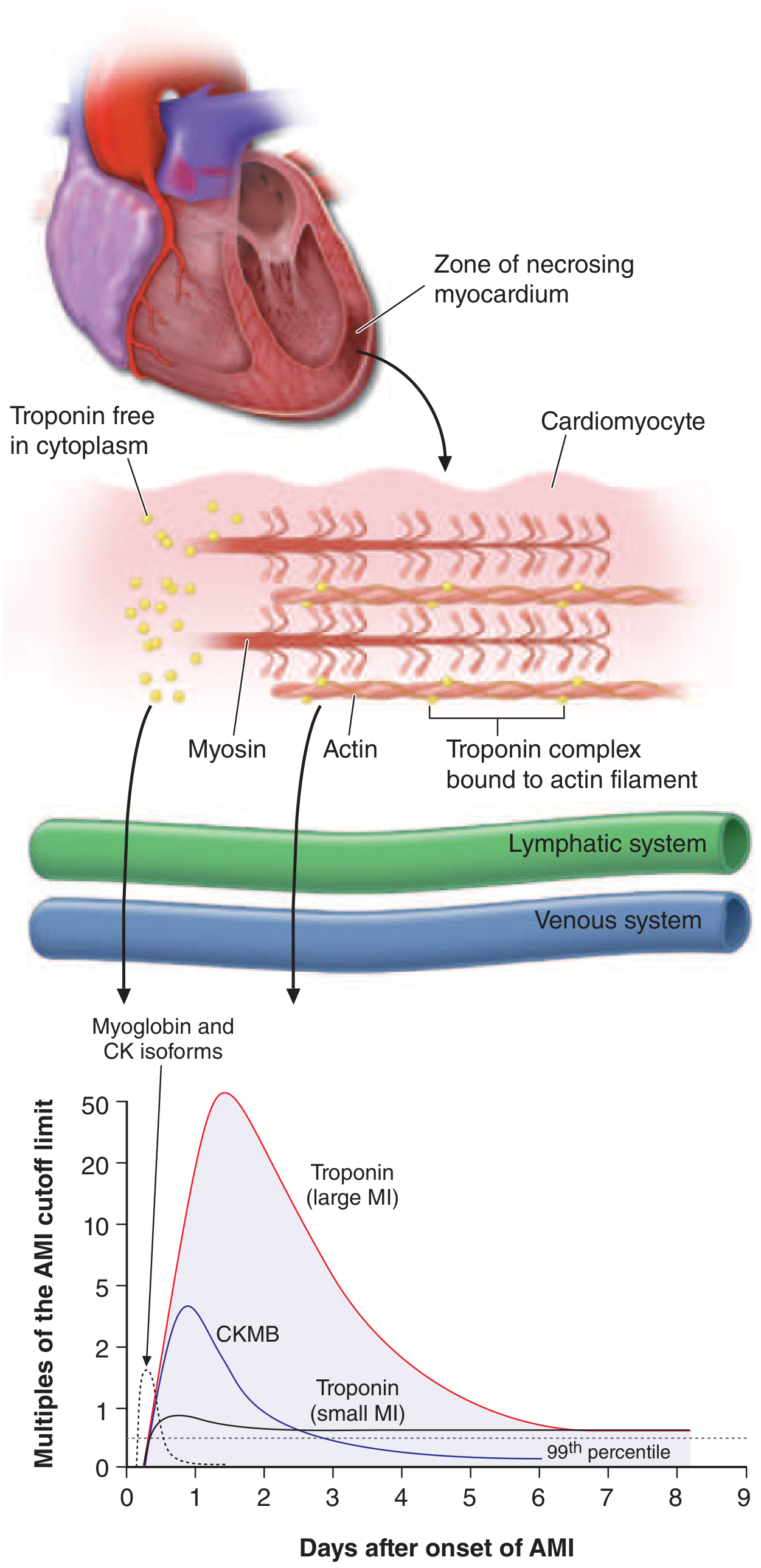
Two-phase release pattern:
- Early (cytoplasmic pool): Small amount of troponin exists free in the cytoplasm. Released early when sarcolemmal membrane is disrupted - contributes to the initial rise at 2-3 hours
- Late (structural pool): Majority of troponin is bound to actin filaments within myofibrils. Released slowly as myofibrils disintegrate over days - causes prolonged elevation (7-10 days for cTnI/T)
This biphasic release explains why troponin rises and stays elevated much longer than CK-MB.
Route of release: Biomarkers first enter the interstitium -> cleared by cardiac lymphatics -> when lymphatic capacity is exceeded, spills over into venous circulation -> detected in blood.
Reperfusion effect: If the coronary artery is opened (PCI, thrombolysis), there is a sudden washout of the infarct zone -> earlier peak, faster rise -> "early peaking" of troponin is a marker of successful reperfusion.
Diagnostic Criteria (Universal Definition of MI)
AMI requires a rise and/or fall in cardiac biomarker values with at least one value above the 99th percentile of the upper reference limit (URL) in a healthy reference population.
All Biomarkers - Complete Reference Table
| Marker | Rises | Peaks | Returns to Normal | Specificity | Key Feature |
|---|---|---|---|---|---|
| Myoglobin | 1-2 h | 6-9 h | 24-36 h | LOW | Earliest marker; found in all muscle |
| CK-MB | 3-4 h | 12-24 h | 48-72 h | Moderate | Best for reinfarction detection |
| cTnI | 2-4 h | 12-24 h | 7-10 days | VERY HIGH | Gold standard |
| cTnT | 2-4 h | 12-24 h | 10-14 days | VERY HIGH | Gold standard |
| hs-cTn (I or T) | 1-2 h | Earlier | Same prolonged | VERY HIGH | Detects microinfarction |
| LDH (LDH₁) | 24 h | 3-6 days | 8-14 days | Low | Historical; useful if presentation delayed |
| AST | 12-24 h | 18-36 h | 3-4 days | Very low | No longer used |
| CK (total) | 3-6 h | 18-24 h | 3-4 days | Low | Non-specific |
Troponin in Detail
Standard Troponin Assay
- Positive = value above 99th percentile of healthy reference population
- Not detectable in normal serum
- Serial measurements mandatory: A single troponin on presentation has limited value in the first 2-3 hours of symptom onset (the test can be negative early in MI)
- Protocol: 0 h + 3 h (or 0 h + 6 h depending on assay and local protocol)
High-Sensitivity Troponin (hs-cTn)
- Definition: An assay is called "high-sensitivity" when it detects measurable troponin in >50% of healthy subjects (i.e., it measures at concentrations far below the 99th percentile cutoff)
- Key advantage: Can detect MI within 1-2 hours of onset - enables rapid rule-in/rule-out protocols (0h/1h or 0h/2h algorithms)
- Can detect microinfarction - cases where CK-MB is still in the normal range
- Troponin rises to 20-50 times the 99th percentile URL in classic large MI
- Limitation: Many non-MI conditions also elevate hs-cTn (see below)
Non-MI Causes of Troponin Elevation ("Troponin Leakage" / Type 2 MI)
This is a critical exam and clinical distinction. Troponin elevation does NOT always mean ACS:
Cardiac causes:
- Heart failure (acute or chronic - due to myocyte stretch)
- Myocarditis / pericarditis
- Arrhythmias (especially tachyarrhythmias)
- Cardiac contusion
- Post-cardioversion
- Post-cardiac surgery or procedures
Non-cardiac causes:
- Pulmonary embolism (RV strain)
- Sepsis / critical illness
- Stroke / subarachnoid haemorrhage (neurogenic myocardial injury)
- Renal failure (reduced clearance + uremic myocardial injury)
- Rhabdomyolysis (skeletal muscle source - more relevant to CK-MB and CK)
- Neuromuscular diseases: cTnT (but NOT cTnI) is elevated in muscular dystrophies and myositis - because cTnT has more cross-reactivity with re-expressed fetal skeletal isoforms. cTnI is more cardiac-specific in this context.
CK-MB
- Molecule: Dimer of M and B subunits (CK-BB in brain, CK-MM in skeletal muscle, CK-MB in heart)
- CK-MB/CK ratio (relative index) ≥2.5% suggests cardiac (not skeletal muscle) source
- NOT cost-effective to measure both troponin and CK-MB simultaneously for diagnosis
- When CK-MB IS useful:
- Early reinfarction - troponin remains elevated for 7-10 days after an index MI; if a patient re-infarcts during this window, troponin cannot show a new rise. CK-MB, which normalises in 48-72 hours, can show a new rise indicating reinfarction.
- Assessment of infarct size (total CK-MB released correlates with infarct mass)
Myoglobin
- Earliest marker to rise (1-2 hours) and fall (back to normal in 24-36 hours)
- Very sensitive, very non-specific - found in all striated muscle
- Used historically as an early "rule-out" test (if negative at 6 hours = probably no MI)
- Now largely replaced by hs-cTnT/I which detect MI almost as early with far better specificity
- Ischemia-modified albumin (IMA) may rise even earlier than myoglobin - detects ischaemia before necrosis
LDH Isoenzymes
- LDH₁ (HHHH) predominates in myocardium; LDH₂ (HHHM) predominates in serum normally
- In MI: LDH₁ > LDH₂ ("flipped LDH") - diagnostic
- Rises 24 h, peaks 3-6 days, remains elevated 8-14 days
- Clinically useful when patient presents late (>48 h after onset) - when troponin is still elevated but CK/CK-MB have already normalised
- Largely historical now
Non-Specific Inflammatory Markers Post-MI
- WBC (neutrophilia): Rises within hours, peaks at 2-4 days, normalises in 3-7 days (12,000-15,000/µL typical)
- ESR: Rises slowly over first week, can remain elevated 1-2 weeks
- CRP: Non-specific marker of inflammation; used for risk stratification but not diagnosis of MI
Key Exam Viva Points
-
Why is cTnI more cardiac-specific than cTnT in neuromuscular disease? - Diseased skeletal muscle re-expresses a fetal cTnT isoform that cross-reacts with cardiac cTnT assay antibodies. cTnI has no equivalent cross-reactivity.
-
How does reperfusion affect biomarker kinetics? - Successful reperfusion (PCI/thrombolysis) causes rapid washout of the infarct zone -> biomarkers peak earlier and higher (early peaking). A troponin that peaks at <12 hours suggests early reperfusion.
-
When is CK-MB superior to troponin? - Detecting reinfarction within the 7-10 day window when troponin remains elevated from the index event.
-
Define high-sensitivity troponin assay: An assay that detects measurable troponin in >50% of healthy subjects. Enables 0h/1h rapid rule-out/rule-in protocols.
-
What is the diagnostic cutoff for all troponin assays? - The 99th percentile of the upper reference limit (URL) in a healthy reference population, with rise and/or fall pattern.
-
Which troponin subunit is NOT cardiac-specific and why? - Troponin C - it is identical in cardiac and slow-twitch skeletal muscle (both require calcium sensitivity).
-
Why does troponin stay elevated so long (7-10 days) compared to CK-MB (48-72 h)? - Most troponin is structurally bound in myofibrils. The slow disintegration of the contractile apparatus releases troponin gradually over many days, long after the cytoplasmic pool and smaller molecules (myoglobin, CK-MB) have already cleared.
-
"Flipped LDH" means what? - LDH₁ > LDH₂, normally LDH₂ > LDH₁ in serum. This inversion indicates cardiac source of LDH release.
Sources: Harrison's Principles of Internal Medicine 22e; Rosen's Emergency Medicine; Tietz Textbook of Laboratory Medicine; Robbins & Kumar Basic Pathology; Lippincott Illustrated Reviews: Biochemistry
This is a shared conversation. Sign in to Orris to start your own chat.