


17844416053444630976570488943116.jpg
17844416359458178433023471015838.jpg
1. Define Anxiety and classify anti anxiety drugs with examples and write the pharmacological actions of Diazepam? Can I write these notes for the question which I have provided?
I can see your handwritten notes in the images. Let me analyze them and then look up the medical library for a complete, accurate answer.
analyse_media
analyse_media
Reading File
Now let me search the medical library for comprehensive content on anxiety and diazepam pharmacology.
Finding Sources
Finding Sources
Finding Sources
Finding Sources
Good findings. Let me read the most relevant sections from Stahl's, Goodman & Gilman's, and Neuroscience textbook on anxiolytics/diazepam.
Reading File
Reading File
Reading File
I now have excellent textbook content. Let me also fetch the GABA-benzodiazepine diagram image and get the Family Medicine anxiety definition.
Loading Image
Reading File
I now have all the information needed to give a comprehensive, well-sourced answer. Let me compile the full response now.
✅ Yes - Your Notes Are a Good Foundation, But Here's a Complete & Corrected Version
I reviewed both pages of your handwritten notes. They are mostly accurate. Below is a thorough, exam-ready answer to all three parts of your question, with corrections and additions where needed.
Definition of Anxiety
Anxiety is a state of apprehension, fear, and worry characterized by disturbed vital parameters. It is characterized by psychological symptoms (apprehension, fear, sense of impending doom) alongside physical symptoms that arise even when no real external threat exists.
Symptoms of Anxiety:
- Tachycardia and palpitations
- Chest tightness
- Diaphoresis (excessive sweating)
- Diarrhea
- Nausea
- Breathing difficulties
- Dryness of mouth
- Tremors
Medical conditions that can cause/mimic anxiety:
- Hyperthyroidism
- Hypoglycemia
- Pheochromocytoma
- Complex partial seizures
- Acute myocardial infarction
- Caffeine intoxication
- Pulmonary disorders
- Substance abuse/withdrawal
Classification of Anti-Anxiety (Anxiolytic) Drugs
(Your notes had this correct - here is the complete expanded version)
| Class | Examples |
|---|---|
| I. Benzodiazepines | Diazepam, Chlordiazepoxide, Alprazolam, Lorazepam, Clonazepam, Oxazepam |
| II. Azapirones | Buspirone, Gepirone |
| III. Sedative Antihistamines | Hydroxyzine (Tab Atarax) |
| IV. Beta-blockers | Propranolol (for situational/performance anxiety) |
| V. SSRIs/SNRIs | Escitalopram, Paroxetine, Venlafaxine, Duloxetine (first-line for GAD/panic) |
| VI. Others | Pregabalin, TCAs (second-line) |
Note: Your notes listed only 4 classes. SSRIs/SNRIs are now considered first-line for most anxiety disorders. Benzodiazepines are used for acute anxiety due to their fast onset.
Pharmacological Actions of Diazepam
Mechanism of Action
Diazepam is a benzodiazepine that acts as a positive allosteric modulator (PAM) at the GABA-A receptor (a GABA-gated Cl- channel).
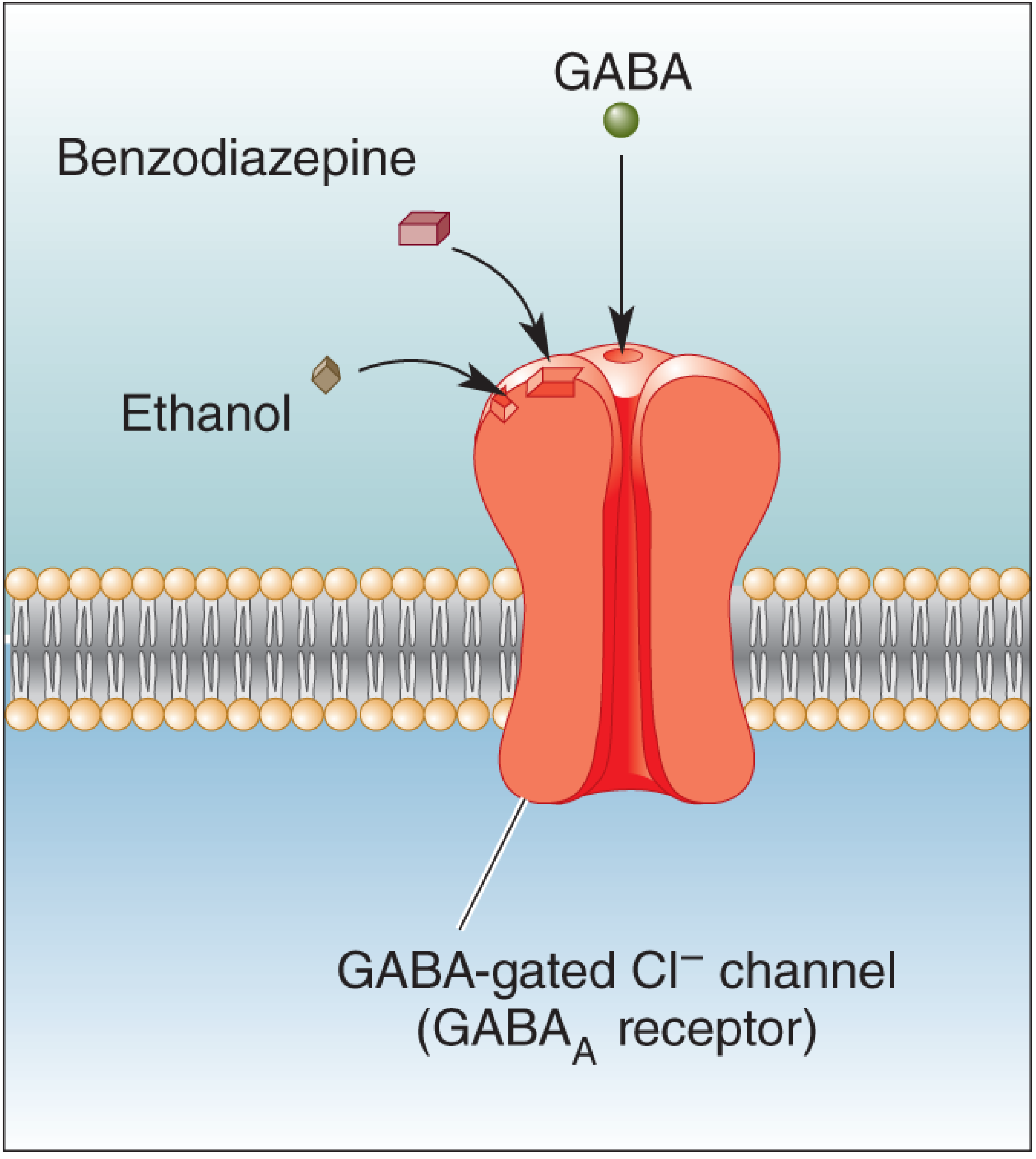
- Diazepam binds to an allosteric site on the GABA-A receptor (between the α and γ subunits) - a site different from where GABA binds.
- By binding here, it increases the frequency of opening of the chloride (Cl-) channel when GABA is present.
- The influx of Cl- hyperpolarizes the neuron, producing inhibition.
- Key point: Diazepam cannot act without GABA being present - it only enhances GABA's effect. It does NOT open the channel by itself.
- Its actions are reversed by flumazenil (a neutral antagonist at the benzodiazepine site).
(Source: Stahl's Essential Psychopharmacology; Neuroscience: Exploring the Brain, 5e)
Pharmacological Effects
1. Anxiolytic Effect
- Reduces anxiety by suppressing hyperactive circuits in the stress response (amygdala, frontal cortex).
- Mediated primarily through GABA-A receptors containing α2 and α3 subunits.
- Highly effective for acute anxiety, generalized anxiety disorder, panic disorder, and situational anxiety.
2. Sedative / Hypnotic Effect
- Produces dose-dependent sedation and sleep induction.
- Sedative effects are primarily mediated by receptors with α1 subunits.
- Used as a preoperative sedative and for procedural sedation.
3. Anticonvulsant Effect
- Suppresses epileptic discharges by enhancing GABAergic inhibition.
- Used for status epilepticus (IV), febrile seizures, and alcohol withdrawal seizures.
4. Muscle Relaxant Effect
- Acts on spinal cord interneurons to reduce muscle tone.
- Useful in spastic conditions, muscle spasm, and tetanus.
5. Amnestic Effect
- Produces anterograde amnesia (patient cannot form new memories during the drug's effect).
- Used to advantage in procedural/endoscopic sedation.
6. CNS Depression (dose-dependent)
- Low dose: Anxiolysis
- Medium dose: Sedation, sleep
- High dose: Anesthesia
- Toxic dose: Coma (but rarely fatal alone; wide therapeutic index)
Other Important Properties
| Property | Detail |
|---|---|
| Route | Oral, IV, IM, rectal |
| Onset | Fast (especially IV) |
| Duration | Long-acting (t½ ~20-70 hours) |
| Metabolism | Hepatic; active metabolite desmethyldiazepam |
| Reversal | Flumazenil (benzodiazepine antagonist) |
| Tolerance & Dependence | Can develop with prolonged use; withdrawal can be dangerous |
Review of Your Notes - What Was Correct ✅ and What to Add 📝
| Your Notes | Verdict |
|---|---|
| Definition with fear, palpitation, sweating, disturbed vitals | ✅ Correct |
| Classification into 4 groups (BDZ, azapirones, antihistamines, beta-blockers) | ✅ Correct but incomplete - SSRIs/SNRIs are now first-line and should be added |
| Examples for each class (Diazepam, Chlordiazepoxide, Alprazolam, Lorazepam; Buspirone; Hydroxyzine; Propranolol) | ✅ All correct |
| "Propanolol" spelling | 📝 Correct drug, but spelled Propranolol |
| Medical conditions causing anxiety listed | ✅ Correct |
| Physical symptoms listed | ✅ Correct |
For the pharmacological actions section of Diazepam, your notes do not appear to contain this yet - so the above section is what you need to write.
Sources: Neuroscience: Exploring the Brain 5e, p.1962-1963; Goodman & Gilman's Pharmacological Basis of Therapeutics, p.371-372; Stahl's Essential Psychopharmacology, p.276
It's for 5 to 6 marks so according to my notes give everything for the question.. Define Anxiety and classify anti anxiety drugs with examples and write the pharmacological actions of Diazepam?
Here is a clean, exam-ready 5-6 mark answer based exactly on your notes:
Define Anxiety, Classify Anti-Anxiety Drugs with Examples & Pharmacological Actions of Diazepam
1. Definition of Anxiety
Anxiety is a state characterized by fear, palpitation, sweating, and disturbed vital parameters in response to stress or apprehension, even without any actual external threat.
Symptoms:
- Tachycardia
- Chest tightness
- Palpitation
- Diaphoresis (excessive sweating)
- Diarrhea
- Nausea
- Breathing difficulties
- Dryness of mouth
2. Classification of Anti-Anxiety Drugs
| Class | Examples |
|---|---|
| I. Benzodiazepines | Diazepam, Chlordiazepoxide, Alprazolam, Lorazepam |
| II. Azapirones | Buspirone, Gepirone |
| III. Sedative Antihistamines | Hydroxyzine (Tab Atarax) |
| IV. Beta-blockers | Propranolol |
3. Pharmacological Actions of Diazepam
Mechanism of Action
Diazepam acts on the GABA-A receptor (a GABA-gated Cl⁻ channel). It binds to the benzodiazepine site (an allosteric site, different from where GABA binds) and increases the frequency of opening of the Cl⁻ channel, causing hyperpolarization and CNS inhibition.
Simple way to remember: Diazepam does NOT act alone - it needs GABA to be present and only enhances GABA's effect.
Actions:
1. Anxiolytic Action
- Reduces anxiety and fear
- Suppresses the stress response circuits in the brain
- Effective in GAD, panic disorder, situational anxiety
2. Sedative-Hypnotic Action
- Produces dose-dependent sedation and sleep
- Used as preoperative sedation
3. Anticonvulsant Action
- Suppresses epileptic seizures
- Used in status epilepticus (IV), febrile seizures, alcohol withdrawal seizures
4. Muscle Relaxant Action
- Reduces muscle tone by acting on spinal cord interneurons
- Used in muscle spasms and spastic conditions
5. Amnestic Action
- Causes anterograde amnesia (inability to form new memories during drug effect)
- Useful during minor surgical procedures
Adverse Effects (bonus points):
- Drowsiness, sedation
- Tolerance and dependence with long-term use
- Anterograde amnesia
- Potentiates alcohol and other CNS depressants
Reversal:
- Flumazenil is the specific antagonist used to reverse diazepam overdose
✏️ Exam Tip: For a 5-6 mark question, write Definition (1 mark) + Classification with examples (2 marks) + Mechanism + 4-5 pharmacological actions of Diazepam (2-3 marks). This covers the full marks.
This is a shared conversation. Sign in to Orris to start your own chat.