
Metallic poison arsenic forensic exam based
Reading File
Arsenic is a classic metallic (inorganic) poison covered extensively in forensic medicine. It causes acute and chronic toxicity, has distinctive post-mortem findings, and several forensic detection tests. Let me search the textbook library now.
Searching sources...
Finding Sources
Finding Sources
Excellent - I found the dedicated forensic medicine textbooks. Let me read the most relevant sections in parallel.
Reading File
Reading File
Finding Sources
Excellent. Now let me read the comprehensive forensic medicine sections in parallel.
Reading File
Reading File
Reading File
Now let me get the chronic arsenic section, post-mortem findings, and forensic tests.
Reading File
Reading File
Reading File
Reading File
Reading File
Reading File
Now let me get the chemical detection tests section and the post-mortem section from Dikshit.
Reading File
Reading File
Reading File
Finding Sources
Reading File
Finding Sources
Now let me get the postmortem appearances section and the forensic chemical tests in detail.
Reading File
Finding Sources
Reading File
Reading File
I now have comprehensive data from multiple authoritative forensic medicine textbooks. Let me fetch the key images and compile the complete answer.
Loading Image
Loading Image
I have all the material I need. Here is the comprehensive forensic medicine exam-based answer on arsenic poisoning.
Arsenic - Metallic Poison (Forensic Medicine & Toxicology)
Sources: The Essentials of Forensic Medicine & Toxicology, 36th ed. (Reddy, 2026) | P.C. Dikshit Textbook of Forensic Medicine & Toxicology | Parikh's Textbook of Medical Jurisprudence, Forensic Medicine & Toxicology | DiMaio's Forensic Pathology, 3rd ed.
1. Introduction & Historical Significance
Arsenic has the longest history as a poison, used since the time of the Roman Empire. It was nicknamed the "inheritance powder" and the "king of poisons" because it was:
- Tasteless, colorless, and odorless
- Easily administered in food and drink
- Symptoms mimicked cholera (a common disease of the era)
- Difficult to detect before 19th century
The Arab alchemist Jabir ibn Hayyen (~800 AD) first isolated white arsenic by heating realgar. The Marsh test (1836) and Reinsch test (1841) were milestones in forensic arsenic detection.
Arsenic is element 33 in the periodic table. It ranks 20th in elemental abundance in Earth's crust and 12th in the human body.
2. Chemical Forms & Compounds
Metallic Arsenic
- Black colored; non-toxic when ingested (not absorbed from GI tract)
- When volatilized by heat, unites with oxygen to form poisonous arsenic trioxide vapor
Poisonous Compounds (in order of importance)
| Compound | Also Known As | Notes |
|---|---|---|
| Arsenious oxide (As₂O₃) | White arsenic / sankhya / somalkhar | Most common form used in poisoning; tasteless, odorless, white powder |
| Arsine gas (AsH₃) | Arsenicuretted hydrogen | Colorless gas with garlic-like odor; acts on hemoglobin → hemolysis |
| Copper arsenite | Scheele's green | Used as insecticide |
| Copper acetoarsenite | Paris green / Emerald green | Common pesticide; source of accidental/suicidal poisoning |
| Arsenic trichloride | Butter of arsenic | Liquid at room temperature |
| Arsenic sulfides | Orpiment (As₂S₃), Realgar (As₂S₂) | Natural ores |
| Sodium/Potassium arsenates | - | Used in weed-killers |
3. Sources of Arsenic
Natural: Rocks, soil (<1 ppm), hot springs, drinking water, seafood, vegetables
Industrial: Smelting of copper/lead/zinc ores; wood preservatives; pesticides; insecticides; glass manufacturing; electronics
4. Mechanism of Action
Arsenic exerts toxicity through multiple pathways:
- Sulphydryl (–SH) group inhibition - reversibly combines with SH groups of mitochondrial enzymes (especially pyruvate oxidase), blocking cellular respiration
- Enzyme inhibition - interferes with multiple enzyme systems essential for cellular metabolism
- Capillary endothelial damage - dilates and damages capillaries → increased permeability → tissue edema, hemorrhage, fluid transudation into bowel lumen
- Oxidative phosphorylation uncoupling (arsenate form) - interferes with glycolysis
- Fatty degeneration of liver
- Renal tubular necrosis
- Peripheral axonal neuropathy - disintegration of axis cylinder, fragmentation and resorption of myelin
5. Fatal Dose and Fatal Period
| Parameter | Value |
|---|---|
| Fatal dose (arsenic trioxide) | 180-300 mg (varies by compound, physical form, tolerance) |
| Fatal period | 12-48 hours (may be as rapid as 2-3 hours) |
| Blood concentration indicating serious poisoning | >1.5 mg/100 mL |
| Liver concentration in fatal cases | >1 mg% |
Arsenophagists: Some individuals take arsenic habitually (as an aphrodisiac/tonic) and acquire tolerance up to 0.3 g or more in one dose.
6. Signs & Symptoms
Acute Arsenic Poisoning
Symptoms appear within 30 minutes of ingestion:
Stage 1 - Oropharyngeal/GI:
- Metallic taste in mouth + slight garlicky odor to breath
- Xerostomia (dry mouth) and dysphagia
- Burning pain, throat constriction, increased salivation
- Intense thirst
Stage 2 - GI Irritation (Cholera-like):
- Severe nausea and projectile vomiting (dark brown/yellow, contains mucus, bile, blood)
- Severe colicky abdominal pain
- Profuse diarrhea with rice-water stools (due to mucosal vesicle formation, sloughing, and plasma transudation into bowel lumen)
- Tenesmus and anal irritation
Stage 3 - Systemic:
- Dehydration: skin cold and clammy, sunken eyes, face pale
- Muscle cramps (calf muscles), restlessness
- Oliguria, proteinuria, hematuria (renal damage)
- Periorbital edema, severe headache, vertigo
- Hyperpyrexia, acute hemolysis
Stage 4 - Cardiovascular/Neurological:
- Acute cardiomyopathy, subendocardial hemorrhages
- ECG: prolonged QT interval, non-specific ST-T changes
- Hypoxia, convulsions, encephalopathy
- Acute tubular necrosis (shock-related)
- Death from irreversible circulatory insufficiency
Subacute effects (2-4 weeks if survives initial poisoning):
- Hair loss (alopecia)
- Mee's lines (Aldrich-Mees lines) - white transverse lines on nail plates
- Sensorimotor peripheral neuropathy (usually 2-8 weeks after exposure)
Chronic Arsenic Poisoning
Occurs from repeated small doses (occupational, homicidal, or follow-up of acute poisoning):
First Stage:
- Weight loss, anorexia, salivation
- Colicky pain, constipation, vomiting, diarrhea
- Soft red gums, coated tongue (thin white silvery fur)
- Edema of eyelids and ankles
- Raised temperature and pulse
Second Stage:
- Cutaneous eruptions; catarrh of larynx and bronchial tubes
- Hoarseness, coryza, cough with bloody expectoration
- Photophobia and conjunctivitis
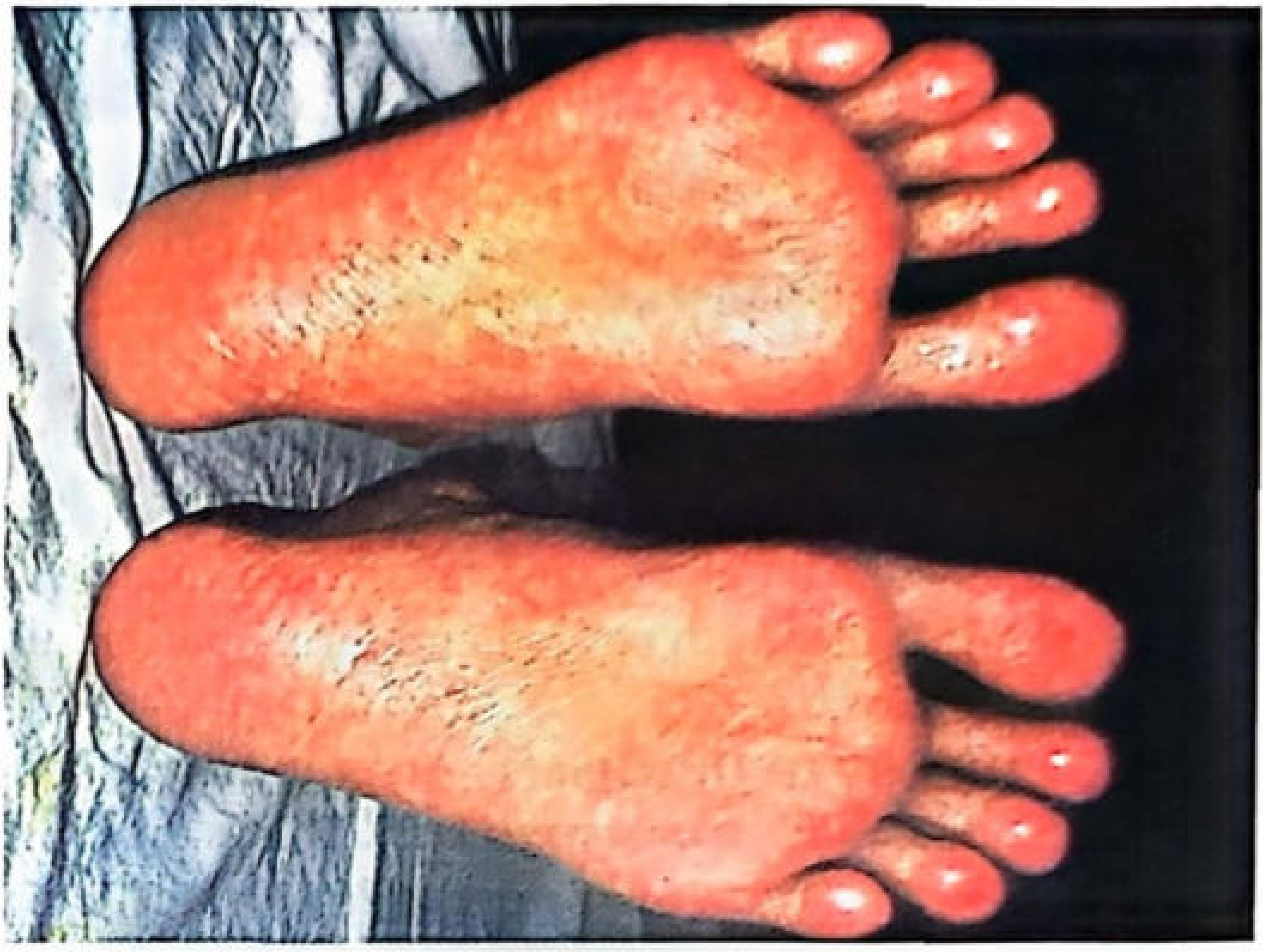
Third Stage (Skin changes - Pathognomonic):
- Raindrop pigmentation - finely mottled brown change on skin flexures, temples, eyelids, neck
- Hyperkeratosis of palms and soles
- Irregular thickening of nails + Aldrich-Mees lines (white transverse lines in fingernails)
Systemic Chronic Effects:
- CNS: polyneuritis, paresthesias, anesthesias, encephalopathy
- GI: nausea, vomiting, abdominal cramps
- Liver: hepatomegaly, jaundice, cirrhosis
- Kidneys: chronic nephritis, renal failure
- CVS: cardiac failure, dependent edema
- Blood: bone marrow suppression, anemia, thrombocytopenia, leukemia
- Cancer: lung cancer, skin cancer (arsenic is a carcinogen/teratogen)
7. Difference: Arsenic Poisoning vs. Cholera
| Feature | Arsenic Poisoning | Cholera |
|---|---|---|
| Pain in throat | Before vomiting | After vomiting |
| Purging | After vomiting | Before vomiting |
| Stools | Dark/bloody initially, then rice-watery | Rice-watery, not bloody, involuntary jet |
| Tenesmus & anal irritation | Present | Absent |
| Vomited matter | Mucus, bile, blood | Watery, without mucus/bile/blood |
| Voice | Not affected | Rough and whistling |
| Conjunctivae | Inflamed | Not inflamed |
| Analysis of excreta | Arsenic present | Cholera vibrio present |
| Epidemiology | Circumstantial evidence of poisoning | Other cholera cases in locality |
8. Post-Mortem Appearances
Acute Arsenic Poisoning
External:
- Body appears dehydrated and cyanosed
- Sunken eyeballs, wrinkled skin
- Skin may be jaundiced
- Rigor mortis lasts longer than usual
Internal:
- Stomach (classic sign): "Red velvet" appearance - mucosa red, edematous, swollen in patches corresponding to arsenic deposits; covered with tenacious blood-tinged mucus; small ulcerations or large erosions at pyloric end; submucous petechial hemorrhages
- Small intestine: Inflamed upper part, dilated, reddened, thickened mucosa; may form a pseudomembrane
- Large intestine: Rectum most prone to inflammation; caecum inflamed, mucosa flabby
- Heart: Petechial hemorrhages under endocardium of left ventricle (comparatively common)
- Liver: Patchy fatty degenerative changes, necrosis with jaundice
- Kidneys: Tubular necrosis, enlarged and congested
- Lungs: Congested, edematous, subpleural ecchymoses
- Brain: Congested; ventricles full of serum
- Spleen: Enlarged and congested
- Note: Decomposition is NOT significantly retarded in acute poisoning
Chronic Arsenic Poisoning (PM Findings)
- Retardation of decomposition is evident (hallmark of chronic poisoning)
- Progressive emaciation, anemia
- Fatty degenerative changes in heart muscle, liver, and kidneys
- Congestion of gastrointestinal tract
- Microscopy: peripheral neuropathy
- Skin changes (raindrop pigmentation, hyperkeratosis)
- Arsenic deposited at the end of long bones (lower end of femur is suitable for analysis)
Arsine Gas Poisoning (PM Findings)
- Skin is dirty yellow
- Mucous membrane of stomach and intestine is yellow and inflamed
- Liver: small or enlarged, fatty degeneration
- Spleen: destruction of blood, blood pigment deposition
- Kidneys: enlarged, congested, tubular necrosis
- Lungs: congested, edematous
9. Distribution & Excretion
| Tissue | Details |
|---|---|
| Early: liver > kidney > spleen | Highest concentrations in initial 24 hours |
| Brain | Lowest - does not cross BBB well |
| Hair and nails | Arsenic deposits within hours of ingestion; arsenic starts appearing in hair after ~15 days; 1 cm of hair = ~25 days |
| Bone (cancellous) | Replaces phosphorus; may remain for years |
| Placenta | Inorganic arsenic crosses the placenta |
Excretion: Primarily via kidneys (methylated form); also via feces, bile, sweat, hair, nails, skin, breast milk. Detectable in urine within 30 minutes of ingestion; continuous excretion for 10-12 days.
Key lab values:
- Normal blood arsenic: <4 mg/L; normal urine: <0.03 µg/L
- Acute poisoning: 24-hour urine excretion >100 µg
- Normal hair: <0.05/100 g; >1 mg/100 g = poisoning
10. Chemical Tests for Detection
| Test | Method | Result |
|---|---|---|
| Marsh's Test (1836) | Arsenic + zinc + H₂SO₄ → arsine gas → arsenic mirror on cold glass | Brownish-black metallic arsenic mirror (soluble in bleaching powder - distinguishes from antimony) |
| Reinsch's Test (1841) | Copper foil in HCl + test solution, heated 1 hour | Dull black = arsenic; Shiny black = bismuth; Copper black = antimony; Silver = mercury |
| Gutzeit's Test | Similar to Marsh; arsine passes through lead acetate paper → silver nitrate | Yellow to brown stain with silver nitrate |
| Atomic Absorption Spectroscopy (AAS) | Current standard | Quantitative; detects arsenic in hair, nails, bone |
| Neutron Activation Analysis | Bombard with neutrons → gamma emission | Forensic gold standard; can date exposure by hair segmentation |
Note: Marsh's and Reinsch's tests are now considered obsolete (Reddy, 2026). Current detection uses atomic absorption spectroscopy.
Hair segmentation analysis: By dividing hair into successive 1 cm lengths from root upward and analyzing each segment, the time elapsed since arsenic administration can be estimated. This has important medicolegal value for intermittent chronic poisoning.
11. Medico-Legal / Forensic Importance
Why Arsenic is a Popular Homicidal Poison:
- Cheap and easily obtained
- Colorless, odorless, nearly tasteless
- Can be administered in food or drink without suspicion
- Small quantity required for death
- Onset of symptoms is gradual
- Symptoms simulate cholera (natural disease)
Disadvantages for the Poisoner (Forensic Detection):
- Delays putrefaction (chronic poisoning) - body preserved for analysis
- Can be detected in completely decomposed bodies
- Found in bones, hair, nails for several years - detectable long after burial
- Detectable even in charred bones or ashes
- Detectable in exhumed bodies
Modes of Administration:
- Homicide: mixed with sweets, bread, milk, tea, cold drinks; mass poisoning via well/food supply
- Suicide: rare (causes much pain)
- Accidental: admixture with food, improper medicinal use, drinking arsenic-contaminated well water
Post-Mortem Imbibition (Defense Plea):
If arsenic is introduced into the stomach after death, the defense can be countered because:
- Post-mortem imbibition follows an anatomical course (left side predominantly)
- Signs of inflammation and ulceration of stomach are ABSENT in post-mortem imbibition
- Arsenic from soil is in insoluble form and cannot percolate into a cadaver
Exhumation:
- Arsenic from soil cannot percolate into the cadaver (insoluble)
- Hair and nails may have higher contamination from soil externally
- Soil at burial site must be taken for chemical analysis as a control
12. Samples for Chemical Analysis (Forensic)
| Sample | Notes |
|---|---|
| Stomach contents | First priority - send whole stomach tied at both ends |
| Liver | First organ to store arsenic |
| Kidney | Second-line storage |
| Hair (with bulbs) | Must include bulbs; 1 cm = 25 days; chronological dosing possible |
| Nails (whole) | Must be whole |
| Urine | 24-hr collection; >100 µg = acute poisoning |
| Bone | Few cm shaft of lower end of femur |
| Soil (from burial site) | Control specimen for exhumation |
13. Treatment
- Remove from source / remove poison from GI tract (emetics, gastric lavage)
- Gastric lavage with freshly prepared ferric oxide in water (forms ferric arsenite, insoluble and harmless) or 1% sodium thiosulfate
- Whole bowel irrigation; nasogastric suction (arsenic is re-secreted into GI tract)
- Antidote: BAL (British Anti-Lewisite / Dimercaprol)
- 400-800 mg day 1; 200-400 mg days 2-3; then 100-200 mg twice daily for 7-10 days
- Chelates arsenic by forming stable ring complexes with SH groups
- Stop when 24-hr urine arsenic falls below 50 µg
- Oral Penicillamine 100 mg/kg/day in 4 divided doses for 4-8 days after initial BAL
- DMSA (succimer) or DMPS - superior to BAL; used if available
- IV normal saline for dehydration
- Morphine for pain, castor oil/MgSO₄ to reduce intestinal absorption
Note: Alkalis should NOT be given as they increase arsenic solubility. Copper sulfate or tartar emetics should NOT be used as emetics.
Quick Exam Summary Table
| Feature | Key Fact |
|---|---|
| Common form | Arsenic trioxide (white arsenic) |
| Fatal dose | 180-300 mg arsenic trioxide |
| Fatal period | 12-48 hours |
| Mechanism | SH-enzyme inhibition; capillary damage |
| Classic smell | Garlic odor (breath + body) |
| Classic symptom | Rice-water stools, cholera-like |
| Skin sign (chronic) | Raindrop pigmentation |
| Nail sign | Aldrich-Mees lines (white transverse lines) |
| PM stomach (acute) | "Red velvet" appearance |
| PM (chronic) | Delays putrefaction |
| Antidote | BAL (Dimercaprol) |
| Classic test | Marsh's test (now obsolete; AAS is current standard) |
| Reinsch test result | Dull black deposit on copper |
| Hair analysis timing | Detectable in 15 days; 1 cm hair = 25 days |
| Forensic significance | Detectable in exhumed bodies; hair/bone for years |
This is a shared conversation. Sign in to Orris to start your own chat.