
Pronation and supination
Reading File
Now let me search the medical library for pronation and supination content.
Finding Sources
Finding Sources
Reading File
Reading File
Reading File
Reading File
Loading Image
Now let me fetch the THIEME atlas diagram of the radioulnar joints and also get the range of motion data:
Loading Image
Reading File
I now have comprehensive material from Gray's Anatomy for Students and the THIEME Atlas. Here is the full answer:
Pronation and Supination
These are rotational movements of the forearm that turn the palm facing upward (supination) or downward (pronation). They occur entirely in the forearm - the hand itself does not move independently.
The Joints Involved
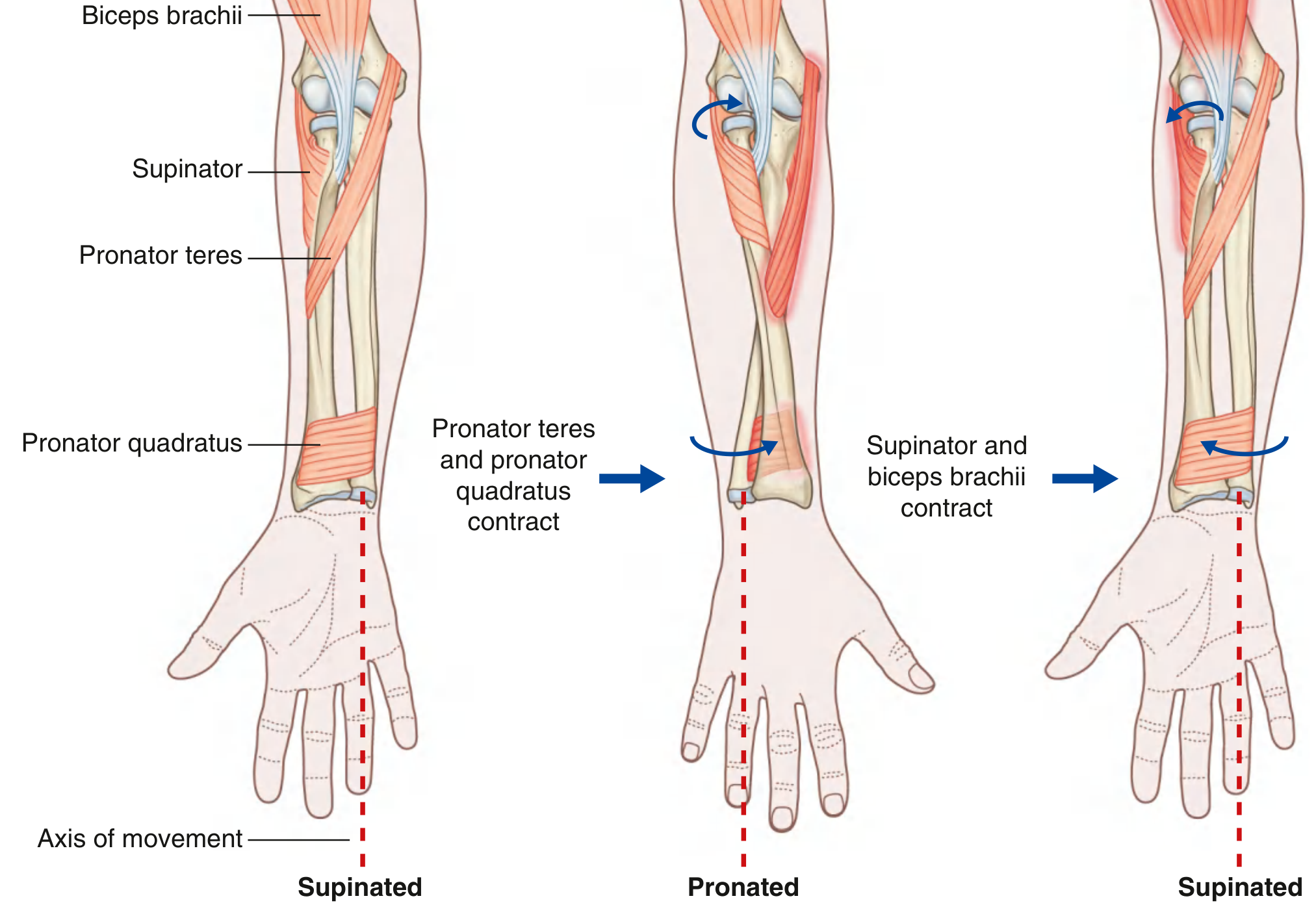
Both the proximal and distal radioulnar joints work together as a functional unit. The interosseous membrane between radius and ulna links them so that movement at one joint necessarily involves the other.
The axis of rotation runs obliquely from the center of the humeral capitulum, through the center of the radial articular fovea, down to the styloid process of the ulna.
- Supination: radius and ulna lie parallel to each other
- Pronation: radius crosses over the ulna
Mechanism at Each Joint
Proximal radioulnar joint:
- The superior articular surface of the radial head spins on the capitulum
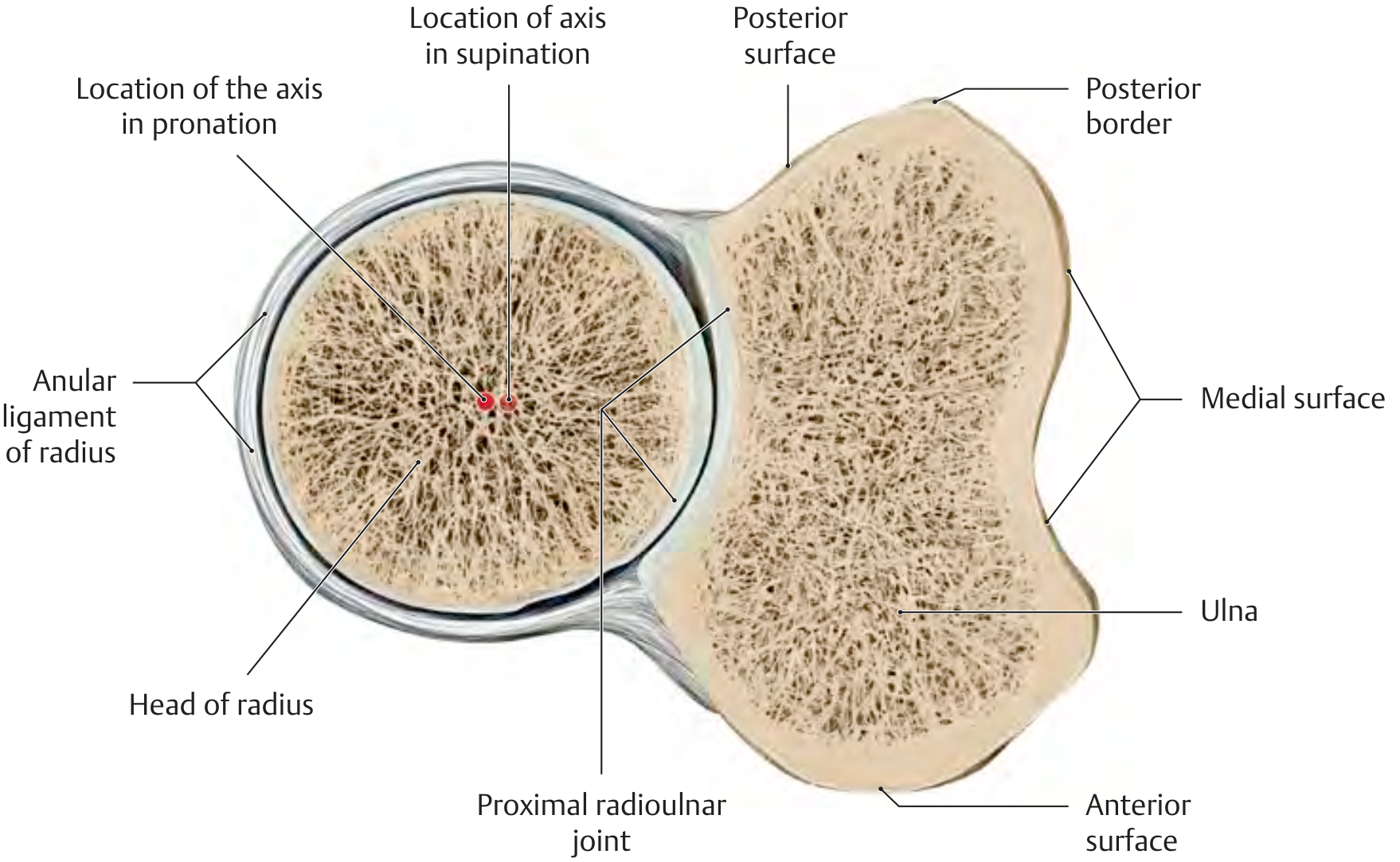
- The side of the radial head slides against the radial notch of the ulna, held in place by the anular ligament of the radius
- The radial head is slightly oval, so the pronation/supination axis shifts ~2 mm radially during pronation - this creates space for the radial tuberosity within the interosseous space
Distal radioulnar joint:
- The ulnar notch of the radius slides anteriorly over the convex head of the ulna
- Stabilized by the articular disc (ulnocarpal complex / triangular fibrocartilage complex - TFCC) and the dorsal/palmar radioulnar ligaments
- Maximum contact between the distal articular surfaces occurs in the neutral/semi-pronated position
Structures holding the bones together throughout:
- Anular ligament of the radius (proximal)
- Interosseous membrane (along the lengths of both bones)
- Articular disc (distal)
Muscles
| Movement | Muscles |
|---|---|
| Supination | Biceps brachii (primary, most powerful), Supinator |
| Pronation | Pronator teres, Pronator quadratus |
| Accessory (pronation) | Anconeus (abducts distal ulna to maintain palm position over central axis) |
Supination muscles in detail:
- Biceps brachii - most powerful supinator; most effective when the forearm is flexed. Its tendon wraps around the proximal radius when pronated; contraction unwraps it, pulling the radius back
- Supinator - in the posterior compartment; originates from the supinator crest of the ulna and lateral epicondyle; inserts onto the radius above the oblique line; also wraps and unwraps around the radius
Pronation muscles in detail:
- Pronator teres - runs from the medial epicondyle of the humerus to the lateral surface of the radius at midshaft; pulls the distal radius over the ulna
- Pronator quadratus - flat muscle connecting the anterior surfaces of the distal ends of radius and ulna; the primary pronator for slow, low-force movements
- Anconeus - triangular, lateral epicondyle to the proximal ulna; during pronation it abducts the distal ulna slightly to keep the palm centered over the axis of movement
Range of Motion (Normal)
| Movement | Range |
|---|---|
| Pronation | ~80° |
| Supination | ~85° |
| Functional range (each) | ~50° |
The neutral (0°) position is semi-pronation - the thumb pointing upward with the palm facing medially.
Functional Importance
Pronation and supination allow the hand to:
- Raise objects to the mouth (eating)
- Touch any area of the body
- Use tools (screwdriver, light bulb, door lock)
- The range can be extended further by adding shoulder and trunk movements to achieve up to a full 360° twist
Because the hand articulates predominantly with the radius (not the ulna), translocating the distal radius medially over the ulna is what shifts the palm from the supinated (anterior-facing) to the pronated (posterior-facing) position. The ulna itself stays essentially stationary.
Sources: Gray's Anatomy for Students; General Anatomy and Musculoskeletal System, THIEME Atlas of Anatomy; Miller's Review of Orthopaedics 9th Edition
This is a shared conversation. Sign in to Orris to start your own chat.