
Neurotransmitter in biochemistry cns portion.
Reading File
Now let me search the medical library for neurotransmitters in the CNS biochemistry section.
Finding Sources
Finding Sources
Good. I can see biochemistry textbooks are available. Let me search specifically for neurotransmitters in biochemistry books and also look for CNS section content.
Finding Sources
Finding Sources
Found the key biochemistry sections. Let me read the main neurotransmitter biochemistry content and also look for broader CNS biochemistry headings.
Finding Sources
Reading File
Excellent content! Let me read more of this section covering individual neurotransmitters (dopamine, serotonin, GABA, etc.).
Reading File
Excellent! This section is very rich. I now have detailed content on catecholamines, MAO, COMT, and degradation pathways. Let me also read the earlier part of this block (before offset 510) which likely contains the start of neurotransmitter synthesis and the BBB section, and also look at the block7 content on drug mechanisms.
Reading File
Reading File
Now let me read the remaining neurotransmitter sections - specifically GABA, serotonin, acetylcholine, glutamate, glycine, and histamine from block9.
Reading File
I have very rich content now. Let me also fetch the key pathway diagrams to include in the answer.
Reading File
I now have comprehensive content on all major neurotransmitters. Let me fetch the key pathway diagrams to include visually.
Loading Image
Loading Image
Excellent! I have both key pathway diagrams. Now let me also fetch the GABA/glutamate shunt diagram and the catecholamine degradation (MAO/COMT) diagram.
Loading Image
I now have all the content and diagrams needed. Let me compile the comprehensive answer on neurotransmitters in biochemistry CNS.
Neurotransmitters in Biochemistry - CNS
(Source: Basic Medical Biochemistry - A Clinical Approach, 6e, Chapter 46)
Overview
Neurotransmitters fall into two structural categories:
- Small nitrogen-containing molecules - glutamate, GABA, glycine, acetylcholine, dopamine, norepinephrine, serotonin, histamine, epinephrine, aspartate, and nitric oxide
- Neuropeptides - synthesized in the CNS (endorphins, growth hormone, TSH, etc.) - often cleaved from larger precursors
General features common to small nitrogen-containing neurotransmitters:
- Synthesized from amino acids, glycolysis/TCA cycle intermediates, and O2 in the cytoplasm of the presynaptic terminal
- Rate of synthesis is regulated to match the neuron's firing rate
- Stored in vesicles via an ATP-requiring pump linked to a proton gradient
- Release triggered by depolarization → Ca2+ influx through voltage-gated channels → vesicle fusion → exocytosis into synaptic cleft
- Action terminated by: reuptake into presynaptic terminal, uptake into glial cells, diffusion, or enzymatic inactivation
I. Catecholamines: Dopamine, Norepinephrine, Epinephrine
All three are synthesized from a common pathway starting from L-tyrosine.
Biosynthesis Pathway
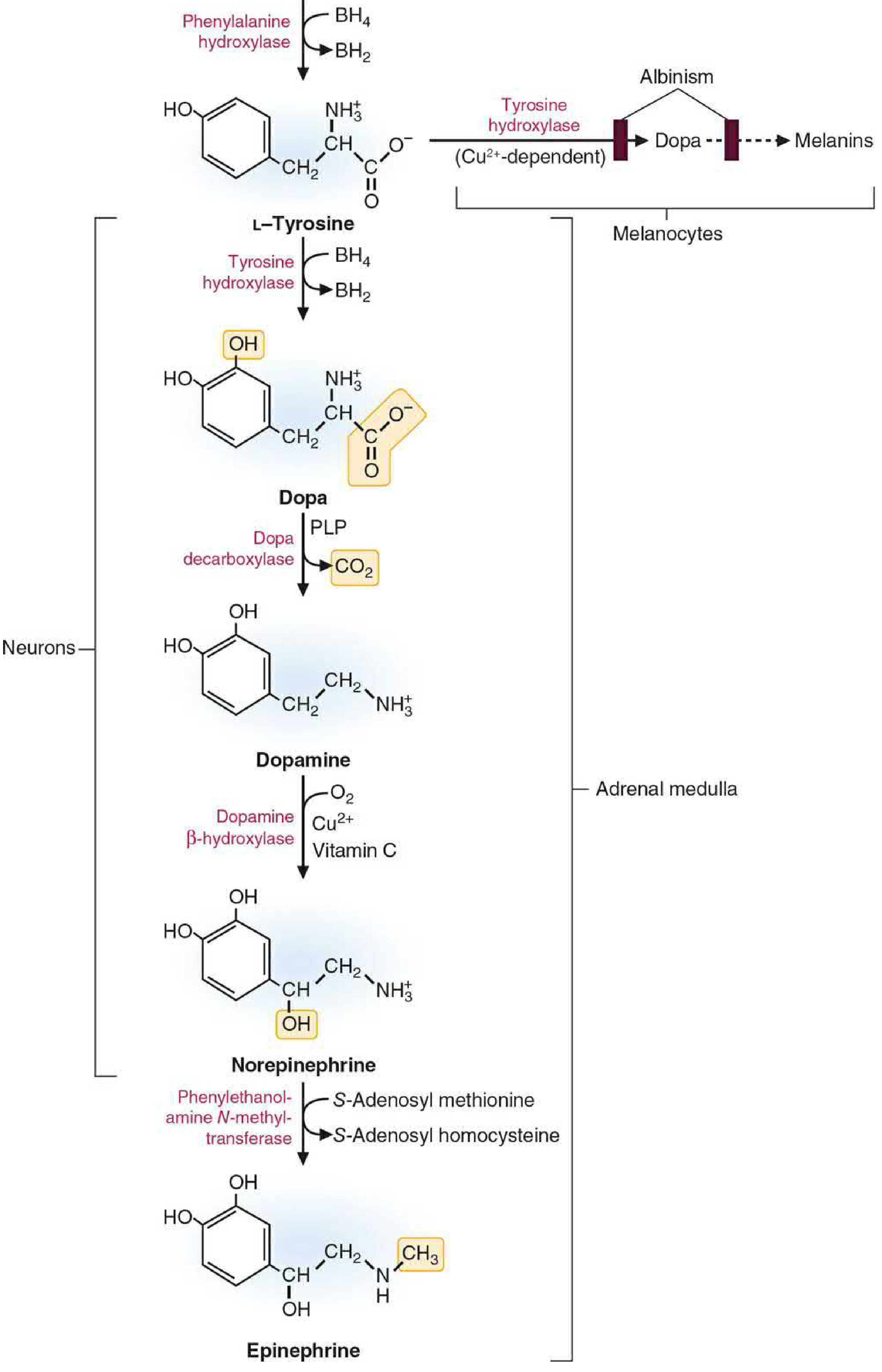
| Step | Reaction | Enzyme | Cofactors | Notes |
|---|---|---|---|---|
| 1 (rate-limiting) | Tyrosine → L-DOPA | Tyrosine hydroxylase (TH gene) | BH4 (tetrahydrobiopterin) | Hydroxylates the ring; BH4 → BH2 |
| 2 | L-DOPA → Dopamine | DOPA decarboxylase | PLP (pyridoxal phosphate, B6) | Dopaminergic neurons stop here |
| 3 | Dopamine → Norepinephrine | Dopamine β-hydroxylase (DBH) | O2, Vitamin C (ascorbic acid) as electron donor, Cu2+ | Reaction occurs inside storage vesicles |
| 4 | Norepinephrine → Epinephrine | Phenylethanolamine N-methyltransferase (PNMT) | SAM (methyl donor) → SAH | Mainly adrenal medulla; some neurons |
Tyrosine itself comes from diet or from phenylalanine via phenylalanine hydroxylase (also BH4-dependent). Defect in PAH → PKU.
Degradation of Catecholamines
Two key enzymes act in any order, producing multiple metabolites:
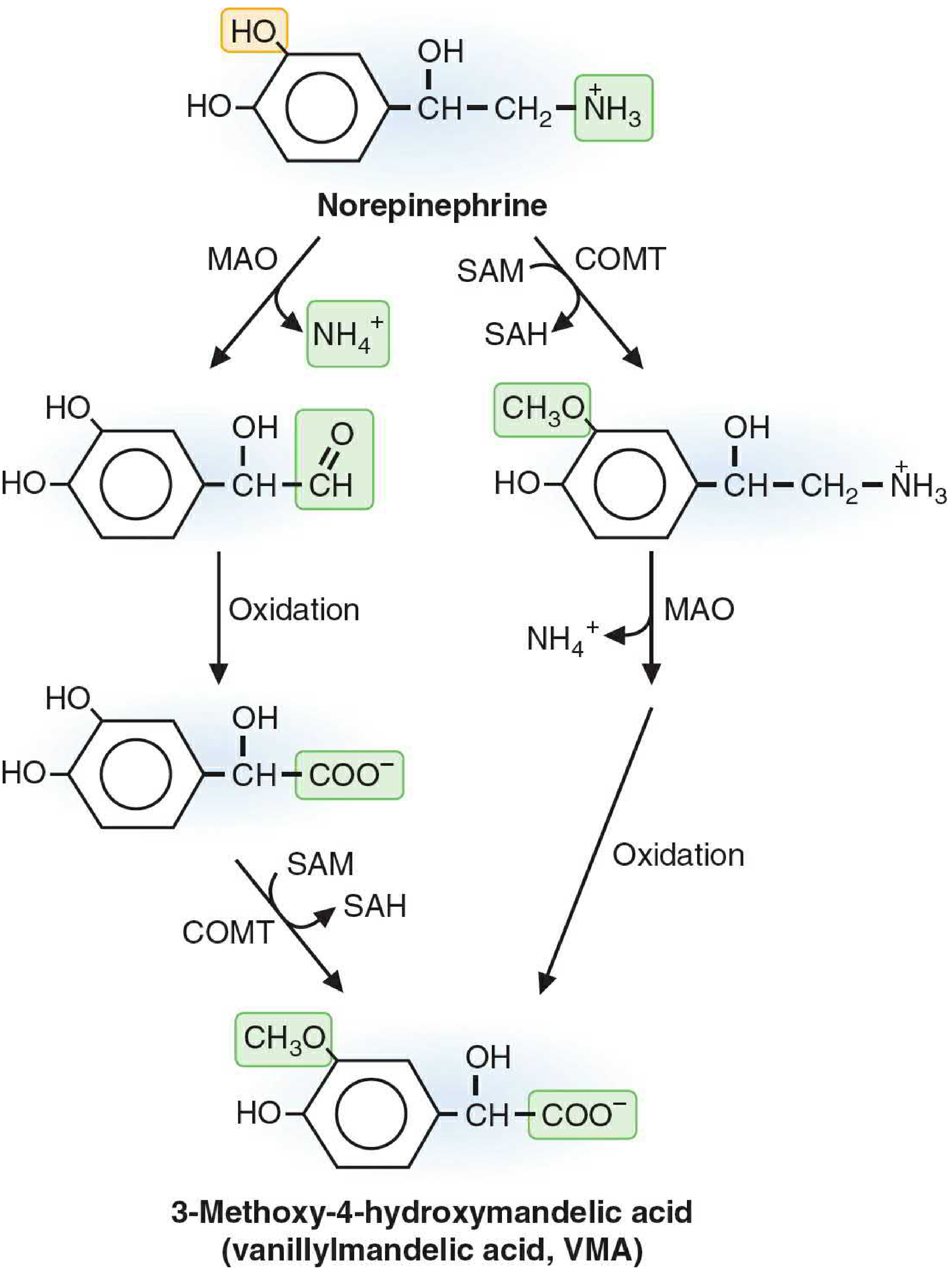
| Enzyme | Location | Action | Specificity |
|---|---|---|---|
| MAO (Monoamine oxidase) | Outer mitochondrial membrane | Oxidizes carbon bearing amino group → aldehyde + NH4+ | MAO-A: NE + serotonin; MAO-B: broad phenylethylamines |
| COMT (Catechol-O-methyltransferase) | Many cells, erythrocytes | Transfers methyl group from SAM to catechol -OH | Broad catechols; requires B12 and folate indirectly |
- Final product of norepinephrine/epinephrine degradation: VMA (vanillylmandelic acid = 3-methoxy-4-hydroxymandelic acid) - excreted in urine; elevated in pheochromocytoma
- Dopamine degradation marker: HVA (homovanillic acid) in CSF - decreased in Parkinson's disease
- MAO in liver protects against dietary tyramine (found in aged cheese, red wine)
MAO Inhibitors (MAOIs) - clinical relevance:
- Irreversible (1st gen): iproniazid - antidepressant but causes "cheese effect" (tyramine → hypertensive crisis)
- Selective irreversible: clorgyline (MAO-A, antidepressant, still has cheese effect); deprenyl/selegiline (MAO-B, used in Parkinson's)
- Reversible (3rd gen): moclobemide (selective, reversible MAO-A inhibitor) - antidepressant without cheese effect
II. Serotonin (5-Hydroxytryptamine, 5-HT)
Synthesized from tryptophan, paralleling the catecholamine pathway.
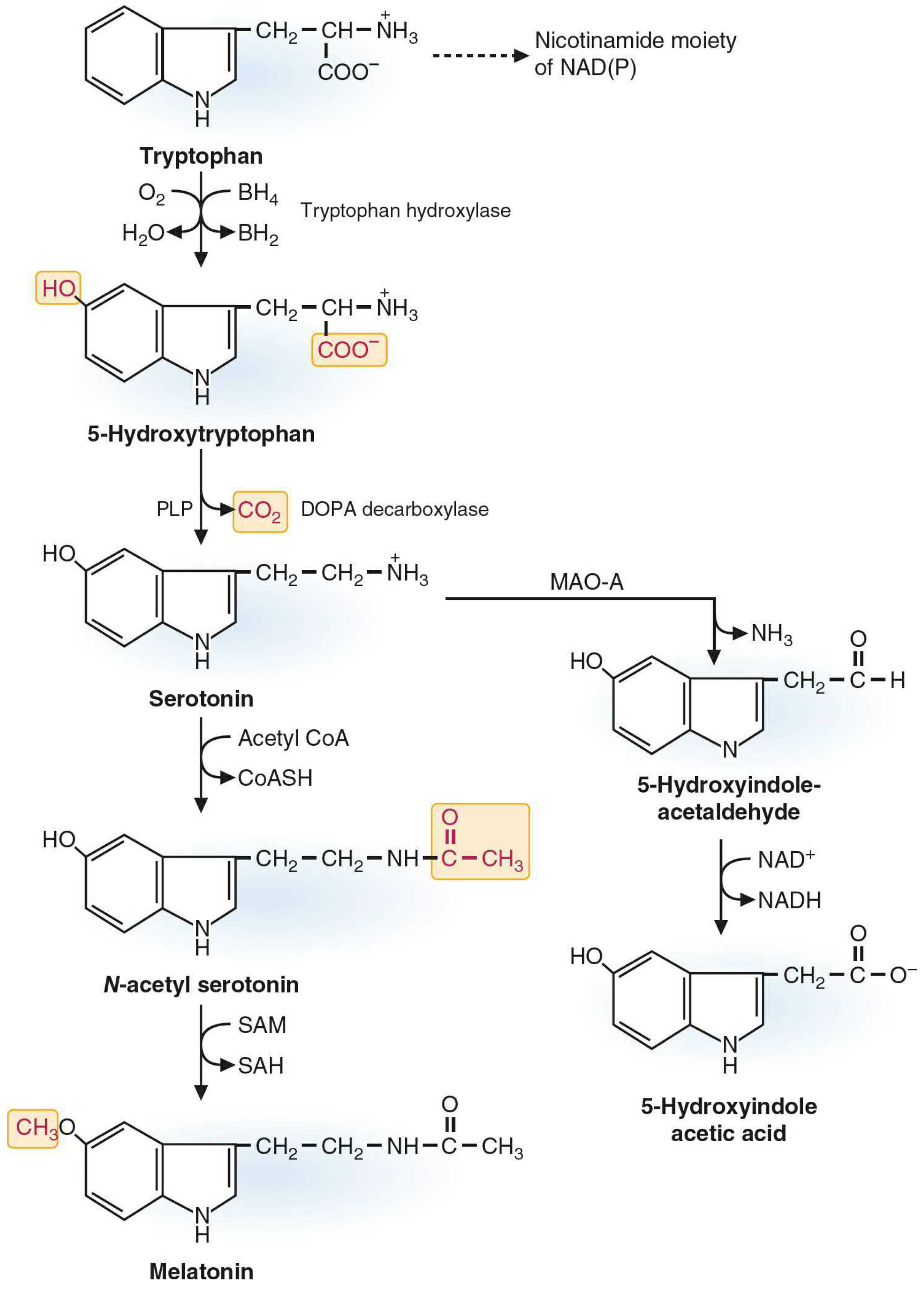
| Step | Reaction | Enzyme | Cofactors |
|---|---|---|---|
| 1 | Tryptophan → 5-Hydroxytryptophan | Tryptophan hydroxylase | BH4 |
| 2 | 5-Hydroxytryptophan → Serotonin | DOPA decarboxylase (same enzyme as catecholamine pathway) | PLP |
- Degraded by MAO-A → 5-HIAA (5-hydroxyindoleacetic acid) excreted in urine; elevated in carcinoid syndrome
Melatonin from Serotonin
- Serotonin → N-acetyl serotonin (acetylation by Acetyl-CoA) → Melatonin (methylation by SAM via COMT-like reaction) in the pineal gland
- Responds to the light-dark cycle; organizes circadian and seasonal rhythms
III. Acetylcholine (ACh)
- Synthesized from choline + acetyl-CoA by choline acetyltransferase (ChAT) in the presynaptic terminal
- Degraded by acetylcholinesterase (AChE) in the synapse → choline + acetate
- Choline is recycled back to the presynaptic terminal via a high-affinity transporter
- Important for neuromuscular junction, autonomic ganglia, and CNS cognition (Alzheimer's disease: cholinergic deficit)
- AChE inhibitors (e.g., donepezil) used in Alzheimer's
IV. Glutamate and GABA
These are interconverted via the GABA shunt and are intimately linked to the TCA cycle.
| Feature | Glutamate | GABA |
|---|---|---|
| Type | Major excitatory NT in CNS | Major inhibitory NT in CNS |
| Synthesis | From α-ketoglutarate (TCA cycle) via transamination or from glutamine | Decarboxylation of glutamate by GAD (glutamic acid decarboxylase) |
| Cofactor | - | PLP (B6) |
| Termination | High-affinity uptake by neurons and glial cells | Uptake into glial cells (glial cells lack GAD - cannot synthesize GABA) |
| Clinical links | Excitotoxicity (stroke, ALS); NMDA receptors | Epilepsy, anxiety; benzodiazepines enhance GABA-A; valproate/tiagabine increase GABA |
The GABA Shunt
- In glial cells: GABA → glutamate (via GABA transaminase) → glutamine (via glutamine synthetase) → transported back to neurons
- In neurons: glutamine → glutamate → GABA (via GAD)
- This conserves glutamate and GABA in the CNS
- Tiagabine: inhibits GABA reuptake → adjunctive treatment for epilepsy
Vigabatrin irreversibly inhibits GABA transaminase → increases GABA levels → anticonvulsant
V. Glycine
- Major inhibitory NT in the spinal cord (and brainstem)
- Synthesized in neurons from serine by serine hydroxymethyltransferase (requires folate)
- Serine itself comes from 3-phosphoglycerate (glycolysis intermediate)
- Action terminated by high-affinity transporter reuptake
- Also acts as a co-agonist at NMDA glutamate receptors
VI. Aspartate
- Excitatory NT (functions in far fewer pathways than glutamate)
- Synthesized from oxaloacetate (TCA intermediate) via transamination
- Cannot cross the blood-brain barrier
VII. Nitric Oxide (NO)
- Synthesized from arginine + O2 by NO synthase (NOS) → citrulline + NO
- Cofactors: NADPH, FAD, FMN, BH4, calmodulin/Ca2+
- Atypical neurotransmitter - not stored in vesicles, not released by exocytosis (it is a gas)
- Acts by stimulating guanylate cyclase → increases cGMP → vasodilation, neurotransmission
- Also role in immune defense (kills tumor cells and parasites)
VIII. Histamine
- Synthesized from histidine by histidine decarboxylase (requires PLP)
- Present in mast cells and histaminergic neurons in the hypothalamus
- Degraded by MAO or histamine N-methyltransferase
Key Summary Table
| Neurotransmitter | Precursor | Key Enzyme | Cofactor | Type | Degradation |
|---|---|---|---|---|---|
| Dopamine | Tyrosine | Tyrosine hydroxylase (rate-limiting) + DOPA decarboxylase | BH4, PLP | Excitatory/modulatory | MAO, COMT → HVA |
| Norepinephrine | Dopamine | Dopamine β-hydroxylase | Vitamin C, Cu2+ | Excitatory | MAO, COMT → VMA |
| Epinephrine | Norepinephrine | PNMT | SAM | - | MAO, COMT → VMA |
| Serotonin | Tryptophan | Tryptophan hydroxylase | BH4, PLP | Modulatory | MAO-A → 5-HIAA |
| Melatonin | Serotonin | Acetyltransferase + COMT | Acetyl-CoA, SAM | - | - |
| GABA | Glutamate | GAD | PLP | Inhibitory (CNS) | GABA transaminase |
| Glycine | Serine | Ser hydroxymethyltransferase | Folate | Inhibitory (spinal cord) | Reuptake |
| Glutamate | α-KG (TCA) | Transamination | PLP | Excitatory | Reuptake |
| Acetylcholine | Choline + Acetyl-CoA | ChAT | - | Excitatory | AChE |
| Nitric oxide | Arginine | NOS | NADPH, BH4, Ca2+ | Gaseous/diffusible | Spontaneous (O2 radical) |
Clinical Correlates (High-Yield)
| Disease | Neurotransmitter Deficit/Excess | Mechanism |
|---|---|---|
| Parkinson's disease | ↓ Dopamine (nigrostriatal) | Loss of dopaminergic neurons; Tx: L-DOPA |
| Schizophrenia | ↑ Dopamine (mesolimbic) | Dopamine hypothesis; Tx: D2 blockers |
| Depression | ↓ Serotonin, ↓ NE, ↓ DA | Tx: SSRIs, SNRIs, MAOIs, TCAs |
| Alzheimer's disease | ↓ Acetylcholine | Loss of cholinergic neurons; Tx: AChE inhibitors |
| Epilepsy | ↓ GABA (or ↑ glutamate) | Tx: GABA enhancers (benzodiazepines, valproate) |
| Anxiety | ↓ GABA | Benzodiazepines ↑ GABA-A receptor sensitivity |
| Pheochromocytoma | ↑ VMA in urine | Excess catecholamine production from adrenal |
| Carcinoid syndrome | ↑ 5-HIAA in urine | Excess serotonin production |
| PKU | ↓ Dopamine, ↓ Serotonin | Phenylalanine blocks tyrosine and tryptophan transport to brain |
Source: Basic Medical Biochemistry - A Clinical Approach, 6e, Chapter 46 (CNS Biochemistry)
This is a shared conversation. Sign in to Orris to start your own chat.