
upper limb nerves
Reading File
Finding Sources
Finding Sources
Reading File
Reading File
Finding Sources
Reading File
Reading File
Reading File
Finding Sources
Finding Sources
Reading File
Finding Sources
Loading Image
Loading Image
Searching Images
upper limb nerve dermatomes cutaneous innervation diagram
Loading Image
Here is a comprehensive overview of the nerves of the upper limb, organized from origin to terminal distribution.
The Brachial Plexus — Origin and Structure
All major nerves of the upper limb arise from the brachial plexus, formed by the anterior rami of C5–C8 and T1. It originates in the posterior triangle of the neck, passes over rib I, and enters the axilla surrounding the axillary artery.
The plexus is organized into four levels: Roots → Trunks → Divisions → Cords → Terminal branches (mnemonic: Real Teenagers Drink Cold Beer).
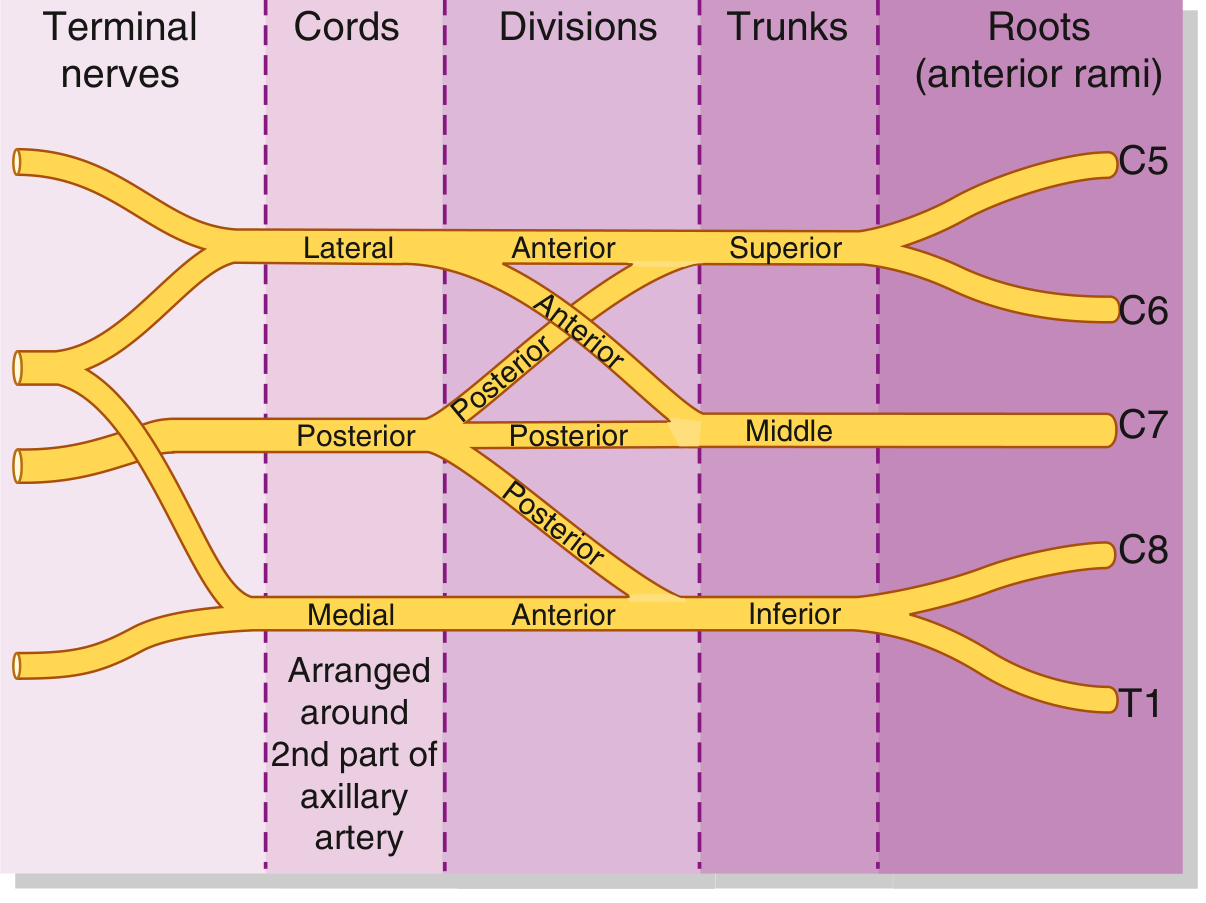
Trunks
| Trunk | Formed by |
|---|---|
| Superior | C5 + C6 |
| Middle | C7 alone |
| Inferior | C8 + T1 |
Divisions
Each trunk splits into anterior (flexor) and posterior (extensor) divisions. No peripheral nerves arise directly from divisions.
Cords (named relative to the axillary artery)
| Cord | Source | Contents |
|---|---|---|
| Lateral | Anterior divisions of superior + middle trunks | C5–C7 |
| Medial | Anterior division of inferior trunk | C8, T1 |
| Posterior | All three posterior divisions | C5–T1 |
Branches of the Plexus
From the Roots
| Nerve | Roots | Motor supply |
|---|---|---|
| Dorsal scapular | C5 | Rhomboid major & minor |
| Long thoracic | C5–C7 | Serratus anterior (damage → winged scapula) |
| Contribution to phrenic nerve | C5 | Diaphragm |
From the Trunks (superior trunk only)
| Nerve | Roots | Motor supply |
|---|---|---|
| Suprascapular | C5, C6 | Supraspinatus, infraspinatus |
| Nerve to subclavius | C5, C6 | Subclavius |
From the Lateral Cord
| Nerve | Roots | Supply |
|---|---|---|
| Lateral pectoral | C5–C7 | Pectoralis major (± minor) |
| Musculocutaneous | C5–C7 | Coracobrachialis, biceps, brachialis; sensory → lateral forearm (LACN) |
| Lateral root of median | C5–C7 | (joins medial root to form median nerve) |
From the Medial Cord
| Nerve | Roots | Supply |
|---|---|---|
| Medial pectoral | C8, T1 | Pectoralis major & minor |
| Medial cutaneous nerve of arm | C8, T1 | Medial arm skin |
| Medial cutaneous nerve of forearm | C8, T1 | Medial forearm skin |
| Ulnar nerve | C8, T1 | See below |
| Medial root of median | C8, T1 | (joins lateral root) |
From the Posterior Cord
| Nerve | Roots | Supply |
|---|---|---|
| Upper subscapular | C5, C6 | Subscapularis |
| Thoracodorsal | C6–C8 | Latissimus dorsi |
| Lower subscapular | C5, C6 | Subscapularis, teres major |
| Axillary | C5, C6 | Deltoid, teres minor; sensory → regimental badge area |
| Radial | C5–T1 | See below |
The Five Terminal Nerves
1. Musculocutaneous Nerve (C5–C7)
- From the lateral cord; pierces the coracobrachialis muscle
- Motor: all three anterior arm muscles (coracobrachialis, biceps brachii, brachialis)
- Sensory: continues as the lateral antebrachial cutaneous nerve (LACN) — lateral forearm
- Injury: weak elbow flexion and supination; reduced lateral forearm sensation
2. Median Nerve (C6–T1)
- Formed in front of the axillary artery by union of the lateral (C5–C7) and medial (C8, T1) roots
- Travels with the brachial artery; no branches in the arm
- Enters the forearm between the two heads of pronator teres
- Motor in forearm: pronator teres, FCR, palmaris longus, FDS, FDP (lateral half), FPL, pronator quadratus (via anterior interosseous nerve)
- Motor in hand (LOAF): Lateral two lumbricals, Opponens pollicis, Abductor pollicis brevis, Flexor pollicis brevis (superficial head)
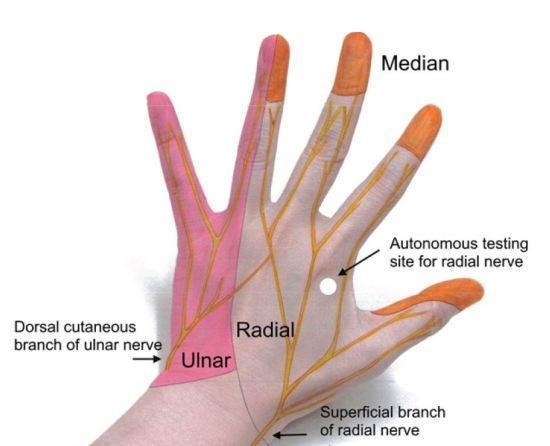
- Sensory: palmar surface of lateral 3½ digits + lateral palm; dorsal fingertips of index, middle, and radial half of ring finger
- Key injury sites: carpal tunnel syndrome (wrist), pronator teres syndrome (elbow)
- Classic sign: "Ape hand" (thenar wasting), loss of thumb opposition; "hand of benediction" with attempted fist
3. Ulnar Nerve (C8, T1)
- From the medial cord
- Passes behind the medial epicondyle (most common injury site) → enters forearm between heads of FCU
- Motor in forearm: FCU, medial half of FDP (ring and little fingers)
- Motor in hand: hypothenar muscles, medial two lumbricals, all interossei (palmar & dorsal), adductor pollicis, deep head of FPB
- Sensory: medial 1½ digits (palmar and dorsal), medial palm; dorsal cutaneous branch given off proximal to wrist (supplies dorsal medial hand)
- Classic sign: "Claw hand" (ring and little fingers), loss of finger abduction/adduction, Froment's sign
4. Radial Nerve (C5–T1) — largest branch of posterior cord
- Exits axilla through the triangular interval, winds around the humerus in the radial (spiral) groove with the profunda brachii artery
- Motor in arm: all three heads of triceps brachii
- Motor in forearm: brachioradialis, ECRL (above lateral epicondyle); then divides into:
- Superficial radial nerve (sensory only): dorsal lateral hand, first dorsal web space (autonomous zone)
- Posterior interosseous nerve (PIN) (motor only): ECRB, supinator, ED, EDM, ECU, APL, EPL, EPB, EI
- Sensory: posterior arm, posterior forearm, dorsal lateral hand
- Classic sign: "Wrist drop" (Saturday night palsy / midshaft humerus fracture)
5. Axillary Nerve (C5, C6)
- From the posterior cord; exits through the quadrangular space with the posterior circumflex humeral artery
- Winds around the surgical neck of the humerus
- Motor: deltoid, teres minor
- Sensory: superior lateral cutaneous nerve of arm ("regimental badge" area over deltoid)
- Injury: shoulder dislocation, surgical neck of humerus fracture → weak shoulder abduction
Cutaneous Innervation of the Hand (Dorsum)
Quick Reference: Motor & Sensory Summary
| Nerve | Key Motor Test | Autonomous Sensory Zone |
|---|---|---|
| Musculocutaneous | Elbow flexion with forearm supinated | Lateral forearm |
| Median | Thumb opposition ("A-OK" sign) | Index fingertip (volar) |
| Ulnar | Finger abduction/adduction | Little fingertip (volar) |
| Radial | Wrist/finger extension ("thumbs-up") | First dorsal web space |
| Axillary | Shoulder abduction (deltoid) | Regimental badge area |
Injury Patterns and Clinical Correlates
| Nerve | Common Injury Site | Classic Deformity |
|---|---|---|
| Axillary | Surgical neck of humerus; shoulder dislocation | Flat shoulder, weak abduction |
| Radial | Midshaft humerus (spiral groove) | Wrist drop; sparing of triceps |
| Median | Carpal tunnel; supracondylar fracture (children) | Ape hand; "hand of benediction" |
| Ulnar | Medial epicondyle; Guyon's canal (wrist) | Claw hand (ring + little); Froment's |
| Long thoracic | Carrying heavy loads on shoulder | Winged scapula |
Sources: Gray's Anatomy for Students (9780323934237); THIEME Atlas of Anatomy — General Anatomy and Musculoskeletal System (9781626237186); Rosen's Emergency Medicine (9780323757898)
This is a shared conversation. Sign in to Orris to start your own chat.