
How to identify type of anemia on the basis of lab report of CBC
Reading File
Now let me search the medical library for comprehensive content on anemia classification by CBC.
Finding Sources
Finding Sources
Finding Sources
Finding Sources
Excellent results. Let me now read the most relevant sections - Harrison's classification section, the Tietz lab medicine section, and Frameworks for Internal Medicine (which has a diagram).
Reading File
Reading File
Reading File
Excellent content found. Let me read more from the Frameworks book for reticulocyte/mechanism-based classification, and also fetch the key images and the Tietz CBC section on RDW.
Reading File
Reading File
Loading Image
Let me also fetch the second diagram which has subcategories, and read a bit more on the reticulocyte-based classification and key CBC parameters.
Loading Image
Finding Sources
Finding Sources
Reading File
Reading File
I have excellent content now. Let me fetch the key algorithm flowcharts and then compile the full answer.
Loading Image
Loading Image
I now have comprehensive, textbook-sourced information with excellent diagnostic algorithms. Let me compose the full answer.
Identifying the Type of Anemia from a CBC Report
Anemia is confirmed when hemoglobin falls below normal (typically <13 g/dL in adult males, <12 g/dL in adult females, <11 g/dL in pregnant women). Once confirmed, the CBC allows a systematic, stepwise approach to narrowing the type.
- Frameworks for Internal Medicine, p. 330
- Harrison's Principles of Internal Medicine 22E, p. 492
- Tietz Textbook of Laboratory Medicine 7E, p. 2944
Step 1 - Use MCV to Classify by Red Cell Size
The MCV (Mean Corpuscular Volume) is the first and most important CBC parameter for anemia classification:

| MCV Value | Category | Think of... |
|---|---|---|
| < 80 fL | Microcytic | Iron deficiency, Thalassemia, Sideroblastic, ACD |
| 80-100 fL | Normocytic | Hemolysis, blood loss, renal disease, aplastic anemia |
| > 100 fL | Macrocytic | B12/folate deficiency, liver disease, hypothyroidism, alcohol |
(Normal MCV: 80-100 fL)
Step 2 - Refine with MCH, MCHC, and RDW
| Parameter | What it tells you |
|---|---|
| MCH (pg/cell) | Average hemoglobin per RBC. Low MCH = hypochromia (impaired Hb synthesis) |
| MCHC (g/dL) | Hb concentration per RBC volume. Low = hypochromia (iron deficiency). High MCHC = spherocytes (hereditary spherocytosis, AIHA), or sickle cell / HbC |
| RDW (%) | Measures anisocytosis (variation in RBC size). High RDW = iron deficiency anemia. Normal RDW = thalassemia trait |
Key RDW Trick - Iron Deficiency vs. Thalassemia Trait
Both cause microcytic anemia, but RDW and the Mentzer Index help distinguish them:
| Feature | Iron Deficiency | Thalassemia Trait |
|---|---|---|
| RDW | Markedly elevated (>15%) | Normal or mildly elevated |
| Mentzer Index (MCV/RBC) | > 15 | < 13 |
| RBC count | Low or normal | Normal or high (relatively) |
| Serum ferritin | Low | Normal |
(Quick Compendium of Clinical Pathology 5e, p. 218)
Step 3 - Use Reticulocyte Count to Classify by Mechanism
The reticulocyte count reveals whether the bone marrow is responding appropriately. This is the second major classification axis.
For Normocytic Anemia:
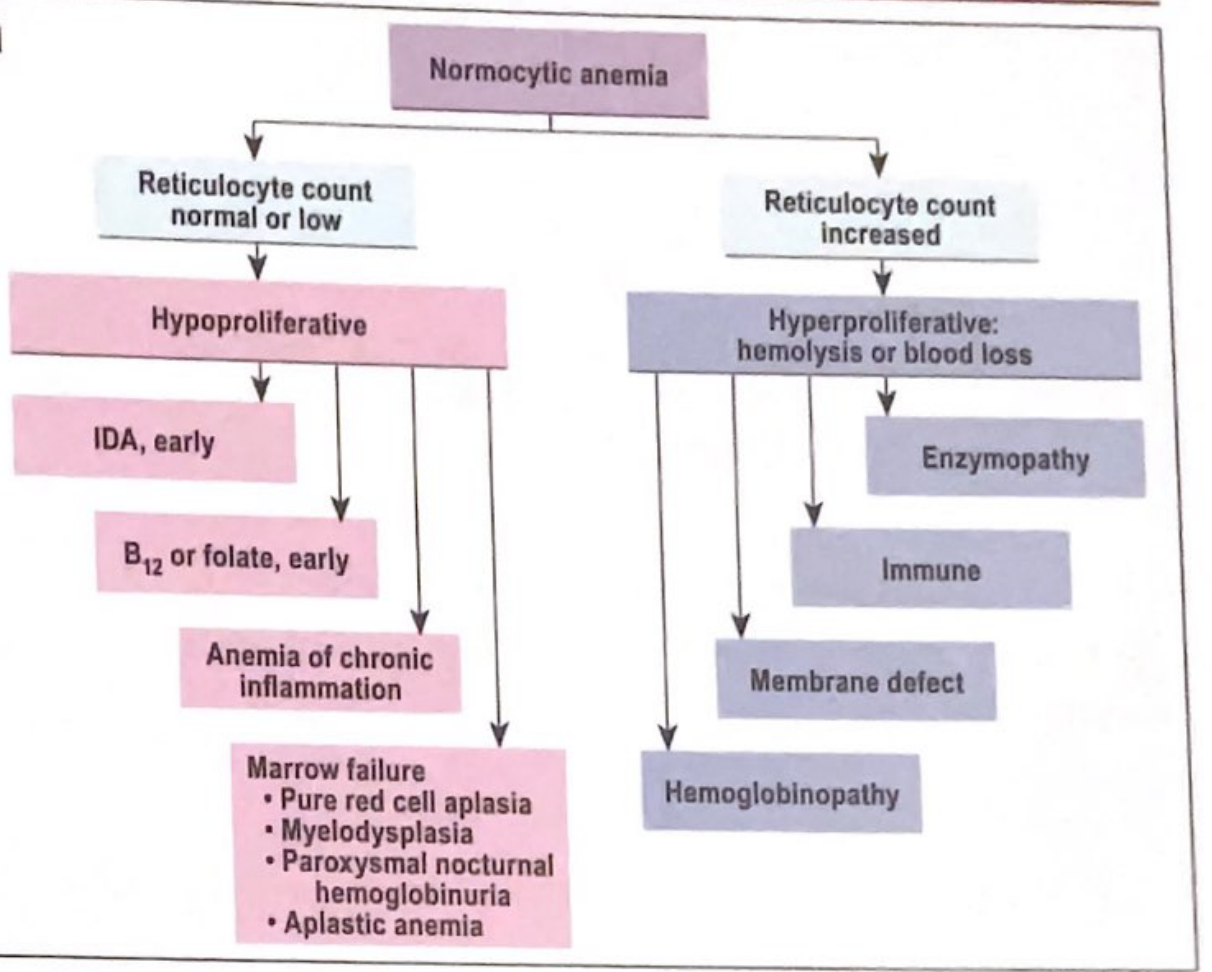
- Reticulocytes LOW/NORMAL = Hypoproliferative (bone marrow not responding): early IDA, early B12/folate deficiency, anemia of chronic inflammation, marrow failure (aplastic anemia, myelodysplasia, pure red cell aplasia, PNH)
- Reticulocytes HIGH = Hyperproliferative (marrow responding - RBCs being lost): hemolysis (enzymopathy, immune, membrane defect, hemoglobinopathy) or acute blood loss
For Microcytic Anemia:
With low reticulocytes: iron deficiency, sideroblastic anemia, thalassemia, anemia of chronic inflammation
With high reticulocytes: think hemolysis with underlying hemoglobinopathy
(Quick Compendium of Clinical Pathology 5e, p. 233-234)
Step 4 - Full Differential by Category
Microcytic Anemia (MCV < 80 fL) - Remember "TAILS"
- T - Thalassemia
- A - Anemia of chronic disease (can also be normocytic)
- I - Iron deficiency (most common cause worldwide)
- L - Lead poisoning
- S - Sideroblastic anemia
Macrocytic Anemia (MCV > 100 fL)
Megaloblastic (oval macrocytes) - due to defective DNA synthesis:
- Vitamin B12 deficiency
- Folate deficiency
- Drugs (methotrexate, hydroxyurea, some anticonvulsants)
- Myelodysplasia
Non-megaloblastic (round macrocytes) - membrane/other defects:
- Alcohol use disorder
- Liver disease
- Hypothyroidism
- Reticulocytosis (young, larger RBCs)
- Smoking, hypoxia, dysproteinemia
Normocytic Anemia (MCV 80-100 fL)
This is the broadest category. The reticulocyte count is essential here:
- Low retics: renal disease (low EPO), anemia of inflammation, aplastic anemia, myelodysplasia, marrow infiltration
- High retics: hemolytic anemia, acute hemorrhage
Quick CBC-Based Algorithm Summary
Low Hb (confirmed anemia)
        |
        ↓
      Check MCV
     /    |    \
  <80   80-100  >100
  Micro  Normo  Macro
    |      |      |
Check MCH, MCHC, RDW
    |      |      |
  Check Reticulocyte Count
    |
  Low/Normal = Underproduction
  High       = Hemolysis/Blood loss
    |
  Further tests: ferritin, TIBC, B12, folate,
  LDH, haptoglobin, peripheral blood smear
Additional CBC Clues
| CBC Finding | Suggests |
|---|---|
| Very low MCV (< 70 fL) + high RBC count | Thalassemia (not usually seen in IDA) |
| Thrombocytosis | Reactive platelet rise, common in iron deficiency |
| Pancytopenia (all 3 cell lines low) | Aplastic anemia, myelodysplasia, marrow infiltration |
| High MCV + hypersegmented neutrophils (on diff) | Megaloblastic (B12/folate) |
| High MCHC (> 36 g/dL) | Hereditary spherocytosis, AIHA |
| Low WBC + low platelets + normocytic anemia | Aplastic anemia, hypersplenism |
The CBC gives you a roadmap - it points you toward the most likely type of anemia and guides which confirmatory tests to order next (serum ferritin, B12, folate, LDH, haptoglobin, peripheral smear, reticulocyte count, hemoglobin electrophoresis, etc.).
This is a shared conversation. Sign in to Orris to start your own chat.