
Write the growth and development of infants, toddlers, preschoolers, schoolers, adolescents in detail
developmental milestones children growth chart
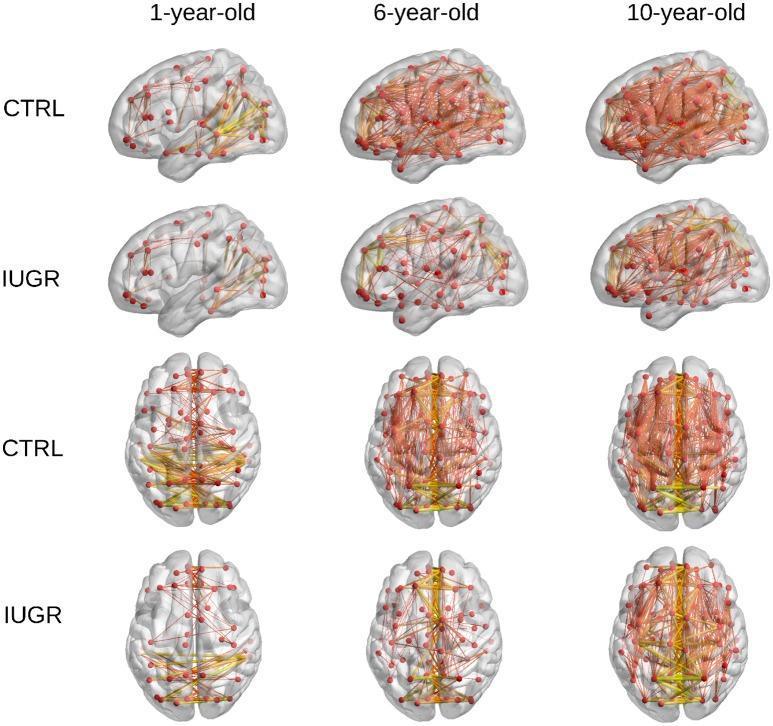
This diagnostic comparison chart displays average brain connectome networks generated from diffusion MRI data, specifically highlighting structural connectivity in human children. The visualization compares a control group (CTRL) with an intrauterine growth restriction (IUGR) group across three developmental stages: 1-year-old, 6-year-old, and 10-year-old. The image consists of two rows of side-view (sagittal) brain renderings and two rows of top-view (axial) renderings. Each brain model displays red spherical nodes representing anatomical regions, connected by lines representing structural pathways with a fractional anisotropy (FA) weight > 0.3. Line width and color (ranging from yellow/orange to deep red) indicate the strength of the connections. Educationally, the diagram illustrates the progression of white matter maturation and myelination, showing that the CTRL group consistently exhibits a higher density and greater strength of high-FA connections compared to the IUGR group. This visualization demonstrates the long-term impact of IUGR on brain network organization and the relative reduction in structural connectivity strength that persists from infancy through childhood.
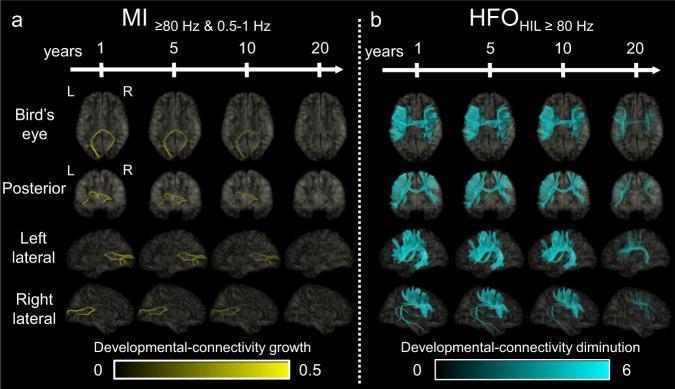
This medical graphic illustrates dynamic tractography and developmental neuroimaging changes in human brain connectivity across four age milestones: 1, 5, 10, and 20 years. The figure is divided into two sections based on intracranial EEG (iEEG) biomarkers. Panel (a) shows the 'co-growth' of the Modulation Index (MI ≥80 Hz & 0.5-1 Hz), representing the strength of coupling between high-frequency oscillations (HFO) and slow-wave phases. Yellow streamlines indicate connectivity growth, which is most prominent in the occipital lobe and increases in intensity over time. Panel (b) depicts the 'co-diminution' of the HFO Hilbert rate (HFOHIL ≥80 Hz). Cyan streamlines represent a decrease in connectivity intensity. This diminution is widespread at age 1 across frontal, parietal, and temporal regions but significantly reduces in spread and intensity by age 20. Both panels present four anatomical perspectives: Bird's eye (superior), Posterior, Left lateral, and Right lateral. Color scales at the bottom quantify the developmental growth (0 to 0.5) and diminution (0 to 6) intensities. This research helps establish normative atlases for distinguishing physiological from pathological brain activity in epilepsy presurgical evaluations.
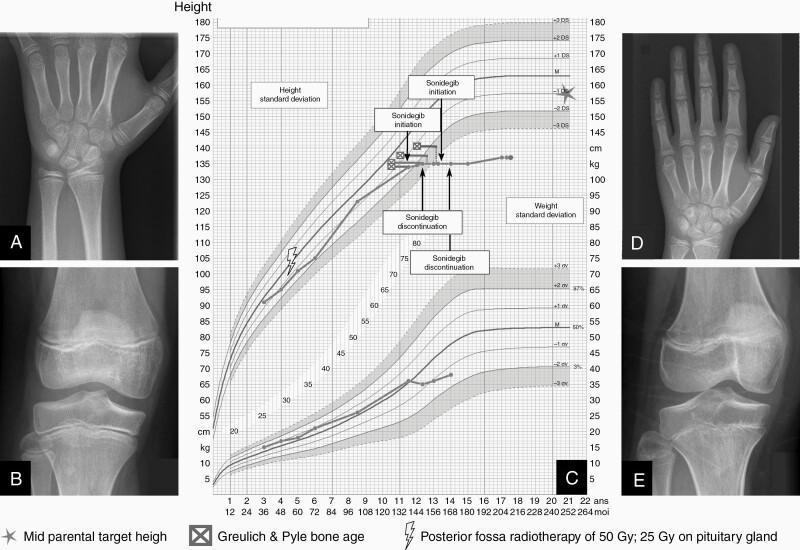
This composite educational image illustrates the adverse impact of the Hedgehog pathway inhibitor sonidegib on skeletal development. (A) and (B) are baseline radiographs of the left hand and knee of a pediatric patient, showing open physes (growth plates) and normal bone density for developmental age. (D) and (E) are follow-up X-rays taken one year after sonidegib initiation, demonstrating premature and complete physeal fusion at the distal radius, distal femur, and proximal tibia, accompanied by dense metaphyseal sclerosis. The central panel (C) presents a longitudinal growth chart plotting height and weight over 22 years. The chart shows a significant flattening of the growth curve—indicating grade III growth deceleration—immediately following sonidegib initiation. Despite subsequent discontinuation, the patient exhibits minimal catch-up growth, with a final adult height more than 3 standard deviations below the mid-parental target height (star symbol). This clinical summary highlights a critical orthopedic side effect of SMO inhibitors in children, where premature epiphyseal closure leads to irreversible growth arrest and short stature.
Growth and Development Across Childhood and Adolescence
Overview: Principles of Child Development
- Gross motor - large muscle control, posture, locomotion
- Fine motor/adaptive - hand-eye coordination, problem-solving
- Language - receptive and expressive communication
- Personal-social - self-care, interaction with others
- Delay - below average in one or more streams
- Deviancy - milestones occurring out of sequence
- Dissociation - major difference in rate between streams (e.g., motor delay with normal cognition in cerebral palsy)
1. INFANTS (Birth to 12 Months)
Physical Growth
- Birth weight: Average ~3.4 kg
- Weight gain: ~30 g/day in first 3 months; birth weight doubles by 5 months, triples by 12 months
- Length: Increases ~50% by end of year 1 (birth length ~50 cm → ~75 cm at 12 months)
- Head circumference: Grows ~2 cm/month for first 3 months, then ~1 cm/month until 6 months; birth HC ~34 cm → ~46 cm at 12 months
- Fontanelles: Posterior closes by 6-8 weeks; anterior closes by 9-18 months
- Teeth: First tooth (lower central incisor) typically at 6-8 months
Primitive Reflexes (Neonatal Period)
| Reflex | Appears | Disappears |
|---|---|---|
| Moro reflex | Birth | 3-6 months |
| Palmar grasp | Birth | 3-4 months |
| Rooting reflex | Birth | 3-4 months |
| Babinski sign | Birth | 12-18 months |
| Tonic neck reflex | Birth | 4-6 months |
Postural Reactions (Prerequisites for Motor Skills)
| Reaction | Age of Appearance | Importance |
|---|---|---|
| Head righting | 6 weeks-3 months | Head control and sitting |
| Landau response | 2-3 months | Trunk control |
| Derotational righting | 4-5 months | Prerequisite for rolling |
| Anterior propping | 4-5 months | Tripod sitting |
| Parachute response | 5-6 months | Facial protection when falling |
| Lateral propping | 6-7 months | Independent sitting |
| Posterior propping | 8-10 months | Pivoting in sitting |
Developmental Milestones - Infancy
- Gross motor: Raises chin off surface in prone; strong head lag when pulled to sit
- Fine motor: Grasp reflex present
- Language: Alerts to sound, cries
- Social: Fixes and follows face briefly
- Gross motor: Raises chest off surface in prone
- Fine motor: Hands predominantly open
- Language: Social smile; cooing, vowel sounds ("ooh", "aah")
- Social: Recognizes parent's face; regards face
- Gross motor: No head lag; rolls from prone to supine; bears weight on forearms in prone
- Fine motor: Reaches for objects; hands come together at midline
- Language: Laughs aloud; squeals; turns to sound
- Social: Smiles spontaneously and frequently; enjoys social interaction
- Gross motor: Rolls both ways; sits with tripod support; bounces when standing with support
- Fine motor: Transfers objects hand to hand; raking grasp; reaches with one hand
- Language: Babbles (consonant-vowel chains: "bababa", "mamama")
- Social: Recognizes familiar faces vs. strangers; mirrors own image
- Gross motor: Sits independently; pulls to stand; crawls or commando-crawls
- Fine motor: Pincer grasp emerging (thumb-finger opposition); bangs objects
- Language: "Mama"/"dada" non-specifically; responds to own name; waves bye-bye
- Social: Stranger anxiety begins; object permanence developing; peek-a-boo
- Gross motor: Walks with one-hand support; stands alone momentarily; cruises along furniture
- Fine motor: Mature pincer grasp well established; releases objects voluntarily; turns pages (several at once)
- Language: 1-2 meaningful words besides "mama"/"dada"; follows simple commands with gesture
- Social: Imitates actions; comes when called; plays pat-a-cake
Cognitive Development (Piaget: Sensorimotor Stage)
- Infant learns entirely through senses and motor actions
- Object permanence (understanding that objects exist when out of sight) develops around 8-9 months - this is why stranger and separation anxiety begin here
- By 12 months: understands cause-and-effect, intentional problem-solving
2. TODDLERS (12 Months to 3 Years)
Physical Growth
- Weight: Gains ~2-3 kg/year (slowing from infancy); birth weight quadruples by ~2.5 years
- Height: Gains ~12 cm in the 2nd year, then ~6-8 cm/year through preschool
- Head circumference: Growth slows significantly; adult HC (~55 cm) approached by 5-6 years
- Body proportions: Protruding abdomen, lordotic posture, wide-based gait are all normal in toddlers
- Teeth: Primary (deciduous) dentition complete by ~2.5 years (20 teeth total)
Developmental Milestones - Toddler
- Gross motor: Walks independently (wide-based gait); creeps up stairs; stoops and recovers
- Fine motor: Builds tower of 2 blocks; marks with crayon; uses spoon (messily); turns book pages several at a time
- Language: 4-6 meaningful words; may use jargon
- Social: Indicates wants by pointing; drinks from cup; brings objects to show caregiver
- Gross motor: Runs (stiffly); throws ball overhand; climbs furniture; walks up stairs with one hand held
- Fine motor: Tower of 3-4 blocks; scribbles spontaneously; removes shoes/socks; uses spoon/fork
- Language: 10-25 words; points to body parts; echoes words; follows 2-step commands
- Social: Parallel play begins; temper tantrums emerge; stranger anxiety may persist; shows affection
- Gross motor: Runs well; walks up and down stairs with 2 feet per step; kicks ball; jumps in place
- Fine motor: Tower of 6-7 blocks; imitates vertical and circular strokes; turns pages one at a time; uses a fork
- Language: 50+ words; 2-word phrases ("more juice", "daddy go"); 50% of speech intelligible to strangers; uses pronouns (I, me)
- Social: Parallel play; begins symbolic play (feeding doll); toilet training readiness begins; very egocentric
- Language: 3-word sentences; 75% intelligible; names body parts; uses plural words
- Fine motor: Differentiates horizontal and vertical strokes; tower of 8 blocks
- Social: May start cooperative play; beginning of "mine" concept; increased autonomy-seeking
- Gross motor: Rides tricycle; walks up stairs alternating feet; stands on one foot briefly (2-3 seconds); broad jumps
- Fine motor: Tower of 9-10 blocks; copies circle; uses scissors (with help); begins dressing/undressing
- Language: 3-word sentences; 75% intelligible to strangers; uses past tense; knows full name and age; 200+ word vocabulary
- Social: Group play begins; shows gender-role awareness; toileting mostly independent by day; magical thinking begins
Cognitive Development (Piaget: Pre-Operational Stage begins ~2 years)
- Language begins to represent objects (symbolic thought)
- Egocentric thinking dominates - cannot take another's perspective
- Animism - attributes life to inanimate objects
- Magical thinking - believes wishes can cause events
Key Behavioral Themes in Toddlerhood
- Autonomy vs. shame/doubt (Erikson) - this is the core developmental conflict; children assert independence, leading to the "terrible twos"
- Temper tantrums peak at 18 months-2 years; normal response to frustration and limited language
- Separation anxiety normally peaks at 9-18 months; school-readiness requires its resolution
- Toilet training: Most children have physiologic and developmental readiness between 18-36 months
3. PRESCHOOLERS (3 to 5 Years)
Physical Growth
- Height: ~6-7 cm/year gain; legs elongate and body proportions become more adult-like
- Weight: ~2 kg/year; body fat decreases, muscle mass increases
- Brain development: By age 5, brain is ~90% of adult weight; massive myelination and synaptic pruning ongoing
- Vision: Visual acuity matures to 20/20 by age 5-6
Developmental Milestones - Preschool
- Gross motor: Hops on one foot (4+ times); skips (one-sided); throws overhand; catches a bounced ball; walks down stairs alternating feet; pumps on a swing
- Fine motor: Copies cross (+); cuts with scissors; uses fork/spoon and sometimes knife; draws a person with 3 parts; buttons large buttons
- Language: 4-5 word sentences; fully intelligible to strangers; counts to 4; tells stories; uses past/future tense; asks "why" constantly; 1,500-word vocabulary
- Social: Associative/cooperative play; has friends; dramatic play and role play; follows 3-4-step commands; knows gender; distinguishes fantasy from reality begins
- Gross motor: Skips alternating feet; jumps rope; catches ball with hands (not arms); balances on one foot 10 seconds; rides bicycle with training wheels
- Fine motor: Copies square and triangle; draws person with 6 parts; prints some letters; ties shoelaces (some); uses knife for spreading
- Language: Fully intelligible; complex sentences; 2,000+ word vocabulary; counts to 10; defines words by use; knows address and phone number; uses all parts of speech
- Social: Cooperative play; understands rules; shares and takes turns; best friends; prefers same-sex play partners; school-readiness
Cognitive Development (Piaget: Pre-Operational continued)
- Symbolic play flourishes - elaborate pretend scenarios
- Centration - can focus on only one aspect of a situation at a time (pre-logic)
- Conservation not yet mastered (the classic water/clay problem)
- Egocentrism persists but slowly declines; beginning of empathy
- Preoperational substages: Symbolic function (2-4 yrs) → Intuitive thought (4-7 yrs)
Key Behavioral Themes in Preschool
- Initiative vs. guilt (Erikson) - child initiates activities and play; guilt arises from perceived misbehavior
- Oedipal/Electra complex (Freudian theory) - gender identity and identification with same-sex parent
- Fears - of the dark, monsters, "bad" things; nightmares and sleep disruptions common
- Discipline: Consistent, positive reinforcement strategies most effective; time-out appropriate at this age
- School readiness by age 5 requires: self-care, ability to separate, basic self-regulation, understanding simple instructions
4. SCHOOL-AGE CHILDREN (6 to 12 Years)
Physical Growth
- Height: ~5-6 cm/year in girls; ~5-7 cm/year in boys
- Weight: ~2-3 kg/year
- Body composition: Girls begin to accumulate fat; boys increase muscle mass slightly
- Teeth: Primary teeth shed starting ~6 years; permanent teeth replace them; all 28 permanent teeth (excluding wisdom teeth) erupt by ~12 years
- Brain: Continued pruning and myelination, especially prefrontal cortex (executive function)
- Pre-pubertal growth spurt: Begins earlier in girls (~10-11 years) than boys (~12-13 years)
Developmental Milestones - School Age
- Gross motor: Rides bicycle without training wheels; skips, hops, jumps well; team games
- Fine motor: Copies diamond shape; writes legibly; draws with perspective; uses all utensils
- Language: Reads simple sentences; 10,000+ word vocabulary; understands sarcasm and jokes; uses complex grammar
- Cognitive: Concrete operations begin (Piaget) - conservation of number, then mass, then volume; logical thinking about concrete objects
- Social: Rule-bound games; strong group identity; "chums" (Sullivan) - same-sex best friendships become key to mental health
- Cognitive: Masters conservation; can seriate and classify objects; reversibility of thought; understands time concepts
- Social: Peer group takes on huge importance; school performance is central to self-concept; "industry vs. inferiority" (Erikson)
- Emotional: Internalization of moral standards (right vs. wrong); conscience development; pride and shame tied to achievement
- Cognitive: Early formal operational thinking in some children - abstract reasoning begins
- Social: Peer pressure intensifies; cliques form; increasing time with peers and less with family
- Physical: Girls typically enter puberty (see below); boys may begin early pubertal changes
Cognitive Development (Piaget: Concrete Operational Stage, ~7-12 years)
- Conservation: Understands that quantity is unchanged despite change in appearance
- Seriation: Can arrange objects in sequence (size, weight)
- Classification: Can group objects by multiple attributes
- Reversibility: Can mentally undo an operation
- Decentration: Can consider multiple aspects of a problem simultaneously
- Still limited to concrete objects - abstract, hypothetical reasoning not yet consistent
Key Behavioral Themes in School Age
- Industry vs. inferiority (Erikson) - competence and mastery in skills; failure leads to feelings of inadequacy
- Moral development (Kohlberg: Conventional level begins) - rules are sacred; fairness is key; authority is respected
- Peer relationships: Friendships become deeper and more selective; peer acceptance is crucial for self-esteem
- Academic skills: Reading fluency by grade 2-3; multiplication and division by grade 3-4; abstract reading comprehension by grade 5-6
- Sleep: 9-11 hours/night recommended for school-age children
- Screen time: AAP recommends consistent limits; quality of content matters more than quantity at this age
5. ADOLESCENTS (12 to 18+ Years)
Physical Growth and Puberty
Female Puberty (Tanner Stages)
| Stage | Breast | Pubic Hair | Age (average) | Key Events |
|---|---|---|---|---|
| I | Prepubertal | None | <8 years | - |
| II | Breast bud (thelarche) | Sparse, straight, pigmented at labia | 8-13 years | Growth spurt begins |
| III | Enlargement beyond areola | Darker, curlier, over mons | 10-14 years | Axillary hair; acne |
| IV | Secondary mound of areola | Adult but not to thighs | 11-15 years | Menarche (average: 12.5 years) |
| V | Adult contour; single mound | Adult pattern to thighs | 12-17 years | Full adult stature |
- Thelarche (breast development) is typically the first sign in girls, average age 10-11 years
- Menarche occurs about 2-2.5 years after thelarche; average age 12.5 years in the USA (range 10-16)
- Peak height velocity in girls: ~5-8 cm/year, occurring at Tanner stage II-III
- Girls gain ~25 cm total height during pubertal growth
Male Puberty (Tanner Stages)
| Stage | Genitalia | Pubic Hair | Age (average) | Key Events |
|---|---|---|---|---|
| I | Prepubertal | None | <9 years | - |
| II | Testes enlarge >4 mL; scrotum thins | Sparse, straight at base of penis | 9-14 years | First sign: testicular enlargement |
| III | Penis lengthens; testes larger | Darker, curlier | 10-15 years | Voice change begins; muscle mass increases |
| IV | Penis wider; testes larger | Adult pattern, not to thighs | 11-16 years | Axillary/facial hair; acne; voice deepens |
| V | Adult size | Adult pattern to thighs | 12-17 years | Full adult stature and muscle mass |
- First sign in males is testicular enlargement (>4 mL by orchidometer), average age 11-12 years
- Spermarche (first ejaculation): average age 13-14 years
- Peak height velocity in boys: ~7-12 cm/year, occurring at Tanner stage III-IV (later than girls)
- Boys gain ~28-30 cm total height during pubertal growth; PHV occurs ~2 years later than in girls
Other Pubertal Changes (Both Sexes)
- Adrenarche: Adrenal androgen production begins at ~8-10 years (before gonadal puberty); causes pubic/axillary hair and body odor
- Acne: Due to sebaceous gland stimulation by androgens
- Body composition: Boys - major increase in lean muscle mass; Girls - increase in fat mass, especially hips/breasts
- Voice change: Males - testosterone causes laryngeal growth (voice drops ~1 octave)
- Bone density: Peak bone mass is accrued during adolescence; calcium and Vitamin D needs are highest
Cognitive Development (Piaget: Formal Operational Stage, ~12+ years)
- Abstract reasoning: Can think about hypotheticals ("what if...")
- Deductive logic: Can reason from general principles to specific conclusions
- Metacognition: Thinking about one's own thinking; introspection
- Idealistic thinking: Can imagine ideal worlds, leading to idealism and disillusionment
- Personal fable: Belief that one is unique and invincible ("this can't happen to me") - contributes to risk-taking
- Imaginary audience: Feels constantly observed and judged by others - explains extreme self-consciousness
Psychosocial Development in Adolescence (Erikson: Identity vs. Role Confusion)
- Concrete thinking still dominant
- Focus on body image and peer acceptance
- Ambivalence about separation from parents
- Strong identification with same-sex peer group
- Moodiness, emotional lability common
- Abstract thinking developing; risk-taking peaks
- Peer relationships dominate; romantic/sexual interests emerge
- Greater independence from parents; conflict may increase
- Identity exploration (career, values, beliefs)
- "Personal fable" and "imaginary audience" thinking at peak
- Identity consolidation; future-oriented thinking
- More stable relationships; intimacy capacity develops (Erikson's next stage)
- Autonomy from parents with maintained relationship
- Career/educational planning; delayed gratification
- Lower impulsivity; emotional regulation improves
Moral Development (Kohlberg: Post-Conventional Level in late adolescence)
- Conventional morality (early-mid adolescence): Rules followed because society/authority requires it
- Post-conventional morality (late adolescence/adulthood): Principles transcend specific rules; social contract; universal ethical principles
Health Risks in Adolescence
- Leading causes of death: Unintentional injuries (especially motor vehicle accidents), suicide, homicide
- Mental health: Anxiety and depression are common; median onset of mental disorders is 14 years
- Substance use: Experimentation with alcohol, tobacco, cannabis peaks in mid-adolescence
- Sexual health: Contraception, STI prevention; HPV vaccination recommended at 11-12 years
- Eating disorders: Anorexia and bulimia most common in females aged 14-18 years
- HEADSSS assessment (Home, Education, Activities, Drugs, Sexuality, Suicide/Depression, Safety) is the standard adolescent psychosocial screening tool
Summary Table: Key Milestones at a Glance
| Age | Gross Motor | Fine Motor | Language | Social/Cognitive |
|---|---|---|---|---|
| 2 months | Lifts chest prone | Hands open | Coos, social smile | Recognizes face |
| 4 months | No head lag; rolls | Reaches midline | Laughs aloud | Smiles spontaneously |
| 6 months | Sits with support | Transfers objects | Babbles | Stranger awareness |
| 9 months | Pulls to stand | Pincer grasp emerging | "Mama/dada" non-specific | Object permanence |
| 12 months | Walks with support | Mature pincer | 1-2 words | Imitates actions |
| 18 months | Runs stiffly | Tower of 4 blocks | 10-25 words | Parallel play |
| 2 years | Runs well, kicks ball | Tower of 7 blocks | 2-word phrases, 50+ words | Symbolic play |
| 3 years | Rides tricycle | Copies circle | 3-word sentences; 75% intelligible | Cooperative play begins |
| 4 years | Hops on 1 foot | Copies cross | 4-5 word sentences; fully intelligible | Role play, has friends |
| 5 years | Skips alternating | Copies square/triangle | 2,000+ words; reads | School-ready |
| 6-7 years | Rides bike | Copies diamond | 10,000+ words; reads | Concrete operations |
| 11-12 years | Full coordination | Complex tasks | Figurative language | Early abstract thinking |
| 14-17 years | Adult capacity | Adult capacity | Abstract, idealistic | Identity formation |
Red Flags Requiring Evaluation
| Age | Red Flag |
|---|---|
| 2 months | No social smile |
| 4 months | No visual tracking |
| 6 months | No babbling |
| 9 months | No response to name |
| 12 months | No single words; no pointing |
| 18 months | No walking independently; <6 words |
| 2 years | No 2-word phrases; any loss of language |
| 3 years | Speech not intelligible to strangers |
| Any age | Loss of previously acquired milestones (always warrants urgent evaluation) |
Write the gross motor, fine motor, language, social for preschoolers and schoolers separately
Growth and Development: Preschoolers and School-Age Children
PART 1 - PRESCHOOLERS (3 to 5 Years)
GROSS MOTOR DEVELOPMENT
- Jumps with both feet off the ground
- Climbs up and down playground equipment with supervision
- Runs with better control than at 24 months
- Walks on tiptoes a few steps
- Walks up stairs alternating feet (without holding rail)
- Pedals and steers a tricycle
- Jumps from a low step with both feet
- Stands briefly on one foot (1-2 seconds)
- Runs smoothly and changes direction
- Broad jumps (standing long jump)
- Kicks a ball forward while walking
- Catches a large ball most of the time (uses hands, not arms)
- Hops on one foot (4+ consecutive hops)
- Skips on one side (gallop-skip)
- Walks down stairs alternating feet without support
- Pumps self on a swing
- Throws overhand with accuracy
- Climbs ladders and playground structures independently
- Hops on one foot 10+ times; hops on alternating feet
- Skips alternating feet smoothly
- Balances on one foot for 10 seconds or more
- Jumps rope
- Rides bicycle with training wheels (some without)
- Catches a small ball with hands only
- Throws with mature, controlled overhand pattern
- Walks heel-to-toe in a straight line
- Proximal-to-distal and cephalocaudal progression continues
- Balance and coordination improve dramatically between 3-5 years
- Running, jumping, throwing, and catching all refine into controlled, adult-like patterns
- By age 5, a child should be fully mobile on playground equipment
FINE MOTOR / ADAPTIVE DEVELOPMENT
- Tower of 8 blocks
- Strings large beads
- Turns single pages of a book
- Holds crayon/pencil in fingers (not fist) - mature grip beginning
- Imitates horizontal and vertical strokes (not yet spontaneous)
- Puts on some clothing (loose pants, jacket)
- Uses a spoon with little spilling; attempts a fork
- Tower of 9-10 blocks
- Copies a circle (key milestone - when shown how)
- Strings items like large macaroni
- Uses a fork consistently
- Begins to use safety scissors (with help)
- Puts on some clothes by himself (loose pants, jacket)
- Turns single pages; holds book correctly
| Age | Drawing Skill |
|---|---|
| 15 months | Imitates a scribble |
| 18 months | Scribbles spontaneously |
| 2 years | Imitates a vertical stroke |
| 2.5 years | Differentiates horizontal and vertical strokes |
| 3 years | Copies a circle |
| 3.5 years | Copies a cross (+) |
| 4 years | Copies a cross (+); draws person with 3+ body parts |
| 4.5 years | Copies a square |
| 5 years | Copies a square and triangle; draws person with 6 parts |
| Age | Number of Blocks Stacked |
|---|---|
| 15 months | 2 blocks |
| 18 months | 3-4 blocks |
| 2 years | 6-7 blocks |
| 2.5 years | 8 blocks |
| 3 years | 9-10 blocks |
- Copies a cross (+) consistently
- Holds crayon or pencil between fingers and thumb (not a fist) - well established
- Draws a person with 3 or more body parts (head, body, legs, arms, face features)
- Unbuttons some buttons; attempts to button
- Serves herself food or pours water with adult supervision
- Uses scissors with some control to cut along a line
- Builds elaborate block structures beyond simple towers
- Copies a square and triangle (key milestones)
- Draws a person with 6 parts (head, body, 2 arms, 2 legs, plus facial features)
- Buttons some buttons independently
- Writes some letters in her name
- Names some letters when pointed to
- Uses a knife for spreading
- Ties shoelaces (some children)
- Colors within lines with reasonable control
- Cuts along a straight line with scissors independently
LANGUAGE / COMMUNICATION DEVELOPMENT
- Vocabulary of ~450-500 words
- Uses 2-3 word sentences regularly
- Says first name when asked
- Uses some pronouns correctly (I, me, mine, you)
- Points to items in a book when asked ("Where is the dog?")
- 75% of speech intelligible to strangers
- Asks "what" and "where" questions
- Talks in conversation using at least 2 back-and-forth exchanges
- Asks "who," "what," "where," and "why" questions actively
- Describes what is happening in a picture ("running," "eating")
- Says first name when asked
- Fully intelligible to strangers most of the time
- 3-4 word sentences; uses plurals, past tense (imperfect)
- 500-900 word vocabulary
- Names body parts
- Follows 3-step instructions
- Sentences of 4 or more words consistently
- Recites some words from songs, rhymes, or stories
- Tells about at least one thing that happened during the day ("I played soccer")
- Answers simple questions about function - "What is a coat for?"
- Uses conjunctions (and, because, so)
- 1,500+ word vocabulary
- Uses all pronouns correctly
- Counts to 4 with one-to-one correspondence
- Can tell you her full name
- Speech fully intelligible to all listeners
- Tells a story with at least two events in sequence ("The cat was stuck in a tree and a firefighter saved it")
- Answers questions about a book or story after it is read to him
- Keeps a conversation going with 3+ back-and-forth exchanges
- Uses and recognizes simple rhymes (bat-cat, ball-tall)
- 2,000-2,500 word vocabulary; uses all parts of speech
- Counts to 10; names some numbers 1-5 when pointed to
- Uses time words correctly ("yesterday," "tomorrow," "morning," "night")
- Writes some letters in her name
- Names some letters when pointed to
- Tells full name, age, and address
- Understands and uses comparative words (bigger, heaviest)
- Speech fully normal; all consonant sounds present (some minor articulation errors still acceptable)
- By 3 years: p, b, m, n, h, w, y sounds clear
- By 4 years: t, d, k, g, f, v sounds clear
- By 5 years: l, sh, ch, j sounds clear
- By 6-7 years: s, z, r, th fully mastered
SOCIAL / EMOTIONAL DEVELOPMENT
- Plays alongside other children (parallel play still dominant)
- Notices when others are hurt or upset; pauses or looks sad
- Looks at parent's face to see how to react in a new situation ("social referencing" continues)
- Increasing desire to help - puts away toys when asked
- Insists on own way - "No!" and "Mine!" are common
- Beginning symbolic play (pretend feeding, "going to sleep")
- Shows increasing independence
- Calms down within 10 minutes after parent leaves (e.g., childcare drop-off) - separation anxiety significantly reduced
- Notices other children and joins them to play - transition to associative play
- Shows empathy: comforts others when hurt or sad
- Avoids hot objects when warned - beginning abstract safety understanding
- Plays "dress-up" and role-play games
- Gender identity solidifying (knows own gender)
- Can share with prompting; takes turns with support
- Understands "mine" vs. "yours" vs. "his/hers"
- Engages in magical thinking (monsters, imaginary friends)
- Erickson's stage: Initiative vs. Guilt - initiating play and activities; guilt from perceived misbehavior
- Pretends to be someone else during play (teacher, superhero, doctor) - rich symbolic/dramatic play
- Asks to go play with children if none around ("Can I play with Alex?") - actively seeks peers
- Comforts others who are hurt or sad (hugs a crying friend)
- Avoids danger (does not jump from tall heights)
- Enjoys being a "helper" to adults
- Changes behavior based on where he is (quieter in library, louder on playground) - context awareness
- Cooperative play well established; understands and follows rules of simple games
- Strong awareness of fairness ("That's not fair!")
- Beginning theory of mind (understanding others have different thoughts/feelings)
- Best friendships forming (usually same sex)
- Can separate from parents easily; comfortable in school/childcare
- Tattling on peers is normal and common
- Follows rules and takes turns in group games consistently
- Sings, dances, or acts for others - enjoys performing and showing off skills
- Does simple chores at home (matching socks, clearing table) - sense of responsibility
- Pays attention for 5-10 minutes during structured activities (story time, arts and crafts)
- Counts to 10 reliably; understands number concepts
- Strong cooperative play; plans and negotiates in group games
- Consistent, stable friendships with 1-3 "best friends"
- Clear gender-role identification; prefers same-sex play partners
- Can distinguish fantasy from reality most of the time
- School-readiness behaviours present: self-care, follows multi-step directions, controls impulses
- Understands the concept of rules and that breaking them has consequences
- Writes some letters in name; names some letters when shown
PART 2 - SCHOOL-AGE CHILDREN (6 to 12 Years)
GROSS MOTOR DEVELOPMENT
- Rides a bicycle without training wheels (typically achieved at 5-6 years)
- Skips confidently on alternating feet
- Hops on either foot repeatedly with balance
- Catches a small ball reliably with hands
- Throws with full overhand technique, accurate and with force
- Walks a balance beam without falling
- Jumps rope alone
- Swims or learns to swim (most children by age 7-8)
- Participates in organized simple team games (tag, relay races)
- Engages in gymnastics-type movements: cartwheels, somersaults
- Agility, speed, and endurance all increasing significantly
- Coordinates movements in complex team sports (soccer, basketball, baseball)
- Accuracy of throwing and catching markedly improved
- Fine balance and coordination reaching near-adult levels
- Eye-hand coordination good enough for racquet sports
- Rides bicycle with speed and control; begins tricks
- Enjoys competitive sports; understands strategy
- Near-adult gross motor skill in most children
- Strength and endurance increase rapidly, especially in boys approaching puberty
- Coordinated in complex sports; can master specific athletic techniques
- Girls: PHV (peak height velocity) begins; movement patterns may briefly become more clumsy during the growth spurt
- Boys: pre-pubertal increase in muscle coordination; full PHV arrives ~2 years later
- Fine sports skills (batting, dribbling, gymnastics, swimming strokes) are practiced and specialized
- Reaction time, proprioception, and dynamic balance all near adult levels
- Movement becomes smoother, faster, and more efficient each year
- Preschool's jerky, exaggerated movements are replaced by economical, fluid motion
- Speed, strength, agility, and endurance all increase linearly until puberty, then more rapidly with hormonal changes
- Boys and girls are nearly equal in motor performance until ~10-11 years, when boys begin to show advantage in strength and speed
FINE MOTOR / ADAPTIVE DEVELOPMENT
- Writes all letters of the alphabet (upper and lower case) legibly
- Writes own name and simple words independently
- Copies complex shapes: diamond and overlapping figures
- Draws a house with perspective (chimney, windows, door)
- Draws a detailed person: clothing, hair, features, proportions
- Ties shoelaces independently and reliably
- Uses knife and fork together for cutting food
- Handles buttons, zippers, shoelaces without help
- Cuts accurately along curved lines with scissors
- Holds pencil with mature tripod grip; good writing pressure
- Writing becomes faster and more legible
- Printing transitions to cursive writing (begins in most school curricula)
- Draws with perspective and spatial proportion
- Uses tools (ruler, compass, protractor) for academic tasks
- Builds complex models; assembles detailed kits (LEGO, crafts)
- Piano/instrument fingering, typing, craft skills developing
- Dominant hand clearly established and highly skilled
- Sewing, knitting, simple carpentry become possible
- Writing speed and legibility near adult levels
- Fine motor precision sufficient for detailed artwork and crafts
- Keyboarding/typing becomes faster
- Complex hand tool use (microscope, soldering, instruments) possible
- Specialized fine motor skills develop for chosen activities (music, sport, art)
- Precision, control, and endurance of fine motor tasks approach adult capability
| Age | Milestone |
|---|---|
| 5 years | Copies triangle; draws person with 6 parts; writes some letters |
| 6 years | Copies diamond; writes all letters; draws house |
| 7 years | Cursive begins; more detailed and proportionate drawings |
| 9-10 years | Complex constructions; perspective in art |
| 11-12 years | Near-adult fine motor control |
LANGUAGE / COMMUNICATION DEVELOPMENT
- Vocabulary of 10,000-14,000 words (massive expansion from 5-year-old's 2,500)
- Reads simple sentences and short books independently (decoding at grade level)
- Understands and uses complex sentence structures (subordinate clauses, conditionals)
- Understands and uses figurative language (some idioms: "it's raining cats and dogs")
- Produces and enjoys jokes and riddles (understanding ambiguity)
- Understands sarcasm in context
- Narrates stories with beginning, middle, and end
- Follows multi-step verbal instructions
- Uses metalinguistic awareness - can talk about language itself
- Vocabulary ~20,000 words
- Reads chapter books; reading comprehension deepens
- Writes multi-sentence paragraphs with topic and supporting sentences
- Uses and understands analogies
- Understands multiple meanings of words (homonyms, puns)
- Expressive written language developing
- Uses language to argue a point and persuade
- Understands passive voice; uses complex syntax consistently
- Vocabulary of 40,000+ words by age 12
- Reads and writes with near-adult fluency
- Understands abstract language, symbolism, metaphor
- Uses language for persuasion, debate, humour, social bonding
- Slang and peer-group language becomes prominent
- Reading comprehension includes inferential and evaluative levels
- Language is a major tool for social negotiation with peers
- 6-7 years: Begins to narrate and explain rather than just label
- 8-9 years: Conversation becomes truly reciprocal; can debate and argue logically
- 10-12 years: Peer discourse dominates; language identity strongly tied to social group
SOCIAL / EMOTIONAL DEVELOPMENT
- Industry vs. Inferiority (Erikson) - competence and mastery become central; takes pride in achievements; failure creates shame
- Peer relationships become central to identity; friendships are selective and meaningful
- Same-sex friendships dominant and intense
- Sullivan's concept of the "chum" - a same-sex best friend during latency who validates and mirrors the child; this friendship is a critical marker of healthy social development
- Understands and respects rules of games; calls out peers who break rules
- School performance becomes linked to self-esteem
- Can sustain attention for 15-30 minutes on structured tasks
- Empathy deepens; can take another person's perspective (theory of mind fully developed ~6-7 years)
- Conscience and internalized moral standards active
- Peer group identity intensifies; cliques begin to form
- Comparative thinking: "Am I as good as him/her?" - competition emerges
- Best friendships become reciprocal and exclusive ("you're my best friend")
- Gender separation in play intensifies (boys vs. girls groups)
- Interests become more specialized (sports, hobbies, music, gaming)
- Greater emotional regulation; fewer outbursts than preschool
- Kohlberg's Conventional Morality - rules are rules because authority says so; "good boy/good girl" orientation
- Can sustain attention for 30-45 minutes on academic tasks
- Beginning of self-concept independent of parents
- Peer relationships reach peak importance; more time with peers than family
- Loyalty and trust become central friendship values
- Exclusion and rejection by peers become profoundly painful
- Same-sex peer groups very strong; cross-gender interaction may decrease temporarily before increasing in early adolescence
- Beginning of puberty in most girls (~10-11 years): body image concerns emerge
- Self-consciousness increases
- Growing capacity for abstract moral reasoning: "rules exist for good reasons" (Kohlberg Stage 3-4)
- Can plan and organize multi-day projects
- Increasing independence: manages own school supplies, homework, some self-care
- Identity exploration begins
- Greater conflict with parents over autonomy
- Peer norms have enormous influence on behavior and self-image
- Abstract thinking emerging (formal operations beginning)
- Puberty arrival (in boys and late-developing girls): bodily self-consciousness, moodiness
- Planning for future begins (career interests, skill development)
- Moral reasoning transitions from "rules" to "values"
Domain Summary: Preschoolers vs School-Age
| Domain | Preschool (3-5 yrs) | School Age (6-12 yrs) |
|---|---|---|
| Gross Motor | Tricycle, hopping, skipping, catching large ball | Bicycle, team sports, complex coordination, near-adult agility |
| Fine Motor | Circle → cross → square/triangle; draws 6-part person; buttons | Writes all letters; copies diamond; cursive; adult tool use |
| Language | 500-2,500 words; 3-5 word sentences; intelligible to all; rhymes | 10,000-40,000 words; reads/writes fluently; abstract language; debate |
| Social | Initiative vs. Guilt; cooperative play; dramatic play; school-ready | Industry vs. Inferiority; chum friendships; peer groups; moral conscience |
Red Flags in These Age Groups
- Age 3: Not using 3-word sentences; speech not intelligible to strangers; no cooperative play; still walking on tiptoes persistently
- Age 4: Not hopping; not drawing any recognizable shapes; not using 4-word sentences; still drooling excessively
- Age 5: Cannot hop on one foot; no letter recognition; speech remains unclear; cannot follow 3-step commands; does not play cooperatively
- Persistent reading difficulty after age 7 (screen for dyslexia)
- Cannot copy diamond by age 7
- Extreme social isolation or inability to make/keep friendships
- Regression of previously acquired skills at any age (always warrants urgent evaluation)
- Persistent inattention, impulsivity, and hyperactivity interfering with school (screen for ADHD)