
Describe the skin incision for opening the body cavities. In autopsy
Reading File
The standard autopsy skin incision uses a large Y-shaped (or I-shaped) cut to open the chest, abdomen, and pelvis in one continuous approach. Let me pull the full textbook detail.
Searching sources...
Finding Sources
Finding Sources
Finding Sources
Finding Sources
Finding Sources
Finding Sources
Excellent - found the key sections. Let me read the most detailed ones.
Reading File
Reading File
Excellent content found. Let me also fetch the diagram and read a bit more about the opening of body cavities.
Loading Image
Reading File
I have all the information needed for a complete, well-illustrated answer. Here it is:
Skin Incisions for Opening Body Cavities in Autopsy
The body is opened through primary skin incisions that provide access to the thoracic, abdominal, pelvic, and cervical contents. There are three standard types, chosen based on the nature of the case.
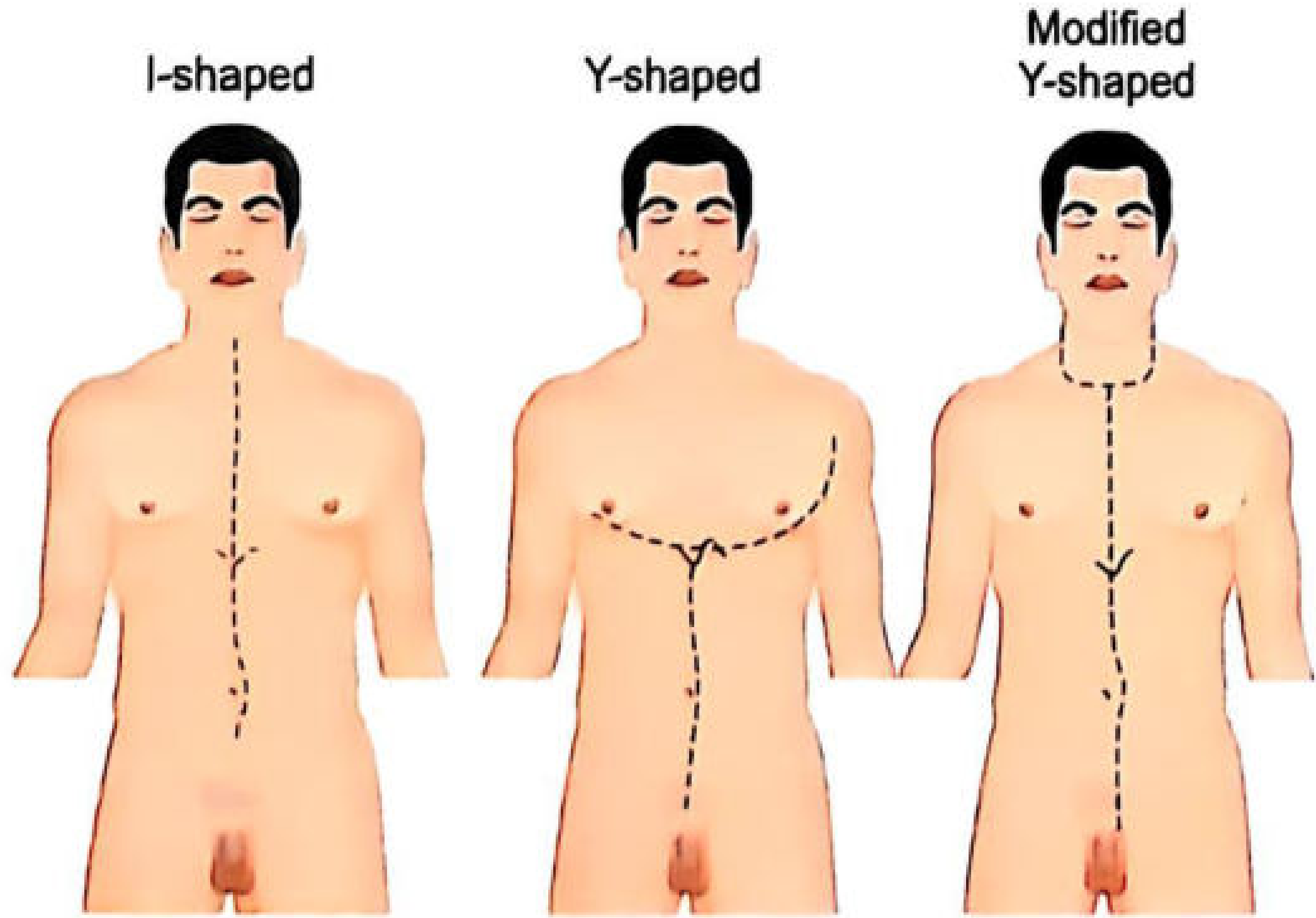
1. "I"-shaped Incision (also called "T"-shaped)
- A single straight vertical incision extending from the chin (or suprasternal notch) straight down to the symphysis pubis.
- Passes either to the left or right of the umbilicus - the umbilicus is deliberately avoided because its dense fibrous tissue is difficult to stitch after the autopsy.
- Simplest of the three; used in routine cases.
2. "Y"-shaped Incision
- Starts at a point close to the acromial process (shoulder tip) on both sides.
- Each limb extends obliquely downward across the chest, below the mammary line, meeting at the xiphoid process.
- From the xiphoid, the incision continues downward in the midline to the symphysis pubis, again passing to one side of the umbilicus.
- This creates the classic "Y" shape - two arms running across the chest and a single stem running down the abdomen.
- Most widely used incision in forensic autopsies, as it gives excellent exposure of the chest and abdomen.
3. Modified "Y"-shaped Incision
- A midline incision is made from the suprasternal notch down to the symphysis pubis.
- From the suprasternal notch, the incision extends over the clavicle to its midpoint on both sides, then passes upward over the neck, behind the ear to the mastoid process.
- This gives added access to the neck structures (larynx, trachea, cervical vessels) without making a separate neck incision.
- Preferred when detailed neck examination is required.
Practical Notes on the Incision
- Position of pathologist: The pathologist stands on the right side of the body (if right-handed).
- Abdominal entry: The recti muscles are divided about 5 cm above the symphysis pubis. A small cut is made in the fascia, the left index and middle fingers are inserted palmar-surface up and separated in a "V" to protect underlying viscera, and a sharp knife is then run between the fingers up to the xiphoid, cutting through the peritoneum.
- Thorax: After the skin is reflected, the ribs/costal cartilages are cut (with a rib-cutter or saw) to remove the sternum and expose the pleural and pericardial cavities.
- Neck: A block (12-20 cm high) is placed under the shoulders so the head falls back and the neck is extended. Dissection is carried immediately deep to the skin through the platysma, up to the lower border of the mandible and laterally to the clavicle.
- Adapting the incision: The incision must be modified if surface wounds (e.g., stab wounds to the chest or abdomen) would be transgressed by the standard approach - the usual line is altered to avoid cutting through such injuries and disturbing forensic evidence.
Choice of Incision
| Incision | Best Used When |
|---|---|
| I-shaped | Routine, straightforward autopsies |
| Y-shaped | Standard forensic autopsy; excellent chest + abdominal access |
| Modified Y-shaped | When neck examination is also required (e.g., strangulation, throat injuries) |
In India, because legislation mandates complete autopsy, all body cavities (head, neck, thorax, abdomen, pelvis) are routinely examined, making the modified Y-shaped or Y-shaped incision most appropriate.
- The Essentials of Forensic Medicine and Toxicology, 36th Edition, p. 544-570
- P.C. Dikshit Textbook of Forensic Medicine and Toxicology, p. 10706-10726
What is post-mortem artifact and give example of such artifact you may encounter during autopsy.
A post-mortem artifact is any change found in a body at autopsy that occurred after death and does not reflect the true cause or manner of death. These must be distinguished from ante-mortem injuries or pathological processes. Let me pull the full textbook detail.
Searching sources...
Finding Sources
Finding Sources
Finding Sources
Reading File
Reading File
Finding Sources
Reading File
Reading File
Reading File
Reading File
I now have comprehensive content. Here is the complete answer:
Post-Mortem Artifacts
Definition
For medicolegal purposes, an artifact is defined as a change in the natural state of the body that is likely to be misinterpreted at autopsy. These are changes that did not exist in life and were not caused by the fatal event - they arise after death and can falsely suggest injury, disease, or a different cause of death.
Artifacts are classified into three types based on when they were introduced:
| Type | When Introduced |
|---|---|
| Therapeutic artifacts | Before death - due to medical treatment |
| Agonal artifacts | At/around the time of death |
| Post-mortem artifacts | After death |
Post-Mortem Artifacts - Causes
Post-mortem artifacts arise from five main sources:
- Improper handling of the dead body
- Improper autopsy procedures
- Embalming
- Anthropophagy (animal/insect activity)
- Post-mortem changes (rigor mortis, lividity, autolysis, putrefaction, heat)
1. Artifacts from Improper Handling of the Body
During removal of the body from the crime scene to the mortuary:
- Fresh abrasions may be produced, mimicking antemortem injuries.
- Blood stains may form on parts of the garments originally free from them.
- Fresh tears in clothing may result from rough handling.
- Rib and bone fractures - rough handling by mortuary assistants, especially in elderly individuals with osteoporosis, can cause rib or limb fractures. These are commonly produced when attempting to straighten extremities bent by rigor mortis. Key distinguishing feature: no ecchymosis or bleeding at the fracture site on dissection.
- During exhumation, fractures may be produced during the digging process.
2. Artifacts from Improper Autopsy Procedures
These may result in artefactual fractures, haemorrhages, and emboli:
- Skull cap removal: Sawing the skull cap incorrectly can extend pre-existing fractures or create new linear fractures into the middle cranial fossa. Dropping the body on a hard surface can also produce skull fractures.
- Subdural haemorrhage artifact: If the skull is opened before the cardiovascular system is decompressed, blood from a passively congested head can escape into the subdural space during dura manipulation - easily confused with antemortem subdural haemorrhage.
- Hyoid fracture artifact: Improper removal of neck organs (forceful traction) may fracture the hyoid bone or thyroid cartilages, particularly in the elderly. This is forensically significant because a fractured hyoid is a classic sign of throttling/strangulation. Note: unilateral non-union of the hyoid segments may also be mistaken for a fracture.
- Pleural/pericardial haemorrhage: Damage to the heart or internal mammary vessels during sternum removal may cause blood to seep into the pleural or pericardial cavities, falsely attributed to antemortem injury.
- Air embolism artifact: Fragmentation of blood in meningeal arteries from pulling the dura, or air in coronary vessels from lung/heart handling after cutting the internal mammary vessels, may simulate systemic or arterial air embolism.
3. Embalming Artifacts
- Trocar wounds (made during embalming via axillary/supraclavicular incisions) may be mistaken for stab wounds or bullet wounds.
- Embalming fluid pumped under pressure may force blood out of disrupted vessels, accumulating in tissues and resembling antemortem haemorrhage.
- Skin bruises may appear accentuated due to increased transparency of overlying skin caused by the embalming process.
4. Anthropophagy (Animal/Insect Activity)
- Ants and insects attack exposed parts and moist areas - face, arms, genitals, groins, axilla.
- Rats, cats, dogs attack exposed parts and destroy soft tissues of the face, head, and hands, with little damage to clothed areas.
- Marine animals attack projecting parts - lips, nose, ears, fingers, scrotum.
- Dogs, jackals, hyenas produce ghastly wounds resembling mutilation with bone involvement; bones may be gnawed through.
- All such injuries are without vital reaction and their edges appear nibbled/ragged.
- Antemortem wounds are frequently enlarged by postmortem animal activity.
5. Post-Mortem Changes as Artifacts
Rigor Mortis
- Variable onset and duration (dependent on age, body condition, ambient temperature) can cause errors in estimating time of death.
- Existing rigor may be partially broken during body transport, further complicating interpretation.
Post-Mortem Lividity (Hypostasis)
- Isolated patches of lividity may be mistaken for bruises due to throttling when they appear on the front and sides of the neck.
- Internal organ lividity simulates:
- Coronary occlusion (heart staining)
- Pneumonia (lung staining)
- Gastrointestinal irritation/poisoning (GI tract staining)
- Certain causes of death (e.g., carbon monoxide poisoning) impart a distinctive cherry-red colour to lividity that must not be misread.
Autolysis
- After death, intracellular enzymes are released, causing aseptic chemical self-digestion of tissues (autolysis) over 2-3 days.
- Simulates injury or disease in:
- Pancreas - reddish-brown discolouration suggests acute inflammation
- Stomach - autolytic perforation must be distinguished from corrosive acid ingestion or peptic ulcer perforation
- Gallbladder, liver, kidney, GI mucosa, brain - tissue discolouration and loss of architecture
- Key distinguishing feature: absence of any cellular inflammatory response in discoloured areas confirms postmortem origin.
Putrefaction Artifacts
- Darkening of blood makes the brain, heart, and lungs appear congested - may suggest asphyxia.
- Swelling of the neck + depressed marks from beaded threads/ornaments may simulate ligature marks.
- Bulging of eyes, protrusion of tongue, red-stained froth from the mouth and nose may be mistaken for signs of manual strangulation.
- Softening of the hyoid synchondrosis producing abnormal mobility may simulate a fracture.
- Displaced postmortem stains from putrefactive gas pressure may simulate antemortem bruises.
- Internal lividity may resemble haemorrhage in the meninges, kidneys, and retroperitoneal tissues.
- Putrefactive blisters may be confused with burns or contact with petroleum products; skin may peel like a glove (resembling burn injuries).
- Skin splits from putrefaction may give a false impression of antemortem lacerations, incised wounds, or thermal injuries.
- The female genitals appear pendulous due to putrefaction - may be mistaken for signs of sexual assault.
- In exhumed bodies, fungus growth on skin - when removed - leaves an area that appears bruised.
Heat Effects
- Skin exposed to heat becomes tense, leathery, hard, and shows splits that may be mistaken for antemortem wounds.
- Heat causes muscle shrinkage ("pugilistic" or "boxer's" posture) - this is a post-mortem finding, not a fighting stance.
- Extradural haemorrhage from heat (blood boiling/steam accumulation between skull and dura) may be mistaken for antemortem injury.
Key Forensic Principle
"Certain events cannot happen after death: pavementation and exudation of white blood cells, proliferation of fixed tissue cells, formation of significant amounts of carboxyhaemoglobin, formation of laminated thrombi, migration of emboli, and significant propulsion of food along the gastrointestinal tract."
The absence of vital reaction (no inflammatory exudate, no WBC infiltration, no tissue repair response) at a site of injury is the most reliable indicator that a lesion is a post-mortem artifact rather than an antemortem wound.
- Parikh's Textbook of Medical Jurisprudence, Forensic Medicine and Toxicology, pp. 12365-12810
This is a shared conversation. Sign in to Orris to start your own chat.