
Assessment of difficult airway
Reading File
Searching sources...
Finding Sources
Finding Sources
Good sources found. Let me read the most relevant sections in parallel.
Reading File
Reading File
Reading File
Good content so far. Let me pull deeper sections on airway assessment predictors, Mallampati, LEMON, and the ASA definition from Cummings and Morgan & Mikhail.
Reading File
Finding Sources
Finding Sources
Reading File
Reading File
Reading File
Reading File
Reading File
Reading File
Excellent - I now have comprehensive material. Let me fetch the key Mallampati classification image and compile the full answer.
Loading Image
Loading Image
I now have comprehensive material from multiple authoritative textbooks. Here is the complete clinical reference on assessment of the difficult airway.
Assessment of the Difficult Airway
Definition
The American Society of Anesthesiologists (ASA) defines a difficult airway as a clinical situation in which a conventionally trained clinician experiences difficulty with mask ventilation, difficulty with tracheal intubation, or both. The definition is context- and provider-dependent - widespread adoption of video laryngoscopy (VL) has further complicated it, as VL rarely fails to provide adequate laryngeal visualization even when direct laryngoscopy (DL) fails. - Miller's Anesthesia, 10e; Fishman's Pulmonary Diseases and Disorders
The approach to the patient with a difficult airway varies depending on whether management is elective or urgent and whether the setting is the operating room or an outside location. - Cummings Otolaryngology, 7e
History and Pre-operative Assessment
A thorough history should be obtained before any airway intervention:
- Previous difficult intubation - this is the strongest predictor. Past anesthetic records must be reviewed.
- Symptoms of obstruction - stridor at rest or on exertion, while lying flat, or bending forward; nocturnal dyspnoea; decreased exercise tolerance.
- Conditions associated with anticipated difficulty:
- Rheumatoid arthritis (cervical spine instability, temporomandibular joint disease)
- Obstructive sleep apnoea
- Acromegaly (macroglossia, prognathism)
- Mucopolysaccharidoses
- Craniofacial syndromes - particularly Treacher Collins and Pierre Robin
- Obesity, morbid obesity
- Head and neck radiation (tissue fibrosis, reduced neck mobility)
- Scott-Brown's Otorhinolaryngology; Miller's Anesthesia
Physical Examination: Key Parameters
1. General External Inspection (the "L" in LEMON)
The examiner first forms a gestalt impression based on:
- Facial trauma, burns, bruising, or obvious deformity
- Large or protruding incisors
- A beard (interferes with mask seal)
- Macroglossia
- Cervical collars or traction devices
- Large goiter, neck masses, or obvious head-neck neoplasm
- Neck circumference >43 cm (17 inches) is more predictive of difficult intubation than BMI alone - Miller's Anesthesia
2. The 3-3-2 Rule (the "E" in LEMON)
This assesses airway geometry for direct laryngoscopy by checking three finger measurements:
| Measurement | Minimum Required | Significance |
|---|---|---|
| Mouth opening (inter-incisor distance) | 3 fingers (3 cm / 2 fingerbreadths) | Allows blade insertion |
| Mandibular space (mentum to hyoid) | 3 fingers | Tongue must be displaced into submandibular space |
| Thyromental distance (laryngeal prominence to chin) | 2 fingers | Places larynx accessibly low in neck |
A patient with a receding mandible and high-riding larynx is exceptionally difficult to intubate with DL because the tongue cannot be adequately displaced and the angle to the glottis is too acute. - Rosen's Emergency Medicine; Scott-Brown's
3. Modified Mallampati Classification (the "M" in LEMON)
First described by Mallampati in 1985, revised to 4 classes by Samson and Young in 1987. The patient sits upright, head neutral, mouth fully open, tongue protruded maximally, with no phonation.
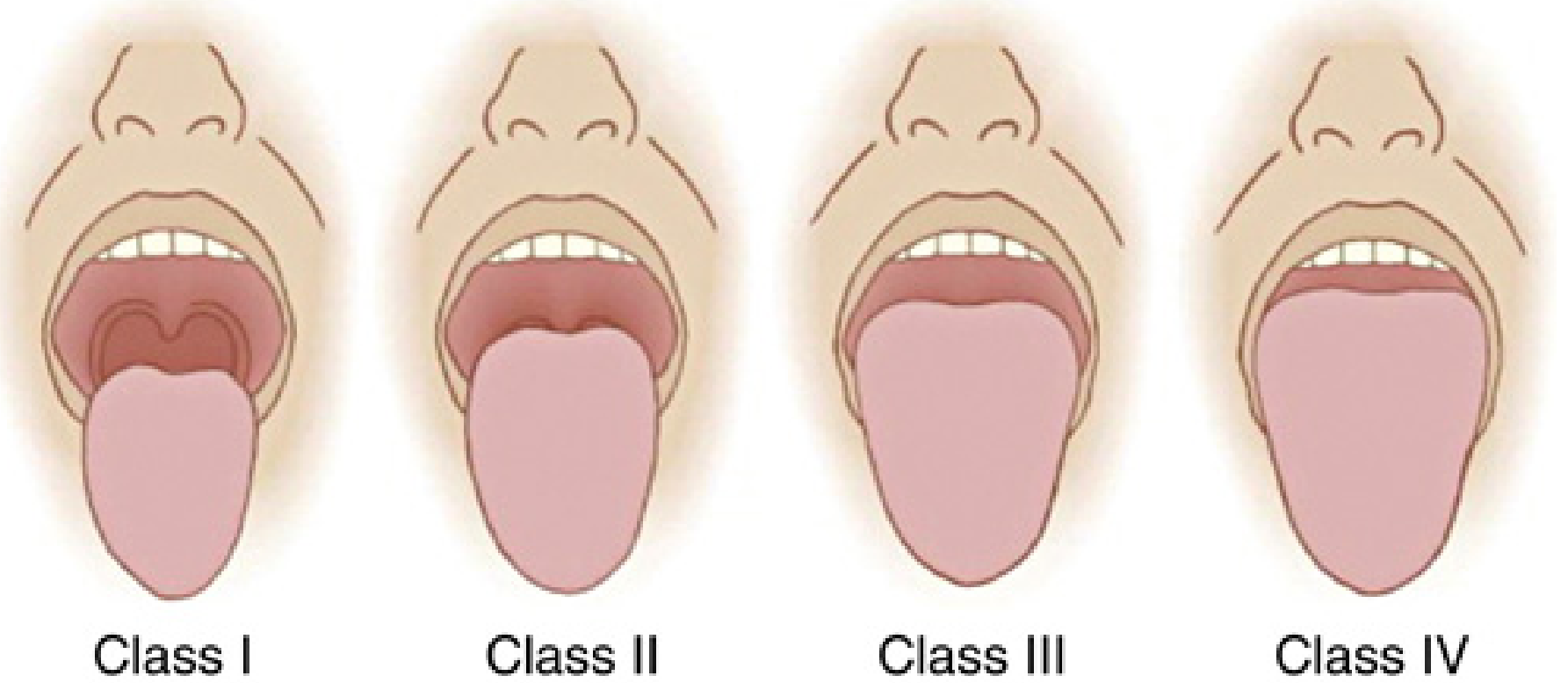
| Class | Structures Visible |
|---|---|
| I | Soft palate, fauces, uvula, tonsillar pillars - easy intubation |
| II | Soft palate, fauces, base of uvula - easy intubation |
| III | Soft palate and base of uvula only - moderate difficulty |
| IV | Soft palate not visible (tongue pressed against hard palate) - high difficulty |
Important limitation: The Mallampati score alone is insufficient for accurate prediction of difficult intubation. A meta-analysis confirmed it performs better as a predictor of difficult laryngoscopy than difficult intubation. Its predictive value improves substantially when combined with thyromental distance, sternomental distance, and other factors. - Miller's Anesthesia; Rosen's Emergency Medicine
4. Obstruction and Obesity (the "O" in LEMON)
- Any supraglottic or glottic mass, abscess, haematoma, or foreign body
- Peritonsillar or retropharyngeal abscess
- Ludwig's angina
- Angioedema
- Epiglottitis
- Obesity - leads to redundant upper airway tissue and rapid desaturation during apnoea
- Obstructive sleep apnoea
5. Neck Mobility (the "N" in LEMON)
- Ask the patient to flex and extend the neck fully
- Limited neck mobility (ankylosing spondylitis, rheumatoid arthritis, cervical collar, post-radiation fibrosis) impairs the alignment of the oral-pharyngeal-laryngeal axes needed for DL
- The chin-to-chest distance and atlanto-occipital extension are practical bedside tests
6. Thyromental and Sternomental Distance
- Thyromental distance <6 cm (or <3 fingerbreadths): indicates high larynx, predicts difficult laryngoscopy
- Sternomental distance: measured from the sternal notch to the mentum with full neck extension; <12.5 cm is associated with difficulty
- Predictive value is enhanced when combined with Mallampati score - Miller's Anesthesia; Cummings Otolaryngology
7. Other Examination Parameters
From the ASA physical examination checklist:
- Dentition: large, protruding, or loose incisors; prominent overbite; edentulous state
- Jaw mobility: interincisor distance, mandibular prognathism test (can the patient slide the lower teeth in front of the upper teeth?)
- Submandibular space compliance: a fibrotic or indurated submandibular space cannot accommodate a displaced tongue
- Palate: high arched or narrow hard palate
- Neck: short or thick neck reduces exposure
- Miller's Anesthesia, 10e
Mallampati vs. Cormack-Lehane: The Correlation
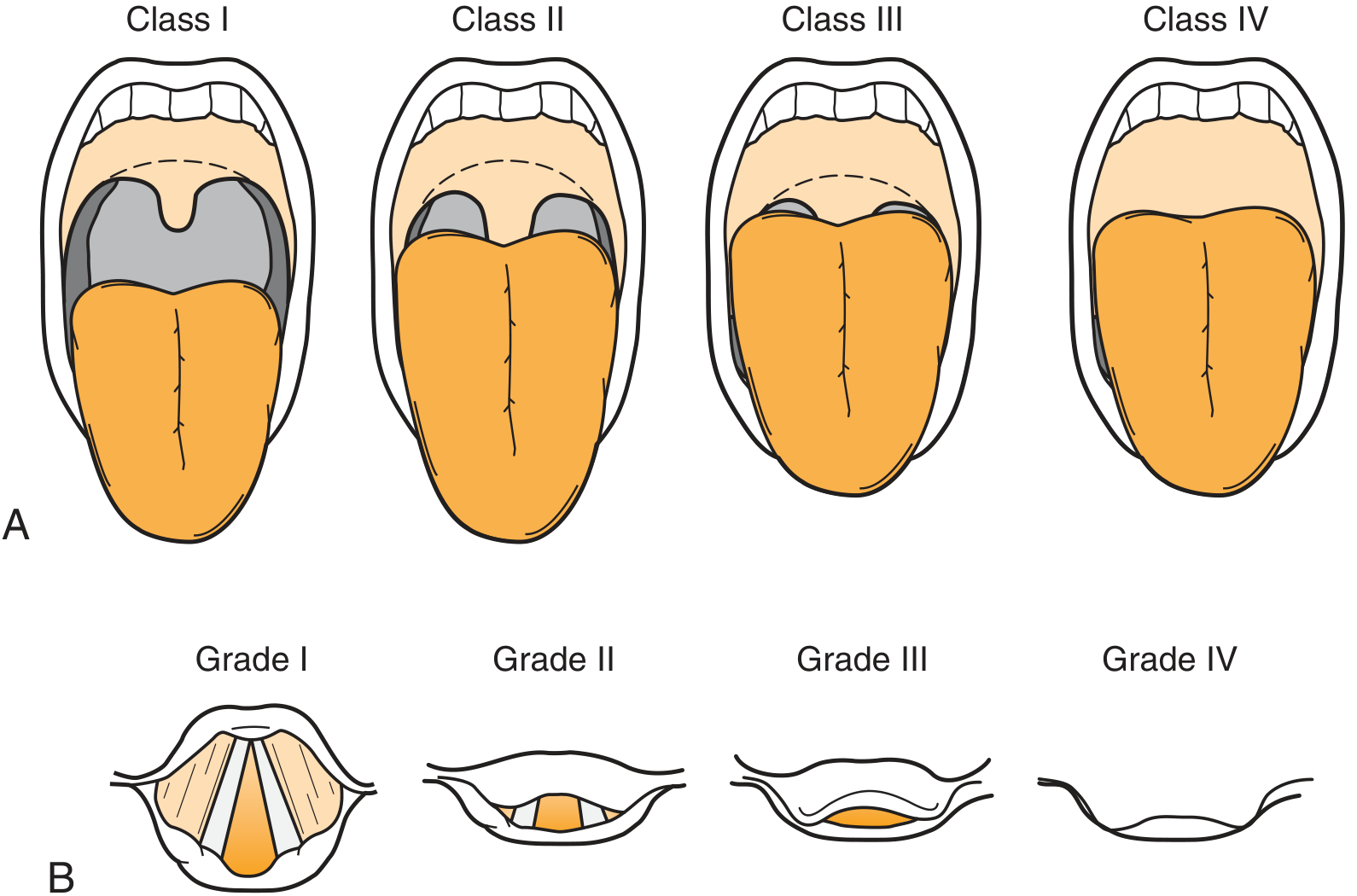
The Cormack-Lehane (C-L) grading describes the laryngoscopic view obtained during direct laryngoscopy:
| Grade | View |
|---|---|
| I | Full glottic opening visible |
| II | Posterior part of glottis visible |
| III | Only epiglottis visible |
| IV | Epiglottis not visible |
Grades III and IV are associated with failed direct laryngoscopy. Mallampati class III and IV correlate broadly with C-L grades III and IV, but no single predictor offers 100% sensitivity. - Cummings Otolaryngology
Assessment for Difficult Bag-Mask Ventilation: ROMAN
Difficult mask ventilation (DMV) is equally important to anticipate, as it determines the safety net if intubation fails:
| Letter | Factor |
|---|---|
| R | Resistance to ventilation (asthma, COPD, ARDS) / prior head-neck radiation |
| O | Obstruction / Obesity / Obstructive sleep apnoea |
| M | Mallampati III-IV / Mask seal difficulty (beard, facial trauma) / Male sex |
| A | Age >55 years |
| N | No teeth (edentulous) |
Risk of impossible BMV increases proportionally with the number of ROMAN factors present. In elective surgical patients, impossible BMV is rare (<0.5%). - Rosen's Emergency Medicine
Assessment for Difficult Extraglottic Device Placement: RODS
If both intubation and mask ventilation fail (cannot intubate, cannot oxygenate - CI:CO), extraglottic devices (EGDs) such as the LMA become the rescue tool. Factors predicting difficult EGD placement:
| Letter | Factor |
|---|---|
| R | Restricted mouth opening / Resistance to ventilation |
| O | Obstruction / Obesity / Obstructive sleep apnoea |
| D | Distorted upper airway anatomy |
| S | Short thyromental distance |
- Rosen's Emergency Medicine
Synthesis: The LEMON Approach (Summary)
The LEMON mnemonic is the recommended bedside tool for a structured pre-intubation assessment, validated to have reasonable sensitivity and high negative predictive value:
| Letter | Component |
|---|---|
| L | Look externally (gestalt, obvious deformity, trauma) |
| E | Evaluate 3-3-2 rule |
| M | Mallampati score |
| O | Obstruction / Obesity |
| N | Neck mobility |
A positive LEMON finding does not necessarily preclude rapid sequence intubation (RSI) - the key clinical question is whether there is a reasonable likelihood of intubation success and whether rescue ventilation (BMV or EGD) will be possible if intubation fails. - Rosen's Emergency Medicine; Tintinalli's Emergency Medicine
Conditions That Mandate Anticipated Difficult Airway Approach
Based on underlying disease or anatomy:
| Category | Examples |
|---|---|
| Systemic disease | Rheumatoid arthritis, ankylosing spondylitis, acromegaly, mucopolysaccharidosis, Treacher Collins, Pierre Robin |
| Obesity/OSA | BMI >35, neck circumference >43 cm, Mallampati III-IV |
| Head/neck pathology | Goiter, neck mass, Ludwig's angina, angioedema, post-radiation fibrosis |
| Trauma | Airway burns, facial fractures, haematoma, cervical spine injury |
| Congenital | Tracheal stenosis, macroglossia, micrognathia |
Documentation and Follow-Up
Any patient identified with a difficult airway should:
- Have the event clearly documented in the anaesthetic record
- Be counselled about the difficult airway
- Be enrolled in a national/international difficult airway registry (e.g. the MedicAlert Foundation National Difficult Airway/Intubation Registry), which provides 24/7 access to their critical airway information for future providers
- Carry identification (e.g. medical alert bracelet)
- Cummings Otolaryngology
Key principle: No single test predicts a difficult airway with certainty. A multiparameter approach (combining Mallampati score, thyromental distance, mouth opening, neck mobility, and clinical gestalt) provides the best pre-procedural risk stratification. When significant predictors are present, the safest strategy is an awake technique (awake fiberoptic intubation) or preparation of a complete failed airway plan including surgical airway access. - Miller's Anesthesia; Scott-Brown's Otorhinolaryngology; Cummings Otolaryngology
This is a shared conversation. Sign in to Orris to start your own chat.