
A 9-month-old boy is brought to the physician 2 months after his parents noticed that he seemed to be ignoring them. On questioning, they note that he does not appear to be startled by loud noises. Growth and development have been otherwise normal. He was born at term to a 28-year-old woman, gravida 2, para 1. His mother's blood group is A, Rh- negative, and his blood group is A, Rh-positive. He had a serum total bilirubin concentration of 25 mg/dl at the age of 2 days and received phototherapy for 2 days. He continued to be mildly jaundiced until the age of 1 month. Serum studies since then have shown no abnormalities. Examination today shows no abnormalities. Which of the following is most likely to have prevented this patient's current condition?
Full Answer
What is happening in this case?
- Mother is Rh-negative (A, Rh-), baby is Rh-positive (A, Rh+)
- This is the mother's second pregnancy (G2P1), meaning she was likely sensitized during her first pregnancy - her immune system made anti-D IgG antibodies
- Those antibodies crossed the placenta and caused hemolytic disease of the newborn (HDN) - red cell destruction
- Massive hemolysis led to a serum bilirubin of 25 mg/dL at age 2 days - a dangerously high level of unconjugated (indirect) bilirubin
- Unconjugated bilirubin is lipid-soluble and crosses the blood-brain barrier, depositing in the auditory brainstem nuclei (cochlear nuclei, inferior colliculi) - which are the most sensitive brain structures to bilirubin toxicity
- Result: Sensorineural hearing loss (SNHL) - the child is now 9 months old and not startled by loud sounds, not responding to his parents
Per Scott-Brown's Otorhinolaryngology: "Hyperbilirubinemia is an independent risk factor for SNHL in infants. High levels of unconjugated bilirubin have been associated with neuronal damage. The auditory brain nuclei and the inferior colliculi are often the first part of the brainstem to be involved, often leading to hearing abnormalities."
What would have prevented this?
- Postpartum after her first delivery (to prevent sensitization), AND
- At 28 weeks gestation during this pregnancy
Why this works:
| Step | Mechanism |
|---|---|
| Anti-D IgG given to mother | Passively coats any fetal Rh+ red cells that entered maternal circulation at delivery of first child |
| Coated cells are cleared before mother's immune system can "see" them | Prevents active immunization - mother never makes her own anti-D antibodies |
| No maternal anti-D antibodies | Nothing crosses the placenta in subsequent pregnancies to destroy fetal RBCs |
| No hemolysis | Bilirubin stays normal - no kernicterus, no hearing loss |
Per Creasy & Resnik's Maternal-Fetal Medicine: "Rh immunization has significantly decreased with the advent of prevention programs including use of Rh immune globulin."
Why the other answer choices are wrong (typical exam options)
| Option | Why incorrect |
|---|---|
| Exchange transfusion | This treats hyperbilirubinemia after it occurs - doesn't prevent Rh sensitization |
| Phototherapy | Also treats jaundice, does not prevent the underlying hemolysis from Rh incompatibility |
| More intensive/prolonged phototherapy | Treats the bilirubin but the damage was from the peak level; doesn't address the root cause |
| ABO compatibility testing | Mother and baby are both type A - no ABO mismatch here; this is not the issue |
Key Teaching Points
- The auditory pathway (specifically cochlear nucleus and inferior colliculus) is the most sensitive to bilirubin toxicity - hearing loss can occur even with bilirubin levels that don't cause classic choreoathetoid kernicterus
- Bilirubin of >20 mg/dL in a term newborn carries significant risk; 25 mg/dL as in this case is in the high-risk zone
- RhoGAM (anti-D immunoglobulin) must be given: (1) after any sensitizing event in an Rh-negative woman, and (2) routinely at 28 weeks of every pregnancy
- Universal newborn hearing screening (otoacoustic emissions + auditory brainstem response) exists partly to catch exactly these infants - per the Textbook of Family Medicine, elevated bilirubin is a listed risk factor prompting auditory brainstem response (ABR) testing
why exchange transfusion was not done in first place knowing that he has >25mg/dl of total bilirubin concentration
Why Exchange Transfusion Was Not Done - The Full Picture
1. "25 mg/dL" is NOT automatically an exchange transfusion threshold
| Variable | This Baby |
|---|---|
| Age in hours | 2 days old = ~48 hours |
| Gestational age / risk category | Born at term (≥38 weeks) |
| Risk factors present? | YES - isoimmune hemolytic disease (Rh incompatibility is explicitly listed as a risk factor) |
2. The question tells us phototherapy was given - not exchange transfusion
- Phototherapy was started (described as given for 2 days)
- Bilirubin apparently responded (no mention of rising levels)
- No overt signs of BIND (no seizures, no opisthotonus described at the time)
3. What exchange transfusion actually does - and why it was warranted here
- Removes bilirubin - reduces TSB by ~50%
- Removes Rh-positive red cells - replaces them with Rh-negative donor cells, stopping the ongoing hemolysis at its source
4. The exam's implied message
Rh incompatibility → hemolysis → bilirubin 25 mg/dL at 48h
         ↓
  This is a HIGH-RISK infant (isoimmune hemolytic disease)
         ↓
  Exchange transfusion threshold was met or nearly met
         ↓
  Only phototherapy was given (insufficient)
         ↓
  Bilirubin deposited in auditory brainstem nuclei
         ↓
  Sensorineural hearing loss
- The baby had an active hemolytic process (Rh incompatibility)
- The bilirubin was at/near the exchange threshold for a high-risk term infant
- Phototherapy alone does not stop ongoing hemolysis
AAP Phototherapy Guidelines (from Rosen's)
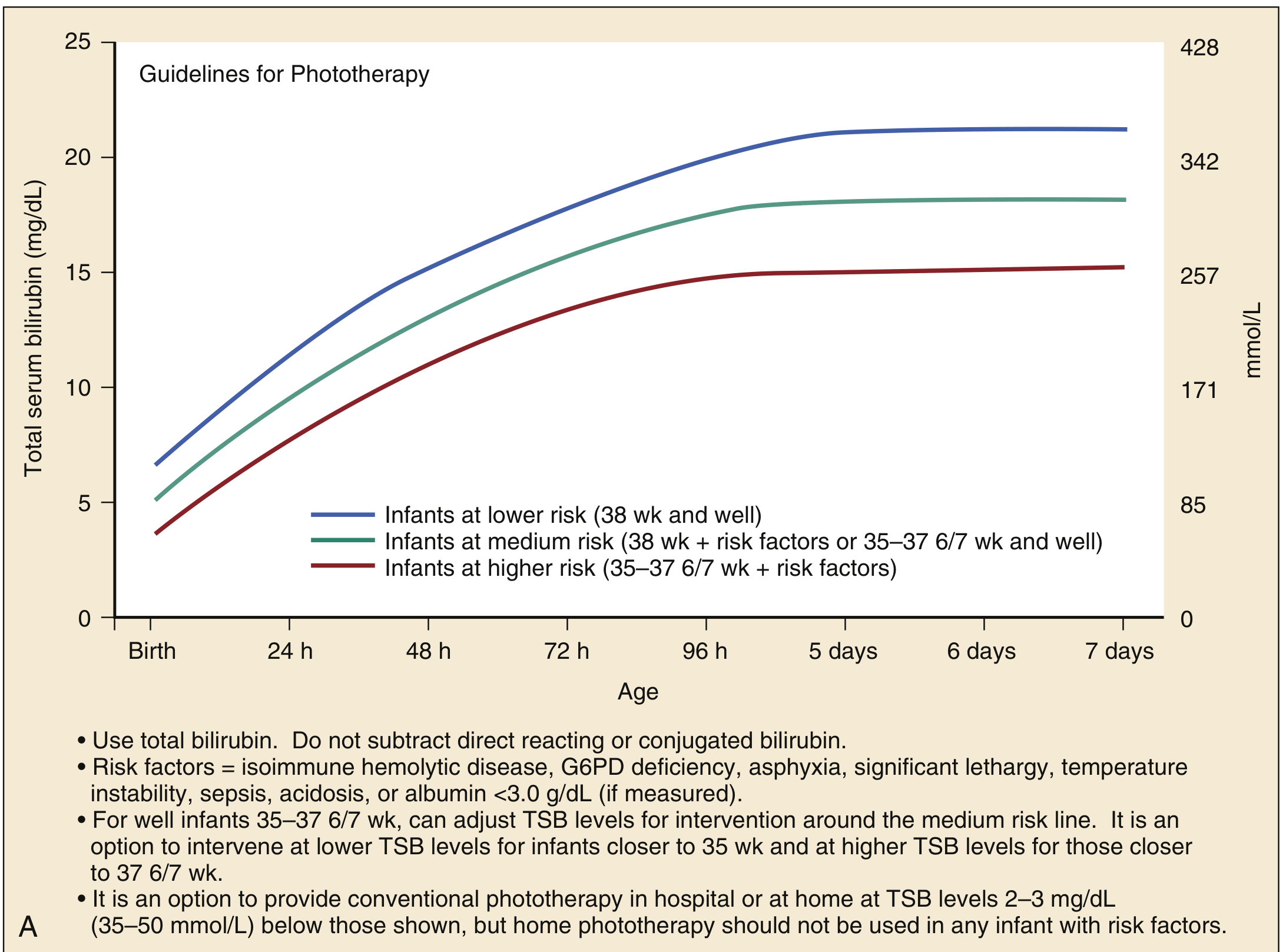
Bottom Line
| Question | Answer |
|---|---|
| Is 25 mg/dL always an exchange transfusion threshold? | No - it depends on age in hours and risk factors |
| Was this baby at high enough risk to warrant exchange transfusion? | Yes - Rh hemolytic disease is a listed risk factor; threshold was ~25 mg/dL at 48h |
| Why did the physicians only give phototherapy? | Likely because the bilirubin was borderline and appeared to respond; possibly also because the question is depicting suboptimal management to make the teaching point |
| What makes exchange transfusion superior in Rh HDN specifically? | It removes both bilirubin AND Rh+ red cells, stopping ongoing hemolysis - something phototherapy cannot do |
if a baby is born at term to Rh negative mother, comes on 2nd day with total bilirubin concentration of 25 mg/dl. what should be done ?
why not phototherapy