
I have my university exam of 1 st year of subject biochemistry These are the important long answer give me answer of this question "Glycogen metabolism" and remeber it's a university examination and make it easy to memorize
Reading File
Now let me search the medical library for comprehensive glycogen metabolism content.
Finding Sources
Finding Sources
Excellent! Let me read the key sections from Lippincott and Harper's - the top biochemistry textbooks for exams.
Reading File
Reading File
Reading File
Reading File
Reading File
I now have comprehensive content. Let me also quickly check the glycogen storage diseases section for completeness.
Reading File
I now have all the content I need. Let me fetch the key diagram image for the answer.
Loading Image
I now have everything I need to write a complete, exam-ready answer. Here is your full university-level answer on Glycogen Metabolism:
Glycogen Metabolism
Source: Lippincott's Illustrated Reviews: Biochemistry, 8th ed.
1. Introduction (Overview)
Glycogen is the storage form of glucose in the body. It acts as a glucose "battery" - quickly recharged after meals and rapidly discharged during fasting or exercise.
Key memory trick: Think of glycogen as a "glucose bank account" - you deposit (glycogenesis) after meals and withdraw (glycogenolysis) when needed.
| Feature | Liver Glycogen | Muscle Glycogen |
|---|---|---|
| Amount | ~100 g (up to 10% of liver weight) | ~400 g (1-2% of muscle weight) |
| Purpose | Maintain blood glucose | Fuel for muscle contraction |
| Key enzyme difference | Has glucose 6-phosphatase | No glucose 6-phosphatase |
| Regulated by | Glucagon + Insulin | Epinephrine + Insulin |
2. Structure of Glycogen
- Glycogen is a highly branched polysaccharide made of α-D-glucose units
- Linear chains: α(1→4) glycosidic bonds
- Branch points: α(1→6) glycosidic bonds, occurring every 8 glucose units
- Branching increases solubility and provides many nonreducing ends for rapid synthesis and breakdown
Memory trick for bonds: "4 in a row, 6 at the branch" - α(1→4) for the straight chain, α(1→6) at branches.
3. Glycogenesis (Synthesis of Glycogen)
Location: Cytosol
Energy required: ATP + UTP
Steps (in order):
Step 1 - Glucose activation:
Glucose → (hexokinase/glucokinase) → Glucose 6-phosphate → (phosphoglucomutase) → Glucose 1-phosphate
Step 2 - UDP-glucose formation:
Glucose 1-phosphate + UTP → UDP-glucose + PPi (enzyme: UDP-glucose pyrophosphorylase) PPi is immediately hydrolyzed to 2 Pi (makes reaction irreversible)
Step 3 - Primer requirement:
Glycogen synthase cannot start a chain from scratch. It needs a primer - a short chain of glucose molecules attached to the protein glycogenin (which auto-glucosylates itself).
Step 4 - Chain elongation:
Glycogen synthase transfers glucose from UDP-glucose to the nonreducing end of the primer, forming α(1→4) bonds.
Step 5 - Branch formation:
Branching enzyme (amylo-α(1→4)→α(1→6)-transglycosylase) removes a 6-8 residue segment from the nonreducing end and reattaches it via an α(1→6) bond, creating a new branch.
Memory trick for synthesis: "GAP-B" = Glucose → Activate (UDP-glucose) → Primer (glycogenin) → Branch (branching enzyme)
4. Glycogenolysis (Degradation of Glycogen)
Location: Cytosol
Important: Glycogenolysis is NOT the reverse of glycogenesis - it uses different enzymes!
Steps (in order):
Step 1 - Chain shortening:
Glycogen phosphorylase cleaves α(1→4) bonds at nonreducing ends by phosphorolysis (uses Pi, not water): Glycogen (n residues) + Pi → Glucose 1-phosphate + Glycogen (n-1 residues) It stops when 4 glucosyl units remain before a branch point → this intermediate is called a "limit dextrin"
Step 2 - Debranching (two-step, one enzyme):
The debranching enzyme does two things:
- Transferase activity: Moves 3 of the 4 remaining residues to another chain end (α(1→4) bond)
- Glucosidase activity: Cleaves the last α(1→6) branch point residue → releases free glucose (not phosphorylated!)
Step 3 - Conversion:
Glucose 1-phosphate → (phosphoglucomutase) → Glucose 6-phosphate
Step 4 - Tissue-specific fate:
- Muscle: Glucose 6-phosphate enters glycolysis directly (no glucose 6-phosphatase)
- Liver: Glucose 6-phosphate → (glucose 6-phosphatase) → Free glucose → released into blood
Memory trick: "Phosphorylase takes, debranching enzyme breaks the bridge and frees one glucose"
5. Regulation of Glycogen Metabolism
Both glycogenesis and glycogenolysis are regulated by:
- Hormonal (covalent) regulation - for whole-body needs
- Allosteric regulation - for immediate, tissue-specific needs
These two pathways are reciprocally regulated - when one is ON, the other is OFF.
A. Hormonal (Covalent) Regulation
KEY CONCEPT: Phosphorylation activates glycogenolysis and inhibits glycogenesis.
| Hormone | Signal | Effect on Glycogen |
|---|---|---|
| Insulin (fed state) | High blood glucose | Glycogenesis ↑, Glycogenolysis ↓ |
| Glucagon (liver) | Low blood glucose | Glycogenolysis ↑, Glycogenesis ↓ |
| Epinephrine (muscle + liver) | Stress/exercise | Glycogenolysis ↑, Glycogenesis ↓ |
The cascade for glycogenolysis (glucagon/epinephrine):
Glucagon/Epinephrine → GPCR → Adenylyl cyclase → cAMP ↑ → PKA (active) → Phosphorylase kinase b (inactive) → Phosphorylase kinase a (active) → Glycogen phosphorylase b (inactive) → Glycogen phosphorylase a (active) → Glycogenolysis
Simultaneously, PKA phosphorylates glycogen synthase → inactivates it → glycogenesis stops.
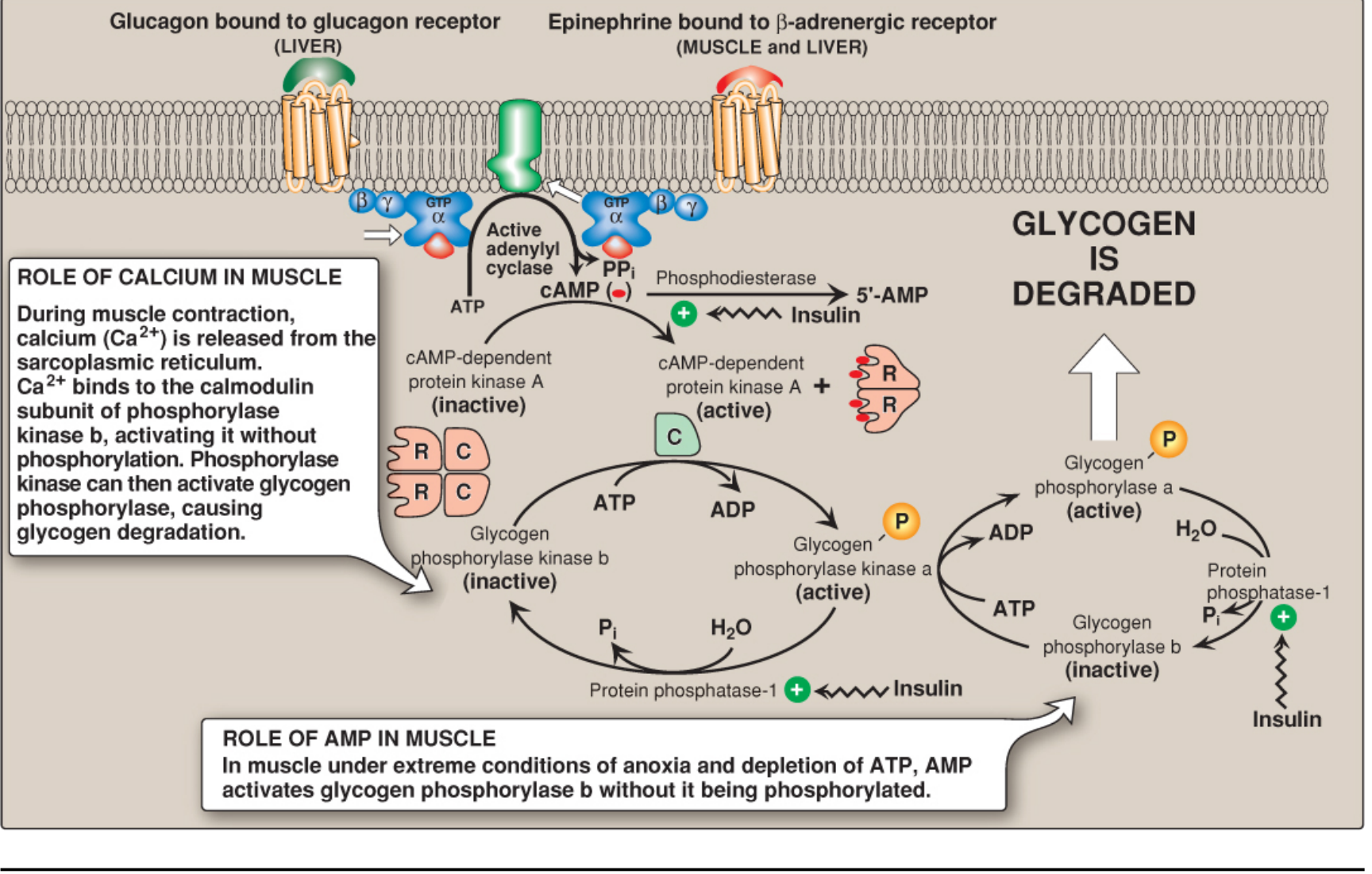
Insulin activates Protein Phosphatase-1 (PP-1), which removes phosphate groups:
- Glycogen synthase is dephosphorylated → activated (glycogenesis ↑)
- Glycogen phosphorylase is dephosphorylated → inactivated (glycogenolysis ↓)
Memory trick: "Phosphorylation = Phosphorylase ON, Synthase OFF"
B. Allosteric Regulation
| Effector | Effect |
|---|---|
| Glucose 6-phosphate (high) | Activates glycogen synthase b (well-fed state) |
| Glucose 6-phosphate (high) | Inhibits glycogen phosphorylase a (stop breakdown) |
| ATP (high energy) | Inhibits glycogen phosphorylase (no need to break down) |
| AMP (low energy, muscle only) | Activates glycogen phosphorylase b WITHOUT phosphorylation |
| Free glucose (liver only) | Inhibits glycogen phosphorylase a |
| Ca²⁺ (muscle + liver) | Activates phosphorylase kinase b via calmodulin → glycogenolysis |
Important - Ca²⁺ mechanism:
During muscle contraction, Ca²⁺ is released from the sarcoplasmic reticulum → binds to calmodulin (CaM) (the δ-subunit of phosphorylase kinase) → activates phosphorylase kinase b without phosphorylation → triggers rapid glycogenolysis even before hormones act.
6. Glycogen Storage Diseases (GSDs) - High Yield for Exams
| Disease | Deficient Enzyme | Affected Organ | Key Feature |
|---|---|---|---|
| Von Gierke disease (Type I) | Glucose 6-phosphatase | Liver, Kidney | Severe hypoglycemia, hepatomegaly; BOTH glycogenolysis and gluconeogenesis fail |
| Pompe disease (Type II) | Lysosomal acid α-1,4-glucosidase | All tissues (heart, muscle) | Cardiomegaly; lysosomal GSD |
| Cori disease (Type III) | Debranching enzyme | Liver, muscle | Milder than Von Gierke; accumulation of limit dextrin |
| Anderson disease (Type IV) | Branching enzyme | Liver | Cirrhosis; long outer chains (like amylose) |
| McArdle disease (Type V) | Muscle phosphorylase | Muscle only | Exercise intolerance, painful cramps; NO rise in blood lactate with exercise |
| Hers disease (Type VI) | Liver phosphorylase | Liver | Mild hypoglycemia, hepatomegaly |
Memory trick for top 3 GSDs: "Von Gierke - glucose stuck in liver; Pompe - heart and muscle hurt; McArdle - muscles can't exercise"
7. Quick Summary Table (for Last-Minute Revision)
| Process | Key Enzyme | Bond Made/Broken | Product |
|---|---|---|---|
| Glycogenesis (elongation) | Glycogen synthase | α(1→4) bonds MADE | Glycogen chain |
| Glycogenesis (branching) | Branching enzyme | α(1→4) broken, α(1→6) MADE | Branched glycogen |
| Glycogenolysis (chain shortening) | Glycogen phosphorylase | α(1→4) broken | Glucose 1-phosphate |
| Glycogenolysis (debranching) | Debranching enzyme | α(1→4) transferred + α(1→6) broken | Free glucose |
| Glucose release into blood | Glucose 6-phosphatase (liver only) | - | Free glucose |
8. Memory Hooks (Final Revision)
- "Glycogenesis uses UTP, Glycolysis uses ATP" - don't mix them up
- "Synthase = Synthesis = fed state (insulin)"
- "Phosphorylase = Phosphorolysis = fasting (glucagon)"
- "Von Gierke = liver looks BIG but blood glucose goes small"
- "McArdle = Muscles Cramp And Ache - can't Release Lactate Easily"
- "α(1→4) in line, α(1→6) at branch time"
This answer covers every component typically expected in a 1st-year university biochemistry exam: structure, synthesis, degradation, regulation (both hormonal and allosteric), and clinical correlations (storage diseases). Good luck on your exam!
This is a shared conversation. Sign in to Orris to start your own chat.