
I have tense swelling at anus around 12 o clock position without bleeding . It occured as pain during defecation 3 days back and subside by time. Yesterday it was very tense but no tenderness. I had a history of fistulous tract wirh pus collection 3 years back .
Reading File
Now let me search the medical library for perianal swelling, thrombosed hemorrhoid, and perianal abscess - running parallel searches.
Finding Sources
Finding Sources
Searching PubMed
perianal abscess recurrence fistula
Finding Sources
Finding Sources
Finding Sources
Finding Sources
Reading File
Reading File
Reading File
Reading File
I now have enough clinical information to provide a comprehensive analysis. Let me also fetch the diagram of perirectal abscess classifications.
Loading Image
Here is a thorough clinical assessment based on your presentation and what authoritative surgical textbooks describe.
Clinical Assessment
Your Key Features
| Feature | Significance |
|---|---|
| Tense perianal swelling at 12 o'clock | Typical location for thrombosed external hemorrhoid OR recurrent perianal abscess |
| Pain during defecation 3 days ago, then subsided | Suggests initial acute phase with possible partial spontaneous decompression |
| Tense but not tender yesterday | Important differentiator - classic thrombosed hemorrhoid resolves its tenderness over days 3-5 as the clot organizes |
| No bleeding | Less likely internal hemorrhoid involvement |
| History of fistulous tract + pus collection 3 years ago | This is the most clinically important feature - raises serious concern for recurrent abscess along the old fistula tract |
Two Leading Diagnoses
1. Thrombosed External Hemorrhoid (Most common for this presentation)
An external hemorrhoid becomes thrombosed with acute onset of perianal pain and development of a purplish/bluish nodule - exactly what you describe. The timeline matches:
- Day 0-2: Acute painful phase (pain during defecation)
- Day 3-5: Clot begins to organize, pain diminishes but swelling remains tense - this is where you are now
- Day 5-10: Gradual resolution OR clot may ulcerate and drain spontaneously
The lack of tenderness at day 3+ is consistent with a thrombosed hemorrhoid entering its resolving phase. (Textbook of Family Medicine 9e, p. 573-575)
2. Recurrent Perianal Abscess via Fistula Tract (Must be ruled out given your history)
Your 3-year history of fistula-in-ano with pus collection is a major red flag. From Roberts & Hedges' Clinical Procedures in Emergency Medicine:
"A fistula-in-ano is usually formed after partial resolution of a perianal abscess, and its presence is suggested by recurrence of these abscesses with intermittent drainage."
The textbook also notes: "Recurrence is the most common complication after I&D of a perianal abscess. The most common cause of recurrence is an unrecognized, and therefore untreated, associated fistula."
If the fistula tract was never definitively treated (fistulotomy/fistulectomy), pus can re-accumulate along the same or adjacent tract. A tense, non-tender swelling can be an early/subacute abscess, especially in someone with a pre-existing tract.
Classification of Perirectal Abscesses (for context)
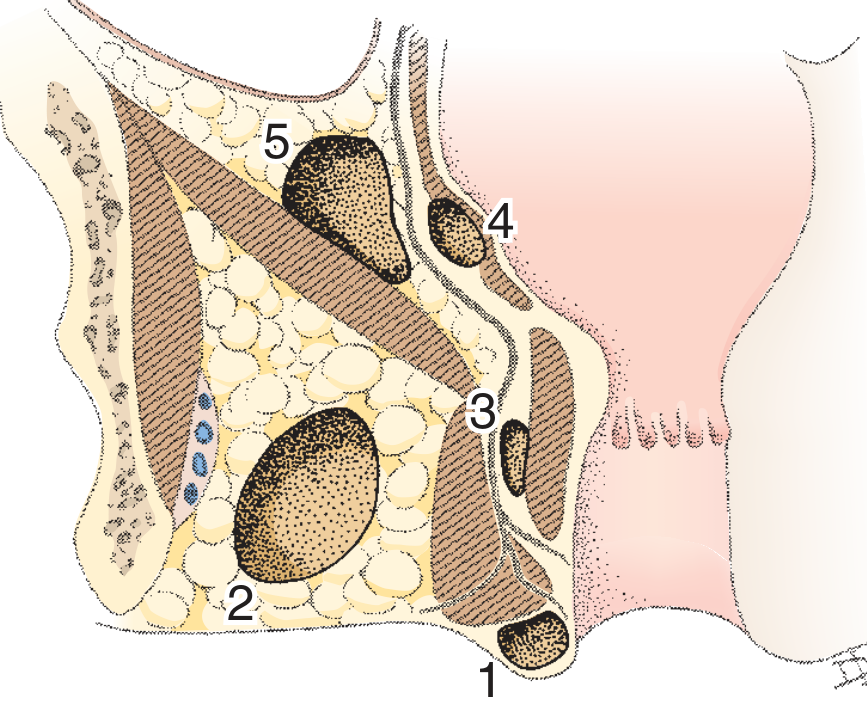
Classification of perirectal abscesses: 1 = Perianal, 2 = Ischiorectal, 3 = Intersphincteric, 4 = High intramuscular, 5 = Pelvirectal - Roberts & Hedges' Clinical Procedures in Emergency Medicine
Given your history, the most likely type would be a perianal (type 1) recurrence.
How to Differentiate
| Feature | Thrombosed Hemorrhoid | Recurrent Abscess |
|---|---|---|
| Color | Purplish-blue | Erythematous (red), skin-colored |
| Tenderness | Initially high, then decreasing | Persistent or increasing |
| Fever/chills | Absent | May be present |
| Surface | Smooth, tense | May show fluctuance later |
| Prior fistula history | Unrelated | Strongly suggestive |
| Location | External, below dentate line | Can be same site as old tract |
What You Should Do - Urgently
You need an in-person surgical/colorectal evaluation. The key reasons:
-
Your fistula history changes everything. Even if this looks like a thrombosed hemorrhoid, an undetected recurrent abscess in someone with a known fistula tract can progress to Fournier's gangrene (necrotizing soft tissue infection) - a life-threatening emergency.
-
MRI or transanal ultrasound may be needed to map any residual or new fistula tract before treatment decisions are made.
-
If this is a thrombosed hemorrhoid within 72 hours of onset, surgical excision (not simple incision) gives the best outcome - lower recurrence, faster resolution. If you are beyond 72 hours and symptoms are improving, conservative management is acceptable:
- Sitz baths 2-3 times/day
- Stool softeners
- Topical anesthetic ointment (e.g., lidocaine 5%)
- Oral analgesics (NSAIDs)
- High-fiber diet and adequate hydration
-
If there is any fluctuance, increasing tension, fever, or return of severe pain, go to an emergency department immediately - abscess drainage cannot be delayed.
Bottom Line
Given the combination of a tense non-tender perianal swelling + prior fistula-in-ano history, this presentation requires colorectal surgical assessment within 24-48 hours to distinguish between a resolving thrombosed hemorrhoid and a recurrent abscess/fistula. Do not manage this purely conservatively at home given your history. The absence of tenderness does not rule out an abscess - deeper or early abscesses can present with minimal tenderness initially.
Disclaimer: This is clinical information for educational purposes. It is not a substitute for an in-person examination. Please see a surgeon or visit an emergency department promptly.
This is a shared conversation. Sign in to Orris to start your own chat.