
Memory and learning physiology mbbs 1st year notes for exam pov
Reading File
Finding Sources
Finding Sources
Reading File
Reading File
Reading File
Finding Sources
Reading File
Loading Image
Reading File
I now have all the content I need to write comprehensive MBBS 1st year exam notes. Let me compile everything.
Memory and Learning - Physiology Notes (MBBS 1st Year Exam)
Source: Ganong's Review of Medical Physiology (26th Ed.) | Costanzo Physiology (7th Ed.)
1. DEFINITIONS
| Term | Definition |
|---|---|
| Learning | Acquisition of information that allows behavior to be altered based on experience |
| Memory | Retention and storage of that information |
| Synaptic plasticity | The fundamental mechanism underlying learning - synaptic function/effectiveness varies depending on prior activity ("traffic") through the synapse |
2. TYPES OF LEARNING
A. Non-associative Learning
- Habituation: Repeated neutral stimulus causes progressively diminishing response. The organism "learns" the stimulus is not important.
- Mechanism: decreased neurotransmitter release from presynaptic terminal due to decreased intracellular Ca2+ (gradual inactivation of Ca2+ channels)
- Example: New city-dweller gradually ignores street noise
- Sensitization: Augmented postsynaptic response after a habituated stimulus is paired with a noxious stimulus (opposite of habituation)
- Mechanism: presynaptic facilitation; Ca2+-mediated change in adenylyl cyclase → greater cAMP production
- Can be short-term or long-term
B. Associative Learning
- Classical conditioning (Pavlovian): Temporal relationship between a conditioned stimulus (CS) and unconditioned stimulus (UCS) is repeatedly paired → CS alone eventually elicits the unconditioned response. Example: Pavlov's dog - bell (CS) paired with food (UCS) → salivation to bell alone.
- Operant conditioning: Response to a stimulus is reinforced positively or negatively, changing the probability of that response.
3. FORMS OF MEMORY
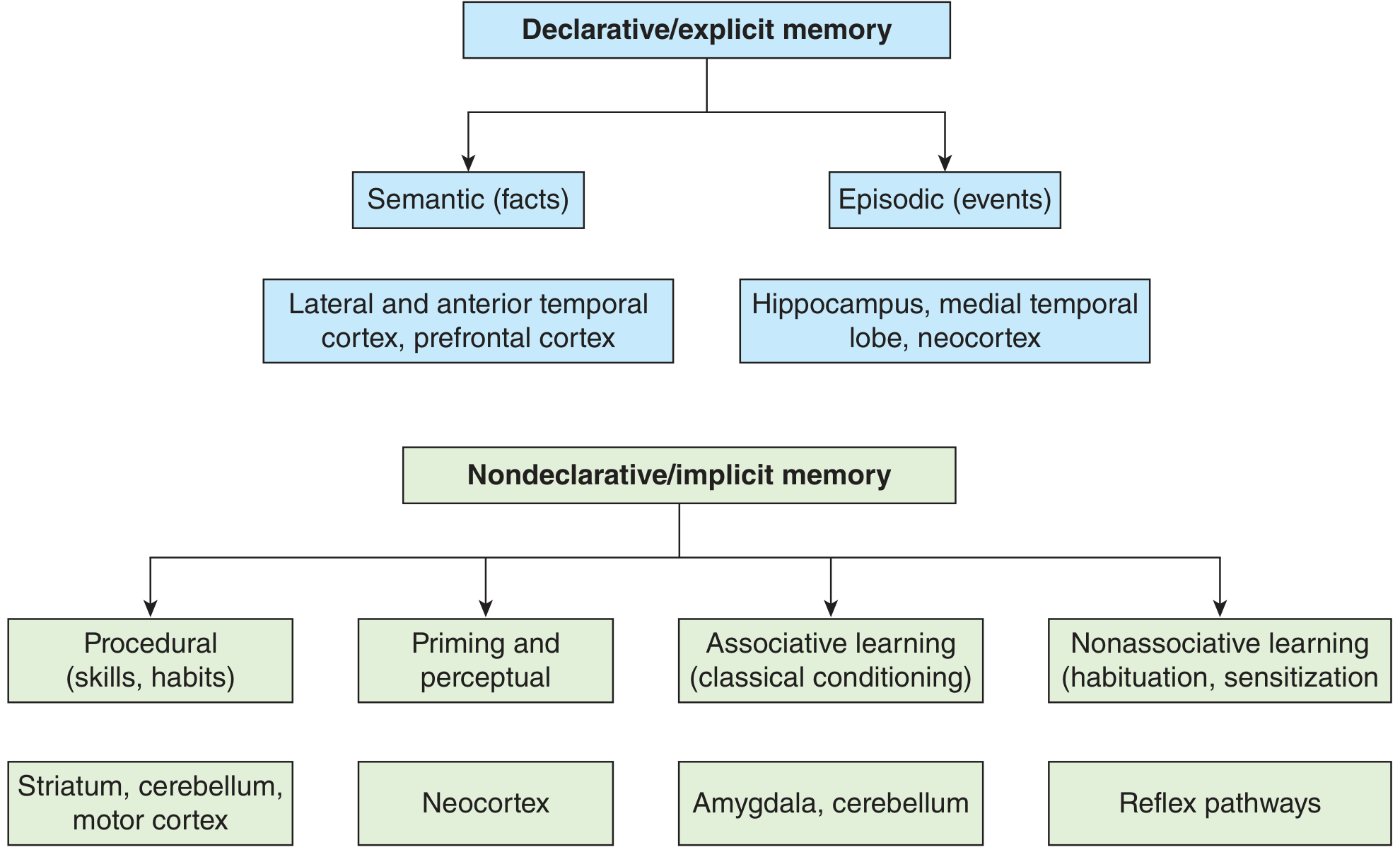
A. Explicit (Declarative) Memory
- Associated with consciousness/awareness
- Dependent on hippocampus and medial temporal lobes for retention
- Subtypes:
- Semantic memory - facts, words, rules, language → stored in lateral and anterior temporal cortex, prefrontal cortex
- Episodic memory - personal events → stored in hippocampus, medial temporal lobe, neocortex
B. Implicit (Non-declarative) Memory
- Does not involve awareness
- Does not require hippocampal processing
- Subtypes:
| Type | Example | Brain Structure |
|---|---|---|
| Procedural | Riding a bicycle, habits | Striatum, cerebellum, motor cortex |
| Priming | Recognition of words by prior exposure | Neocortex |
| Associative | Classical conditioning | Amygdala, cerebellum |
| Non-associative | Habituation, sensitization | Reflex pathways |
Exam tip: Skills like riding a bicycle begin as explicit memory but become implicit once thoroughly learned.
4. SHORT-TERM vs. LONG-TERM MEMORY
| Feature | Short-term Memory | Long-term Memory |
|---|---|---|
| Duration | Seconds to hours | Years, sometimes lifelong |
| Processing site | Hippocampus and elsewhere | Laid down as long-term synaptic strength changes |
| Susceptibility | Disrupted by trauma, drugs, ECT | Remarkably resistant to disruption |
| Special type | Working memory - holds info briefly while planning action | - |
5. NEURAL BASIS OF MEMORY
Key principle: Memory = alteration in strength of selected synaptic connections
- Second messenger systems contribute to changes in neural circuitry
- Alterations in membrane ion channels correlate with learning
- Conversion from short-term to long-term memory requires protein synthesis and gene activation
6. SYNAPTIC PLASTICITY AND LTP
Posttetanic Potentiation
- Enhanced postsynaptic potentials after a brief tetanizing stimulation of presynaptic neuron
- Lasts up to 60 seconds
- Mechanism: Ca2+ accumulates in presynaptic neuron overwhelming intracellular binding sites
Long-Term Potentiation (LTP) ⭐ (HIGH YIELD)
- Definition: Rapidly developing, persistent enhancement of postsynaptic potential response after brief high-frequency (tetanic) stimulation of presynaptic neuron
- Lasts days to weeks (much more prolonged than posttetanic potentiation)
- The most important cellular mechanism of learning and memory
NMDA Receptor-Dependent LTP Mechanism:
- Presynaptic neuron releases glutamate
- Glutamate activates NMDA receptors on postsynaptic membrane
- NMDA receptors = ligand-gated Ca2+ channels (open when activated)
- High-frequency stimulation → more Ca2+ accumulates in postsynaptic cell
- High intracellular Ca2+ → activates calcium-calmodulin-dependent protein kinase
- → Increased responsiveness of synapse (increased synaptic strength)
- Long-term: involves protein synthesis and growth of pre- and postsynaptic neurons
Note: LTP can also be NMDA receptor-independent; in those cases, initiation still requires increase in intracellular Ca2+ in either pre- or postsynaptic neuron.
Long-Term Depression (LTD)
- Opposite of LTP - decreased synaptic strength
- Also involves NMDA receptors and Ca2+ signaling
7. BRAIN STRUCTURES IN MEMORY (Summary)
| Structure | Role |
|---|---|
| Hippocampus | Declarative/episodic memory encoding; spatial memory; key for transfer of short-term to long-term memory |
| Amygdala | Emotional memories; fear conditioning; associative learning |
| Cerebellum | Procedural/motor learning; conditioned reflexes |
| Striatum (basal ganglia) | Habits, skills, procedural memory |
| Neocortex | Long-term storage; semantic memory; priming |
| Prefrontal cortex | Working memory; semantic facts |
The Famous Case of HM (Patient Henry Molaison) - Classic Exam Vignette
- Underwent bilateral hippocampal and amygdala removal for seizure control (1953)
- Result: Anterograde amnesia - could not form NEW long-term memories
- Short-term memory was intact
- Remote (pre-surgical) long-term memories were intact
- Procedural memory was normal (could learn new motor skills but not remember learning them)
- Lesson: The hippocampus is required for encoding NEW declarative memories, not for their storage or retrieval once consolidated
8. AMNESIA
| Type | Definition | Cause example |
|---|---|---|
| Retrograde amnesia | Loss of memory for events BEFORE the insult | Brain concussion, ECT (can span many days before event; remote memories intact) |
| Anterograde amnesia | Inability to form NEW memories AFTER the insult | Hippocampal damage (HM case) |
9. ALZHEIMER DISEASE (Memory Pathology)
Cytopathological hallmarks:
- Intracellular neurofibrillary tangles (paired helical filaments of hyperphosphorylated tau protein)
- Extracellular amyloid (senile) plaques - core of β-amyloid peptides surrounded by altered nerve fibers and reactive glial cells
- Brain atrophy - narrowing of gyri, widening of sulci, enlarged ventricles, reduced brain weight
Pathophysiology of β-amyloid toxicity:
- Aβ peptides (40-42 amino acids) stick to AMPA receptors and Ca2+ channels → increased Ca2+ influx
- Initiate inflammatory response → intracellular tangles
- Most toxic form: Aβ1-42
Risk factors: Age is the most common (8-17% in >65 yr; 40-50% in >95 yr)
Treatment:
- Acetylcholinesterase inhibitors (donepezil, galantamine, rivastigmine): increase ACh availability; delay symptom worsening ~12 months in ~50% patients
- Memantine (NMDA receptor antagonist): prevents glutamate-induced excitotoxicity; used in moderate-to-severe Alzheimer disease
10. QUICK RECALL TABLE - Mechanisms at a Glance
| Phenomenon | Mechanism | Duration | Type |
|---|---|---|---|
| Habituation | ↓ Ca2+ → ↓ NT release | Short/long | Non-associative |
| Sensitization | Presynaptic facilitation → ↑ cAMP | Short/long | Non-associative |
| Posttetanic potentiation | Ca2+ accumulation in presynaptic | Up to 60 s | Plasticity |
| LTP | NMDA receptor → Ca2+ → kinase activation → protein synthesis | Days to weeks | Plasticity/memory |
| LTD | NMDA receptor - Ca2+ signaling (low-level) | Long | Plasticity/memory |
11. KEY EXAM POINTS (One-Liners)
- Learning = acquisition; Memory = retention/storage
- Fundamental mechanism of learning = synaptic plasticity
- LTP = high-frequency stimulation → NMDA → Ca2+ → kinase → persistent synaptic enhancement
- Hippocampus = needed for encoding declarative memory (not storage)
- Explicit memory = hippocampus dependent; Implicit = hippocampus independent
- Semantic memory = facts; Episodic memory = events (both are explicit)
- Procedural memory = cerebellum + striatum (implicit)
- Alzheimer plaques = β-amyloid; Tangles = tau protein
- Anterograde amnesia = cannot form new memories (HM case)
- Retrograde amnesia = loss of old memories before injury
- Short-term → Long-term memory conversion requires protein synthesis
- Memantine blocks NMDA receptors (used in moderate-severe Alzheimer)
- "Use it or lose it" - effortful mental activity slows onset of cognitive dementia
Sources: Ganong's Review of Medical Physiology 26th Ed., Ch. 15 | Costanzo Physiology 7th Ed., Ch. 3
This is a shared conversation. Sign in to Orris to start your own chat.