
Bronchopneumonia paediatric
Reading File
Now let me search the medical library for paediatric bronchopneumonia content across multiple dimensions simultaneously.
Finding Sources
Finding Sources
Searching PubMed
"bronchopneumonia" AND "children" AND "management"
Good - found relevant sections. Let me read the key sources in parallel, and also search for paediatric pneumonia content more broadly.
Reading File
Finding Sources
Finding Sources
Good content from Fishman's. Now let me search specifically for paediatric pneumonia sections in the textbooks.
Finding Sources
Finding Sources
Finding Sources
Excellent. Let me now read the most relevant paediatric-focused sections from Tintinalli's (emergency medicine - paediatric pneumonia), Park's (prevention/management tables), and Murray & Nadel's in parallel.
Reading File
Reading File
Searching PubMed
"community acquired pneumonia" AND "pediatric" AND "guidelines"
Excellent data from Tintinalli's and Park's. Let me now read more of Tintinalli's paediatric pneumonia section (etiology, clinical features, treatment) and get antibiotic dosing from Park's.
Reading File
Reading File
Now let me read the empiric antibiotic section from Tintinalli's and also fetch the CXR image for illustration.
Reading File
Reading File
I now have comprehensive content. Let me fetch a relevant CXR image and read more of Tintinalli's for the clinical exam / age-specific etiology section.
Reading File
Loading Image
I now have all the information needed to compose a thorough, well-structured answer. Let me put it together.
Bronchopneumonia in Paediatrics
Definition and Pathology
Bronchopneumonia is a pattern of pneumonia in which the focus of infection and the inflammatory response cause epithelial ulceration of the bronchial walls with fibrinopurulent exudate filling the surrounding peribronchiolar alveoli. This produces a patchy, multifocal, segmental distribution - in contrast to the homogeneous consolidation of lobar pneumonia. Segmental involvement can become confluent, appearing more homogeneous on imaging. It is the dominant pattern of pneumonia in infants and young children.
- Fishman's Pulmonary Diseases and Disorders, p. 2137
Epidemiology
Globally, pneumonia is the leading cause of death in children under 5, with ~120 million cases and nearly 1.3 million deaths annually. Children under 2 years account for 81% of paediatric deaths from pneumonia. In the developed world, pneumonia causes ~1 million hospitalisations per year in children and is the second costliest reason for paediatric hospitalisation in the United States.
- Tintinalli's Emergency Medicine, p. 854
Pathophysiology
Pathogens reach the lower respiratory tract by:
- Inhalation/aspiration (most common - droplet or fomite transmission for viruses, nasopharyngeal colonisation then spread for bacteria)
- Contiguous spread from upper airway
- Haematogenous seeding (less common)
Anatomic defences include nasal turbinates, cilia, epiglottis, cough reflex, secretory IgA, alveolar macrophages, and cellular immunity. Once infection is established, injury to respiratory epithelium causes interstitial inflammation and alveolar exudate, leading to atelectasis, impaired oxygenation, and V/Q mismatch.
Viruses are the most commonly detected cause, accounting for over 70% of hospitalised paediatric pneumonia in the United States.
- Tintinalli's Emergency Medicine, p. 854
Age-Specific Aetiology
This is the most important frame for paediatric bronchopneumonia - the causative agent varies dramatically with age.
| Age Group | Dominant Pathogens |
|---|---|
| Neonates (0-30 days) | Group B Streptococcus, Klebsiella, E. coli, Listeria monocytogenes; S. aureus, S. pneumoniae (late-onset) |
| Infants 1-3 months | RSV, rhinovirus, parainfluenza; also C. trachomatis (afebrile pneumonitis with staccato cough) |
| Infants/toddlers 30 days-2 years | RSV, rhinovirus, influenza, parainfluenza, human metapneumovirus, adenovirus; S. pneumoniae (most common bacterial cause); H. influenzae (type b in unvaccinated) |
| Children 2-5 years | RSV, rhinovirus, human metapneumovirus; S. pneumoniae, H. influenzae |
| Children 5-13 years | Viruses still predominate; M. pneumoniae (~17% of cases), C. pneumoniae, S. pneumoniae; S. aureus, Group A Streptococcus, nontypeable H. influenzae |
| Adolescents | Atypical organisms (M. pneumoniae, C. pneumoniae) take on an adult-like pattern |
Additional organisms to consider in appropriate settings: B. pertussis (including in vaccinated children - immunity wanes), M. tuberculosis (endemic areas, immunocompromised), varicella-zoster (unvaccinated).
S. aureus and non-encapsulated H. influenzae classically produce a bronchopneumonic radiographic pattern. Segmental bronchopneumonia is also the typical pattern for Chlamydophila pneumoniae, M. pneumoniae, and most viral pneumonias.
- Tintinalli's Emergency Medicine, pp. 854-855
- Fishman's Pulmonary Diseases and Disorders, p. 2137
Clinical Features
Cardinal symptoms: cough, fever, tachypnea, and respiratory distress - though these vary by age and causative agent.
Key signs to elicit:
- Tachypnoea - the single most sensitive sign (WHO cut-offs below)
- Chest indrawing / subcostal retractions - indicates severe disease
- Nasal flaring, grunting - in infants
- Fever - common but nonspecific
- Auscultation - crepitations, decreased breath sounds, bronchial breathing
Important clinical pearls:
-
Young infants (<2 months) may present with non-specific signs only: poor feeding, hypothermia (not fever), and mild chest indrawing may be normal in healthy young infants due to soft chest wall
-
Lower lobe pneumonia can present as abdominal pain and mimic appendicitis
-
Persistent or recurrent pneumonia should prompt investigation for cystic fibrosis, immune deficiency, or anatomic abnormality
-
Chlamydia pneumonitis in infants 1-3 months produces a distinctive staccato cough with tachypnoea and diffuse pulmonary infiltrates, often afebrile
-
Tintinalli's Emergency Medicine, pp. 854-856
WHO / IMCI Classification (2 months to 5 years)
This is the standard framework used in primary care and resource-limited settings:
| Signs | Classification | Action |
|---|---|---|
| Chest indrawing (+ or - fast breathing) | Severe pneumonia | Refer urgently; give first dose antibiotic; treat fever/wheeze |
| Fast breathing, no chest indrawing | Pneumonia | Home care + oral antibiotic; review in 2 days |
| No chest indrawing, no fast breathing | No pneumonia: cough or cold | Symptomatic; reassess if not improving in 30 days |
Fast breathing thresholds (WHO):
- Age 2-11 months: ≥50 breaths/minute
- Age 12 months-5 years: ≥40 breaths/minute
Young infants (<2 months): fast breathing = ≥60 breaths/minute. Any pneumonia in a young infant is classified as severe - refer immediately.
- Park's Textbook of Preventive and Social Medicine, pp. 191-192
Investigation
Chest Radiograph
Not required routinely in mild, uncomplicated presentations. Indications include:
- Toxic appearance with respiratory findings
- Age 0-3 months with fever + respiratory symptoms (part of full sepsis workup)
- Age <5 years with temperature >39°C lasting ≥5 days, WBC ≥20,000/mm³, no clear source
- Suspicion of complications (effusion, pneumothorax, abscess)
Radiographic pattern in bronchopneumonia: patchy, multifocal, bilateral airspace opacities - not confined to a single lobe. Note that chest radiograph:
- Is not the gold standard - neither 100% sensitive nor 100% specific
- Cannot reliably distinguish bacterial from viral aetiology
- May be falsely positive: atelectasis from viral bronchiolitis can mimic infiltrates
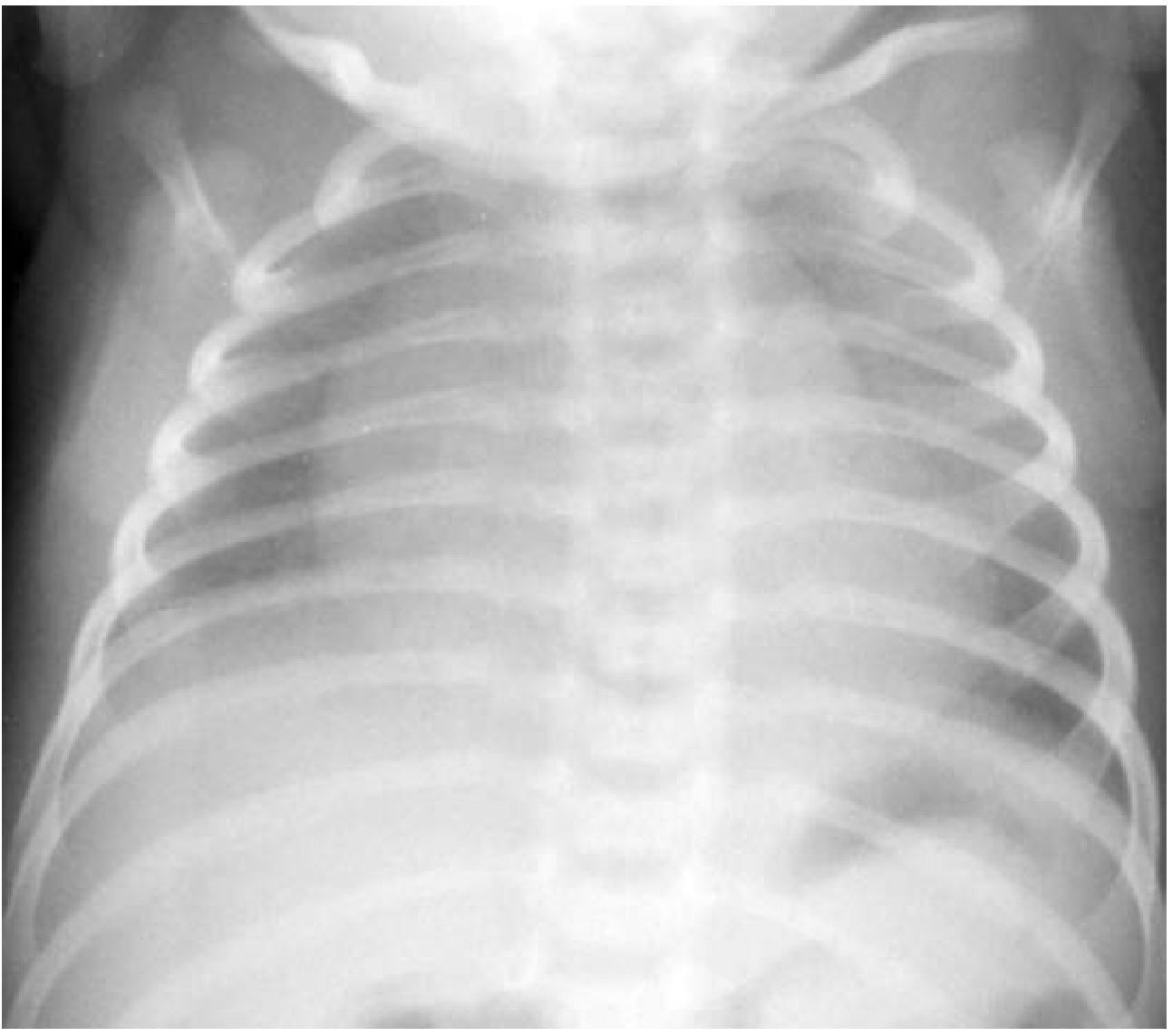
Poor inspiration can produce false infiltrates and apparent cardiomegaly in a normal infant - an important pitfall in paediatric radiology.
Lung Ultrasound
Early evidence shows high interobserver agreement and acceptable sensitivity/specificity when performed by an experienced operator - a useful bedside adjunct, particularly where radiation exposure is a concern.
Microbiology
-
Definitive identification requires invasive procedures (BAL, lung puncture, pleural fluid culture/PCR) - usually impractical in the ED
-
Blood cultures have low yield in community-acquired pneumonia
-
Rapid viral detection via nasopharyngeal swab is useful for RSV, influenza, adenovirus
-
Tintinalli's Emergency Medicine, pp. 855-856
Treatment
General Principles
- All children with suspected bacterial pneumonia should receive prompt empiric antibiotics
- Oral antibiotics are adequate for most mild-to-moderate cases
- Parenteral therapy is indicated for neonates and severe/hospitalised cases
- Duration: typically 7-10 days (5 days if azithromycin is used)
- Supportive care: oxygen if SpO₂ <92-94%, adequate hydration, fever management
Empiric Antibiotic Therapy by Age
Neonates (<1 month):
- Ampicillin (covers Listeria, Group B Streptococcus) + gentamicin or cefotaxime (gram-negative coverage)
- Ceftriaxone is contraindicated in neonates (displaces bilirubin)
Young infants 1-3 months:
- Afebrile pneumonitis (Chlamydia pattern): erythromycin or clarithromycin
- Azithromycin avoided in this age group - increased risk of pyloric stenosis
Infants/children 3 months-5 years:
- High-dose oral amoxicillin (80-100 mg/kg/day) - drug of choice for suspected bacterial pneumonia
- If high penicillin resistance in community, incomplete immunisation, or life-threatening infection: third-generation cephalosporin (ceftriaxone or cefotaxime)
Children 5-18 years:
- Amoxicillin (with or without clavulanate) as first-line for simple CAP
- Macrolide monotherapy reasonable if atypical pneumonia is strongly suspected
- Hospitalised children ≥5 years with unclear aetiology: β-lactam + macrolide
- Suspected resistant/multiple pathogens: third-generation cephalosporin + macrolide
WHO Antibiotic Dosing for Inpatients (Children 2 months - 5 years, Severe Pneumonia)
First 48 hours:
- Benzyl penicillin 50,000 IU/kg/dose q6h IM, OR
- Ampicillin 50 mg/kg/dose q6h IM, OR
- Chloramphenicol 25 mg/kg/dose q6h IM
If improving after 48 hours: step down to oral procaine penicillin (50,000 IU/kg once daily IM) or oral ampicillin/chloramphenicol for 3 more days.
If not improving after 48 hours: switch antibiotic class (e.g., ampicillin → chloramphenicol IM; or add cloxacillin 25 mg/kg/dose q6h + gentamicin 2.5 mg/kg/dose q8h).
Very severe disease: chloramphenicol IM is drug of choice for 10 days total; if no improvement at 48 hours, switch to cloxacillin + gentamicin.
Young infants <2 months: ampicillin + gentamicin IM (chloramphenicol not recommended as first line in this age group).
- Tintinalli's Emergency Medicine, pp. 857-858
- Park's Textbook of Preventive and Social Medicine, pp. 192-193
Severity Assessment and Disposition
Indications for Hospitalisation
- Age <3-6 months
- Oxygen saturation <92-94%
- Respiratory distress (retractions, grunting, nasal flaring)
- Toxic appearance
- Dehydration or inability to feed
- Failure to respond to outpatient therapy
- Suspected complications (effusion, empyema, pneumothorax, abscess)
- Unreliable follow-up or social concerns
Complications
- Parapneumonic effusion / empyema - common with S. pneumoniae, S. aureus
- Lung abscess - S. aureus, anaerobes
- Pneumatoceles - S. aureus in infants
- Tension pneumothorax - rare but life-threatening
- Septicaemia / septic shock
- A child returning with worsening symptoms after initial treatment should raise concern for secondary bacterial pneumonia or a resistant/unusual pathogen
Reassessment (WHO Framework)
In a child taking an antibiotic for pneumonia, reassess in 2 days:
| Finding | Action |
|---|---|
| Worsening / unable to drink / chest indrawing / danger signs | Refer urgently |
| Same - no improvement | Change antibiotic or refer |
| Improving - slower breathing, less fever, eating better | Complete 5-day course |
- Park's Textbook of Preventive and Social Medicine, p. 191
Prevention
- Vaccines: S. pneumoniae (PCV13/PCV15), H. influenzae type b, pertussis, measles, varicella, influenza (annual, recommended from age 6 months)
- Breastfeeding - provides passive immunity via secretory IgA
- Avoidance of tobacco smoke exposure
- Hand hygiene and respiratory etiquette
Sources:
- Tintinalli's Emergency Medicine, Chapter 128 (Paediatric Pneumonia)
- Park's Textbook of Preventive and Social Medicine, Chapter on ARI/IMCI
- Fishman's Pulmonary Diseases and Disorders, Chapter 122 (Bronchopneumonia)
This is a shared conversation. Sign in to Orris to start your own chat.