
Culture medias What is culture What is media Easy explanation to students
Reading File
Now let me search the medical library for culture media content.
Finding Sources
Finding Sources
Reading File
Reading File
Reading File
I now have enough rich textbook content to give a thorough, student-friendly explanation. Here it is:
Culture Media - Easy Student Guide 🧫
What is "Culture"?
In microbiology, culture simply means growing microorganisms (bacteria, fungi, etc.) in a laboratory setting - outside the body, in a controlled environment.
Think of it like farming, but for tiny microbes:
- A farmer plants seeds in soil and waters them so they grow.
- A microbiologist places microbes on/in a special substance and provides the right conditions so they grow and can be studied.
The process is called in vitro culture ("in vitro" = in glass/laboratory, not inside a living body).
Why do we culture? To identify which organism is causing a patient's infection, test which antibiotics will kill it, and study how it behaves.
What is "Media" (Medium)?
Media (singular: medium) is the food/nutrient substance provided to microorganisms so they can grow and multiply in the lab.
Just like how:
- Plants need soil + water + sunlight
- Microbes need a medium that provides nutrients, moisture, and the right conditions
Media are usually made from:
- Digests of animal or plant products (muscle, milk, soybeans)
- These digests contain amino acids, polypeptides, vitamins, trace metals, and growth factors
- Salts, blood, serum, or sugars can be added depending on what you need to grow
Physical forms of media:
| Form | Description | Example |
|---|---|---|
| Solid (Agar) | Gel-like surface; organisms form visible colonies | Blood Agar, MacConkey Agar |
| Liquid (Broth) | Liquid; organisms grow throughout the liquid | Thioglycolate broth |
"Agar" is the gelling agent (from seaweed) that makes media solid.
Types of Culture Media
There are 4 main types, each with a specific purpose:
1. Enriched Nonselective Media
Purpose: Supports growth of most organisms - "a welcoming home for almost everyone."
These don't block any organism - they just provide good nutrition.
| Media | What It's Used For |
|---|---|
| Blood Agar | Grows most bacteria AND fungi; also shows hemolysis (destruction of red blood cells) |
| Chocolate Agar | Like blood agar, but heated - turns brown (like chocolate!); grows fastidious organisms like Haemophilus and Neisseria gonorrhoeae |
| Mueller-Hinton Agar | Standard medium for antibiotic susceptibility testing |
| Thioglycolate Broth | Enrichment broth; recovers both aerobic AND anaerobic bacteria from small numbers |
| Sabouraud Dextrose Agar | Grows fungi (molds and yeasts) |
Simple analogy: Nonselective media = an "all-you-can-eat buffet" open to everyone.
2. Selective Media
Purpose: Allows ONLY specific organisms to grow by blocking/inhibiting others.
They contain dyes, chemicals, or antibiotics that stop unwanted organisms but let the target organism grow freely.
Example: If you're looking for Campylobacter in a stool sample, but stool has millions of normal bacteria - selective media suppresses the normal flora and lets Campylobacter grow.
| Media | Who It Selects For |
|---|---|
| MacConkey Agar | Selects for gram-negative bacteria (blocks gram-positive) |
| Mannitol Salt Agar | Selects for Staphylococci (high salt blocks most other organisms) |
| Lowenstein-Jensen / Middlebrook | Selects for Mycobacteria (TB organisms) |
Simple analogy: Selective media = a VIP-only nightclub. Only the "right" microbes get in.
3. Differential (Indicator) Media
Purpose: Doesn't just grow organisms - it also shows differences between them using color changes or visible reactions.
They contain pH indicators or sugars - if an organism ferments the sugar, the indicator changes color, revealing its identity.
Best example - MacConkey Agar (both selective AND differential):
- Selects for gram-negative bacteria
- Also contains lactose + a pH indicator
- Lactose fermenters (like E. coli) produce acid → turn pink/red
- Non-fermenters (like Salmonella, Shigella) stay colorless
Simple analogy: Differential media = a lab test that also gives a color result - like a pregnancy test strip.
4. Specialized Media
Purpose: Designed for specific, hard-to-grow (fastidious) organisms that won't grow on regular media.
| Media | Target Organism |
|---|---|
| BCYE Agar (Buffer Charcoal Yeast Extract) | Legionella (requires iron + L-cysteine) |
| Cystine-tellurite Agar | Corynebacterium diphtheriae (diphtheria) |
| Lim Broth | Streptococcus agalactiae (Group B Strep) |
| MacConkey Sorbitol Agar | E. coli O157 (dangerous strain causing bloody diarrhea) |
Quick Summary Table
| Type | Simple Description | Analogy |
|---|---|---|
| Nonselective | Grows almost everything | All-you-can-eat buffet |
| Selective | Grows only specific organisms | VIP-only club |
| Differential | Distinguishes organisms by color | Color-coded name tags |
| Specialized | Grows difficult/fussy organisms | Special diet for picky eaters |
Key Terms to Remember
- Culture = Growing microorganisms in a lab
- Medium/Media = The nutrient substance they grow in or on
- Agar = The gelling agent that makes media solid
- Colony = A visible cluster of microorganisms growing on solid media from a single original cell
- Fastidious organism = A microbe with very specific/demanding growth requirements (hard to grow)
- Selective = Inhibits some organisms, allows others
- Differential = Distinguishes between organisms using color changes
Sources: Medical Microbiology 9e; Sherris & Ryan's Medical Microbiology, 8th Edition
Images
Looking for culture media images from the textbooks.
Searching sources...
Finding Sources
Finding Sources
Found the image-rich section in Tietz. Let me read it to get the image URLs.
Reading File
Reading File
Now let me find the actual image URLs in the Tietz block that mentions colony morphology photos.
Reading File
Reading File
Found one image. Now let me find the Fig 84.3 images (blood agar, MacConkey, etc.) in the Tietz block.
Reading File
I have the image URLs. Let me now fetch all of them to display them properly.
Loading Image
Loading Image
Loading Image
Here are all the real textbook images of culture media for you!
Culture Media - Real Laboratory Images 🧫
IMAGE 1 - Blood Agar & MacConkey Agar: Colony Appearances
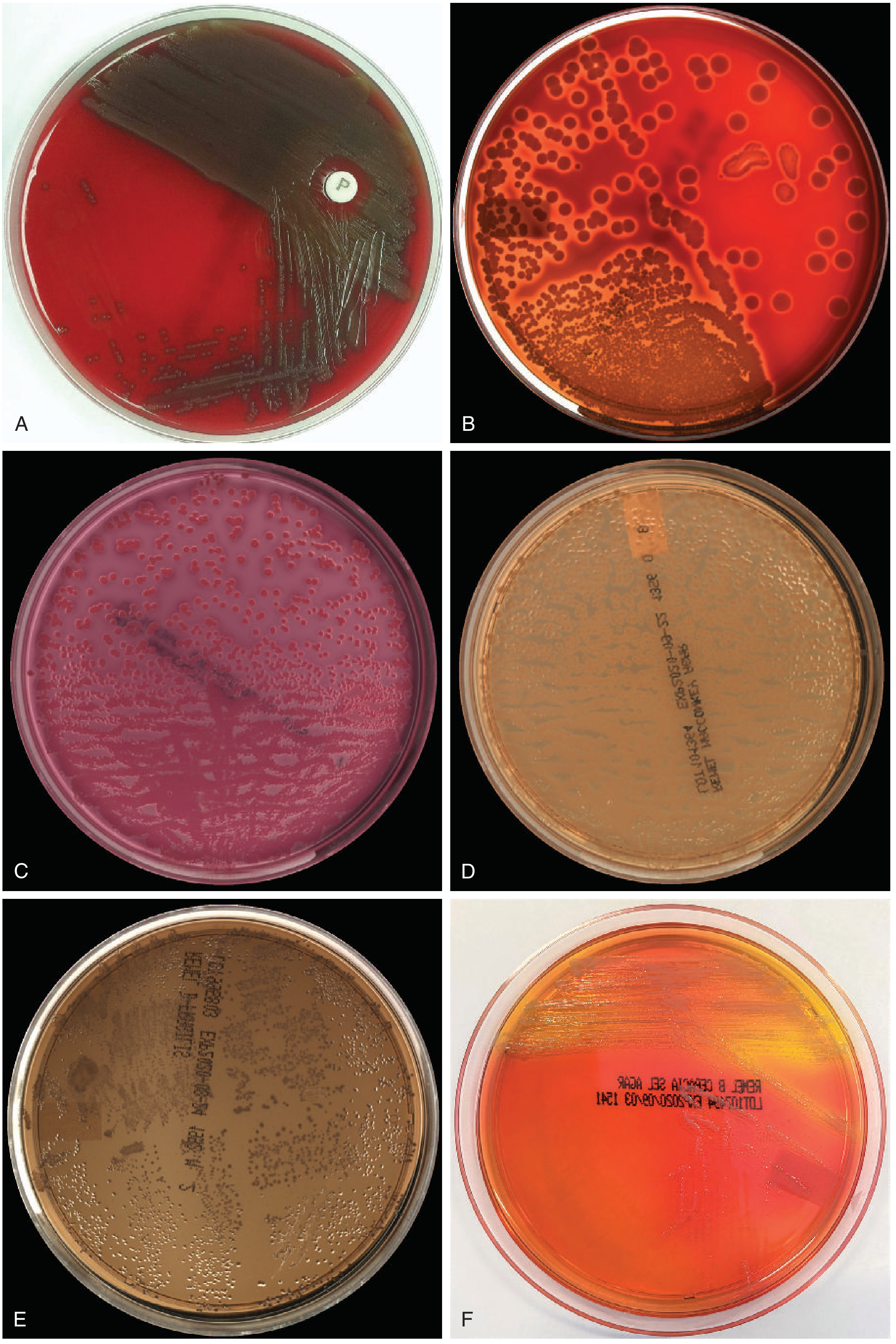
What you're seeing (A to F):
| Panel | Media | What it Shows |
|---|---|---|
| A | Blood Agar Plate (BAP) | Alpha (α) hemolysis - greenish discoloration around colonies (partial red blood cell destruction) - seen with Streptococcus pneumoniae |
| B | Blood Agar Plate (BAP) | Beta (β) hemolysis - clear zones around colonies (complete destruction of red blood cells) - seen with Streptococcus pyogenes, Staph. aureus |
| C | MacConkey Agar (MAC) | Lactose fermenters - bright pink/red colonies (e.g., E. coli, Klebsiella) - acid turns the pH indicator pink |
| D | MacConkey Agar (MAC) | Non-lactose fermenters - colorless/pale colonies (e.g., Salmonella, Shigella, Pseudomonas) |
| E | Bacteroides Bile Esculin (BBE) Agar | Selective for anaerobes (Bacteroides spp.) |
| F | Burkholderia Cepacia Agar | Selective specialized medium |
IMAGE 2 - More Specialized & Differential Media
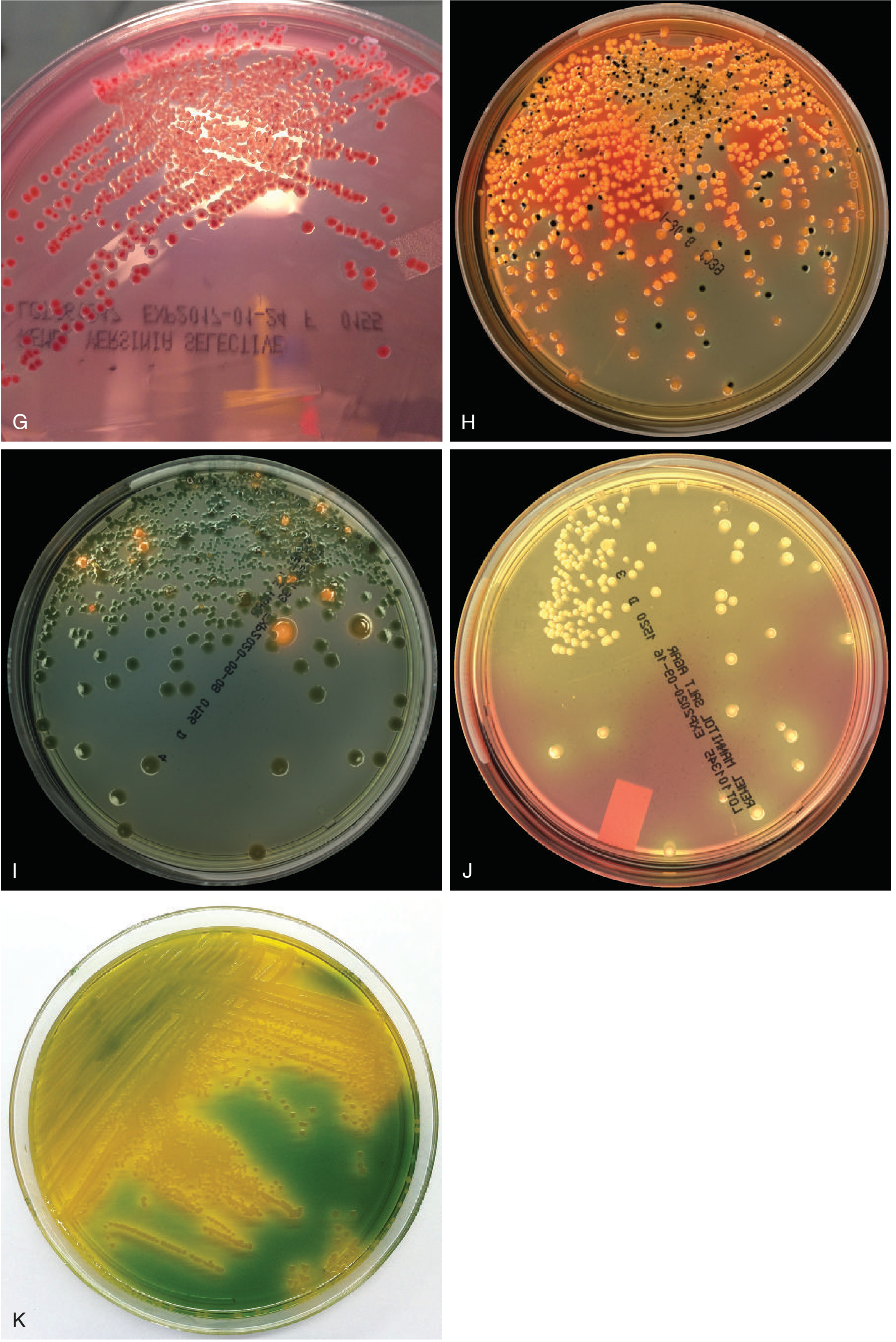
What you're seeing (G to K):
| Panel | Media | What it Shows |
|---|---|---|
| G | CIN Agar (Cefsulodin-Irgasan-Novobiocin) | "Bullseye" colonies - red center, clear edge - selective for Yersinia |
| H | Hektoen Enteric (HE) Agar | Black colonies = H₂S producers (e.g., Salmonella); orange colonies = non-H₂S producers |
| I | Hektoen Enteric (HE) Agar | Green colonies with no H₂S production - different enteric pathogen |
| J | Mannitol Salt Agar (MSA) | Yellow colonies = Staphylococcus aureus (ferments mannitol, producing acid) |
| K | TCBS Agar (Thiosulfate Citrate Bile Salts Sucrose) | Yellow-green growth - selective for Vibrio species (e.g., Vibrio cholerae) |
IMAGE 3 - Flowchart: When to Use Special vs. Routine Media
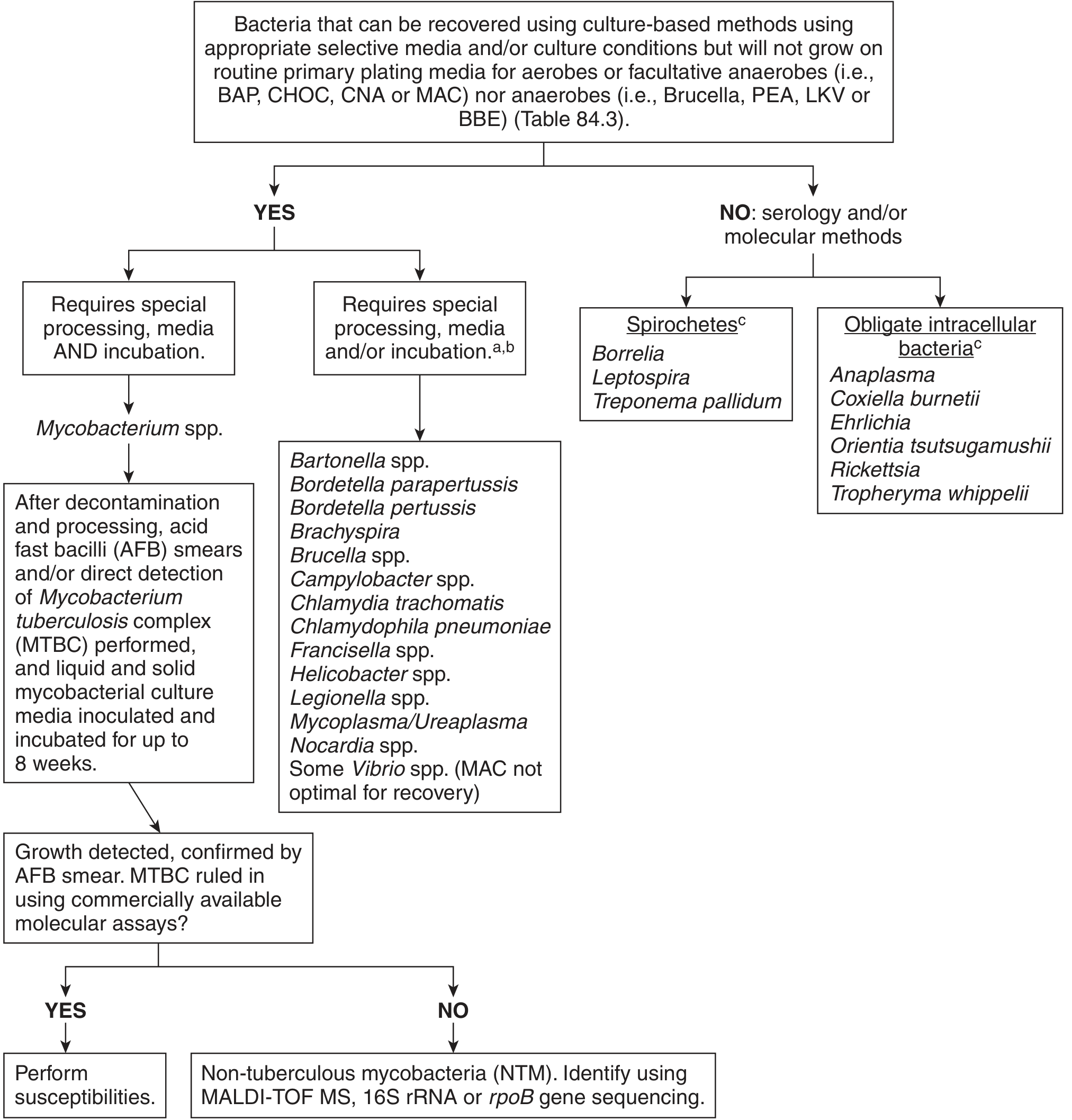
This chart shows which bacteria need special media (like Mycobacterium, Legionella, Campylobacter, Chlamydia) vs. those that cannot be cultured at all (like Rickettsia, Treponema pallidum) and need serology or molecular tests instead.
Key Visual Learning Points
- Red plates (Blood Agar) = broad, general purpose - look for hemolysis zones
- Pink/Purple plates (MacConkey) = gram-negative selection - look for pink (fermenters) vs. colorless (non-fermenters)
- Black colonies = H₂S production (Salmonella on HE agar)
- Yellow colonies = acid production from sugar fermentation (Staph. aureus on MSA)
- Colorless/pale colonies = organism is there but not fermenting the sugar
Source: Tietz Textbook of Laboratory Medicine, 7th Edition, Fig. 84.3
This is a shared conversation. Sign in to Orris to start your own chat.