
Explain me The abdominal regions
Reading File
Finding Sources
Searching the Web
abdominal regions quadrants nine regions anatomy diagram
Finding Sources
Loading Image
Finding Sources
Loading Image
Here is a full explanation of the abdominal regions.
Abdominal Regions
The abdomen is divided into regions to help clinicians localize pain, describe organ positions, and document physical exam findings. There are two common systems: the 4-quadrant system (simpler, used in clinical practice) and the 9-region system (more precise, used in anatomy and detailed examination).
The Dividing Planes
Both systems use imaginary planes drawn through the abdomen:
- Median (sagittal) plane - a vertical line through the midline (linea alba), from xiphoid to pubic symphysis
- Subcostal plane - horizontal line through the lowest point of the costal margin (10th costal cartilages)
- Intertubercular (transtubercular) plane - horizontal line connecting the iliac tubercles
- Umbilical plane - horizontal line through the umbilicus (used only in the 4-quadrant system)
System 1: The 4 Quadrants
Formed by one vertical and one horizontal line crossing at the umbilicus. Simple and widely used in clinical settings.
| Quadrant | Abbreviation | Key Organs |
|---|---|---|
| Right Upper Quadrant | RUQ | Liver (right lobe), gallbladder, right kidney, duodenum, hepatic flexure of colon, part of stomach and pancreas |
| Left Upper Quadrant | LUQ | Stomach, spleen, left kidney, pancreas (tail/body), splenic flexure of colon, liver (left lobe) |
| Right Lower Quadrant | RLQ | Appendix, cecum, ascending colon, right ovary/tube (in females), right ureter |
| Left Lower Quadrant | LLQ | Sigmoid colon, descending colon, left ovary/tube (in females), left ureter |
System 2: The 9 Regions
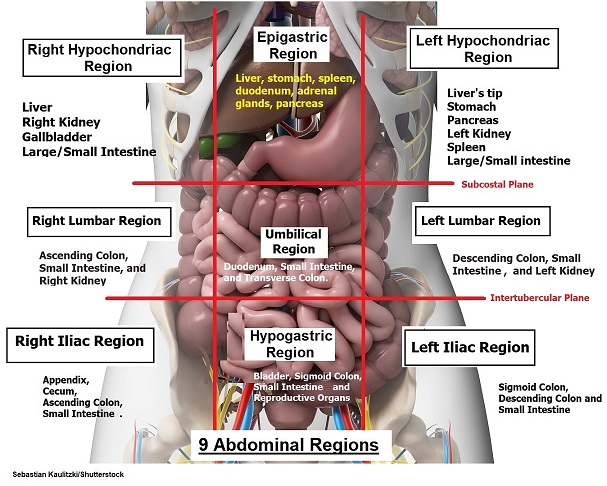
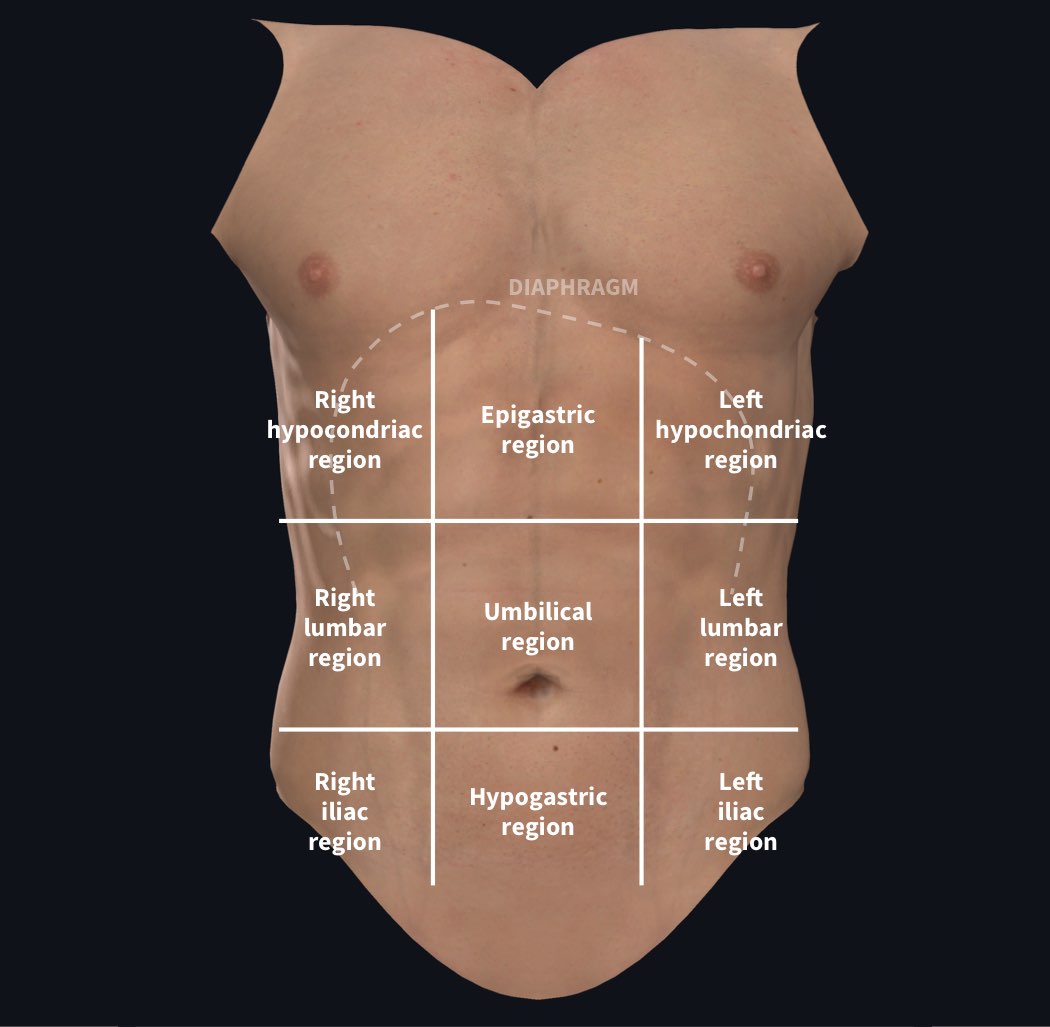
Created by two vertical lines (lateral borders of the rectus abdominis muscles, or mid-clavicular lines) and two horizontal planes (subcostal and intertubercular), dividing the abdomen into a 3x3 grid.
Upper Row
| Region | Location | Key Organs |
|---|---|---|
| Right Hypochondriac | Upper right, under ribs | Liver (right lobe), gallbladder, right kidney, hepatic flexure of colon |
| Epigastric | Upper middle | Stomach, liver (left lobe), duodenum, pancreas (head), adrenal glands, aorta |
| Left Hypochondriac | Upper left, under ribs | Stomach, spleen, left kidney, pancreas (tail), splenic flexure of colon |
Middle Row
| Region | Location | Key Organs |
|---|---|---|
| Right Lumbar (Lateral) | Middle right | Ascending colon, right kidney (lower pole), small intestine |
| Umbilical | Central, around the navel | Transverse colon, duodenum (lower part), small intestine (jejunum/ileum), aorta, inferior vena cava |
| Left Lumbar (Lateral) | Middle left | Descending colon, left kidney (lower pole), small intestine |
Lower Row
| Region | Location | Key Organs |
|---|---|---|
| Right Iliac (Inguinal) | Lower right | Appendix, cecum, right ovary/tube (female), right ureter, small intestine |
| Hypogastric (Pubic) | Lower middle | Bladder, sigmoid colon, uterus (female), small intestine, rectum |
| Left Iliac (Inguinal) | Lower left | Sigmoid colon, descending colon, left ovary/tube (female), left ureter |
Clinical Relevance
Knowing which region corresponds to which organs helps narrow the differential diagnosis when a patient reports abdominal pain:
- Epigastric pain - think peptic ulcer, gastritis, pancreatitis, MI (referred)
- RUQ pain - think gallstones, cholecystitis, hepatitis, liver abscess
- LUQ pain - think splenic rupture, gastric ulcer, pancreatitis
- RLQ pain - think appendicitis, ovarian cyst (right), ectopic pregnancy, inguinal hernia
- LLQ pain - think diverticulitis, constipation, ovarian pathology (left)
- Hypogastric pain - think cystitis, uterine pathology, PID
- Periumbilical pain - think early appendicitis, small bowel obstruction, mesenteric ischemia
- Lumbar/flank pain - think renal colic (kidney stones), pyelonephritis, musculoskeletal
The 9-region system is favored in anatomy and for precise organ localization, while the 4-quadrant system is more practical for everyday clinical documentation.
This is a shared conversation. Sign in to Orris to start your own chat.