
1. Central visual acuity. Visometry, examination method.
Reading File
Finding Sources
Finding Sources
Reading File
Reading File
Finding Sources
Reading File
Reading File
Reading File
Reading File
Finding Sources
Reading File
Loading Image
I now have comprehensive material from multiple authoritative sources. Here is a complete answer.
Central Visual Acuity — Visometry and Examination Method
1. Definition and Physiological Basis
Central visual acuity (VA) is the ability of the eye to discriminate fine spatial detail, specifically the capacity to resolve two separate points as distinct. It is determined by the resolution of the foveal cone mosaic.
Physiologically, light focused on the retina produces a spot of ~11 µm in diameter due to optical imperfections. Foveal cones average ~1.5 µm in diameter. Because a focused point has a bright center and shaded edges, two points can just be resolved when their retinal images are ~2 µm apart — about the width of a single foveal cone. The normal angular limit of resolution is approximately 25 seconds of arc (minimum angle of resolution, MAR). At 10 metres, this corresponds to two bright pinpoints separated by 1.5–2 mm being just distinguishable as two.
The fovea subtends <2° of visual field. Outside it, VA falls off rapidly — more than 10-fold toward the periphery — because more rods and cones share each optic nerve fiber in the peripheral retina. (Guyton and Hall Textbook of Medical Physiology)
2. Visometry — Notation Systems
"Visometry" refers to the quantitative measurement of VA. Three notation systems are in common use:
a. Snellen Notation (fraction notation)
The standard clinical expression of VA is a non-mathematical fraction:
Distance patient reads the chart / Distance at which a normal observer reads the same line
- 6/6 (metric) = 20/20 (feet) = normal acuity
- 6/12 (20/40) = the patient reads at 6 m what normals read at 12 m
- 6/60 (20/200) = threshold for legal blindness
In youth, VA is often better than 6/6 (e.g., 6/5 or 20/15). (Adams and Victor's Principles of Neurology, 12th ed.)
b. Decimal Notation
VA expressed as a decimal: 6/6 = 1.0, 6/12 = 0.5, 6/60 = 0.1.
c. LogMAR Notation
LogMAR = log₁₀(MAR), where MAR is expressed in minutes of arc.
| Snellen | Decimal | LogMAR |
|---|---|---|
| 6/6 (20/20) | 1.0 | 0.00 |
| 6/12 (20/40) | 0.5 | 0.30 |
| 6/60 (20/200) | 0.1 | 1.00 |
LogMAR charts (Bailey-Lovie, ETDRS) address Snellen deficiencies: equal numbers of letters per line, balanced letter legibility, systematic spacing — making them preferred for research. Each letter = 0.02 log units; testing continues until half a line is missed. (Kanski's Clinical Ophthalmology, 10th ed.)
d. Near VA — Jaeger System
Used when testing at near (standard distance: 16 in / 40 cm, e.g., Rosenbaum card at 36 cm):
- J1 ≈ 20/20
- J7 ≈ 20/50
- J13 ≈ 20/100
- J16 ≈ 20/200
3. Examination Method
Equipment
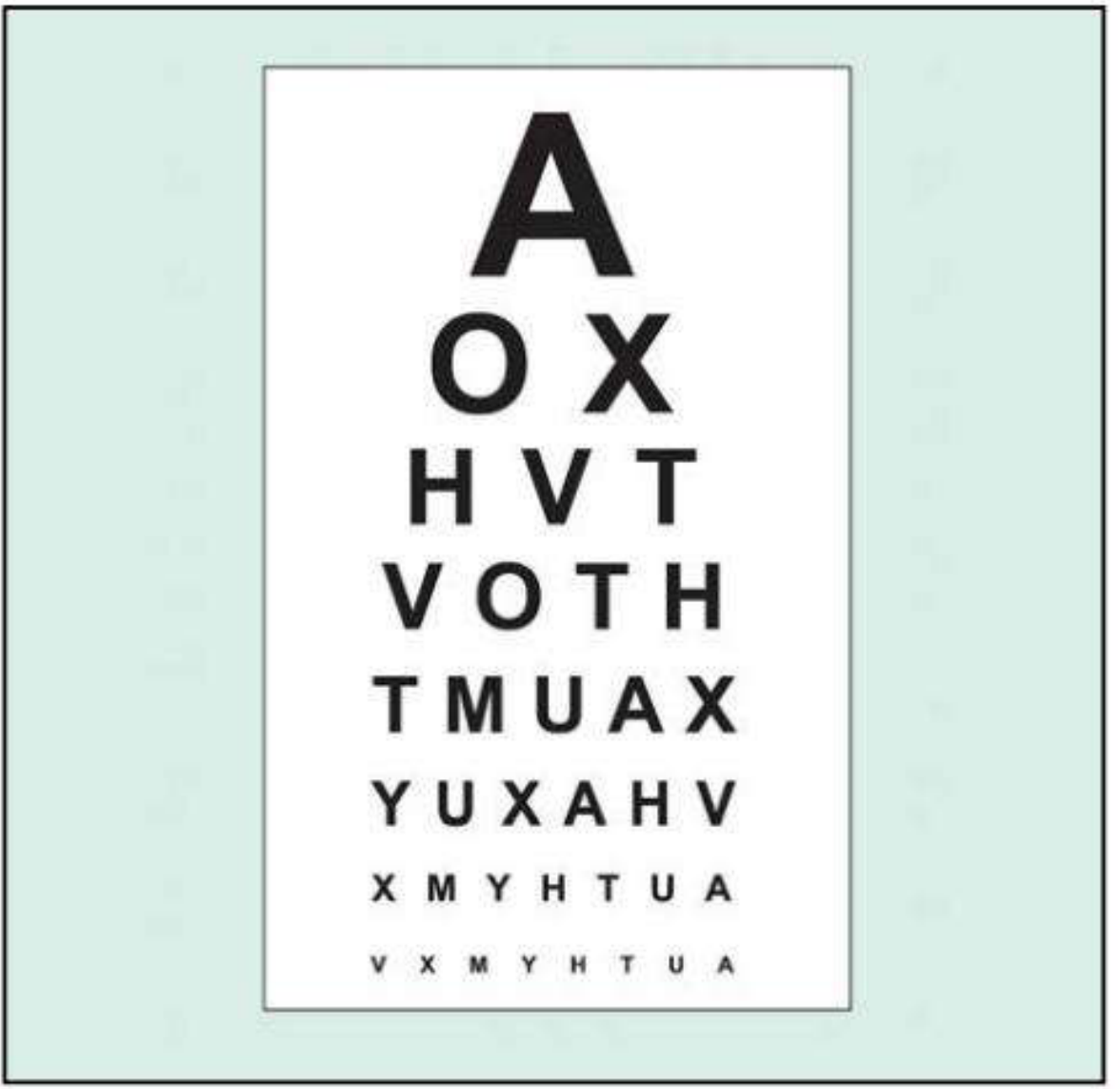
- Snellen chart — wall-mounted at 6 m (20 ft); illuminated
- Rosenbaum card — portable near card held at 36 cm (14 in); useful at bedside
- Pinhole occluder — opaque disc with ~1 mm hole(s) (Fig. 1.2 in Kanski)
- ETDRS / Bailey-Lovie chart — for research-grade measurement
Step-by-Step Procedure
- Refractive correction: Test first with the patient's habitual correction (glasses or contact lenses). Unaided acuity may also be recorded separately.
- Monocular testing: Test each eye individually — the worse eye first, with the fellow eye fully occluded.
- Distance testing: Patient stands 6 m (20 ft) from the chart; reads the smallest line possible. Push the patient to attempt every letter.
- Record acuity: Note the smallest line where the majority of letters are read correctly.
- Pinhole test: If VA < 6/6, repeat with a pinhole aperture over the tested eye.
- Improvement with pinhole → refractive error or anterior media opacity (cornea, lens, aqueous, vitreous) — optical cause
- No improvement → suggests retinal or neural disease (macular, optic nerve)
- Note: pinhole may worsen acuity in macular disease and posterior lens opacity
- Binocular VA: Usually equals or exceeds the better monocular VA when both eyes are roughly equal.
For Very Poor Vision (Below Chart Level)
| Level | Abbreviation | Test |
|---|---|---|
| Counting fingers | CF | Patient counts fingers at 1 m |
| Hand movements | HM | Patient detects hand motion in front of eye |
| Perception of light | PL | Patient detects pen-torch light only |
| No light perception | NLP | No response to any light |
For light perception, direction testing is also performed: the patient identifies which quadrant (superior, inferior, nasal, temporal) the light comes from. Correct localization in all 4 quadrants suggests intact retinal function — useful when dense media opacity (e.g., mature cataract) prevents fundal view. (Kanski's Clinical Ophthalmology)
Legal and Regulatory Thresholds
- Legal blindness: best-corrected VA ≤ 6/60 (20/200) in the better eye, OR visual field ≤ 20°
- Driving (most jurisdictions): corrected VA ≥ 6/12 (20/40) in at least one eye
- Homonymous hemianopia is an independent contraindication to driving regardless of acuity. (Harrison's Principles of Internal Medicine, 22nd ed.)
Testing in Preverbal Children
- Fixation and following response (face or bright targets)
- Preferential looking (Teller/Keeler acuity cards, Cardiff acuity cards): infants prefer patterned over homogeneous stimuli; finest grating resolved = VA estimate
- 10Δ prism test and rotation test assess inter-eye equality
- Note: grating acuity may overestimate Snellen acuity in amblyopia. (Kanski's Clinical Ophthalmology)
4. Summary Table: VA Notation Equivalents
| LogMAR | Metre | Foot | Decimal |
|---|---|---|---|
| 0.00 | 6/6 | 20/20 | 1.0 |
| 0.30 | 6/12 | 20/40 | 0.5 |
| 0.50 | 6/19 | 20/63 | 0.32 |
| 1.00 | 6/60 | 20/200 | 0.1 |
Sources: Kanski's Clinical Ophthalmology, 10th ed. · Guyton and Hall Textbook of Medical Physiology · Adams and Victor's Principles of Neurology, 12th ed. · Harrison's Principles of Internal Medicine, 22nd ed.
Eyelid diseases. Blepharitis. Barley. Chalazion. Definition. Etiology. Risk factors. Clinic. Diagnostics Treatment.
Finding Sources
Finding Sources
Finding Sources
Reading File
Reading File
Reading File
Reading File
Reading File
Reading File
Reading File
Reading File
Reading File
Reading File
Loading Image
Loading Image
Reading File
I now have comprehensive material from authoritative sources. Here is the full structured answer.
Eyelid Diseases: Blepharitis, Hordeolum (Stye), and Chalazion
I. BLEPHARITIS
Definition
Blepharitis is chronic inflammation of the eyelid margins. It is one of the most common causes of ocular discomfort and irritation, and is classified into anterior and posterior forms (mixed blepharitis — overlap of both types — is the most common presentation). (Kanski's Clinical Ophthalmology, 10th ed.)
Classification and Etiology
| Type | Location | Cause |
|---|---|---|
| Anterior staphylococcal | Around lash bases | S. aureus — possibly via abnormal cell-mediated immune response to bacterial cell wall components |
| Anterior seborrhoeic | Around lash bases | Associated with generalized seborrhoeic dermatitis (scalp, nasolabial folds, sternum) |
| Posterior (meibomian gland dysfunction, MGD) | Meibomian gland orifices | Altered meibum composition; bacterial lipases → free fatty acids → raised meibum melting point → gland obstruction + tear film instability |
| Demodex-associated | Follicles / sebaceous glands | Demodex folliculorum longus (anterior); D. brevis (posterior); collarettes are pathognomonic |
Posterior blepharitis is strongly associated with acne rosacea. Bacterial lipases elevate the melting point of meibum, cause retained secretions, increase tear evaporation and osmolarity, and enable S. aureus growth — creating a self-perpetuating cycle.
Risk Factors
- Seborrhoeic dermatitis / dandruff
- Acne rosacea
- Atopic dermatitis / eczema
- Demodex infestation (especially in older patients)
- Contact lens wear
- Immunosuppression
- Dry eye syndrome (bidirectional relationship)
Clinical Features
Symptoms (similar across all forms; typically bilateral and symmetrical):
- Burning, itching, grittiness, mild photophobia
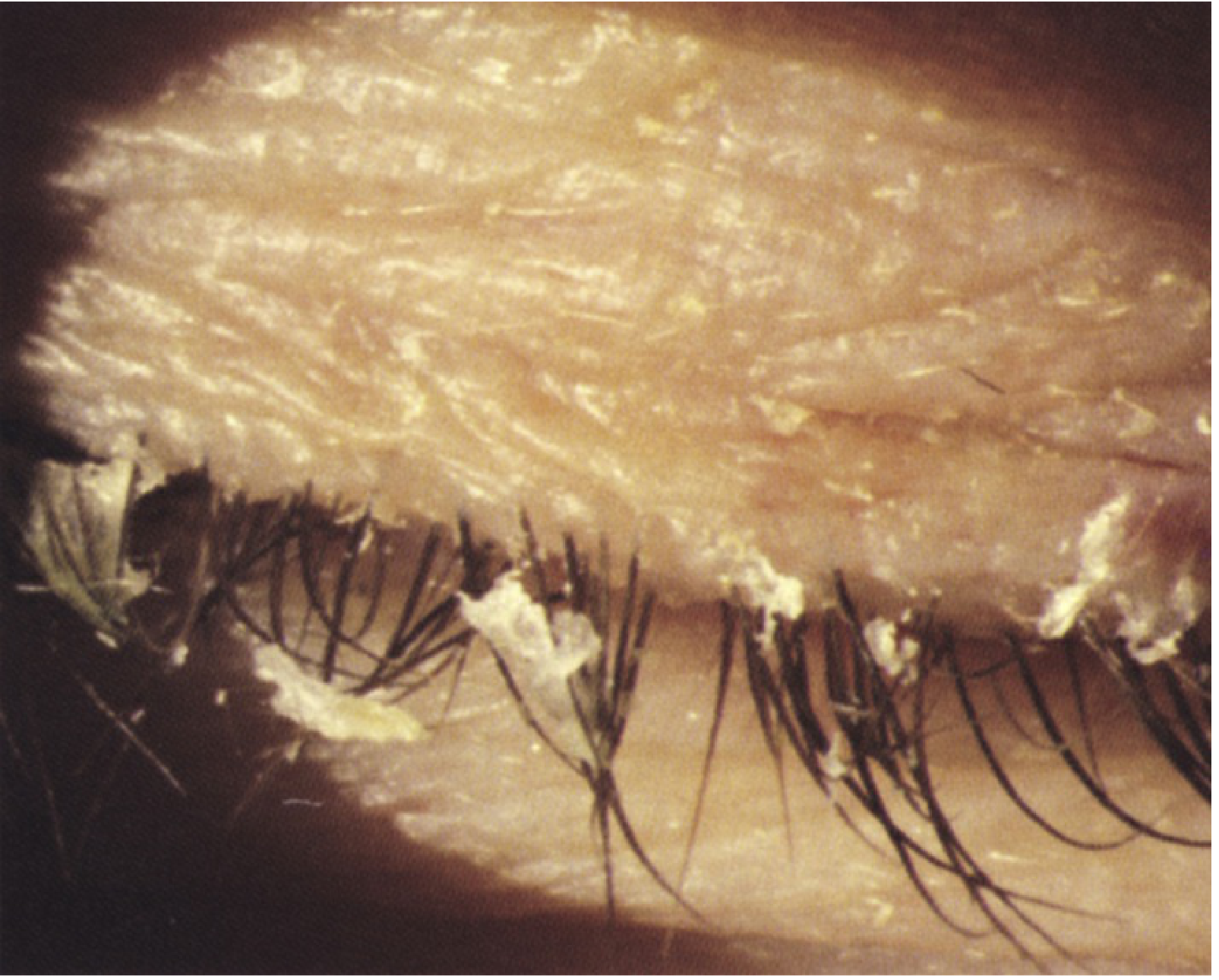
- Crusting and redness of the lid margins
- Morning crusting / lashes stuck together on waking
- Tearing; contact lens intolerance
- Remissions and exacerbations (chronically relapsing course)
- Stinging more common in posterior disease; dry eye symptoms worsen through the day
Signs by type:
| Feature | Staphylococcal | Seborrhoeic | Posterior (MGD) |
|---|---|---|---|
| Lid deposits | Hard scales, crusting | Soft, greasy scales | Inspissated meibomian glands |
| Lash changes | Collarettes, madarosis, trichiasis, poliosis | Sticky, greasy lashes | — |
| Lid margin | Ulceration, notching | — | Notching, telangiectasia, foamy tear film |
| Cyst | Hordeolum (++), chalazion (+) | — | Chalazion (++) |
| Tear film | Dry eye (+) | Dry eye (+) | Foaming, dry eye (++) |
| Cornea | Punctate erosions, peripheral infiltrates, vascularization | — | SPK (++) |
| Associated skin | Atopic dermatitis | Seborrhoeic dermatitis | Acne rosacea |
Collarettes (cylindrical sleeves around lash bases) are considered pathognomonic of Demodex infestation.
Long-standing disease → scarring, lid margin notching, madarosis (lash loss), trichiasis (misdirected lashes), poliosis (whitening of lashes).
Diagnostics
- Clinical diagnosis — slit-lamp examination of lid margins, lash bases, meibomian gland orifices
- Evert eyelid: assess meibomian gland inspissation
- Microscopic examination of epilated eyelashes — if Demodex suspected (cylindrical sleeves confirm)
- Culture if bacterial superinfection suspected
- Look for associated skin disease (rosacea, seborrhoeic dermatitis, atopic dermatitis)
- Important to exclude sebaceous gland carcinoma in chronic unilateral blepharitis, recurrent chalazia, or madarosis in older patients
Treatment
Step 1 — Lid hygiene (cornerstone of management):
- Warm compresses 5–10 min, 2–4× daily → softens crusts and meibum
- Lid scrubs 2× daily with commercial scrub pads or diluted mild shampoo on a washcloth → removes debris, reduces bacterial load
- Meibomian gland expression: roll finger anteriorly over lid margin when significant MGD is present
- Frequency can be reduced once controlled
Step 2 — Topical antibiotics (for active anterior folliculitis):
- Topical: sodium fusidic acid, erythromycin ointment, azithromycin gel-drop, bacitracin, chloramphenicol — applied to lid margins at bedtime (q.h.s.) after lid hygiene
Step 3 — Oral antibiotics (posterior/MGD, rosacea-associated, or resistant disease):
- Doxycycline 50–100 mg twice daily × 1 week → taper to 50 mg daily × 6–24 weeks (reduces lipase production; anti-inflammatory)
- Lymecycline 408 mg daily up to 3 months
- Azithromycin 500 mg daily × 3 days for 3 cycles at 1-week intervals (preferred for anterior disease)
- Erythromycin 250 mg 1–2× daily (alternative; safe in children and pregnancy)
- ⚠️ Tetracyclines contraindicated in children <12 years and pregnancy/breastfeeding
Step 4 — Anti-inflammatory agents:
- Topical steroid (fluorometholone 0.1% or loteprednol 4× daily × 1 week) for active inflammation or papillary conjunctivitis; occasionally higher-strength preparations
- Cyclosporine 0.05% / 0.09% or lifitegrast 5% drops b.i.d. for immune-mediated component
- Topical antibiotic-steroid combination (e.g., tobramycin/dexamethasone) for unresponsive meibomitis
Step 5 — Adjunctive / Demodex-specific:
- Omega-3 fatty acid supplementation (fish/plant oil supplements show substantial benefit)
- Tea tree oil (50% scrub + 5% ointment; or terpinen-4-ol 2.5% wipes) — anti-Demodex activity
- Topical permethrin, oral ivermectin (200 µg/kg × 2 doses, 1 week apart)
- Lotilaner 0.25% (TP-03) ophthalmic solution — novel, effective at reducing collarettes and Demodex density within 4 weeks
- Preservative-free artificial tears for dry eye component
- Novel devices (e.g., LipiFlow) — thermal pulsation to heat and express meibomian glands
II. HORDEOLUM (STYE — "Barley")
Definition
An hordeolum is an acute, painful, tender infection of an eyelid gland:
- External hordeolum (stye): abscess of the gland of Zeis (sebaceous gland of a lash follicle) or Moll's gland — appears at the eyelid margin
- Internal hordeolum: abscess of the meibomian gland — points toward the conjunctival surface
Etiology
- Causative organism: Staphylococcus aureus (most common); occasionally other Staphylococcus species
- May evolve from or coexist with a chalazion
Risk Factors
- Blepharitis (most important predisposing condition)
- Poor eyelid hygiene
- Rosacea
- Immunocompromise / diabetes
- Contact lens wear
Clinical Features
- Acute onset of painful, red, tender, localized swelling at the eyelid margin (external) or within the tarsal plate (internal)
- Erythema, oedema of surrounding lid
- May point and drain mucopurulent material spontaneously
- May progress to preseptal cellulitis if untreated
Diagnostics
- Clinical — history and external examination
- Palpate lid for nodule; evert eyelid
- Slit-lamp assessment for associated blepharitis/meibomitis
- Culture only if recurrent or cellulitis develops
Treatment
- Warm compresses ≥10 minutes, 4× daily — promotes spontaneous drainage
- Topical antibiotic (bacitracin, tobramycin, or erythromycin ointment b.i.d. × 1–2 weeks)
- If worsening → incision and drainage (I&D); manage secondary preseptal cellulitis with systemic antibiotics
- Systemic antibiotics (e.g., oral penicillinase-resistant antibiotic or trimethoprim-sulfamethoxazole for MRSA) if cellulitis develops
III. CHALAZION (Meibomian Cyst)
Definition
A chalazion is a sterile, chronic, granulomatous inflammatory lesion (lipogranuloma) of the meibomian gland (occasionally of the gland of Zeis), resulting from obstruction and retained sebaceous secretions. It may evolve from an internal hordeolum. (Kanski's Clinical Ophthalmology)
Etiology and Pathogenesis
- Obstruction of meibomian gland duct → retained lipid secretions → lipogranulomatous chronic inflammatory reaction
- Histopathology: extracellular fat deposits surrounded by lipid-laden epithelioid cells, multinucleated giant cells, and lymphocytes
- Not primarily infectious (though may become secondarily infected → internal hordeolum)
- Bortezomib (proteasome inhibitor for multiple myeloma) predisposes to chalazia within 3 months of initiation
Risk Factors
- Chronic blepharitis / MGD
- Acne rosacea (associated with multiple and recurrent chalazia)
- Seborrhoeic dermatitis
- Systemic retinoids
- Bortezomib therapy
- Immunosuppression
Clinical Features
Subacute/chronic presentation (typical):
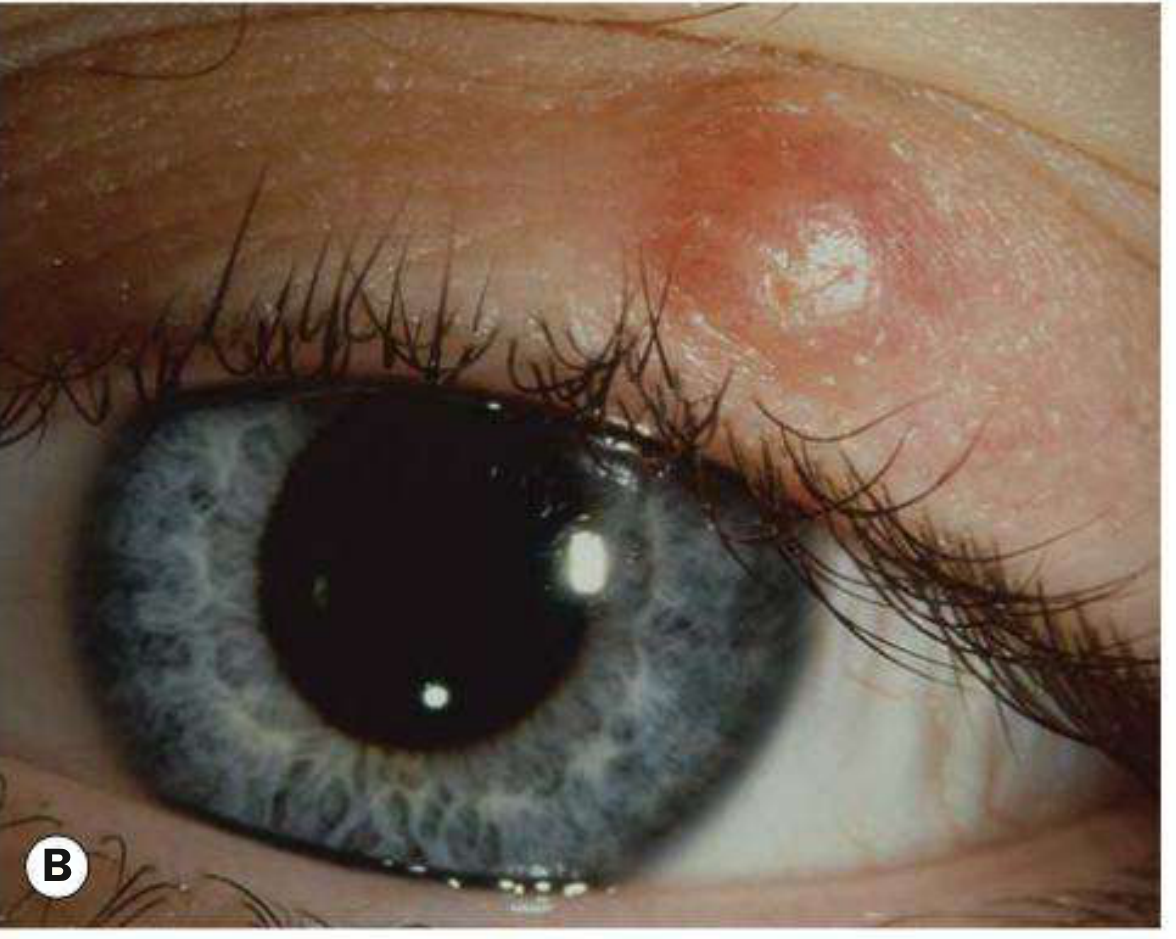
- Gradually enlarging, painless, well-defined, firm, rounded nodule within the tarsal plate — visible or palpable
- Upper lid more commonly affected than lower
- Bulging inspissated secretions may be visible at the meibomian gland orifice
- Associated conjunctival granuloma may form on the inner surface of the everted lid
Acute presentation:
- Localized cellulitis, pain, erythema if secondarily infected (internal hordeolum)
Diagnostics
- History: previous chalazia, eyelid lesions, ocular surgery, systemic medications (bortezomib, retinoids), rosacea
- External examination: palpate eyelid for nodule; inspect for rosacea
- Slit-lamp examination: evert eyelid — assess meibomian glands for inspissation; look for madarosis, poliosis, ulceration (to exclude malignancy)
- Differential diagnosis to exclude:
- Sebaceous gland carcinoma — suspect in older patients with recurrent chalazia in the same position, eyelid thickening, madarosis, or chronic unilateral blepharitis → biopsy
- Preseptal cellulitis
- Pyogenic granuloma
- Rule: All excised chalazia (especially recurrent or atypical) should be sent for histopathology
Treatment
Conservative (first-line):
- Warm compresses ≥10 minutes, 4× daily + gentle massage over the lesion
- At least one-third of chalazia resolve spontaneously → observation appropriate if improving
Medical:
- Topical antibiotic-steroid ointment (e.g., neomycin/polymyxin B/dexamethasone b.i.d. × 1–2 weeks) — for chalazion
- Oral doxycycline 20–50 mg daily–b.i.d. (low-dose, anti-inflammatory) — for multiple or recurrent chalazia, especially with rosacea
- Systemic antibiotics only if significant bacterial infection present
Intralesional steroid injection (if conservative treatment fails):
- Triamcinolone acetonide 40 mg/mL diluted 1:1 with 2% lidocaine/epinephrine, 0.2–1.0 mL, 27- or 30-gauge needle
- Success rate ~80% after one injection; second injection possible after 1–2 weeks
- Preferred for marginal lesions or those near the lacrimal punctum
- ⚠️ Risks: skin depigmentation (especially dark-skinned individuals), fat atrophy, rare retinal vascular occlusion — use conjunctival approach to minimize depigmentation risk
Surgical — Incision and Curettage (I&C) (if lesion persists after 3–4 weeks of medical therapy):
- Local anaesthesia infiltration
- Eyelid everted with a chalazion clamp
- Vertical incision through the tarsal plate (conjunctival surface)
- Contents curetted; solid inflammatory material excised with fine scissors and sent for histopathology
- No sutures required
- Topical antibiotic 3× daily for 5 days post-procedure
- Marginal lesions: intralesional steroid, or horizontal incision on conjunctival surface, or vertical incision through the grey line
Prophylaxis of recurrence:
- Daily lid hygiene regimen (treat underlying blepharitis)
- Systemic tetracycline (long-term, low-dose) for recurrent chalazia with acne rosacea
Comparison Summary
| Feature | Hordeolum (Stye) | Chalazion |
|---|---|---|
| Nature | Acute infectious | Chronic sterile granuloma |
| Gland involved | Zeis / Moll (external); Meibomian (internal) | Meibomian (primarily) |
| Organism | S. aureus | None (sterile) |
| Pain | Acute, marked | Usually painless |
| Onset | Rapid (hours–days) | Gradual (weeks–months) |
| Location | At lid margin (ext.) / within tarsus (int.) | Within tarsal plate |
| Spontaneous resolution | Common | ~1/3 resolve spontaneously |
| Treatment | Warm compresses, topical antibiotic; I&D if severe | Warm compresses; steroid injection; I&C |
| Cancer risk | No | Recurrent → biopsy to exclude sebaceous carcinoma |
Sources: Kanski's Clinical Ophthalmology, 10th ed. · Wills Eye Manual · Rosen's Emergency Medicine · Goldman-Cecil Medicine
Eyelid diseases. Blepharitis. Barley. Chalazion. Definition. Etiology. Risk factors. Clinic. Diagnostics Treatment.
This question was just answered in full detail in the previous response. Here is a concise structured summary for quick reference:
Eyelid Diseases: Blepharitis, Hordeolum (Stye), Chalazion
BLEPHARITIS
Definition
Chronic bilateral inflammation of the eyelid margins. Divided into anterior (lash-base area) and posterior (meibomian gland dysfunction, MGD) forms; mixed overlap is most common.
Etiology
| Type | Cause |
|---|---|
| Anterior — staphylococcal | S. aureus; abnormal cell-mediated response to bacterial cell wall antigens |
| Anterior — seborrhoeic | Seborrhoeic dermatitis; overcolonization with Malassezia |
| Posterior (MGD) | Altered meibum → bacterial lipases → free fatty acids → raised melting point → gland obstruction, tear film instability |
| Demodex-associated | D. folliculorum longus (anterior); D. brevis (posterior) |
Risk Factors
Seborrhoeic dermatitis, acne rosacea, atopic dermatitis/eczema, Demodex infestation (older patients), contact lens wear, dry eye syndrome, immunosuppression.
Clinical Features
Symptoms (all forms): bilateral burning, itching, grittiness, morning crusting, mild photophobia, tearing — chronic relapsing course; worse in the morning (vs. dry eye which worsens through the day).
Signs by type:
| Staphylococcal | Seborrhoeic | Posterior/MGD | |
|---|---|---|---|
| Deposits | Hard scales, collarettes | Soft greasy scales | Inspissated meibomian glands, foam |
| Lash changes | Madarosis, trichiasis, poliosis | Sticky lashes | — |
| Lid margin | Ulceration, notching | — | Notching, telangiectasia |
| Complications | Hordeolum, peripheral corneal infiltrates | — | Chalazion, dry eye (++) |
| Associated disease | Atopic dermatitis | Seborrhoeic dermatitis | Acne rosacea |
Collarettes (cylindrical deposits around lash bases) = pathognomonic of Demodex infestation.
Chronic disease → scarring, madarosis, trichiasis, poliosis.
Diagnostics
- Clinical slit-lamp examination of lid margins and meibomian orifices
- Eyelid eversion: meibomian gland inspissation
- Epilated lash microscopy: Demodex mites/eggs
- Culture if bacterial superinfection suspected
- Exclude sebaceous carcinoma in chronic unilateral blepharitis with madarosis (especially older patients)
Treatment
- Lid hygiene (cornerstone): warm compresses 5–10 min b.i.d.–q.i.d. + eyelid scrubs (commercial pads or diluted mild shampoo) 2×/day; meibomian gland expression for MGD
- Topical antibiotics (anterior disease): erythromycin, bacitracin, azithromycin gel, fusidic acid — rubbed onto lid margins at bedtime
- Oral antibiotics (posterior/MGD or rosacea):
- Doxycycline 50–100 mg b.i.d. × 1 week → taper to 50 mg daily × 6–24 weeks
- Azithromycin 500 mg daily × 3 days for 3 cycles (preferred for anterior)
- Erythromycin 250 mg 1–2×/day (safe in children and pregnancy)
- ⚠️ Tetracyclines contraindicated <12 years, pregnancy, breastfeeding
- Topical steroids: fluorometholone 0.1% or loteprednol q.i.d. × 1 week for active inflammation
- Immunomodulators: cyclosporine 0.05–0.09% or lifitegrast 5% b.i.d.
- Demodex-specific: tea tree oil (50% scrub + 5% ointment) or terpinen-4-ol 2.5% wipes; oral ivermectin 200 µg/kg × 2 doses 1 week apart; lotilaner 0.25% ophthalmic solution
- Omega-3 supplements, preservative-free artificial tears, LipiFlow thermal pulsation device (for MGD)
HORDEOLUM ("BARLEY" / STYE)
Definition
Acute infectious abscess of an eyelid gland:
- External hordeolum: abscess of the gland of Zeis (sebaceous, at lash base) or Moll's gland — visible at the lid margin
- Internal hordeolum: abscess of the meibomian gland — points toward the conjunctival surface; more deeply seated
Etiology
Staphylococcus aureus (predominant); other Staphylococcus species. Acute bacterial infection — may evolve from or trigger a chalazion.
Risk Factors
Chronic blepharitis (primary predisposing condition), poor lid hygiene, rosacea, diabetes, immunocompromise, contact lens wear.
Clinical Features
- Rapid onset (hours to days) of painful, tender, erythematous, localized swelling
- External: at the lid margin, often with a visible pointing abscess or pustule
- Internal: within the tarsal plate, palpable tender nodule; conjunctival surface may show yellow spot
- Surrounding lid oedema and erythema
- May drain spontaneously (mucopurulent discharge)
- ⚠️ Can progress to preseptal (periorbital) cellulitis if untreated
Diagnostics
- Clinical diagnosis: history and external examination
- Palpate involved lid; evert eyelid
- Slit-lamp: assess for associated blepharitis/meibomitis
- Culture only if recurrent or cellulitis develops
Treatment
- Warm compresses ≥10 min, q.i.d. (promotes spontaneous drainage — first-line)
- Topical antibiotic: bacitracin, tobramycin, or erythromycin ointment b.i.d. × 1–2 weeks
- If worsening or no resolution: Incision and drainage (I&D)
- If preseptal cellulitis develops: systemic antibiotics (oral or IV depending on severity)
CHALAZION (Meibomian Cyst)
Definition
A sterile, chronic, granulomatous inflammatory lesion (lipogranuloma) of the meibomian gland (occasionally the gland of Zeis), caused by ductal obstruction and retention of sebaceous secretions. Not primarily infectious — may evolve from an internal hordeolum.
Etiology / Pathogenesis
- Obstruction of meibomian duct → stagnant lipid secretions → lipogranulomatous reaction
- Histopathology: extracellular fat deposits surrounded by lipid-laden epithelioid cells, multinucleated giant cells, lymphocytes
- Associated conditions: blepharitis, acne rosacea, seborrhoeic dermatitis
- Drug-associated: bortezomib (proteasome inhibitor) predisposes within 3 months of initiation
Risk Factors
Chronic blepharitis/MGD, acne rosacea (multiple/recurrent chalazia), seborrhoeic dermatitis, systemic retinoids, bortezomib therapy, immunosuppression.
Clinical Features
Subacute/chronic (typical):
- Gradual, painless, well-defined, firm, rounded nodule within the tarsal plate
- Upper lid > lower lid
- No acute tenderness; may cause cosmetic deformity or visual blurring if large (induced astigmatism)
- Inspissated secretions visible at gland orifice
- Associated conjunctival granuloma (visible on everted lid)
Acute:
- Secondarily infected → internal hordeolum: painful, erythematous, tender lid swelling
Diagnostics
- History: previous chalazia, medications (bortezomib, retinoids), rosacea
- External examination: palpate nodule; inspect for rosacea
- Slit-lamp + lid eversion: assess meibomian glands, look for madarosis/poliosis/ulceration
- Differential: preseptal cellulitis, sebaceous carcinoma, pyogenic granuloma, forniceal foreign body
- ⚠️ Recurrent chalazion in same position in older patient → biopsy to exclude sebaceous gland carcinoma
- All excised specimens sent for histopathology
Treatment
Conservative (first-line):
- Warm compresses ≥10 min q.i.d. + gentle massage
- ~1/3 resolve spontaneously; observation appropriate if improving
Medical:
- Topical antibiotic-steroid ointment (neomycin/polymyxin B/dexamethasone b.i.d. × 1–2 weeks)
- Oral doxycycline 20–50 mg daily (low-dose anti-inflammatory) for recurrent/multiple chalazia or rosacea
Intralesional steroid injection (if conservative therapy fails at 3–4 weeks):
- Triamcinolone acetonide 40 mg/mL diluted 1:1 with 2% lidocaine/epinephrine, 0.2–1.0 mL
- Success ~80% after first injection; repeat at 1–2 weeks if needed
- Preferred for marginal lesions near the lacrimal punctum
- ⚠️ Risks: skin depigmentation (especially dark skin), fat atrophy, rare retinal artery occlusion
Surgical — Incision and Curettage (I&C):
- Indications: failed medical therapy + patient request
- Technique: local anaesthesia → eyelid everted with chalazion clamp → vertical incision through tarsal plate (conjunctival surface) → curette contents → no suture → topical antibiotic 3× daily × 5 days
- Send contents for histopathology
Prophylaxis:
- Daily lid hygiene (treats underlying blepharitis)
- Long-term low-dose tetracycline if recurrent chalazia with rosacea
At-a-Glance Comparison
| Feature | Hordeolum | Chalazion |
|---|---|---|
| Nature | Acute infection | Chronic sterile granuloma |
| Gland | Zeis/Moll (ext.) or meibomian (int.) | Meibomian (primarily) |
| Organism | S. aureus | None |
| Pain | Acute, severe | Usually painless |
| Onset | Rapid (hours–days) | Gradual (weeks) |
| Spontaneous resolution | Common | ~1/3 |
| Treatment | Warm compress; topical antibiotic; I&D | Warm compress; steroid injection; I&C |
| Malignancy risk | No | Recurrent/atypical → biopsy |
Sources: Kanski's Clinical Ophthalmology 10th ed. · Wills Eye Manual · Rosen's Emergency Medicine · Goldman-Cecil Medicine
This is a shared conversation. Sign in to Orris to start your own chat.