
myasthenia gravis
I'll read the medical library skill first, then research myasthenia gravis comprehensively.
Reading File
Now I'll run parallel searches - heading search for MG sections, paragraph FTS for key details, and PubMed for recent evidence.
Finding Sources
Searching PubMed
"myasthenia gravis"[MeSH Terms] AND treatment
Excellent. The neurology textbook (Bradley and Daroff's) has the most comprehensive sections. Let me read those in parallel along with key paragraph searches.
Reading File
Reading File
Reading File
Good content so far. Now let me search for the main dedicated MG chapter and treatment details in parallel.
Finding Sources
Finding Sources
Let me now read the most comprehensive dedicated MG sections - the neurology block 29/30 (dedicated chapter) and Rosen's Emergency Medicine and the Harriet Lane/Robbins pathology sections.
Reading File
Reading File
Reading File
Excellent content. Let me now read the main dedicated chapter from block29 more fully (treatment, diagnosis sections), the Harriet Lane pediatric section, and Henry's lab diagnostics section.
Reading File
Reading File
Reading File
Excellent content gathered. Now let me fetch the clinical images from the neurology textbook and read the diagnosis/treatment sections from block29.
Reading File
Loading Image
I now have comprehensive content from multiple textbooks. Let me fetch one more key image (NMJ pathology) and read the treatment section from block29.
Reading File
Loading Image
I now have extensive, detailed content from multiple authoritative textbooks. Let me compile the comprehensive answer.
Myasthenia Gravis (MG)
Definition & Overview
Myasthenia gravis is the most common primary disorder of neuromuscular transmission (NMT). It is an autoimmune disease in which circulating antibodies target proteins at the neuromuscular junction (NMJ), resulting in fatigable, fluctuating skeletal muscle weakness - the cardinal feature. Weakness worsens with activity and improves with rest.
- US prevalence: ~20 per 100,000 (~60,000 patients)
- The prevalence has been rising over the past 50 years, largely due to increased diagnosis in elderly patients
- Bradley and Daroff's Neurology in Clinical Practice, p. 2770
Epidemiology
| Feature | Details |
|---|---|
| Bimodal onset | Early (20s-30s, female predominance); Late (50s-70s, male predominance) |
| Gender | Women affected ~3x more than men before age 40; male predominance after age 50 |
| Thymic abnormalities | Thymic hyperplasia (60-70%); Thymoma (10-15%) |
| Overall | All ethnicities affected; majority of US patients are now over age 50 |
- Robbins & Kumar Basic Pathology, p. 507; Bradley and Daroff's Neurology, p. 2771
Pathophysiology
The NMJ lacks a blood-nerve barrier, making it uniquely vulnerable to circulating autoimmune factors.
Anti-AChR antibodies (80-85% of generalized MG) target the α1 subunit of the nicotinic acetylcholine receptor (nAChR) on the postsynaptic junctional folds. They cause disease by three mechanisms:
- Complement-mediated destruction of the postsynaptic membrane and junctional folds
- Accelerated internalization and degradation of AChRs (cross-linking/modulating antibodies)
- Direct blocking of ACh binding to the AChR (blocking antibodies)
With repeated stimulation, fewer and fewer AChR sites remain available, producing the characteristic fatigue.
- Rosen's Emergency Medicine, p. 2261; Robbins & Kumar Basic Pathology, p. 509
Autoantibody Subtypes & Clinical Correlates
| Antibody | Frequency | Key Features |
|---|---|---|
| Anti-AChR (binding) | 85-90% of generalized MG; 50% ocular MG | Measured by radioimmunoassay (RIA); complement-activating IgG1 |
| Anti-AChR (blocking) | <1% of seropositive patients | Blocks ACh binding at α-subunit |
| Anti-AChR (modulating) | ~10% of binding-Ab-negative | Cross-links, internalizes AChR; associated with thymoma |
| Anti-MuSK | 30-40% of AChR-negative patients | IgG4; prominent facial/bulbar/respiratory weakness; may worsen with pyridostigmine |
| Anti-LRP4 | 1-3% of all MG patients | Mild-moderate symptoms; marked female predominance |
| Striational Abs (anti-titin, anti-ryanodine) | Thymoma-associated MG | Associated with severe disease |
| Seronegative | ~5% | Antibodies against clustered AChR, agrin, or cortactin in some |
- Bradley and Daroff's Neurology, Table 108.1; Henry's Clinical Diagnosis, p. 21
Clinical Subtypes
- Ocular MG: Weakness confined to extraocular and eyelid muscles; ~15-20% of patients remain at this stage
- Generalized MG (GMG): Spreads beyond ocular muscles; can involve bulbar, limb, and respiratory muscles
- Myasthenic crisis: Respiratory muscle weakness requiring mechanical ventilation - a medical emergency
- Bradley and Daroff's Neurology, p. 2769
Clinical Features
Ocular symptoms (initial in ~65% of patients):
- Ptosis (drooping eyelid) - often asymmetric, worse at end of day
- Diplopia (double vision) due to extraocular muscle weakness
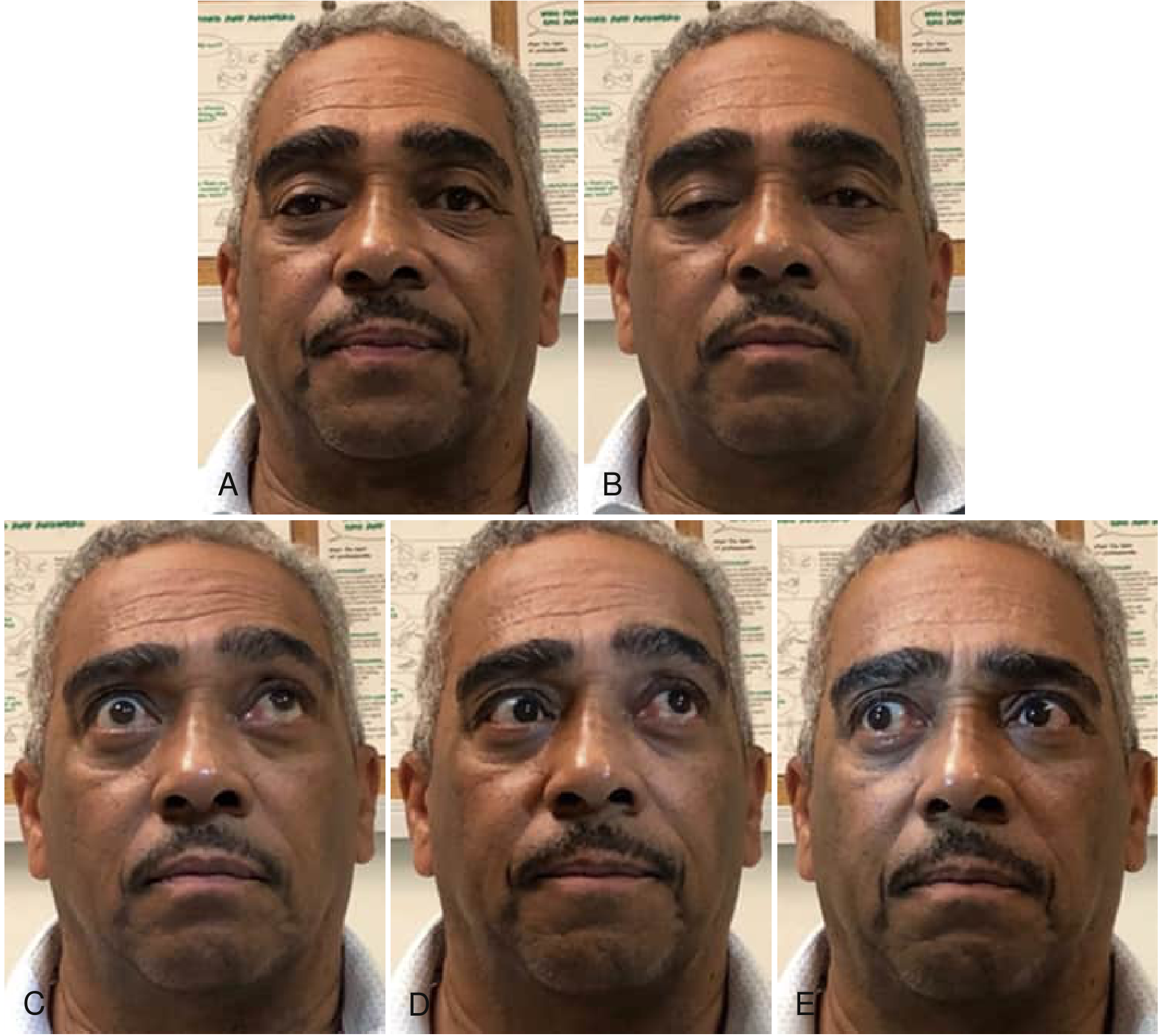
Bulbar symptoms (initial in ~6-30%):
- Dysarthria (nasal/slurred speech), dysphagia, difficulty chewing
- Aspiration (often silent) in 35%+ of those with dysphagia
- Can precipitate myasthenic crisis (56% of crisis cases linked to dysphagia)
Other features:
- Limb weakness (initial in ~10%): difficulty combing hair, brushing teeth, "drooping head" sign
- Respiratory failure (rarely the initial symptom)
- Tendon reflexes and sensation are normal - key distinguishing feature
- Bradley and Daroff's Neurology, p. 2769-2770; Harriet Lane Handbook, p. 748
Diagnosis
The diagnosis rests on four pillars:
- Compatible clinical history (fatigable weakness)
- Serological testing (AChR-Ab, MuSK-Ab)
- Abnormal electrodiagnostic study
- Beneficial response to acetylcholinesterase inhibitors
Electrodiagnostic Testing
- Repetitive nerve stimulation (RNS): Decremental response (>10-15% decrease in compound muscle action potential amplitude) is characteristic
- Single-fiber EMG (SFEMG): Most sensitive test for NMJ dysfunction; shows increased "jitter"
Serological Testing
- AChR binding assay: ~85% sensitivity for GMG, ~50% for ocular MG
- Anti-MuSK (RIA): tested if AChR-Ab negative
- AChR-Ab levels do not reliably predict disease severity or response to treatment
Edrophonium (Tensilon) Test
- Inhibits acetylcholinesterase; positive in 60-95% of ocular MG and 72-95% of generalized MG
- Largely replaced by antibody testing in modern practice
Imaging
- CT or MRI of the chest to detect thymoma - mandatory in all patients
- Henry's Clinical Diagnosis, p. 26; Bradley and Daroff's Neurology, p. 2774-2775
Bedside tests (from Harriet Lane):
- Single breath count: Patient counts as high as possible in one breath; result <20 suggests respiratory impairment
- Slurp test: Patient drinks 4 oz of water through a straw; slowing after 1-2 oz indicates bulbar risk
Treatment
Treatment is organized into four categories:
1. Symptomatic: Acetylcholinesterase Inhibitors (ChEIs)
- Pyridostigmine bromide is first-line; initial adult dose 30-60 mg every 4-8 hours
- Pediatric dose: 1 mg/kg; available as syrup (60 mg/5 mL) for children/NG tube
- Timed-release tablet (180 mg) useful as a bedtime dose
- Side effects: muscarinic effects (nausea, diarrhea, abdominal cramps, increased secretions); manage with glycopyrrolate or propantheline
- Caution: Patients with MuSK-MG may worsen with ChEIs
2. Short-Term / Rapid-Onset Immune Therapies
| Therapy | Mechanism | Onset | Duration |
|---|---|---|---|
| Plasma exchange (PLEX) | Removes circulating antibodies | Days | 4-12 weeks |
| IV Immunoglobulin (IVIG) | Modulates immune response | Days | 4-8 weeks |
- Typical PLEX course: 5-6 exchanges every other day (2-3 L each)
- Used for myasthenic crisis, pre-thymectomy, to blunt corticosteroid-induced exacerbations
3. Long-Term Immunosuppression
- Corticosteroids (prednisone): Highly effective but caution - large initial doses can cause paradoxical worsening
- Azathioprine: Steroid-sparing; onset 6-18 months
- Mycophenolate mofetil: Alternative steroid-sparing agent
- Rituximab: Anti-CD20; particularly effective in MuSK-MG; a 2025 Cochrane review (PMID: 40607605) and 2025 network meta-analysis (PMID: 40346603) confirm its role
- Eculizumab: Terminal complement inhibitor; FDA-approved for refractory generalized MG
- Cyclosporine, tacrolimus, methotrexate: Used in refractory cases
4. Thymectomy
- Indicated in all patients with thymoma (risk of malignant transformation)
- Recommended in AChR-Ab-positive patients (even without thymoma) - retrospective studies show improved survival and symptom relief
- Less clear benefit in MuSK-MG or seronegative MG
- Bradley and Daroff's Neurology, p. 2776-2785; Harriet Lane Handbook, p. 748
Myasthenic Crisis
A life-threatening exacerbation causing respiratory failure.
Precipitating factors:
- Infections, surgery, fever, heat
- Dysphagia (major precipitant in 56% of crises)
- Medications (see below)
- Inadequate immunosuppression, rapid steroid tapering
ED Management (Rosen's Emergency Medicine):
- PLEX or IVIG as mainstay
- Evaluate need for definitive airway management
- ICU-level respiratory monitoring (vital capacity monitoring)
- Continue pyridostigmine if able to swallow; IV neostigmine if not
Drugs to Avoid in MG
Certain drugs can exacerbate MG or precipitate crisis:
| Category | Agents |
|---|---|
| Antibiotics | Aminoglycosides, fluoroquinolones, tetracyclines, clindamycin, polymyxin B |
| Cardiovascular | Beta-blockers, calcium channel blockers, quinine, procainamide, lidocaine |
| Anesthesia | Succinylcholine (hypersensitive), non-depolarizing NMBs (prolonged effect) |
| Antimalarials | Chloroquine, hydroxychloroquine |
| Antipsychotics | Chlorpromazine, risperidone |
| Other | Phenytoin, thyroid replacement |
- Rosen's Emergency Medicine Box 94.2; Harriet Lane Box 20.13
Special Populations
Neonatal MG: Transplacental transfer of maternal AChR antibodies; transient (weeks to months) - resolves as maternal antibodies clear
Congenital myasthenic syndromes: Genetic defects in NMJ proteins (not autoimmune); distinct from acquired MG
Pregnancy: MG can worsen during pregnancy and postpartum; management requires specialist involvement (neonatal MG risk must be assessed)
MuSK-MG: More prominent facial, bulbar, and respiratory weakness; IgG4 antibodies; thymus usually normal; ChEIs may worsen symptoms; rituximab particularly effective
Prognosis
- Most patients achieve minimal manifestation status or stable improvement with treatment
- Normal lifespan in the majority
- ~10% are treatment-refractory
- Mortality risk from respiratory failure remains in severe/crisis cases
Recent Evidence (2024-2026)
Two high-tier meta-analyses update the management landscape:
- A 2025 Cochrane systematic review on rituximab for MG (PMID 40607605) provides updated evidence on its role, particularly in refractory and MuSK-MG
- A 2025 network meta-analysis comparing novel biologics (including eculizumab, efgartigimod, rozanolixizumab, and others) for generalized MG (PMID 40346603) - FcRn inhibitors and complement inhibitors show strong efficacy signals and are changing the treatment landscape for refractory disease
Sources: Bradley and Daroff's Neurology in Clinical Practice | Robbins & Kumar Basic Pathology | Rosen's Emergency Medicine | Henry's Clinical Diagnosis and Management by Laboratory Methods | Harriet Lane Handbook | Medical Physiology | Cochrane Database 2025
This is a shared conversation. Sign in to Orris to start your own chat.