
Sonics amd ultrasonics
Asking for Preferences
What would you like to know about sonics and ultrasonics?
Medical/diagnostic ultrasound - got it. Let me pull from the medical library for a thorough, textbook-grounded answer.
Reading File
Finding Sources
Finding Sources
Good - I found a dedicated "Ultrasound" section in Pye's Surgical Handicraft which is likely a physics/principles overview, plus clinical procedure content from Roberts & Hedges. Let me read the core sections in parallel.
Reading File
Finding Sources
Finding Sources
The Campbell Walsh Urology text has a "PHYSICAL PRINCIPLES" section for ultrasound. Let me read it and also search for more detailed principles.
Reading File
Finding Sources
Excellent! Murray & Nadel has a dedicated "PHYSICS OF ULTRASOUND" section, and Bailey & Love, Goldman Cecil, and Miller's Anesthesia have great content too. Let me read multiple key sections in parallel.
Reading File
Reading File
Finding Sources
Excellent content. Let me now get Doppler, imaging modes, and artifacts/safety sections.
Reading File
Finding Sources
Finding Sources
I now have excellent, comprehensive content from multiple authoritative textbooks. Let me fetch the key ultrasound diagram image to include visually.
Reading File
I now have comprehensive textbook content to deliver a thorough answer. Let me compose it.
Loading Image
Now I have everything needed for a comprehensive, well-illustrated answer. Here it is:
Medical/Diagnostic Ultrasound: Sonics and Ultrasonics
1. What Is Ultrasound?
Sound exists on a spectrum defined by frequency:
| Range | Frequency | Examples |
|---|---|---|
| Infrasound | < 20 Hz | Earthquakes, elephant communication |
| Audible sound (sonic) | 20 Hz - 20,000 Hz | Human hearing |
| Ultrasound | > 20,000 Hz (20 kHz) | Medical imaging, industrial testing |
Medical/diagnostic ultrasound uses frequencies of 2 to 20 MHz - far above the limit of human hearing. Lower frequencies (2-5 MHz) penetrate deeply but resolve poorly; higher frequencies (5-20 MHz) resolve finely but penetrate only a few centimetres.
"Ultrasound is the second most commonly used method of imaging. It relies on high-frequency sound waves generated by a transducer containing piezoelectric material."
- Bailey and Love's Short Practice of Surgery, 28th Ed.
2. Physical Principles
The Piezoelectric Effect
The heart of every ultrasound transducer is a piezoelectric crystal (typically lead zirconate titanate). When alternating electrical current is applied, the crystal alternately expands and contracts - generating mechanical (sound) waves. The reverse is also true: returning sound waves deform the crystal and produce electrical signals. So the transducer acts as both transmitter and receiver.
"Short bursts of alternating electrical current [are applied] to a series of crystals housed in the transducer. Alternating expansion and contraction of the crystals via the piezoelectric effect creates a mechanical wave that is transmitted through a coupling medium to the skin and then into the body."
- Campbell Walsh Wein Urology, 3-Volume Set
Wave Propagation
Ultrasound waves are longitudinal waves - particle motion occurs in the same direction as wave propagation, creating alternating zones of compression and rarefaction through tissue.
A layer of conductive gel is applied to the skin to eliminate the air gap (air reflects ~99.9% of ultrasound energy) and allow wave transmission into the body.
Acoustic Impedance
Acoustic impedance (Z) is the resistance a tissue offers to sound propagation. The greater the difference in impedance between two adjacent tissues, the more sound is reflected at their interface. This is what creates the image - bone/soft tissue interfaces reflect strongly (appearing bright/hyperechoic), while fluid transmits sound without reflection (appearing dark/anechoic).
Attenuation
As waves travel deeper, they lose energy through absorption, scatter, and reflection - this is attenuation. Higher-frequency waves attenuate more rapidly, limiting their depth penetration. This explains why:
- Abdominal imaging uses 2-5 MHz transducers
- Superficial structures (breast, musculoskeletal, thyroid) use 5-15 MHz transducers
- Endocavity probes (transvaginal, transrectal) use high frequencies (up to 20 MHz) because the organ is close
"Higher frequency (shorter wavelength) waves experience more attenuation and therefore exhibit less tissue penetration."
- Murray & Nadel's Textbook of Respiratory Medicine
Resolution
- Axial resolution: ability to distinguish two structures along the beam axis (superficial vs. deep). Improves with higher frequency.
- Lateral resolution: ability to distinguish structures side by side. Improves with wider transducers and is best at the focal zone.
- Focal zone: the depth at which beam width is narrowest and resolution is sharpest. Proximal = near field; distal = far field.
3. Transducer Types
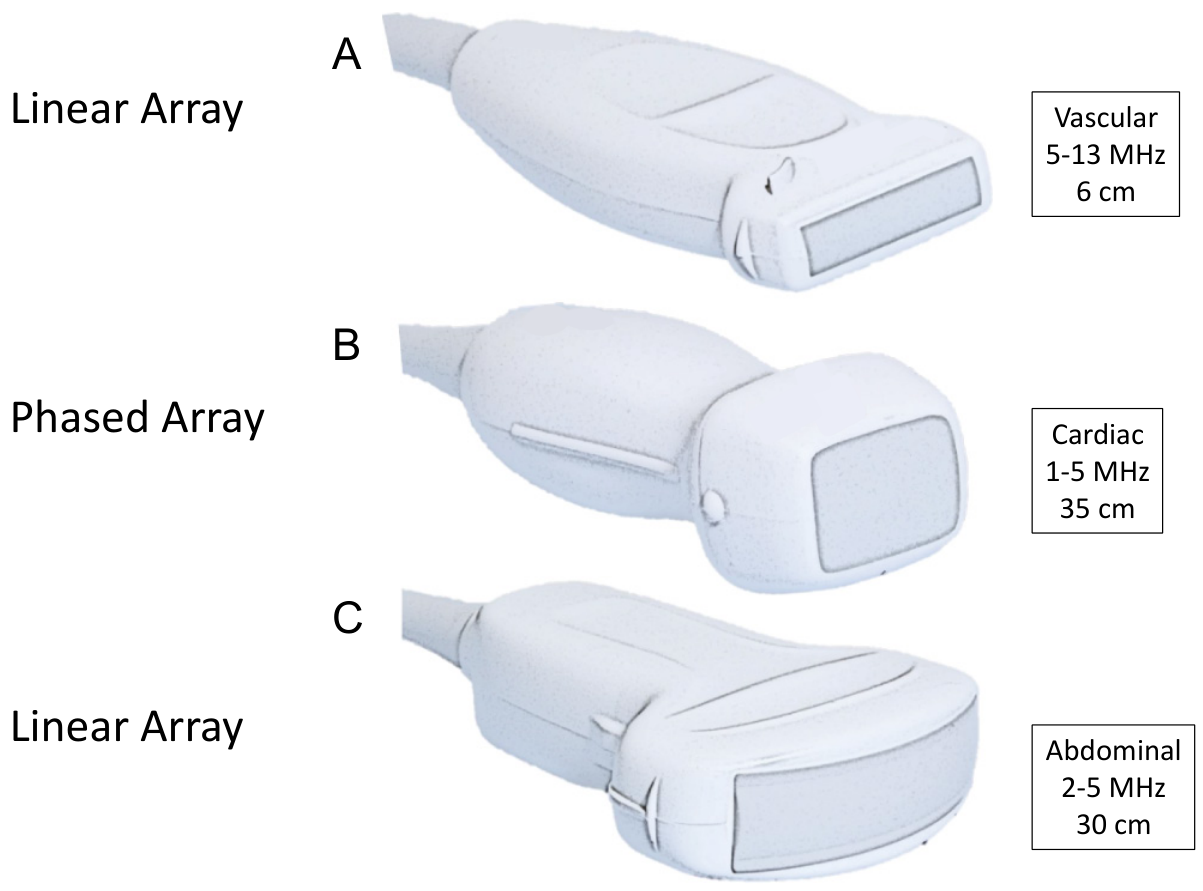
| Transducer | Frequency | Crystal Array | Primary Use |
|---|---|---|---|
| Linear (flat) | 5-13 MHz | Sequential excitation | Vascular, superficial structures |
| Phased array | 1-5 MHz | Simultaneous multi-directional | Cardiac imaging, small footprint |
| Curvilinear/Convex | 2-5 MHz | Curved linear array | Abdomen, pelvis, deeper structures |
| Endocavity | 5-15 MHz | Miniaturized | Transvaginal, transrectal |
"A typical configuration for a POCUS machine includes a high-frequency (5-13 MHz) linear transducer for superficial structures and at least one lower frequency (1-8 MHz) transducer for deeper structures."
- Murray & Nadel's Textbook of Respiratory Medicine
4. Imaging Modes
B-Mode (Brightness Mode) - 2D
The standard imaging mode. Pixel brightness is proportional to reflected signal intensity. A real-time, two-dimensional cross-sectional image is built from many scan lines. This is the default mode for most clinical examinations.
Echogenicity descriptors:
- Hyperechoic (bright) - e.g., bone cortex, gallstones, calcifications
- Hypoechoic (dark) - e.g., solid tumors, muscle
- Anechoic (black) - e.g., fluid, blood, bile, cyst contents
- Isoechoic - same brightness as surrounding tissue
M-Mode (Motion Mode)
Surveys a single line in the ultrasound beam over time, graphing changes in that line's echo intensity. Particularly useful for:
- Measuring IVC diameter variation with respiration (volume status assessment)
- Measuring cardiac wall motion and chamber dimensions
- Fetal heart rate confirmation in obstetrics
"M- (for 'motion') mode surveys a single point in the ultrasound beam over time. This mode is useful for evaluating changes in size or shape over time, such as change in diameter of the IVC with respiration."
- Murray & Nadel's Textbook of Respiratory Medicine
A-Mode (Amplitude Mode)
Historically the earliest form - a simple 1D display of echo amplitude vs. depth. Now largely replaced but still used in ophthalmology (axial length measurement) and some specialized applications.
Doppler Modes
Based on the Doppler effect: sound reflected from moving objects (e.g., red blood cells) is shifted in frequency relative to the emitted signal. The frequency shift is proportional to velocity.
| Doppler Type | How It Works | Uses |
|---|---|---|
| Color Flow Doppler | Flow toward transducer = red; away = blue, displayed over 2D image | Quick vascular survey, valve disease |
| Pulsed Wave (PW) Doppler | Sample gate placed at specific location, gives velocity at that point | Measure flow at specific site (e.g., mitral valve, renal artery) |
| Continuous Wave (CW) Doppler | Continuous transmission - measures all velocities along the beam, not localized | High-velocity flow (e.g., aortic stenosis jet) |
| Tissue Doppler Imaging (TDI) | Measures myocardial velocity, not blood velocity | Diastolic function assessment |
"Color flow Doppler is most often used to evaluate blood flow in vessels. Flow toward or away from the transducer is color coded on the ultrasound machine in response to the Doppler shift during 2D imaging."
- Murray & Nadel's Textbook of Respiratory Medicine
Key limitation: Doppler is angle-dependent. Velocities measured at >60° to the beam direction are significantly underestimated. Accurate measurement requires aligning the sample gate as close to parallel with flow as possible.
5. Common Artifacts
Understanding artifacts is essential to avoiding misdiagnosis:
| Artifact | Mechanism | Appearance | Clinical Example |
|---|---|---|---|
| Acoustic shadowing | Dense structure blocks sound (high impedance mismatch) | Dark shadow posterior to structure | Gallstones, calcifications, bone |
| Posterior enhancement | Fluid transmits sound well - tissue behind gets extra signal | Bright area posterior to fluid | Cysts, bladder |
| Reverberation | Sound bounces between two reflectors repeatedly | Multiple equally spaced lines | Needle artifact, bowel gas |
| Mirror artifact | Strong reflector (e.g., diaphragm) duplicates image | Duplicate structure on other side | Liver mirrored above diaphragm |
| Aliasing (color Doppler) | Flow velocity exceeds Nyquist limit of pulsed Doppler | Color wraps from red to blue abruptly | Stenotic jets |
| Side lobe artifact | Off-axis beam reflections | Spurious echoes in fluid | Apparent debris in bladder |
"Acoustic shadowing occurs when a large impedance mismatch is encountered by the ultrasound wave, and there is intense hyperechoic reflection... This can result in a false image deep to the true image."
- Yamada's Textbook of Gastroenterology
6. Clinical Applications
Abdominal
- Liver (metastases, cirrhosis, focal lesions)
- Gallbladder and bile ducts (stones, cholecystitis, ductal dilatation - highly sensitive)
- Pancreas (limited by bowel gas)
- Kidneys (hydronephrosis, calculi, masses)
- Aorta (aneurysm screening)
- FAST exam (Focused Assessment with Sonography in Trauma) - free fluid in peritoneum/pericardium
"Ultrasound is... effective method of detecting bile duct dilatation in the investigation of jaundice... more accurate than radio-isotope scanning in the detection of metastatic deposits."
- Pye's Surgical Handicraft, 22nd Ed.
Cardiac (Echocardiography)
- Ventricular function (ejection fraction)
- Valve disease (stenosis, regurgitation - quantified by Doppler)
- Pericardial effusion
- Cardiac tamponade
Frequency range for cardiac: 2-10 MHz; lower frequencies for adults (more depth needed), higher for pediatric.
"The frequency of ultrasound waves used for diagnostic imaging ranges from 2 to 10 MHz, with lower frequencies having greater tissue penetration and higher frequencies providing better image resolution."
- Goldman-Cecil Medicine
Vascular
- Deep vein thrombosis (DVT) - compression ultrasound of lower extremity veins
- Carotid artery stenosis (color Doppler + spectral analysis)
- Transcranial Doppler (TCD) for cerebral blood flow velocities
- Renal artery stenosis
Obstetric
- Fetal biometry and growth monitoring
- Anatomic survey (structural anomalies)
- Placental location
- Amniotic fluid volume
- Fetal Doppler (umbilical artery resistance - placental insufficiency)
Procedural Guidance
- Central and peripheral venous access
- Nerve blocks (regional anesthesia - real-time visualization)
- Paracentesis, thoracentesis, pericardiocentesis
- Biopsy guidance (liver, kidney, thyroid, lymph nodes)
7. Frequency-Depth Trade-off Summary
| Frequency | Depth | Resolution | Typical Use |
|---|---|---|---|
| 1-5 MHz | Up to 30-35 cm | Lower | Cardiac, deep abdominal |
| 3-7 MHz | Up to 15-20 cm | Moderate | General abdominal, OB/GYN |
| 5-13 MHz | Up to 6-8 cm | High | Vascular, superficial |
| 7-20 MHz | 1-4 cm | Very high | Thyroid, MSK, breast, eyes |
8. Safety
Diagnostic ultrasound has an excellent safety record. Two bioeffects mechanisms are monitored:
- Thermal index (TI): relates to heating of tissue from absorbed sound energy. Relevant for prolonged obstetric scanning.
- Mechanical index (MI): relates to non-thermal effects (cavitation - bubble formation/collapse). Relevant at high intensities.
The principle of ALARA (As Low As Reasonably Achievable) applies - use the lowest output power and shortest scan time that gives the necessary diagnostic information. Diagnostic intensities remain well below thresholds for known harm.
"The dashed line shows the upper limit of intensities typically encountered in diagnostic ultrasound applications."
- Textbook of Clinical Echocardiography
Key Takeaways
- Diagnostic ultrasound uses frequencies of 2-20 MHz - well above the audible range of 20 Hz-20 kHz
- The piezoelectric effect converts electrical energy to mechanical sound waves (and back)
- Images form from reflected waves at tissue interfaces of differing acoustic impedance
- Higher frequency = better resolution but less penetration; lower frequency = deeper penetration but worse resolution
- The main modes are B-mode (2D), M-mode (motion over time), and Doppler (flow velocity/direction)
- Doppler is angle-dependent - optimal at <60° to the direction of flow
- Ultrasound is real-time, portable, radiation-free, and cost-effective - a core tool across virtually every specialty
Sources:
- Murray & Nadel's Textbook of Respiratory Medicine - Physics of Ultrasound
- Bailey and Love's Short Practice of Surgery, 28th Ed. - Ultrasound
- Campbell Walsh Wein Urology - Physical Principles of Ultrasonography
- Goldman-Cecil Medicine - Echocardiographic Imaging Principles
- Pye's Surgical Handicraft, 22nd Ed. - Ultrasound
- Yamada's Textbook of Gastroenterology - Principles of Imaging
- Textbook of Clinical Echocardiography - Doppler Echocardiography and Safety
This is a shared conversation. Sign in to Orris to start your own chat.