
Mechanism of venous return
Reading File
Finding Sources
Finding Sources
Finding Sources
Reading File
Reading File
Reading File
Reading File
Reading File
Finding Sources
Now let me read the Guyton section on venous valves/muscle pump - the key mechanical mechanism section.
Reading File
Searching Images
venous return curve right atrial pressure cardiac output diagram
Searching Images
skeletal muscle pump venous valves leg veins diagram
Mechanism of Venous Return
Venous return is the rate of blood flow from the systemic veins back into the right atrium. At steady state it must equal cardiac output, and the two are coupled through the interaction of the heart's pumping function and the peripheral circulation's ability to push blood back to the heart.
1. The three physical determinants (Guyton's venous return curve)
Guyton demonstrated experimentally (heart-lung bypass preparations) that venous return depends on three factors:
- Right atrial pressure (RAP) - this is the "back pressure" that opposes flow from the veins into the right atrium. As RAP rises, venous return falls, because the pressure gradient driving blood from the peripheral veins toward the heart shrinks.
- Mean systemic filling pressure (Psf) - the pressure that exists throughout the systemic circulation when flow is stopped (normally about 7 mm Hg). It reflects how full the vasculature is relative to its unstressed capacity and is the "upstream" driving pressure for venous return. It rises with increased blood volume or with sympathetic venoconstriction (which reduces vascular capacity), and falls with venodilation or blood loss.
- Resistance to venous return (RVR) - the resistance blood encounters flowing from the small veins/venules back to the right atrium, determined mainly by venous tone and venous compliance (large veins offer little resistance until they collapse).
This gives the relationship: Venous Return = (Psf - RAP) / RVR
Plotted graphically, this is the venous return curve: venous return falls linearly as RAP rises, reaches zero when RAP equals the mean systemic filling pressure, and plateaus (cannot increase further) when RAP falls below about -2 mmHg because the large veins entering the thorax collapse under negative pressure, capping inflow regardless of how negative RAP becomes.
"The plateau is caused by collapse of the large veins entering the chest when the right atrial pressure falls below atmospheric pressure. Note also that venous return becomes zero when the right atrial pressure rises to equal the mean systemic filling pressure." - Guyton and Hall Textbook of Medical Physiology, p. 257
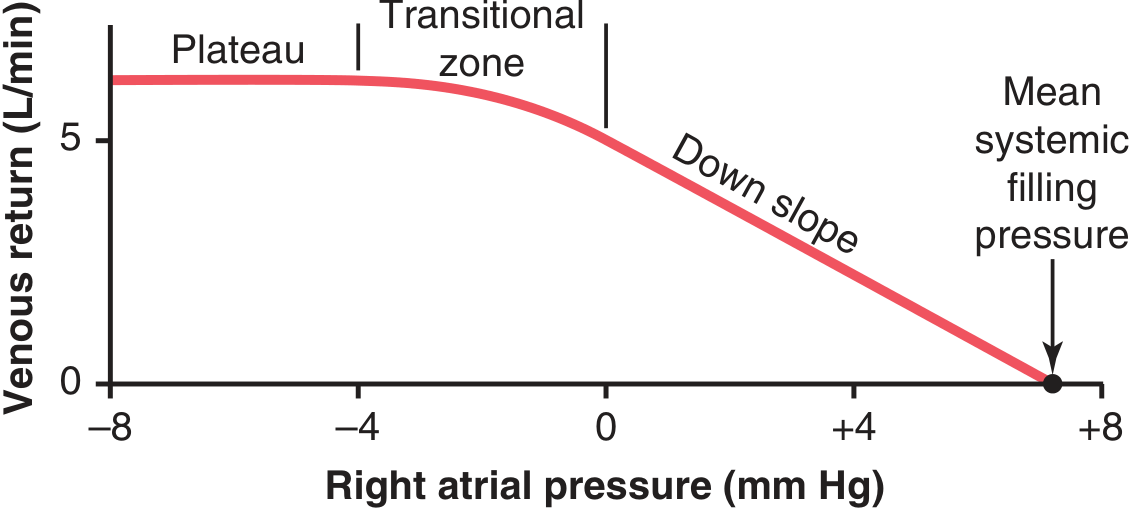
Venous return and cardiac output curves are then plotted together (right atrial pressure on the x-axis) to find the single equilibrium point at which both cardiac output and venous return match - this "coupling" analysis explains how changes in blood volume, venous tone, total peripheral resistance, or cardiac contractility shift the operating point of the whole circulation.
2. Mechanical/anatomical mechanisms that assist venous return against gravity
Because venous pressure in the limbs is low and gravity opposes upward flow when upright, several accessory mechanisms are essential:
-
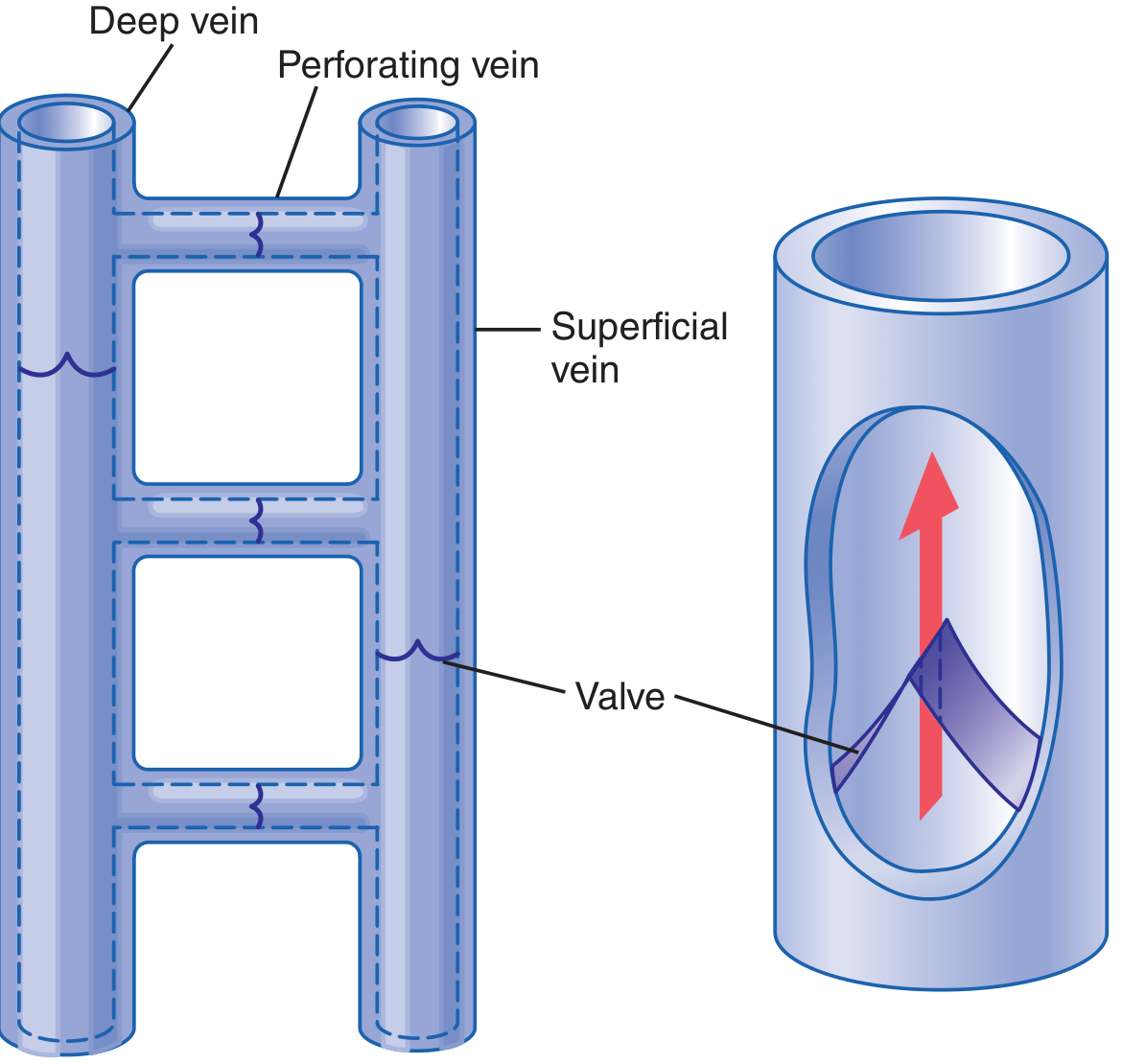
Skeletal muscle pump (venous pump): Contraction of skeletal muscles (especially calf muscles) compresses the deep veins running through and between them, squeezing blood toward the heart. One-way venous valves ensure this milked blood moves only centrally and cannot fall back. Guyton notes that in a walking adult this keeps foot venous pressure below +20 mmHg, versus the ~90 mmHg that gravity alone would produce with a static column of blood. If the pump fails to operate (e.g., standing motionless) or the valves become incompetent (varicose veins), venous and capillary pressure rise, causing edema and pooling."This pumping system is known as the venous pump or muscle pump, and it is efficient enough that under ordinary circumstances, the venous pressure in the feet of a walking adult remains less than +20 mm Hg." - Guyton and Hall Textbook of Medical Physiology, p. 195
- Respiratory pump: During inspiration, intrapleural (intrathoracic) pressure becomes more negative and intra-abdominal pressure rises slightly, creating a pressure gradient that draws blood from the abdominal veins into the thoracic veins and right atrium, augmenting venous return. This is why inspiration transiently increases right ventricular filling and stroke volume (contributing to physiological splitting of S2, and to the paradoxical pulse seen in tamponade).
- Sympathetic venoconstriction: Sympathetic stimulation constricts venous smooth muscle, decreasing unstressed venous volume and raising mean systemic filling pressure, which increases the pressure gradient driving venous return - important in exercise and hemorrhage/shock compensation.
- Right atrial "suction" effect: During ventricular systole and early diastole, descent of the atrioventricular junction and ventricular relaxation create a slight negative pressure that pulls blood forward from the great veins.
3. Coupling with cardiac output (Frank-Starling mechanism)
Increased venous return raises right ventricular end-diastolic volume (preload), which increases stroke volume via the Frank-Starling mechanism, matching cardiac output to venous return. This is how the heart "auto-regulates" to pump out whatever volume returns to it, keeping the two in dynamic balance.
"Mechanically, the muscle pump increases venous return, and stroke volume rises by the Starling mechanism." - Medical Physiology (Boulpaep & Boron), p. 231
Clinical relevance (brief)
- Hypovolemic shock: falling blood volume lowers mean systemic filling pressure, reducing venous return and thus cardiac output (Costanzo Physiology).
- Positive-pressure ventilation / pneumoperitoneum / tension pneumothorax: raise intrathoracic/intra-abdominal pressure, impeding venous return.
- Nitrates in angina: venodilation reduces venous return and preload, lowering myocardial oxygen demand (Katzung's Pharmacology).
- Cardiac tamponade: exaggerated respiratory variation in venous return underlies the paradoxical pulse.
This information is drawn from standard physiology texts (Guyton and Hall Textbook of Medical Physiology; Costanzo Physiology; Medical Physiology by Boulpaep & Boron) and is foundational, well-established physiology, not an area where recent trial evidence would change the underlying mechanism, so no additional PubMed evidence check was needed for this conceptual question.
This is a shared conversation. Sign in to Orris to start your own chat.