
Fire arm injury fmt 3rd yr mbbs pk mquestion explain i simple waym with nemonoc
Reading File
Now let me search the medical library for firearm injury content:
Finding Sources
Finding Sources
Finding Sources
Finding Sources
Good - I found forensic medicine textbooks. Now let me search specifically for firearm/gunshot content:
Finding Sources
Finding Sources
Finding Sources
Finding Sources
Excellent! I found great content in the Essentials of Forensic Medicine (2026) and Parikh's. Let me now read the relevant sections:
Reading File
Reading File
Reading File
Reading File
I now have excellent content from both Parikh's and Essentials of Forensic Medicine (2026). Let me compile the comprehensive answer with mnemonics for 3rd year MBBS students in Pakistan's format.
Loading Image
Now I have everything I need to write a thorough, exam-focused answer with mnemonics. Here it is:
🔫 Firearm Injury - 3rd Year MBBS (Forensic Medicine)
Based on: The Essentials of Forensic Medicine & Toxicology 36th ed. (2026) and Parikh's Textbook of Medical Jurisprudence
PART 1 - BASIC CONCEPTS
Types of Firearms
| Type | Example | Key Feature |
|---|---|---|
| Rifled | Pistol, Revolver, Rifle | Spiral grooves inside barrel (give spin to bullet) |
| Smooth-bore | Shotgun | No grooves; fires pellets/shots |
Mnemonic: "Rifle = Rotation, Shotgun = Scatter"
PART 2 - COMPONENTS OF A FIREARM DISCHARGE
Mnemonic: "FGSMP" - Five things come out of a gun barrel:
Flame - Gas - Smoke/Soot - Metal particles - Powder grains (unburnt)
These cause all the characteristic wound features at different ranges.
PART 3 - ENTRY WOUND CHARACTERISTICS (THE MOST IMPORTANT EXAM TOPIC)
Basic entry wound features:
Mnemonic: "BAGS IC"
| Letter | Feature |
|---|---|
| B | Burning / Blackening (at close range) |
| A | Abrasion collar (present at ALL ranges) |
| G | Grease collar (may/may not be present) |
| S | Smaller size (compared to exit) |
| I | Inverted edges |
| C | Clothing carried IN (turned inward) |
Abrasion Collar
- Ring of abrasion around entry hole
- Due to bullet rubbing skin as it passes
- Present at ALL ranges - this is the most reliable sign of entry wound
- Also called "abrasion ring" or "contusion ring"
PART 4 - RANGE ESTIMATION (MOST FREQUENTLY ASKED IN EXAM)
This is the golden topic. Learn it with the mnemonic below.
Mnemonic: "CONTACT = STAR; CLOSE = SBT; NEAR = T; DISTANT = Nothing"
1. CONTACT SHOT (Muzzle touching skin)
Mnemonic: "MUZZLE STARS":
Muzzle imprint on skin U (you'll see) stellate/cruciate Shaped wound (star-shaped tears) Tattooing in depth (not surface) Abrasion collar present Reddish-pink track (CO combines with haemoglobin - Carboxy-Hb) Smoke/soot inside wound (not outside) Back spatter (blood sucked back into barrel)
Special: Hard Contact over bone (skull) = STAR-SHAPED wound because gas has nowhere to go, bursts outward
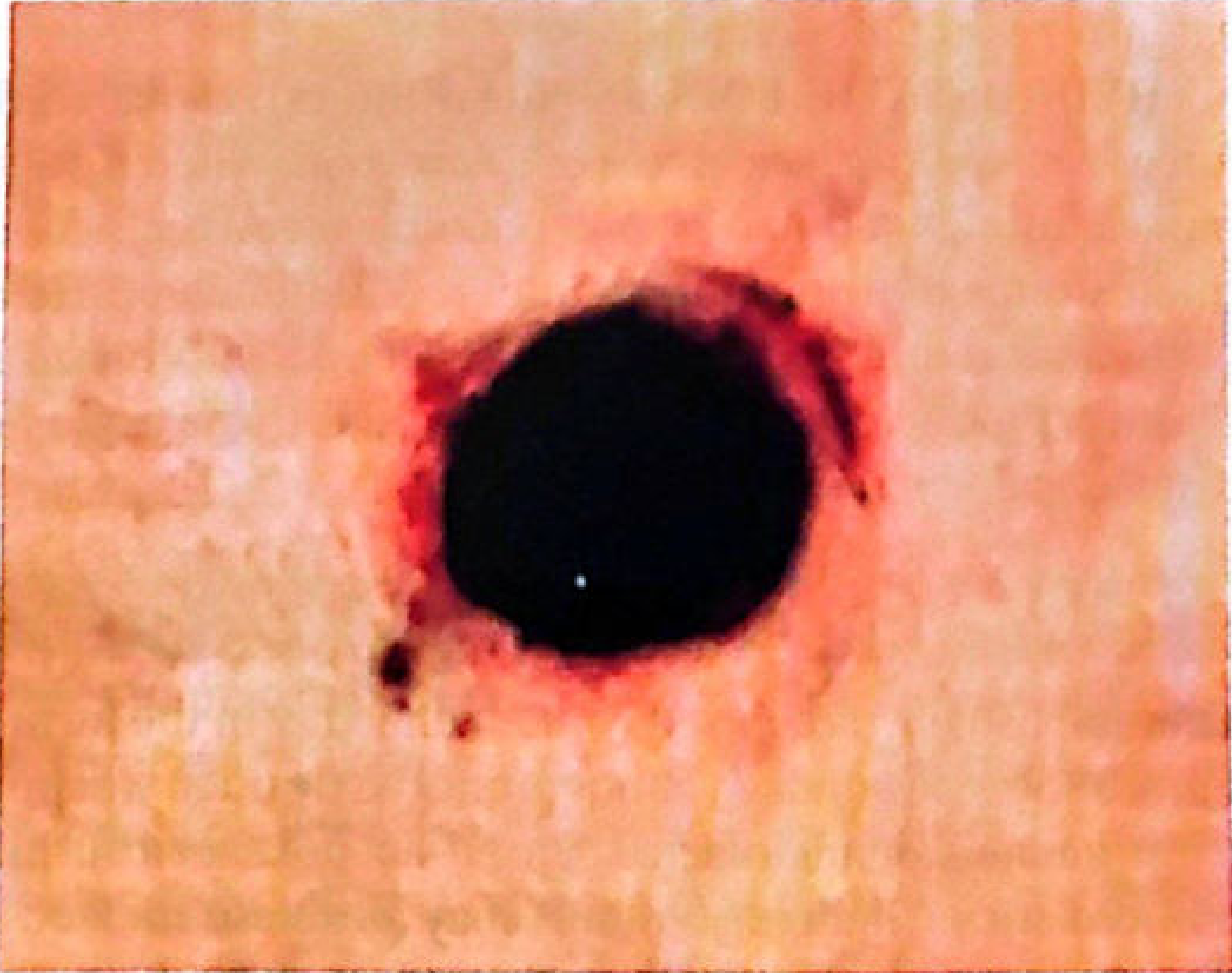
Tight-contact shotgun wound of chest - note muzzle imprint visible
2. CLOSE RANGE (Up to 15 cm / 6 inches)
Mnemonic: "SBT" - Soot, Burning, Tattooing (all 3 present)
- Scorching/Burning of skin present
- Blackening (soot deposit) present
- Singeing of hair present
- Tattooing present (close range)
- No muzzle imprint
- No stellate tearing
3. NEAR RANGE (15 cm - 60 cm)
Mnemonic: "T only" - Tattooing present, Blackening disappearing
- Soot disappears (>15-40 cm)
- Singeing disappears
- Tattooing (stippling) STILL present - this is the key finding
- Tattooing = small pinpoint hemorrhagic spots from unburnt powder grains hitting skin
- Cannot be washed off (unlike soot) - important forensic fact!
4. DISTANT RANGE (>60 cm)
Mnemonic: "NOTHING extra = just hole + abrasion collar"
- No burning, no blackening, no singeing, no tattooing
- Only: circular hole + abrasion collar
- Clean punched-out wound
SUMMARY TABLE - Range vs Features
| Feature | Contact | Close (<15cm) | Near (15-60cm) | Distant (>60cm) |
|---|---|---|---|---|
| Muzzle imprint | ✅ | ❌ | ❌ | ❌ |
| Stellate wound | ✅ (bony area) | ❌ | ❌ | ❌ |
| Burning/Scorching | ✅ (in depth) | ✅ | ❌ | ❌ |
| Soot/Blackening | Inside wound | ✅ | ❌ | ❌ |
| Singeing of hair | ✅ | ✅ | ❌ | ❌ |
| Tattooing | In depth | ✅ | ✅ | ❌ |
| Abrasion collar | ✅ | ✅ | ✅ | ✅ |
| Pink track (CO-Hb) | ✅ | Occasionally | ❌ | ❌ |
PART 5 - ENTRY vs EXIT WOUND (Classic MCQ/SEQ)
Mnemonic: "Entry = INSIDE; Exit = OUTSIDE" (edges reflect where force pushes)
| Feature | Entry Wound | Exit Wound |
|---|---|---|
| Size | Smaller | Larger (usually) |
| Edges | Inverted (pushed in) | Everted (pushed out) |
| Abrasion collar | Present | Absent |
| Grease collar | May be present | Never present |
| Skull beveling | Inward bevel (inner table chipped) | Outward bevel (outer table chipped) |
| Burning/Tattooing | Present (at range) | Absent |
| Clothing | Turned IN | May turn out |
| Pink track (CO) | Present (near range) | Absent |
| Shape | Circular/punched out | Irregular/stellate |
Key exam tip: Tattooing is NEVER seen at exit wound (unless two wounds overlap).
PART 6 - TYPES OF WOUNDS (ODD & EVEN RULE)
Mnemonic: "Odd Entries = Bullet Inside"
From Parikh's Textbook: If entry wounds > exit wounds = bullet retained inside (search by imaging) If exit wounds > entry wounds = bullet fragmented
Types of firearm injury:
- Penetrating - bullet enters but does NOT exit (stays inside)
- Perforating - bullet enters AND exits (two holes)
- Grazing/Tangential - bullet grazes skin surface (gutter wound - elongated)
Mnemonic: "PeP-G" = Penetrating, Perforating, Grazing
PART 7 - TATTOOING vs BLACKENING (Common confusion)
| Tattooing (Stippling) | Blackening (Soot) | |
|---|---|---|
| Cause | Unburnt powder grains embedding in skin | Soot/carbon particles depositing on skin |
| Can be washed off? | NO (embedded in dermis) | YES (superficial) |
| Range | Up to ~60 cm | Up to ~15-30 cm |
| Forensic importance | Permanent evidence of range | Can be destroyed |
PART 8 - BACK SPATTER (Important new concept)
- In contact shots, after gas blast, a negative pressure forms in barrel
- Sucks blood, tissue fragments, hair back into barrel
- Called "back spatter"
- Can identify shooter's gun even if cleaned
QUICK REVISION MNEMONICS SUMMARY
| Mnemonic | Meaning |
|---|---|
| FGSMP | What comes out of barrel: Flame, Gas, Smoke, Metal, Powder |
| BAGS IC | Entry wound features: Burning, Abrasion collar, Grease collar, Smaller, Inverted, Clothing in |
| STAR | Contact shot: Stellate, Tattooing in depth, Abrasion, Reddish-pink track |
| SBT | Close range: Soot, Burning, Tattooing |
| T only | Near range: Tattooing only |
| Nothing extra | Distant: only hole + abrasion collar |
| PeP-G | Types: Penetrating, Perforating, Grazing |
| Odd rule | Odd entries = bullet inside |
COMMONLY ASKED EXAM QUESTIONS (Pakistan MBBS Pattern)
- SEQ: Describe the features of entry wound at contact, close, near, and distant range.
- SEQ: Differentiate between entry and exit wound of a bullet.
- MCQ: Tattooing cannot be washed off - TRUE (it's embedded in skin)
- MCQ: Abrasion collar is present at - ALL ranges (entry wound only)
- MCQ: Muzzle imprint is seen in - Contact shot only
- MCQ: Stellate wound over skull = Contact shot over bony surface
- MCQ: Pink wound track (CO-Hb) = Near contact/close contact shot
Sources: The Essentials of Forensic Medicine and Toxicology, 36th ed. 2026 (Reddy), p. 920-1490 | Parikh's Textbook of Medical Jurisprudence, Forensic Medicine & Toxicology, Table 17.2, Q.17.11-17.16
This is a shared conversation. Sign in to Orris to start your own chat.