
Black stool
Reading File
Now let me search the medical library and PubMed in parallel for black stool (melena).
Finding Sources
Finding Sources
Searching PubMed
melena upper gastrointestinal bleeding management
Good results. Now let me read the Harrison's GI bleeding section for detailed content.
Reading File
Reading File
Excellent - I have comprehensive information. Let me also get more Harrison's content on causes and workup.
Reading File
I have rich material. Let me fetch the algorithm image and compile the comprehensive answer.
Loading Image
Here is a thorough clinical overview of black stool (melena).
Black Stool (Melena)
Definition
Melena is black, tarry, foul-smelling stool produced when blood (typically >50-100 mL) undergoes bacterial and chemical degradation during transit through the GI tract. The black color results from hematin, formed when hemoglobin is oxidized by intestinal bacteria and gastric acid.
Melena is distinct from hematochezia (red/maroon stool from lower GI bleeding) and hematemesis (vomiting blood). - Harrison's Principles of Internal Medicine 22E, p.360
Key Distinction: True Melena vs. False Black Stool
Before attributing black stool to bleeding, exclude:
| Cause | Clue |
|---|---|
| Iron supplements | Dark-grey/black, not tarry; no occult blood |
| Bismuth (Pepto-Bismol) | Greyish-black; no occult blood |
| Activated charcoal | History of ingestion |
| Dark foods (licorice, blueberries, black beans) | Diet history |
| Cefdinir (antibiotic) | Medication history |
True melena tests positive on fecal occult blood testing.
Causes
Upper GI Bleeding (most common cause of melena)
Bleeding originates proximal to the ligament of Treitz (esophagus, stomach, duodenum):
| Cause | Notes |
|---|---|
| Peptic ulcer disease | ~50% of upper GIB; most common cause overall |
| Esophageal/gastric varices | 2-40% depending on population; high mortality |
| Mallory-Weiss tears | Preceded by vomiting/retching; 80-90% stop spontaneously |
| Erosive gastritis/esophagitis | NSAID/alcohol-related; usually self-limited |
| Dieulafoy lesion | Large submucosal artery erosion |
| Aortoenteric fistula | Rare; consider post-aortic surgery |
| Gastric cancer/GAVE | Less common |
Small Bowel Bleeding
Can also present as melena if transit time is prolonged. Causes include: angiodysplasia, Meckel diverticulum (younger patients), Crohn's disease, NSAID ulcers, malignancy.
Bleeding from the small intestine often presents with prolonged occult blood loss but can cause melena if GI transit times are long. - Rosen's Emergency Medicine, p.3361
Initial Evaluation
History
- Duration and quantity of black stool
- Associated hematemesis (suggests UGIB)
- NSAID/aspirin/anticoagulant use
- Alcohol use, cirrhosis, portal hypertension
- Prior peptic ulcer disease or GI surgery
- Symptoms of hemodynamic compromise (dizziness, syncope, chest pain, dyspnea)
Hemodynamic Assessment (first priority)
- Tachycardia at rest suggests ~15% blood volume loss
- Orthostatic hypotension suggests ~20-30% loss
- Shock (BP <90 mmHg) suggests >30% loss
Nasogastric Lavage
- Bloody return confirms UGIB
- Clear return does not exclude UGIB (up to 16% false negative)
Labs
- CBC (hemoglobin, platelet count)
- BMP (BUN elevated from blood digestion - BUN:Cr ratio >30 supports UGIB)
- Coagulation (PT/INR, aPTT)
- Type and crossmatch
- Liver function tests (if varices suspected)
Management
Resuscitation (stabilize first)
- Two large-bore IVs; IV fluids (normal saline or LR)
- Transfuse PRBCs: target Hgb >7 g/dL (>9 g/dL in active cardiac disease or varices)
- Correct coagulopathy (FFP, vitamin K if INR elevated)
- Platelets if <50,000
Medical Therapy
- PPI (IV): IV pantoprazole/omeprazole bolus + infusion for suspected peptic ulcer bleeding (reduces rebleeding and mortality in high-risk ulcers)
- Octreotide: IV infusion for suspected variceal bleeding (reduces portal pressure); continue 2-5 days
- Antibiotics (ceftriaxone): Standard in cirrhotic patients with variceal bleeding - reduces infection risk and mortality
Endoscopy (EGD)
- Should be performed within 24 hours of presentation in most cases (within 12 hours in hemodynamically unstable or suspected varices)
- Both diagnostic and therapeutic
The algorithm below from Harrison's guides therapy based on endoscopic findings:
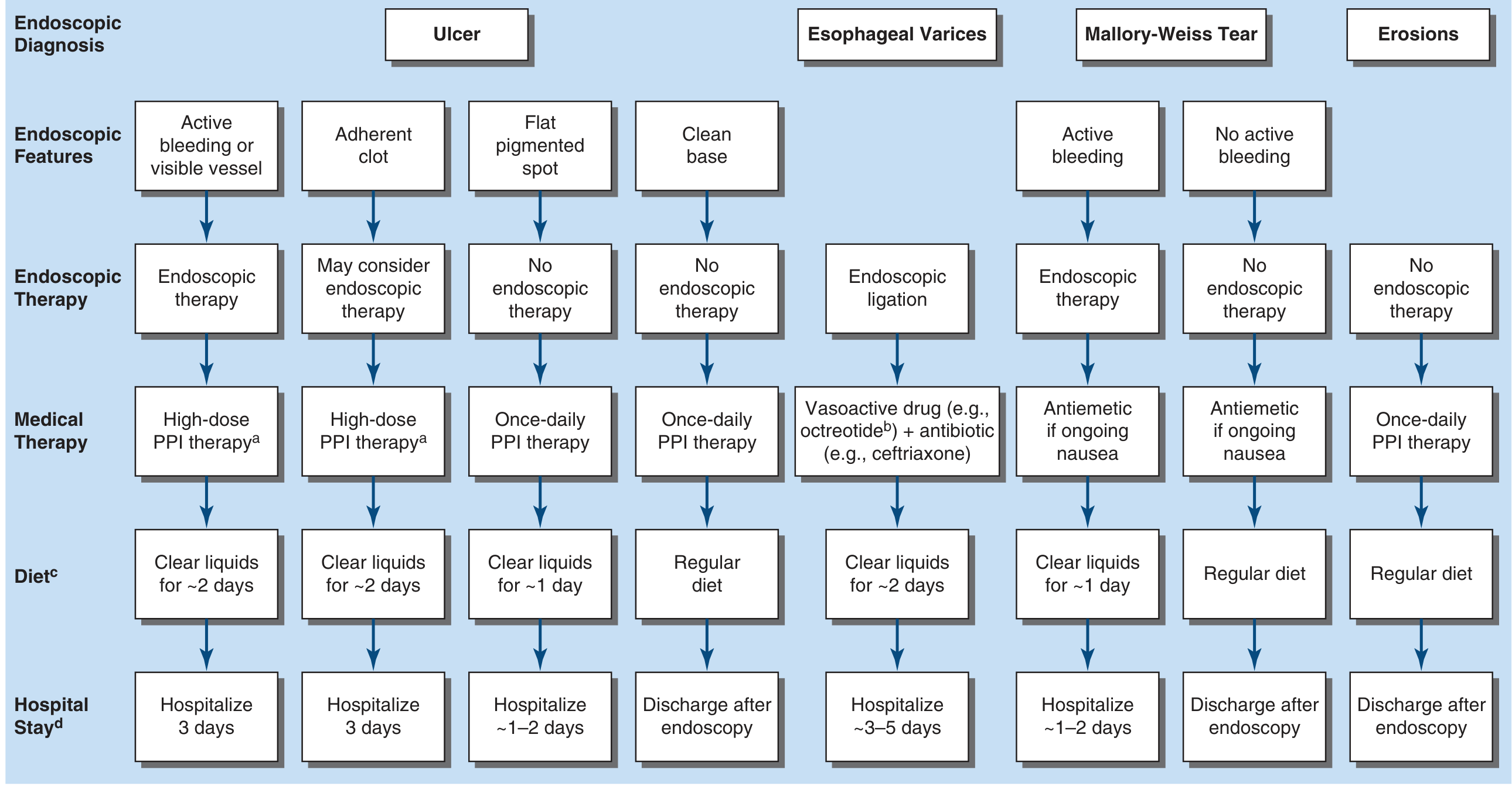
Endoscopic Therapy Options
- Ulcers with active bleeding or visible vessel: Bipolar electrocoagulation, heater probe, epinephrine injection, hemostatic clips, or topical hemostatic powder
- Varices: Endoscopic band ligation (esophageal); tissue adhesive injection or TIPS (gastric)
- Mallory-Weiss tears: Endoscopic ligation if actively bleeding
Refractory/Recurrent Bleeding
- TIPS (transjugular intrahepatic portosystemic shunt): For refractory variceal bleeding; also first-line for Child-Pugh B/C patients with active variceal hemorrhage
- Interventional radiology (angiographic embolization): When endoscopy fails
- Surgery: Reserved for massive ongoing bleeding not controlled endoscopically
Prevention of Recurrence
- H. pylori eradication: Reduces rebleeding from peptic ulcers to <5%
- Discontinue NSAIDs if bleeding ulcer; if NSAIDs must be continued, use COX-2 inhibitor + PPI
- Aspirin for secondary cardiovascular prevention: Do NOT discontinue; restart promptly after hemostasis (early reinstitution associated with lower 8-week mortality: 1% vs 13%)
- Long-term PPI: For ulcers unrelated to H. pylori or NSAIDs (42% rebleeding rate at 7 years without therapy)
- Beta-blockers + endoscopic ligation: For variceal bleeding prophylaxis
Prognosis
- Overall case fatality ~2% for all GIB hospitalizations
- Inpatient mortality: ~10% for UGIB, ~4% for LGIB
- Patients most often die from decompensation of underlying comorbidities rather than exsanguination
Sources: Harrison's Principles of Internal Medicine 22E (2025), p. 360-361; Rosen's Emergency Medicine, p. 3344-3361; Fischer's Mastery of Surgery 8E; Yamada's Textbook of Gastroenterology 7E
Melena in bedridden patients
Searching sources...
Finding Sources
Finding Sources
Searching PubMed
stress ulcer gastrointestinal bleeding critically ill
Reading File
Reading Article
PMID: 39007578
Reading Article
PMID: 38874580
Finding Sources
Finding Sources
Reading File
Reading Article
PMID: 41655594
I now have all the needed information. Here is a focused, clinically relevant answer:
Melena in Bedridden Patients
Bedridden patients (ICU-bound, post-surgical, stroke patients, elderly nursing home residents) represent a distinct clinical population for melena. The dominant mechanism is stress-related mucosal disease (SRMD), but several unique risk factors, challenges, and management considerations apply.
Why Bedridden Patients Are at Higher Risk
1. Stress-Related Mucosal Disease (SRMD)
The primary cause of upper GI bleeding in immobilized, critically ill patients. The mechanism is impaired mucosal protection from splanchnic hypoperfusion - not acid hypersecretion or H. pylori.
Endoscopic evidence of upper GI bleeding from SRMD is common, even shortly after admission, in high-acuity ICU patients. The pathophysiology is impaired mucosal protection, mostly related to blood flow, and not acid hypersecretion or H. pylori infection. - Mulholland & Greenfield's Surgery 7E
Key risk factors for clinically significant SRMD bleeding:
| Risk Factor | Notes |
|---|---|
| Mechanical ventilation >48 hours | Strongest independent predictor |
| Coagulopathy (INR >1.5 or platelets <50k) | Strongest independent predictor |
| Shock / hemodynamic instability | Splanchnic hypoperfusion |
| Chronic liver disease / cirrhosis | 2024 SCCM Guideline adds this as high-risk |
| Severe burns (Curling's ulcer) | Gastric stress ulcer |
| CNS injury (Cushing's ulcer) | Vagally mediated acid hypersecretion |
| Sepsis | Systemic inflammatory state |
| Renal failure | Uremic platelet dysfunction |
| Prolonged immobility/bedrest | Reduced GI motility, reduced perfusion |
2. Medications Common in Bedridden Patients
- NSAIDs / ketorolac: frequently used for pain; disrupt prostaglandin-mediated mucosal protection
- Anticoagulants (heparin, warfarin, DOACs): used for DVT prophylaxis; amplify bleeding
- Corticosteroids: combined with NSAIDs markedly increases risk
- Antiplatelet agents: aspirin, clopidogrel
3. Diagnostic Challenges
- Patients may be intubated, sedated, or cognitively impaired - cannot report symptoms
- Melena may be mistaken for normal dark stool, especially with iron supplements or enteral formulas
- Hemodynamic changes (tachycardia, hypotension) may be masked by vasopressors or beta-blockers
- Nasogastric tube in place may detect bloody aspirate before formal melena appears
Clinical Presentation Clues
- Black tarry stool on rectal exam or noted on diaper/pad change
- Coffee-ground material in nasogastric aspirate
- Unexplained drop in hemoglobin (>2 g/dL)
- Rising BUN out of proportion to creatinine (BUN:Cr >30 suggests digested blood)
- Hemodynamic deterioration (tachycardia, hypotension) in absence of other cause
Management
Resuscitation
- IV access, fluid resuscitation
- Transfuse PRBCs: target Hb >7 g/dL (>9 g/dL in active cardiac ischemia)
- Correct coagulopathy: FFP, vitamin K, platelets if <50,000
- Hold/reverse anticoagulants as clinically appropriate (weigh DVT/PE risk)
Pharmacologic
- IV PPI (pantoprazole 80 mg bolus + 8 mg/hr infusion, or 40 mg IV BID): first-line for suspected peptic/stress ulcer bleeding
- IV octreotide: if variceal bleeding suspected (cirrhotic patient)
- Antibiotics (e.g., ceftriaxone): if cirrhosis present
Endoscopy
- Upper endoscopy (EGD) within 24 hours (within 12 hours if hemodynamically unstable)
- May be technically challenging but feasible in intubated patients
- Provides both diagnosis and treatment
Stress Ulcer Prophylaxis (Prevention)
This is a cornerstone of care in bedridden/ICU patients.
Who Should Receive Prophylaxis?
Per the 2024 SCCM/ASHP Guideline (MacLaren et al., Crit Care Med 2024):
- Coagulopathy, shock, or chronic liver disease - give SUP (conditional recommendation)
- Mechanical ventilation alone - no longer considered a firm independent indication
- Enterally fed patients at high risk - suggest SUP; at low risk, suggest no SUP
- Discontinue when ICU risk factors resolve; do NOT continue on ward transfer without active indication
What Agent?
- PPI or H2 receptor antagonist (H2RA) - either acceptable; use low-dose regimens
- Sucralfate is less preferred than PPI/H2RA
- The 2024 NEJM Evidence meta-analysis (9,533 patients, 12 RCTs) confirmed PPIs reduce clinically important UGIB by 49% (RR 0.51, 95% CI 0.34-0.76; high certainty). However, PPIs may increase mortality in the most severely ill patients (possible signal; low certainty) - reinforcing targeted rather than blanket prophylaxis.
- A 2026 meta-analysis (Awan et al., Dig Dis 2026) flags increased C. difficile risk with PPIs in ICU patients - another reason not to over-prescribe.
Role of Enteral Nutrition
- Early enteral feeding likely reduces UGIB risk in ICU patients by maintaining mucosal integrity and perfusion
- The 2024 SCCM guideline notes enteral nutrition as a probable protective factor - when feasible, prefer enteral over parenteral nutrition
Prophylaxis against SRMD is indicated for patients requiring mechanical ventilation >48 hours or with coagulopathy. Either PPIs or H2 antagonists can be used. There may be a role to avoid pharmacologic agents even in highest-risk patients if they are being enterally fed. - Mulholland & Greenfield's Surgery 7E
Special Considerations
| Scenario | Clinical Note |
|---|---|
| Stroke / neuro ICU patient | Cushing's ulcer (CNS injury) - vagal hypersecretion; PPI prophylaxis warranted |
| Burn patient | Curling's ulcer - gastric stress ulcer; aggressive PPI prophylaxis |
| Post-operative patient | NSAIDs + immobility + stress = high risk; early enteral feeding preferred |
| Elderly nursing home resident | NSAIDs, anticoagulants, polypharmacy; often delayed diagnosis due to communication barriers |
| Anticoagulated patient | Weigh bleed vs. thrombosis risk carefully; bridging strategies may apply |
Summary
In bedridden patients, melena is most commonly from stress-related mucosal disease driven by splanchnic hypoperfusion rather than acid excess. Diagnosis is often delayed due to impaired communication and masked hemodynamics. Management follows the same resuscitation + PPI + endoscopy principles as general upper GIB, but prevention through targeted stress ulcer prophylaxis (in high-risk patients: coagulopathy, shock, liver disease) and early enteral nutrition are the key pillars of care. Avoid blanket PPI use in all ICU/bedridden patients - risk of C. difficile and possible excess mortality in the most severely ill argue for selective use.
Sources: Mulholland & Greenfield's Surgery 7E; Harrison's Principles of Internal Medicine 22E; SCCM/ASHP 2024 Guideline (PMID 39007578); Wang et al. NEJM Evidence 2024 (PMID 38874580); Amer et al. Acta Anaesthesiol Scand 2026 (PMID 41655594)
This is a shared conversation. Sign in to Orris to start your own chat.