
Epidermis
Reading File
Now let me search the medical library for comprehensive epidermis content in parallel.
Finding Sources
Finding Sources
Excellent - let me now read the key blocks from Fitzpatrick's, Junqueira's Histology, and Bailey & Love's in parallel.
Reading File
Reading File
Reading File
Now let me read the Junqueira's detailed epidermis section and get the Fitzpatrick's deeper epidermis content in parallel:
Reading File
Reading File
Now let me fetch the epidermis histology images and read more Junqueira's content on specific layers and non-keratinocyte cells:
Reading File
Loading Image
Loading Image
I now have rich content. Let me read more of Junqueira's - the corneum, lucidum, and non-keratinocyte cells sections:
Reading File
I now have comprehensive content from multiple authoritative textbooks. Let me compile the full answer.
The Epidermis
The epidermis is the outermost layer of the skin - a stratified squamous keratinized epithelium of ectodermal origin. It constitutes about 5% of skin thickness and sits atop the dermis, separated by a dermal-epidermal junction (basement membrane). Like all epithelia, the epidermis is avascular: its cells receive nutrients and O₂ by diffusion from the dermis below.
Thickness
| Skin type | Location | Epidermal thickness |
|---|---|---|
| Thick skin | Palms, soles | 400-600 µm |
| Thin skin | Rest of body | 75-150 µm |
Layers (Strata)
The epidermis has 4 layers in thin skin and 5 layers in thick skin, listed from deep to superficial:
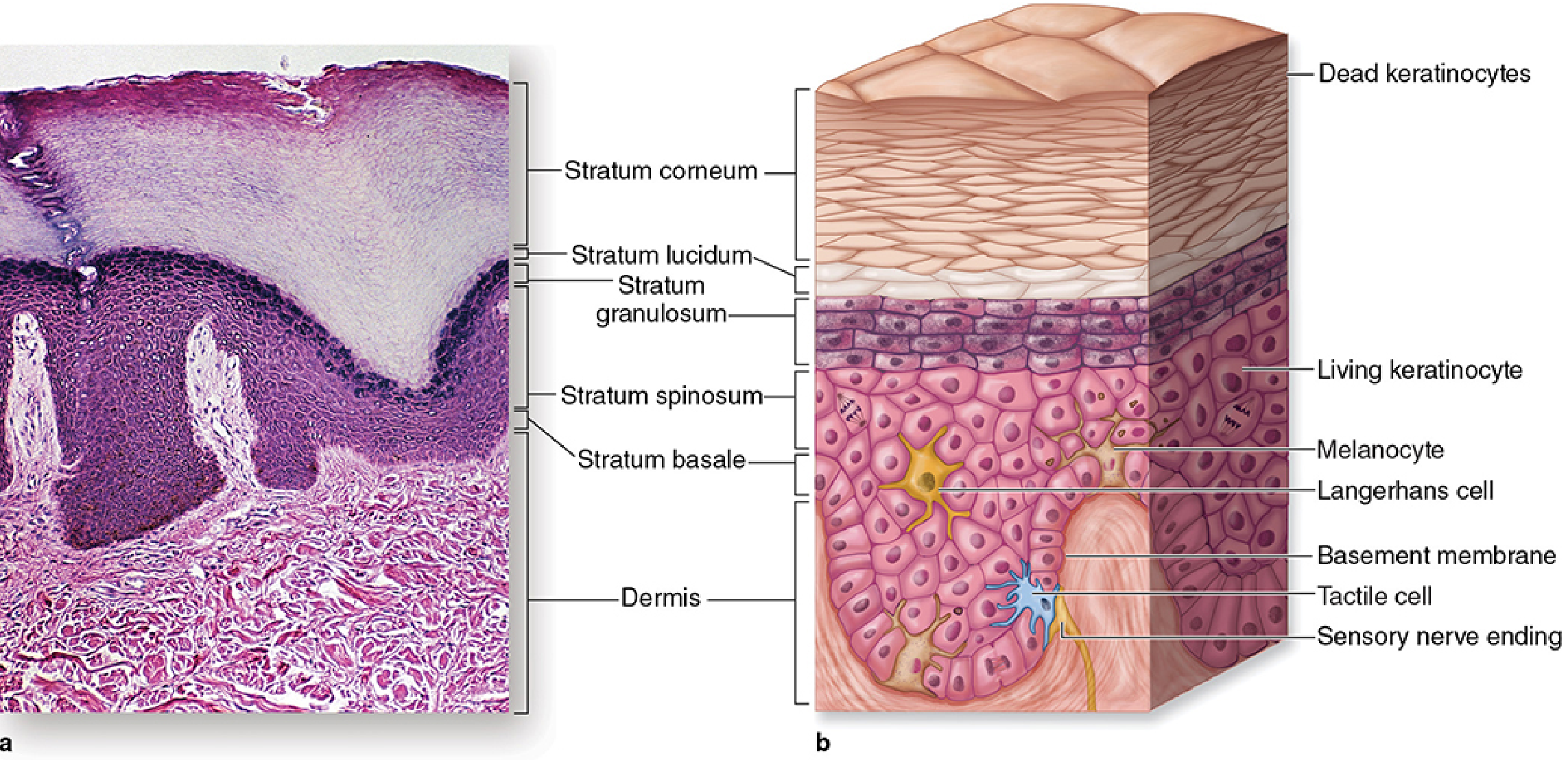
1. Stratum Basale (Basal Layer)
- A single layer of basophilic cuboidal or columnar cells resting on the basement membrane
- Attached to the basal lamina via hemidesmosomes; connected to each other by desmosomes
- Site of intense mitotic activity - contains keratinocyte stem/progenitor cells
- Keratin intermediate filaments (~10 nm diameter) begin forming here
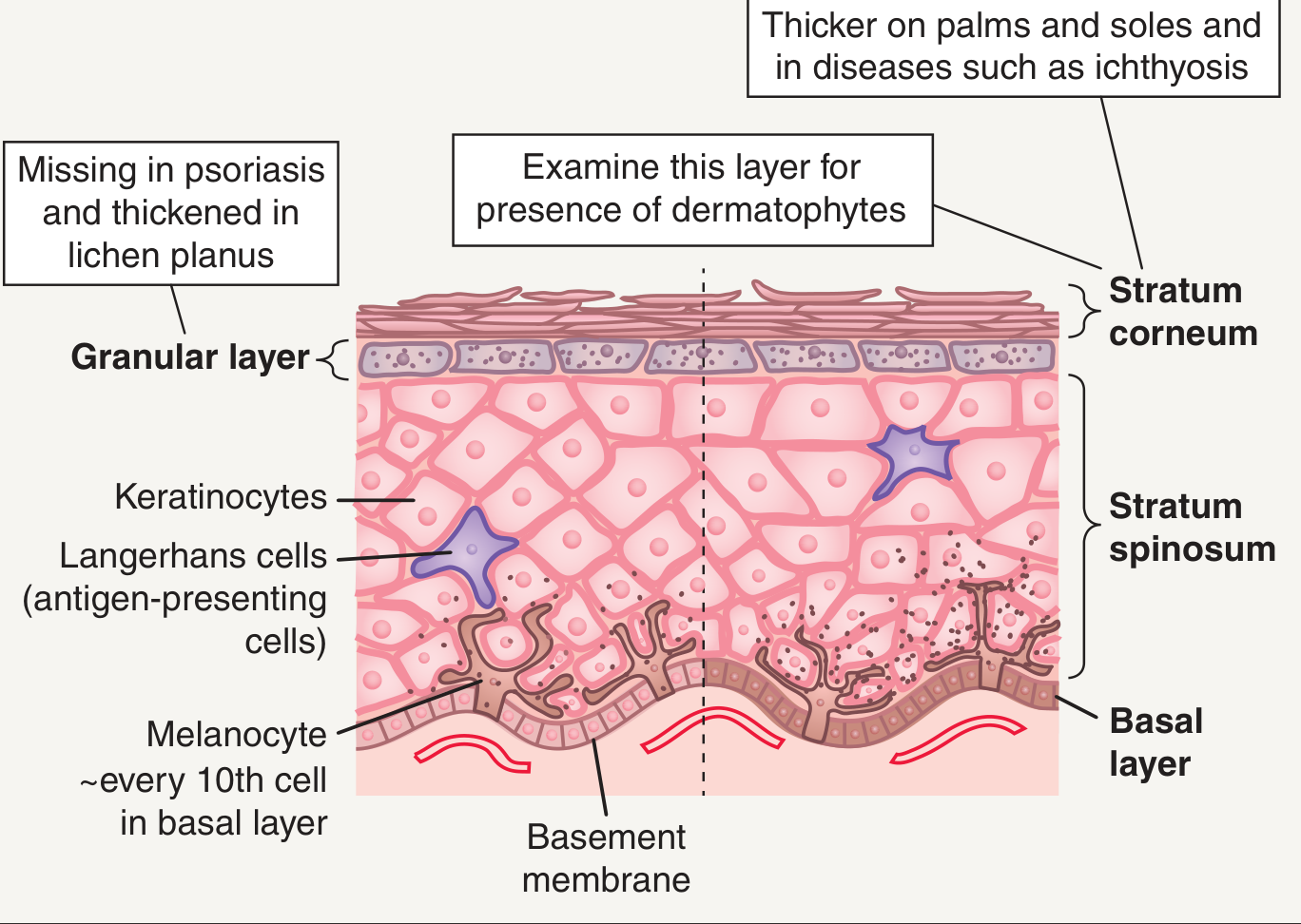
- Also contains melanocytes (~every 10th cell) and Merkel cells
- The human epidermis turns over approximately every 15-30 days
2. Stratum Spinosum (Prickle Cell / Spinous Layer)
- Multiple layers of polyhedral cells with central nuclei and nucleoli
- Cells continue synthesizing keratins
- Keratin filaments bundle into tonofibrils, converging on numerous desmosomes
- Cells appear to have short "spines" or prickles (artifact of cell shrinkage around desmosomes during processing)
- Thicker in glabrous skin (palms/soles) and areas of friction
- Langerhans cells reside predominantly in this layer
- Lower part of this layer still has some mitotic progenitor cells
3. Stratum Granulosum (Granular Layer)
- 3-5 layers of flattened cells undergoing terminal differentiation (keratinization)
- Cytoplasm filled with intensely basophilic keratohyaline granules - non-membrane-bound masses of filaggrin + proteins that cross-link keratin tonofibrils
- Also contains lamellar granules (Golgi-derived, 100 × 300 nm ovoid organelles) that undergo exocytosis, secreting a lipid-rich layer around cells - this creates the critical water-permeability barrier
- This is the last layer with living, nucleated cells
4. Stratum Lucidum (Clear Layer) - thick skin only
- A thin, optically refractile, translucent band of flattened, acidophilic keratinocytes
- Found only in thick palmar and plantar skin
- No nuclei or organelles; cytoplasm consists almost exclusively of packed keratin filaments in an electron-dense matrix
- Cells held together by desmosomes
5. Stratum Corneum (Horny Layer)
- The outermost, fully differentiated layer of dead, anucleate keratinocytes (called corneocytes or squames)
- Cells are flat, filled with keratin, and embedded in the lipid-rich lamellar granule secretions
- This layer is thicker on palms and soles; thickened in ichthyosis; and examined for dermatophytes in fungal infections
- Cells are continually shed (desquamation) from the surface
Cell Populations
The epidermis contains four distinct cell types:
Keratinocytes (predominant)
- Form the bulk of the epidermis (vast majority of epidermal cells)
- Continuously renew: mitosis in basal/lower spinous layers → upward migration → progressive differentiation → cornification → shedding
- Progressively accumulate keratin intermediate filaments as they mature (up to 50% of total protein in superficial layers)
- Key products: keratin, filaggrin, involucrin (cross-linking proteins)
Melanocytes
- Neural crest-derived dendritic cells, located in the basal layer (~1 per 10 keratinocytes)
- Synthesize melanin (brown-black pigment) in organelles called melanosomes
- Transfer melanosomes via dendritic processes to keratinocytes in the spinous and granular layers
- Melanin caps over keratinocyte nuclei, protecting them from UV radiation
- Ethnic skin color differences are determined by amount, combination, and distribution of melanin - NOT by differences in melanocyte number
Langerhans Cells
- Bone marrow-derived antigen-presenting cells (APCs) - part of the innate and adaptive immune system
- Located predominantly in the stratum spinosum
- Contain characteristic Birbeck granules (tennis-racket-shaped on EM)
- Express CD1a, S100, and langerin
- Capture antigens, process them, and migrate to lymph nodes to present to T lymphocytes
Merkel Cells (Tactile Epithelial Cells)
- Located in the basal layer, associated with sensory nerve endings
- Function as slowly adapting mechanoreceptors (light touch, texture, spatial acuity)
- Form the Merkel cell-neurite complex with unmyelinated sensory fibers
- Express CK20 (cytokeratin 20) - clinically useful marker (Merkel cell carcinoma is CK20+)
The Dermal-Epidermal Junction (DEJ)
The basement membrane separating epidermis from dermis is strengthened by:
- Epidermal ridges (rete pegs) projecting down into dermis
- Dermal papillae projecting up between ridges
- This interdigitation greatly increases surface area for adhesion and nutrient diffusion
The DEJ consists of:
- Lamina lucida (beneath hemidesmosomes)
- Lamina densa (type IV collagen-rich)
- Sublamina densa (anchoring fibrils of type VII collagen)
Defects in DEJ components cause various blistering diseases (e.g., bullous pemphigoid targets BP180/BP230 hemidesmosomes; epidermolysis bullosa targets type VII collagen).
Functions of the Epidermis
| Function | Mechanism |
|---|---|
| Physical barrier | Keratin-filled squames + lipid envelope |
| UV protection | Melanin from melanocytes |
| Permeability barrier | Lamellar granule lipids in stratum granulosum |
| Immune surveillance | Langerhans cells (APCs) |
| Mechanoreception | Merkel cell-neurite complexes |
| Antimicrobial | Acid pH surface coating (acid mantle) |
| Vitamin D synthesis | UV light acts on precursors in keratinocytes |
Thick vs. Thin Skin - Key Differences
| Feature | Thick Skin | Thin Skin |
|---|---|---|
| Location | Palms, soles | Rest of body |
| Strata | 5 (includes lucidum) | 4 (no lucidum) |
| Epidermal thickness | 400-600 µm | 75-150 µm |
| Spinous layer | Thick | Thinner |
| Hair follicles | Absent | Present |
| Sweat glands | Abundant | Present |
Clinical Correlations
- Psoriasis: granular layer is absent/thinned; stratum corneum shows parakeratosis (retained nuclei)
- Lichen planus: granular layer is thickened (hypergranulosis)
- Dermatophyte infections: fungi colonize the stratum corneum (examined for hyphae in KOH prep)
- Ichthyosis: stratum corneum is abnormally thickened
- Friction blisters: lymph-filled spaces at the DEJ from shear forces; prolonged friction causes callus/corn formation (stratum corneum thickening)
- Basal cell carcinoma: arises from stratum basale
- Squamous cell carcinoma: arises from stratum spinosum
- Melanoma: arises from melanocytes
Sources:
- Junqueira's Basic Histology: Text and Atlas, 17e, Ch. 18
- Fitzpatrick's Dermatology, 9e, Vol. 1
- Bailey and Love's Short Practice of Surgery, 28e
- Dermatology 2-Volume Set, 5e
This is a shared conversation. Sign in to Orris to start your own chat.