
Infection and disinfection
Reading File
The topic "Infection and Disinfection" is broad. Let me search the library for dedicated sections covering both.
Searching sources...
Finding Sources
Finding Sources
Finding Sources
Reading File
Reading File
Finding Sources
Reading File
Finding Sources
Reading File
Reading File
Reading File
Reading File
I now have rich content from both Sherris Medical Microbiology and Park's Preventive Medicine. Let me fetch the key diagrams and compile the full answer.
Loading Image
Reading File
I now have comprehensive content. Let me compile a thorough, well-structured answer.
Infection and Disinfection
1. Key Definitions
Infection is the invasion and multiplication of pathogenic microorganisms in body tissues. Infections can be:
- Community-acquired - present at or incubating before hospital admission
- Nosocomial (hospital-acquired) - acquired during hospital care, not present/incubating at admission. Infections occurring >48 hours after admission are usually classified as nosocomial. They include surgical wound infections, hepatitis B, and urinary tract infections.
- Opportunistic - caused by organisms normally innocuous (commensals) that become pathogenic when the host's immune defenses are compromised (e.g., in AIDS).
Sources: Park's Preventive & Social Medicine; Sherris Medical Microbiology 8e
2. The Microbial Killing Spectrum - Key Terms
| Term | Definition |
|---|---|
| Sterilization | Complete killing/removal of ALL living organisms (absolute term) |
| Disinfection | Destruction of pathogenic organisms - does NOT meet the criteria for sterilization |
| Antisepsis | Use of disinfecting agents (antiseptics) safe enough for body surfaces (skin, mucous membranes) |
| Pasteurization | Intermediate heat treatment that kills vegetative pathogens but not spores |
| Sanitization | Broad housekeeping term - somewhere between disinfection and general cleanliness |
| Asepsis | Working systems/procedures designed to prevent organisms from reaching a protected environment (e.g., the operating room) |
3. Kinetics of Microbial Killing
Killing by heat, radiation, or chemicals follows exponential kinetics - a fixed proportion of the population dies per unit time. On a log-scale graph, survivor counts fall linearly:
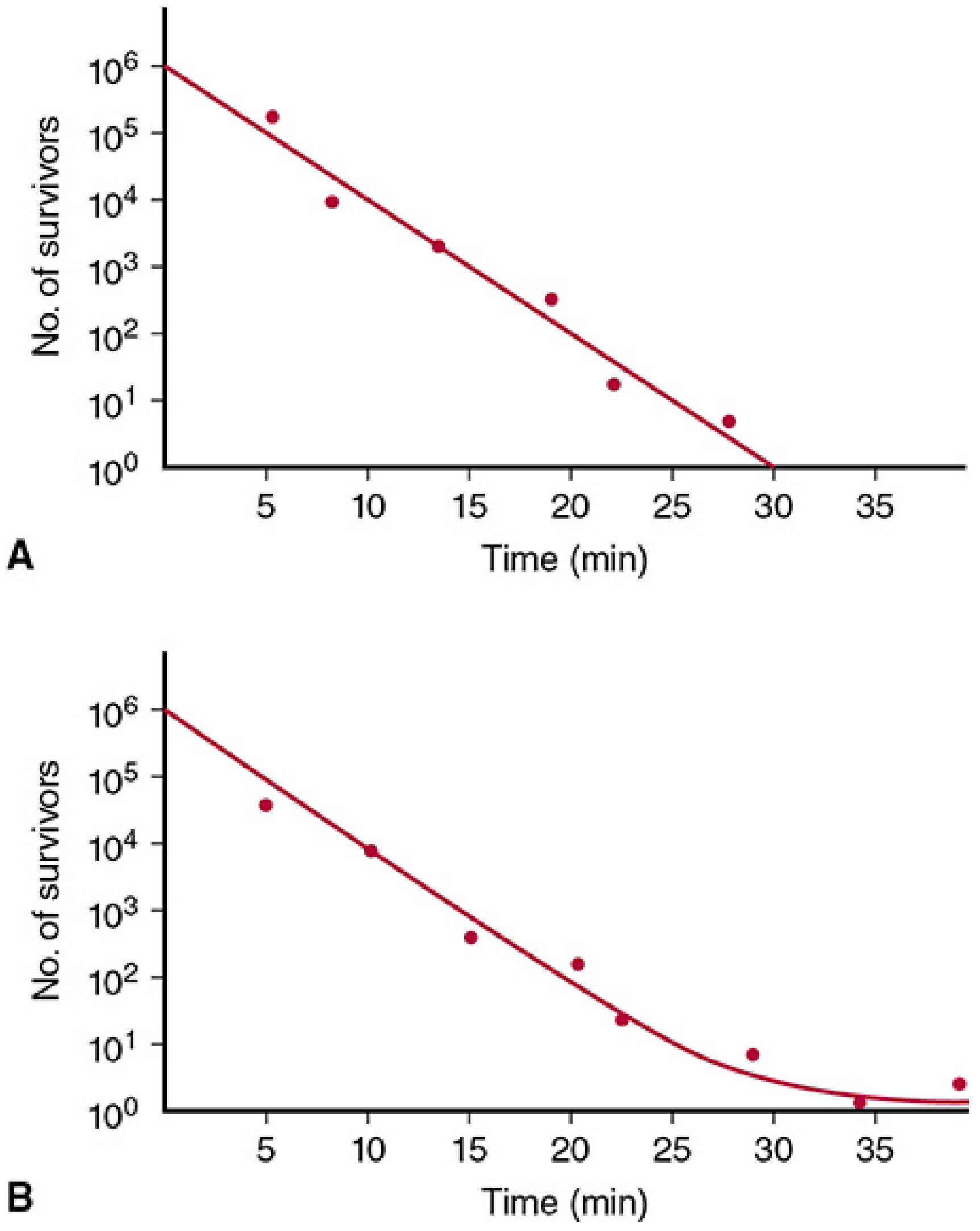
Panel A = homogeneous population (straight-line log kill). Panel B = mixed population containing spores - the curve flattens late, so extrapolating from the exponential phase underestimates total kill time.
- The kill rate increases exponentially with arithmetic rises in temperature or disinfectant concentration.
- Bacterial spores are far more resistant than vegetative forms - they can survive pasteurization and many chemical disinfectants.
Sherris Medical Microbiology 8e, p. 102
4. Methods of Sterilization
4a. Heat
| Method | Conditions | Notes |
|---|---|---|
| Autoclave (moist heat) | 121°C/15 psi for 15-20 min; "Flash" at 134°C for 3 min | Gold standard - kills all organisms including spores. Effectiveness requires pure saturated steam and no air pockets. |
| Pasteurization | 74°C for 3-5 sec, or 62°C for 30 min | Kills vegetative pathogens; spores survive |
| Boiling | 100°C | Kills most pathogens and some spores; not true sterilization |
| Incineration | Direct burning | Used for contaminated waste |
4b. Gas Sterilization
- Ethylene oxide (EtO): An alkylating agent - inactivates microorganisms by replacing labile hydrogen atoms in DNA. Used for heat-labile plastics, artificial heart valves, lensed instruments. Flammable and potentially explosive; requires prolonged post-treatment aeration.
- Formaldehyde vapor: Can decontaminate larger areas such as rooms without pressure.
4c. Radiation
- Ultraviolet (UV) light: Causes direct DNA damage. Limited by poor tissue/material penetration. Used for air irradiation in critical hospital sites and handling of hazardous organisms.
- Ionizing radiation (gamma/cathode rays): Damages DNA and generates free radicals/H₂O₂. Used industrially to sterilize pre-packaged surgical supplies (gloves, syringes, containers, food) because radiation penetrates packaging.
4d. Filtration
- Membrane filters (pore size 0.2 μm) remove bacteria from heat-sensitive liquids (e.g., serum). Not effective against viruses (too small).
Sherris Medical Microbiology 8e, pp. 103-107
5. Methods of Disinfection
5a. Physical Disinfection
- Pasteurization: 70°C for 30 min effective for plastic inhalation therapy equipment.
- Microwaves: Achieve near-boiling temperatures with moisture; used as an alternative to incineration for hospital waste. Not true sterilization - heat-resistant spores may survive.
5b. Chemical Disinfectants
All chemical disinfectants are inactivated by organic matter/dirt - surfaces must be cleaned first.
| Agent | Mechanism | Uses | Limitations |
|---|---|---|---|
| Alcohol (70-95%) | Protein denaturation | Skin decontamination before venipuncture | Inactive against spores and many viruses; 100% alcohol paradoxically fails (needs water) |
| Iodine / Iodophors | Iodination/oxidation of cellular components | Skin prep before surgery (povidone-iodine) | Tinctures cause staining; iodophors release iodine slowly to minimize this |
| Chlorine / Hypochlorite | Oxidation (hypochlorous acid) | Drinking water (<1 ppm), swimming pools, surface decontamination of spores/viruses (5% hypochlorite solution) | Rapidly inactivated by organic matter |
| Hydrogen peroxide | Oxidizes membrane lipids and other cell components | Contact lenses, medical device disinfection | Corrosive to some materials |
| Quaternary ammonium compounds ("Quats", e.g., benzalkonium chloride) | Disrupt cell membrane lipids - alter permeability, loss of essential cell components | Surface and skin disinfection | Inactive against spores and most viruses; inactivated by organic matter and cotton |
| Phenolics | Protein denaturation | Inanimate surfaces, laboratory bench disinfection | Too toxic for skin/tissue use |
| Chlorhexidine | Cationic - disrupts membrane; binds to skin for persistent effect | Routine hand and skin disinfectant | Neutralized by soaps and anionic detergents |
Sherris Medical Microbiology 8e, pp. 108-110
5c. Antiseptics vs. Disinfectants
- Antiseptics (e.g., alcohol, iodophors, chlorhexidine) - lower toxicity, safe on body surfaces, but usually less potent in killing organisms.
- Disinfectants (e.g., phenolics, strong hypochlorite) - higher potency but too toxic for body surfaces; used on inanimate objects/environments.
6. Spectrum of Resistance to Disinfectants
Most resistant → least resistant:
Bacterial spores > Mycobacteria (waxy coat) > Non-enveloped viruses > Vegetative bacteria > Enveloped viruses
This is why spores require autoclaving or sporicidal chemicals (e.g., glutaraldehyde, high-concentration chlorine), while routine vegetative bacteria are killed easily by most agents.
7. Hospital-Acquired (Nosocomial) Infections
Sources of HAI
- Endogenous - patient's own flora (e.g., gut bacteria post-surgery)
- Exogenous - from other patients, staff, environment, devices
The 4 Most Common Nosocomial Infections
| Infection | Typical Link |
|---|---|
| Urinary tract infection (UTI) | Indwelling urinary catheter |
| Surgical site infection (SSI) | Operative wound |
| Pneumonia (VAP/HAP) | Mechanical ventilation, aspiration |
| Primary bloodstream infection | Central venous catheter |
Surveillance Criteria (Simplified, WHO)
| Infection | Criterion |
|---|---|
| Surgical site | Purulent discharge/abscess/cellulitis within 1 month |
| Urinary | Positive culture ≥10⁵ bacteria/mL |
| Respiratory | Cough + purulent sputum + new CXR infiltrate (≥2 of 3) |
| Vascular catheter | Inflammation/lymphangitis/pus at insertion site |
| Septicaemia | Fever/rigors + ≥1 positive blood culture |
Park's Preventive & Social Medicine, p. 409
8. Prevention of Hospital-Acquired Infection
Standard (routine) precautions apply to ALL patients:
- Gloves for any contact with secretions/body fluids
- Gown, mask, and eye protection when splashing is anticipated
- Disposal of sharps safely
Specific preventive measures:
- Isolation - separate infectious patients from susceptibles
- Hand hygiene - the single most effective measure. WHO "Clean Care is Safer Care" (2009) guidelines; use soap+water or alcohol-based hand rub
- Dust control - wet dusting and vacuum cleaning rather than dry sweeping
- Disinfection of patient articles - equipment, urine, faeces, sputum properly disinfected
- Droplet control - masks, adequate bed spacing, ventilation, prevent overcrowding
- Barrier nursing - for highly infectious patients
- Infection control committee - hospital-level administrative oversight of policies
Device-specific proven measures (Table 2, Park's):
| Device/Infection | Effective | Not Effective |
|---|---|---|
| Urinary catheter | Limit catheter duration, aseptic insertion, closed drainage, antimicrobial-coated catheter | Systemic antibiotic prophylaxis, bladder irrigation |
| Surgical site | Proper surgical technique, clean operating environment | (Prophylactic antibiotics alone insufficient) |
Park's Preventive & Social Medicine, pp. 409-410
Summary Table: Sterilization vs. Disinfection vs. Antisepsis
| Feature | Sterilization | Disinfection | Antisepsis |
|---|---|---|---|
| Goal | Kill ALL organisms | Kill pathogens | Reduce pathogens on body surfaces |
| Kills spores? | Yes | Usually no | Usually no |
| Used on | Instruments, equipment | Inanimate surfaces/environment | Skin, mucous membranes |
| Examples | Autoclave, EtO gas, ionizing radiation | Hypochlorite, phenolics, glutaraldehyde | Chlorhexidine, iodophors, alcohol |
Primary sources: Sherris & Ryan's Medical Microbiology 8e (Ch. 3: Sterilization, Disinfection, and Infection Control); Park's Textbook of Preventive and Social Medicine (Nosocomial/Hospital-Acquired Infection sections)
This is a shared conversation. Sign in to Orris to start your own chat.