
What is bun
BUN stands for Blood Urea Nitrogen - it's a blood test that measures the amount of urea nitrogen in your blood, used to assess kidney function. However, "bun" can also simply refer to a type of bread roll or a hairstyle.
Let me check if you mean the medical term or something else.
Asking for Preferences
What do you mean by 'bun'?
Reading File
Searching sources...
Finding Sources
Searching PubMed
"blood urea nitrogen" kidney function
Reading File
Reading File
Loading Image
Here is a thorough breakdown of BUN (Blood Urea Nitrogen):
BUN - Blood Urea Nitrogen
What it is
BUN measures the amount of nitrogen (in the form of urea) circulating in the blood. Urea is the end product of protein metabolism - the liver converts ammonia (from amino acid breakdown) into urea, which is then excreted by the kidneys. It is routinely measured as part of a basic or comprehensive metabolic panel (BMP/CMP).
Normal Values
- Normal BUN: approximately 7-25 mg/dL (varies slightly by lab)
- BUN:Creatinine ratio (normal): approximately 15:1
What BUN Tells You (and its Limitations)
BUN is used to evaluate kidney function, but it has important limitations:
- BUN is NOT a direct correlate of GFR (glomerular filtration rate). It is not elevated until GFR drops to almost 75% below normal. - Miller's Anesthesia, 10e
- BUN is also influenced by many non-renal factors, making it less specific than creatinine or creatinine clearance.
Factors that RAISE BUN (non-renal causes)
| Factor | Mechanism |
|---|---|
| High-protein diet | Increased urea production |
| GI bleeding | Blood proteins digested in the gut absorbed as amino acids |
| Corticosteroid therapy | Increased protein catabolism |
| Exercise / strenuous activity | Muscle tissue breakdown |
| Massive tissue injury | Large-scale protein catabolism |
| Decreased urine flow (heart failure, dehydration) | Increased tubular reabsorption of urea |
- National Kidney Foundation Primer on Kidney Diseases, 8e
BUN in Kidney Disease
BUN rises steeply once kidney function is severely impaired. In the absence of glomerular filtration:
- BUN rises 10-15 mg/dL/day in non-catabolic patients
- In hypercatabolic states or high-protein intake, BUN can rise >50 mg/dL/day
When GFR reaches 5-10% of normal, the patient has end-stage renal disease (ESRD) and needs renal replacement therapy (dialysis or transplant).
BUN:Creatinine Ratio (Clinical Uses)
The BUN:Cr ratio is a key diagnostic tool:
| Ratio | Interpretation |
|---|---|
| >20:1 | Pre-renal azotemia (dehydration, heart failure, GI bleed) |
| ~15:1 | Normal |
| <10:1 | Intrinsic renal disease, low-protein diet, liver failure |
In heart failure or decreased effective circulating volume, BUN rises disproportionately more than creatinine because decreased tubular flow increases urea reabsorption in the proximal tubule.
BUN vs. Creatinine - Which is Better?
Serum creatinine and creatinine clearance are better indicators of GFR than BUN because creatinine is freely filtered and not significantly reabsorbed. BUN is affected by too many extra-renal variables to be used in isolation.
The chart below (from Miller's Anesthesia) shows how both BUN and serum creatinine rise exponentially as GFR declines:
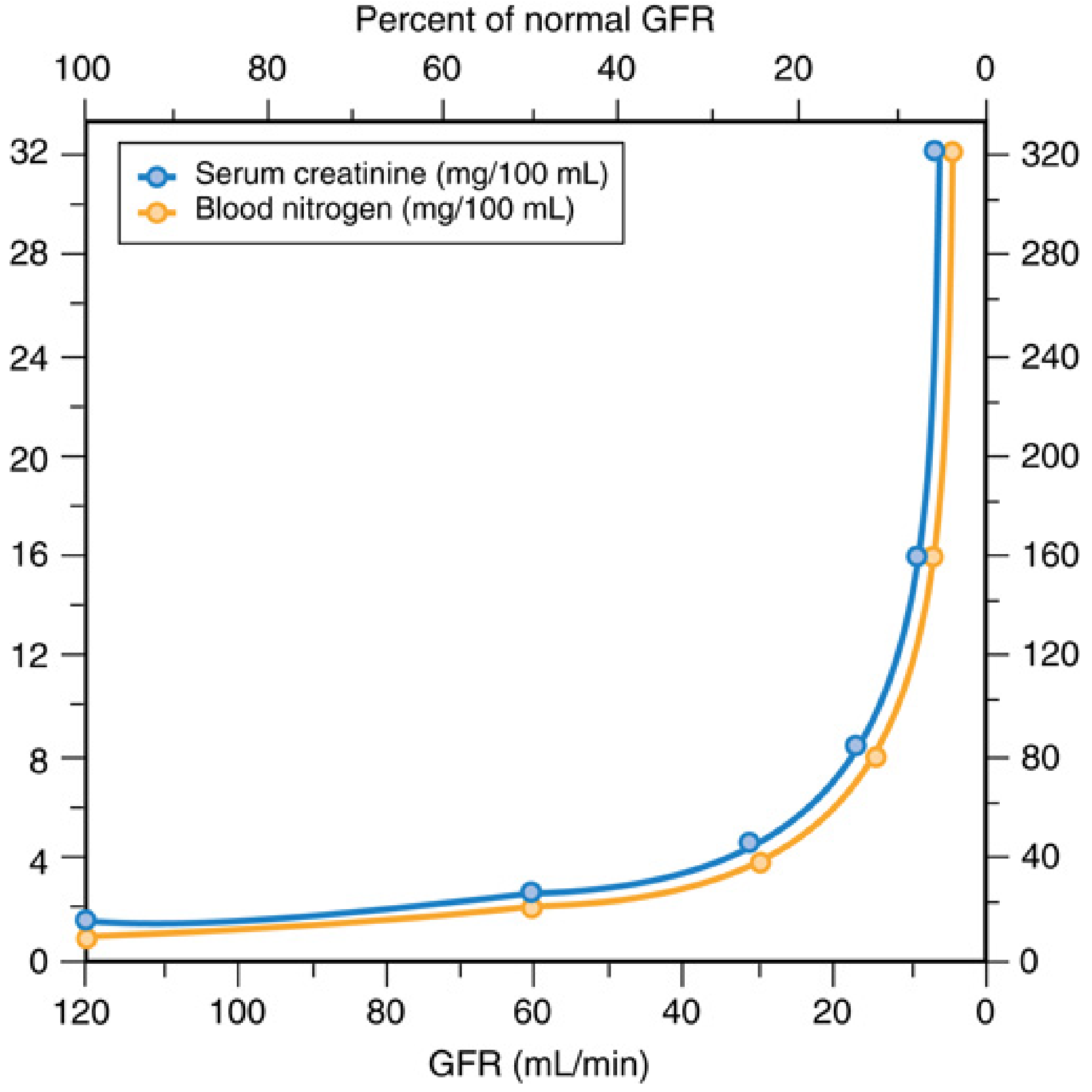
As shown, both values remain near-normal until GFR drops significantly, then rise sharply - this is why early kidney disease can be "silent."
Plasma Osmolarity Formula (BUN's Role)
BUN also appears in the plasma osmolarity formula used in anesthesia and ICU settings:
Plasma Osmolarity = [Na⁺] × 2 + Glucose/18 + BUN/2.8
- Miller's Anesthesia, 10e
Sources: National Kidney Foundation Primer on Kidney Diseases, 8e | Miller's Anesthesia, 10e
This is a shared conversation. Sign in to Orris to start your own chat.