~/antioxidants-pptx/build.js
const pptxgen = require("pptxgenjs");

const pres = new pptxgen();
pres.layout = "LAYOUT_WIDE"; // 13.3 x 7.5
pres.title = "Antioxidant Mechanisms - Flowchart Comparison";
pres.author = "M.Pharm Pharmacology";

// ─── COLOR PALETTE ───────────────────────────────────────────────
const C = {
  deepBlue:   "0A1628",  // dominant dark bg
  navyBlue:   "0D2347",  // card bg
  teal:       "0E7C86",  // accent 1 (enzymatic)
  green:      "1A7A4A",  // accent 2 (non-enzymatic)
  orange:     "D4700A",  // accent 3 (chain-breaker)
  red:        "C0392B",  // free radical / danger
  yellow:     "F4C842",  // highlight / key text
  lightBlue:  "3EC9D6",  // arrows / flow
  white:      "FFFFFF",
  offWhite:   "E8F4F8",
  mutedGray:  "A0B4C0",
  lightGreen: "27AE60",
  purple:     "7D3C98",
  rose:       "E91E8C",
};

// ─── HELPERS ─────────────────────────────────────────────────────
function titleSlide(slide) {
  // full bg
  slide.addShape(pres.ShapeType.rect, { x: 0, y: 0, w: 13.3, h: 7.5, fill: { color: C.deepBlue } });
  // accent bar left
  slide.addShape(pres.ShapeType.rect, { x: 0, y: 0, w: 0.25, h: 7.5, fill: { color: C.teal } });
  // accent bar bottom
  slide.addShape(pres.ShapeType.rect, { x: 0, y: 7.1, w: 13.3, h: 0.4, fill: { color: C.teal } });
}

function box(slide, x, y, w, h, fillColor, lineColor, radius) {
  slide.addShape(pres.ShapeType.roundRect, {
    x, y, w, h,
    fill: { color: fillColor },
    line: { color: lineColor || fillColor, width: 1.5 },
    rectRadius: radius !== undefined ? radius : 0.12,
  });
}

function arrow(slide, x, y, w, h, color) {
  // simple downward line + arrowhead using a thin rect + triangle
  slide.addShape(pres.ShapeType.line, {
    x, y, w, h,
    line: { color: color || C.lightBlue, width: 2.5, endArrowType: "arrow" },
  });
}

function label(slide, txt, x, y, w, h, opts) {
  slide.addText(txt, {
    x, y, w, h,
    fontSize: opts?.fontSize || 13,
    color: opts?.color || C.white,
    bold: opts?.bold || false,
    align: opts?.align || "center",
    valign: opts?.valign || "middle",
    fontFace: "Calibri",
    margin: opts?.margin !== undefined ? opts.margin : 4,
    wrap: true,
  });
}

// ═══════════════════════════════════════════════════════════════════
// SLIDE 1 — TITLE
// ═══════════════════════════════════════════════════════════════════
{
  const s = pres.addSlide();
  titleSlide(s);

  // large molecule-like circle decoration
  s.addShape(pres.ShapeType.ellipse, { x: 9.5, y: -1.0, w: 5.5, h: 5.5, fill: { color: "0E2A3A" }, line: { color: C.teal, width: 1 } });
  s.addShape(pres.ShapeType.ellipse, { x: 10.2, y: 3.8, w: 3.5, h: 3.5, fill: { color: "0B1F2F" }, line: { color: C.lightBlue, width: 1 } });

  // molecule dots
  [[10.8,1.0,0.18,C.teal],[11.5,0.5,0.13,C.yellow],[10.2,1.8,0.14,C.lightBlue],
   [11.9,1.4,0.1,C.white],[10.5,2.2,0.12,C.orange]].forEach(([cx,cy,r,col]) => {
    s.addShape(pres.ShapeType.ellipse, { x: cx-r, y: cy-r, w: r*2, h: r*2, fill: { color: col }, line: { color: col, width: 0 } });
  });

  label(s, "ANTIOXIDANT\nMECHANISMS", 0.5, 1.2, 9.0, 2.2, { fontSize: 46, bold: true, color: C.white, align: "left" });
  label(s, "A Comparative Flowchart Analysis", 0.7, 3.3, 8.5, 0.7, { fontSize: 22, color: C.lightBlue, align: "left" });

  // divider
  s.addShape(pres.ShapeType.line, { x: 0.7, y: 4.1, w: 7.0, h: 0, line: { color: C.teal, width: 1.5 } });

  label(s, "Free Radicals  •  ROS & RNS  •  Enzymatic Defenses  •  Non-Enzymatic Defenses", 0.7, 4.25, 10.0, 0.5, { fontSize: 14, color: C.mutedGray, align: "left" });
  label(s, "M.Pharm Pharmacology  |  2026", 0.7, 6.8, 8.0, 0.5, { fontSize: 12, color: C.mutedGray, align: "left" });
}

// ═══════════════════════════════════════════════════════════════════
// SLIDE 2 — Overview: Free Radical → Oxidative Stress → Antioxidant Defense
// ═══════════════════════════════════════════════════════════════════
{
  const s = pres.addSlide();
  s.addShape(pres.ShapeType.rect, { x: 0, y: 0, w: 13.3, h: 7.5, fill: { color: C.deepBlue } });
  s.addShape(pres.ShapeType.rect, { x: 0, y: 0, w: 13.3, h: 0.55, fill: { color: C.teal } });
  label(s, "OVERVIEW: THE OXIDATIVE STRESS PATHWAY", 0, 0, 13.3, 0.55, { fontSize: 16, bold: true, color: C.deepBlue });

  // Row 1: triggers
  const trigX = [0.3, 2.3, 4.3, 6.3, 8.3, 10.3];
  const trigLabels = ["Radiation\n/ UV", "Toxins\n/ Drugs", "Inflammation\n(Phagocytes)", "Ischemia-\nReperfusion", "Normal\nMetabolism", "Heavy\nMetals"];
  const trigColors = [C.red, C.orange, "8E44AD", "2980B9", C.green, "7F8C8D"];
  trigLabels.forEach((t, i) => {
    box(s, trigX[i], 0.75, 1.9, 0.85, trigColors[i], trigColors[i], 0.1);
    label(s, t, trigX[i], 0.75, 1.9, 0.85, { fontSize: 11, bold: false });
  });

  label(s, "TRIGGERS", 0.15, 0.7, 1.5, 0.9, { fontSize: 10, color: C.mutedGray, align: "left", valign: "top" });

  // Arrow down
  s.addShape(pres.ShapeType.line, { x: 6.4, y: 1.6, w: 0, h: 0.45, line: { color: C.yellow, width: 2.5, endArrowType: "arrow" } });

  // Row 2: ROS/RNS box
  box(s, 1.5, 2.05, 10.3, 0.85, "1A0A0A", C.red, 0.15);
  s.addShape(pres.ShapeType.rect, { x: 1.5, y: 2.05, w: 10.3, h: 0.85, fill: { color: "2C0A0A" }, line: { color: C.red, width: 2 } });
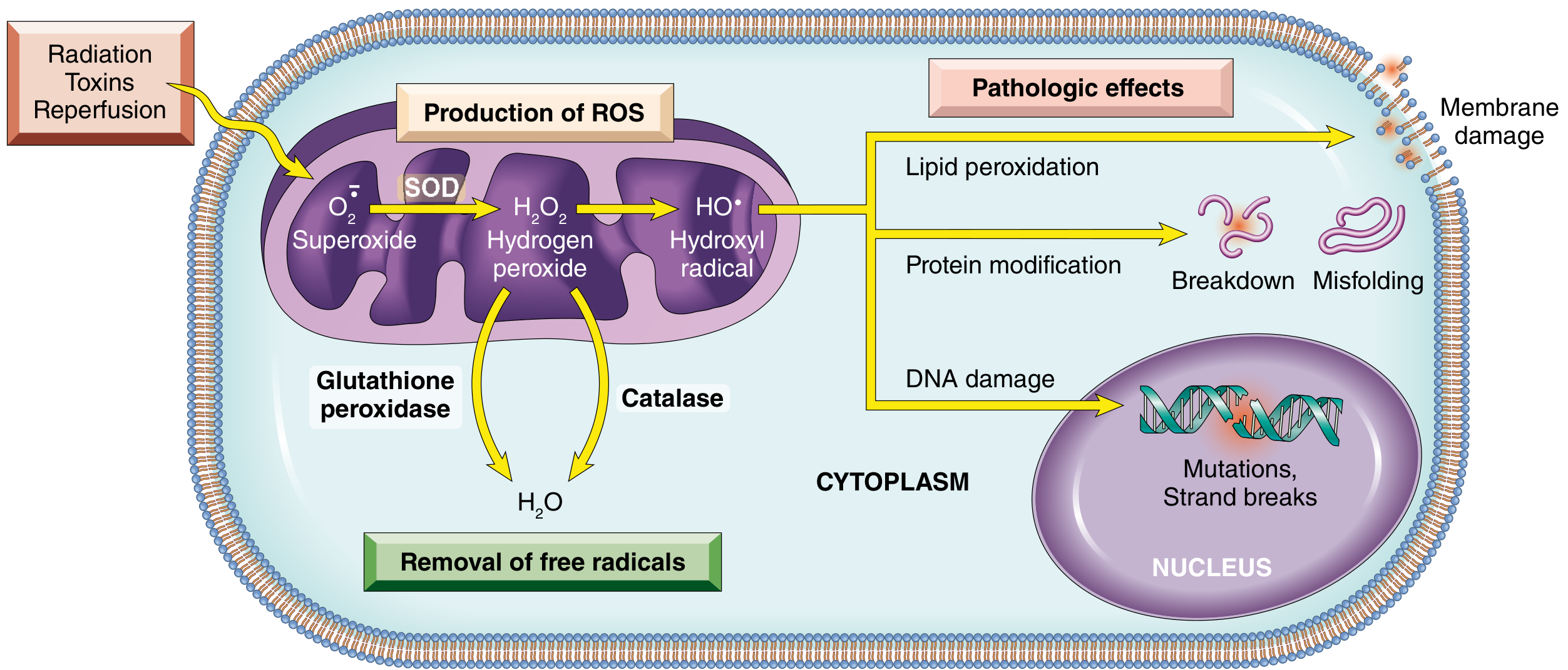
  label(s, "⚡  EXCESS FREE RADICALS  (ROS + RNS)", 1.5, 2.05, 10.3, 0.85, { fontSize: 17, bold: true, color: C.red });

  // sub labels under ROS box
  const ros = ["O₂•⁻ Superoxide", "H₂O₂ Hydrogen Peroxide", "•OH Hydroxyl Radical", "ONOO⁻ Peroxynitrite", "NO• Nitric Oxide", "¹O₂ Singlet Oxygen"];
  const rosColors = ["3498DB","2ECC71","E74C3C","9B59B6","F39C12","1ABC9C"];
  ros.forEach((r, i) => {
    const rx = 0.5 + i * 2.1;
    box(s, rx, 2.95, 1.9, 0.55, rosColors[i], rosColors[i], 0.08);
    label(s, r, rx, 2.95, 1.9, 0.55, { fontSize: 10, bold: false });
  });

  // Arrow down
  s.addShape(pres.ShapeType.line, { x: 6.4, y: 3.55, w: 0, h: 0.35, line: { color: C.yellow, width: 2.5, endArrowType: "arrow" } });

  // oxidative stress box
  box(s, 3.5, 3.9, 6.3, 0.75, "2C1810", C.orange, 0.15);
  label(s, "⚠  OXIDATIVE STRESS", 3.5, 3.9, 6.3, 0.75, { fontSize: 18, bold: true, color: C.orange });

  // damage arrows
  const dmgX = [0.8, 4.5, 8.5];
  const dmgLabels = ["Lipid\nPeroxidation", "Protein\nDamage", "DNA\nDamage"];
  const dmgColors = [C.orange, C.red, "8E44AD"];
  dmgX.forEach((dx, i) => {
    s.addShape(pres.ShapeType.line, { x: dx + 0.65, y: 4.65, w: 0, h: 0.45, line: { color: dmgColors[i], width: 2, endArrowType: "arrow" } });
    box(s, dx, 5.1, 1.7, 0.7, "1A0D1A", dmgColors[i], 0.1);
    label(s, dmgLabels[i], dx, 5.1, 1.7, 0.7, { fontSize: 12, bold: true, color: dmgColors[i] });
  });

  // VS antioxidant shield
  box(s, 5.5, 4.7, 2.5, 0.8, "0A2A1A", C.lightGreen, 0.1);
  label(s, "🛡  ANTIOXIDANT\nDEFENSE", 5.5, 4.7, 2.5, 0.8, { fontSize: 12, bold: true, color: C.lightGreen });

  label(s, "If defense OVERWHELMED:", 0.4, 5.85, 4.5, 0.4, { fontSize: 11, color: C.mutedGray, align: "left" });
  const diseaseList = ["Cancer","Diabetes","CVD","Neurodegeneration","Aging"];
  diseaseList.forEach((d,i) => {
    box(s, 0.3 + i*2.5, 6.3, 2.2, 0.55, "1A0A0A", C.red, 0.08);
    label(s, d, 0.3 + i*2.5, 6.3, 2.2, 0.55, { fontSize: 12, bold: true, color: "FF6B6B" });
  });
}

// ═══════════════════════════════════════════════════════════════════
// SLIDE 3 — Enzymatic Antioxidants Flowchart
// ═══════════════════════════════════════════════════════════════════
{
  const s = pres.addSlide();
  s.addShape(pres.ShapeType.rect, { x: 0, y: 0, w: 13.3, h: 7.5, fill: { color: C.deepBlue } });
  s.addShape(pres.ShapeType.rect, { x: 0, y: 0, w: 13.3, h: 0.55, fill: { color: C.teal } });
  label(s, "ENZYMATIC ANTIOXIDANTS — SEQUENTIAL DEFENSE FLOWCHART", 0, 0, 13.3, 0.55, { fontSize: 15, bold: true, color: C.deepBlue });

  // Column headers
  const cols = [
    { x: 0.3,  label: "STEP 1", sub: "SOD", color: "2980B9" },
    { x: 3.4,  label: "STEP 2a", sub: "CATALASE", color: C.teal },
    { x: 6.5,  label: "STEP 2b", sub: "GLUTATHIONE\nPEROXIDASE", color: C.green },
    { x: 9.6,  label: "STEP 3", sub: "GLUTATHIONE\nREDUCTASE", color: C.purple },
  ];

  cols.forEach(c => {
    box(s, c.x, 0.7, 2.8, 0.55, c.color, c.color, 0.08);
    label(s, c.label, c.x, 0.7, 2.8, 0.55, { fontSize: 12, bold: true });
    label(s, c.sub, c.x, 1.25, 2.8, 0.55, { fontSize: 13, bold: true, color: c.color });
  });

  // Chain: O2•- → H2O2 → H2O
  // SOD box
  box(s, 0.3, 1.85, 2.8, 1.1, "0A1E35", "2980B9", 0.12);
  label(s, "Superoxide Dismutase\n(SOD)", 0.3, 1.85, 2.8, 1.1, { fontSize: 14, bold: true, color: "5DADE2" });

  // reaction
  box(s, 0.3, 3.05, 2.8, 0.75, "071422", "2980B9", 0.1);
  label(s, "2O₂•⁻ + 2H⁺\n→ H₂O₂ + O₂", 0.3, 3.05, 2.8, 0.75, { fontSize: 13, color: C.white });

  // location
  box(s, 0.3, 3.9, 2.8, 0.55, "051020", "3498DB", 0.08);
  label(s, "Cu/Zn-SOD: Cytosol\nMn-SOD: Mitochondria", 0.3, 3.9, 2.8, 0.55, { fontSize: 11, color: C.mutedGray });

  // cofactor
  box(s, 0.3, 4.55, 2.8, 0.5, "071422", "2980B9", 0.08);
  label(s, "Cofactor: Cu, Zn (Mn in mitochondria)", 0.3, 4.55, 2.8, 0.5, { fontSize: 11, color: "AED6F1" });

  // product arrow
  s.addShape(pres.ShapeType.line, { x: 3.1, y: 3.1, w: 0.3, h: 0, line: { color: C.yellow, width: 2.5, endArrowType: "arrow" } });
  label(s, "H₂O₂\nproduced", 2.9, 2.85, 0.8, 0.55, { fontSize: 9, color: C.yellow });

  // CATALASE box
  box(s, 3.4, 1.85, 2.8, 1.1, "051A1E", C.teal, 0.12);
  label(s, "Catalase", 3.4, 1.85, 2.8, 1.1, { fontSize: 14, bold: true, color: C.lightBlue });

  box(s, 3.4, 3.05, 2.8, 0.75, "040F12", C.teal, 0.1);
  label(s, "2H₂O₂\n→ 2H₂O + O₂", 3.4, 3.05, 2.8, 0.75, { fontSize: 13, color: C.white });

  box(s, 3.4, 3.9, 2.8, 0.55, "030B0E", C.teal, 0.08);
  label(s, "Location: Peroxisomes\n(high H₂O₂ environments)", 3.4, 3.9, 2.8, 0.55, { fontSize: 11, color: C.mutedGray });

  box(s, 3.4, 4.55, 2.8, 0.5, "040F12", C.teal, 0.08);
  label(s, "Cofactor: Heme (iron)\nMost efficient H₂O₂ remover", 3.4, 4.55, 2.8, 0.5, { fontSize: 11, color: "A9CCE3" });

  // OR label
  label(s, "OR", 6.0, 2.9, 0.5, 0.5, { fontSize: 14, bold: true, color: C.yellow });

  // GPx box
  box(s, 6.5, 1.85, 2.8, 1.1, "0A1E0F", C.green, 0.12);
  label(s, "Glutathione Peroxidase\n(GPx)", 6.5, 1.85, 2.8, 1.1, { fontSize: 14, bold: true, color: "58D68D" });

  box(s, 6.5, 3.05, 2.8, 0.75, "06120A", C.green, 0.1);
  label(s, "H₂O₂ + 2GSH\n→ 2H₂O + GSSG", 6.5, 3.05, 2.8, 0.75, { fontSize: 13, color: C.white });

  box(s, 6.5, 3.9, 2.8, 0.55, "040C07", C.green, 0.08);
  label(s, "Location: Cytosol +\nMitochondria", 6.5, 3.9, 2.8, 0.55, { fontSize: 11, color: C.mutedGray });

  box(s, 6.5, 4.55, 2.8, 0.5, "06120A", C.green, 0.08);
  label(s, "Cofactor: Selenium (Se)\nAlso detoxifies lipid peroxides", 6.5, 4.55, 2.8, 0.5, { fontSize: 11, color: "A9DFBF" });

  // Arrow to GR
  s.addShape(pres.ShapeType.line, { x: 9.3, y: 3.1, w: 0.3, h: 0, line: { color: C.yellow, width: 2.5, endArrowType: "arrow" } });
  label(s, "GSSG\nformed", 9.0, 2.85, 0.8, 0.55, { fontSize: 9, color: C.yellow });

  // Glutathione Reductase box
  box(s, 9.6, 1.85, 2.8, 1.1, "1A0A2A", C.purple, 0.12);
  label(s, "Glutathione Reductase\n(GR)", 9.6, 1.85, 2.8, 1.1, { fontSize: 14, bold: true, color: "C39BD3" });

  box(s, 9.6, 3.05, 2.8, 0.75, "0F0619", C.purple, 0.1);
  label(s, "GSSG + NADPH + H⁺\n→ 2GSH + NADP⁺", 9.6, 3.05, 2.8, 0.75, { fontSize: 13, color: C.white });

  box(s, 9.6, 3.9, 2.8, 0.55, "0A0415", C.purple, 0.08);
  label(s, "Location: Cytosol\n(Mitochondria)", 9.6, 3.9, 2.8, 0.55, { fontSize: 11, color: C.mutedGray });

  box(s, 9.6, 4.55, 2.8, 0.5, "0F0619", C.purple, 0.08);
  label(s, "Cofactor: FAD\nNADPH from Pentose Phosphate Pathway", 9.6, 4.55, 2.8, 0.5, { fontSize: 11, color: "D2B4DE" });

  // Recycling arrow (GR back to GPx)
  s.addShape(pres.ShapeType.line, { x: 9.6, y: 5.1, w: -3.1, h: 0, line: { color: C.lightGreen, width: 1.5, endArrowType: "arrow", dashType: "dash" } });
  label(s, "♻ GSH regenerated → reused by GPx", 6.0, 5.05, 4.2, 0.4, { fontSize: 10, color: C.lightGreen });

  // Peroxiredoxin addition
  box(s, 0.3, 5.2, 12.7, 0.65, "0A0A1A", C.lightBlue, 0.1);
  label(s, "PEROXIREDOXINS (PRDx)  —  Reduce ONOO⁻ (Peroxynitrite) → HNO₂   |   Location: Cytosol + Mitochondria   |   Cofactor: Thioredoxin (Trx)", 0.3, 5.2, 12.7, 0.65, { fontSize: 12, color: C.lightBlue });

  // Final outcome
  box(s, 2.5, 6.0, 8.3, 0.7, "0A2A1A", C.lightGreen, 0.12);
  label(s, "✓  OUTCOME: Free Radicals Neutralized  →  Cell Protected from Oxidative Damage", 2.5, 6.0, 8.3, 0.7, { fontSize: 14, bold: true, color: C.lightGreen });

  // footnote
  label(s, "Note: SOD → Catalase / GPx pathway is the PRIMARY enzymatic cascade (First-line defense)", 0.3, 6.9, 12.7, 0.4, { fontSize: 10, color: C.mutedGray });
}

// ═══════════════════════════════════════════════════════════════════
// SLIDE 4 — Non-Enzymatic Antioxidants Comparison
// ═══════════════════════════════════════════════════════════════════
{
  const s = pres.addSlide();
  s.addShape(pres.ShapeType.rect, { x: 0, y: 0, w: 13.3, h: 7.5, fill: { color: C.deepBlue } });
  s.addShape(pres.ShapeType.rect, { x: 0, y: 0, w: 13.3, h: 0.55, fill: { color: C.orange } });
  label(s, "NON-ENZYMATIC ANTIOXIDANTS — MECHANISMS & COMPARISON", 0, 0, 13.3, 0.55, { fontSize: 15, bold: true, color: C.deepBlue });

  // Cards for each antioxidant
  const cards = [
    {
      name: "Vitamin E\n(α-Tocopherol)",
      color: "C0392B",
      type: "FAT-SOLUBLE",
      mechanism: "Donates H• to lipid\nperoxyl radical (LOO•)\nBreaks lipid peroxidation\nchain in membranes",
      rxn: "LOO• + Vit-E-OH\n→ LOOH + Vit-E-O•",
      target: "Lipid peroxyl\nradicals (LOO•)",
      location: "Cell membrane\nlipid bilayer",
      regenerated: "By Vitamin C",
    },
    {
      name: "Vitamin C\n(Ascorbic Acid)",
      color: "F39C12",
      type: "WATER-SOLUBLE",
      mechanism: "Scavenges O₂•⁻, •OH,\nHOCl directly\nRegenerates Vitamin E\nAqueous phase protection",
      rxn: "Vit-E-O• + Vit-C\n→ Vit-E-OH + Vit-C•",
      target: "O₂•⁻, •OH, HOCl,\nVit-E radical",
      location: "Plasma, cytosol\n(aqueous phase)",
      regenerated: "By GSH",
    },
    {
      name: "Glutathione\n(GSH)",
      color: "27AE60",
      type: "TRIPEPTIDE",
      mechanism: "Direct scavenger of\n•OH, HOCl, ONOO⁻\nSubstrate for GPx\nDetoxifies xenobiotics",
      rxn: "2GSH + H₂O₂\n→ GSSG + 2H₂O\n(via GPx)",
      target: "•OH, HOCl, ONOO⁻\nlipid peroxides",
      location: "Cytosol, nucleus\nmitochondria",
      regenerated: "By GR + NADPH",
    },
    {
      name: "Beta-Carotene\n(Provitamin A)",
      color: "E67E22",
      type: "FAT-SOLUBLE",
      mechanism: "Quenches singlet\noxygen (¹O₂) by\nenergy transfer\nScavenges lipid radicals",
      rxn: "¹O₂ + β-carotene\n→ ³O₂ + excited\ncarotenoid (harmless)",
      target: "Singlet oxygen (¹O₂)\nlipid peroxyl radicals",
      location: "Lipid membranes\nplasma (as Vit A)",
      regenerated: "Not regenerated",
    },
    {
      name: "Uric Acid",
      color: "8E44AD",
      type: "WATER-SOLUBLE",
      mechanism: "Scavenges HOCl\nand singlet oxygen\nChelates Fe²⁺/Cu²⁺\nPrevents Fenton rxn",
      rxn: "Urate + •OH\n→ Allantoin +\nharmless products",
      target: "HOCl, ¹O₂, •OH\nFe²⁺ and Cu²⁺",
      location: "Plasma\n(highest conc.)",
      regenerated: "Excreted in urine",
    },
    {
      name: "Flavonoids /\nPolyphenols",
      color: "2980B9",
      type: "PLANT-DERIVED",
      mechanism: "Multi-target:\nRadical scavenging\nMetal chelation\nNrf2 pathway activation",
      rxn: "Fl-OH + R•\n→ Fl-O• + RH\n(stable radical)",
      target: "Multiple ROS/RNS\nFe²⁺ and Cu²⁺",
      location: "Plasma, tissues\n(dietary uptake)",
      regenerated: "By ascorbate",
    },
  ];

  // 2 rows, 3 cols
  cards.forEach((card, i) => {
    const col = i % 3;
    const row = Math.floor(i / 3);
    const cx = 0.25 + col * 4.35;
    const cy = 0.75 + row * 3.3;
    const cw = 4.1;
    const ch = 3.1;

    // card bg
    s.addShape(pres.ShapeType.roundRect, {
      x: cx, y: cy, w: cw, h: ch,
      fill: { color: "0C1C2A" },
      line: { color: card.color, width: 2 },
      rectRadius: 0.15,
    });
    // header bar
    s.addShape(pres.ShapeType.roundRect, {
      x: cx, y: cy, w: cw, h: 0.6,
      fill: { color: card.color },
      line: { color: card.color, width: 0 },
      rectRadius: 0.15,
    });
    label(s, card.name, cx, cy, cw, 0.6, { fontSize: 13, bold: true });

    // type badge
    box(s, cx + 0.1, cy + 0.65, cw - 0.2, 0.28, "0A0A1A", card.color, 0.06);
    label(s, card.type, cx + 0.1, cy + 0.65, cw - 0.2, 0.28, { fontSize: 10, color: card.color, bold: true });

    // mechanism
    label(s, card.mechanism, cx + 0.1, cy + 0.98, cw - 0.2, 0.78, { fontSize: 11, color: C.offWhite, align: "left", valign: "top", margin: 2 });

    // reaction
    box(s, cx + 0.1, cy + 1.8, cw - 0.2, 0.52, "060D14", card.color, 0.06);
    label(s, card.rxn, cx + 0.1, cy + 1.8, cw - 0.2, 0.52, { fontSize: 10, color: card.color });

    // 2 small info rows
    label(s, "Target: " + card.target, cx + 0.1, cy + 2.37, cw - 0.2, 0.35, { fontSize: 10, color: C.mutedGray, align: "left", margin: 1 });
    label(s, "Regenerated: " + card.regenerated, cx + 0.1, cy + 2.72, cw - 0.2, 0.32, { fontSize: 10, color: "58D68D", align: "left", margin: 1 });
  });

  // footer
  s.addShape(pres.ShapeType.rect, { x: 0, y: 7.15, w: 13.3, h: 0.35, fill: { color: C.orange } });
  label(s, "Synergy: Vit E → Vit C → GSH → NADPH forms a regeneration cascade — each antioxidant recycles the previous", 0, 7.15, 13.3, 0.35, { fontSize: 11, bold: true, color: C.deepBlue });
}

// ═══════════════════════════════════════════════════════════════════
// SLIDE 5 — Antioxidant Regeneration Cascade
// ═══════════════════════════════════════════════════════════════════
{
  const s = pres.addSlide();
  s.addShape(pres.ShapeType.rect, { x: 0, y: 0, w: 13.3, h: 7.5, fill: { color: C.deepBlue } });
  s.addShape(pres.ShapeType.rect, { x: 0, y: 0, w: 13.3, h: 0.55, fill: { color: C.green } });
  label(s, "ANTIOXIDANT REGENERATION CASCADE — The Synergistic Cycle", 0, 0, 13.3, 0.55, { fontSize: 15, bold: true, color: C.deepBlue });

  // Central cascade — left to right chain
  const chain = [
    { label: "LIPID RADICAL\n(LOO•)", color: C.red, x: 0.4, y: 2.5 },
    { label: "VITAMIN E\n(α-Tocopherol)\nFat-soluble", color: "C0392B", x: 2.4, y: 1.2 },
    { label: "Vit E Radical\n(Vit-E-O•)\nStable", color: "7B241C", x: 4.9, y: 1.2 },
    { label: "VITAMIN C\n(Ascorbate)\nWater-soluble", color: "E67E22", x: 7.0, y: 1.2 },
    { label: "Vit C Radical\n(Asc•)\nSemi-stable", color: "784212", x: 9.5, y: 1.2 },
    { label: "GLUTATHIONE\n(GSH)\nTripeptide", color: C.green, x: 11.1, y: 1.2 },
  ];

  // draw chain nodes
  chain.forEach((node, i) => {
    const nw = 1.9;
    const nh = 0.85;
    box(s, node.x, node.y, nw, nh, "0C1C2A", node.color, 0.12);
    s.addShape(pres.ShapeType.roundRect, { x: node.x, y: node.y, w: nw, h: 0.25, fill: { color: node.color }, line: { color: node.color, width: 0 }, rectRadius: 0.12 });
    label(s, node.label, node.x, node.y, nw, nh, { fontSize: 11, bold: false });
  });

  // Arrows between chain
  [[2.3, 1.6, "Quenches"], [4.8, 1.6, "Regenerates"], [6.95, 1.6, "Regenerates"], [9.45, 1.6, "Regenerates"]].forEach(([ax, ay, lbl], i) => {
    s.addShape(pres.ShapeType.line, { x: ax, y: ay + 0.03, w: 0.35, h: 0, line: { color: C.yellow, width: 2, endArrowType: "arrow" } });
    label(s, lbl, ax - 0.1, ay - 0.25, 0.8, 0.3, { fontSize: 8, color: C.yellow });
  });

  // LOOH label (product)
  box(s, 0.4, 3.6, 1.9, 0.6, "1A0000", C.red, 0.08);
  label(s, "LOOH\n(stable lipid\nhydroperoxide)", 0.4, 3.6, 1.9, 0.6, { fontSize: 10, color: C.red });

  // GSH → GSSG cycle
  box(s, 11.1, 2.5, 1.9, 0.75, "071A0F", C.green, 0.1);
  label(s, "GSSG\n(oxidized)", 11.1, 2.5, 1.9, 0.75, { fontSize: 11, color: "58D68D" });
  s.addShape(pres.ShapeType.line, { x: 12.0, y: 2.05, w: 0, h: 0.45, line: { color: C.green, width: 2, endArrowType: "arrow" } });

  // GR box
  box(s, 10.0, 3.4, 2.9, 0.85, "0F0619", C.purple, 0.12);
  label(s, "Glutathione Reductase (GR)\nGSSG + NADPH → 2GSH + NADP⁺", 10.0, 3.4, 2.9, 0.85, { fontSize: 12, bold: false, color: "C39BD3" });
  s.addShape(pres.ShapeType.line, { x: 11.1, y: 3.4, w: 0, h: -0.35, line: { color: C.purple, width: 2, endArrowType: "arrow" } });
  s.addShape(pres.ShapeType.line, { x: 11.0, y: 4.25, w: 0.5, h: 0, line: { color: C.purple, width: 1.5, dashType: "dash" } });

  // NADPH source
  box(s, 9.4, 4.35, 3.5, 0.65, "060312", C.purple, 0.1);
  label(s, "NADPH from Pentose\nPhosphate Pathway (G6PD)", 9.4, 4.35, 3.5, 0.65, { fontSize: 11, color: C.mutedGray });

  // Metal chelation box (separate mechanism)
  box(s, 0.4, 4.7, 5.5, 1.5, "050E1A", "7F8C8D", 0.12);
  label(s, "METAL CHELATION — PREVENTIVE MECHANISM", 0.4, 4.7, 5.5, 0.4, { fontSize: 12, bold: true, color: "85929E" });
  const chelators = [
    "Transferrin / Ferritin  →  Sequesters Fe²⁺/Fe³⁺",
    "Ceruloplasmin  →  Binds Cu²⁺",
    "Albumin  →  Binds Cu²⁺ + heme",
    "Lactoferrin  →  Binds Fe in inflammation",
  ];
  chelators.forEach((c, i) => {
    label(s, c, 0.5, 5.1 + i * 0.28, 5.3, 0.28, { fontSize: 10, color: C.offWhite, align: "left", margin: 1 });
  });
  label(s, "✓ Prevents Fenton Reaction: Fe²⁺ + H₂O₂ → •OH", 0.4, 6.2, 5.5, 0.35, { fontSize: 11, bold: true, color: C.yellow });

  // Nrf2 pathway box
  box(s, 6.2, 4.7, 6.7, 1.5, "050E1A", C.lightBlue, 0.12);
  label(s, "Nrf2 PATHWAY — INDUCIBLE DEFENSE", 6.2, 4.7, 6.7, 0.4, { fontSize: 12, bold: true, color: C.lightBlue });
  const nrf2 = [
    "Oxidative stress → Nrf2 released from Keap1",
    "Nrf2 translocates to nucleus",
    "Binds ARE (Antioxidant Response Element)",
    "↑ SOD, Catalase, GPx, GR, GSH synthesis",
  ];
  nrf2.forEach((n, i) => {
    label(s, (i+1) + ". " + n, 6.3, 5.1 + i * 0.28, 6.5, 0.28, { fontSize: 10, color: C.offWhite, align: "left", margin: 1 });
  });
  label(s, "Inducers: Sulforaphane, Curcumin, Resveratrol, NAC, Quercetin", 6.2, 6.2, 6.7, 0.35, { fontSize: 10, bold: false, color: C.yellow });

  // footer note
  box(s, 0.3, 6.65, 12.7, 0.6, "0A1810", C.lightGreen, 0.1);
  label(s, "Key Insight: Antioxidants work in LAYERS — enzymatic (SOD→Catalase/GPx) + non-enzymatic (Vit E→C→GSH) + preventive (metal chelation) + inducible (Nrf2)", 0.3, 6.65, 12.7, 0.6, { fontSize: 12, bold: true, color: C.lightGreen });
}

// ═══════════════════════════════════════════════════════════════════
// SLIDE 6 — Head-to-Head Comparison Table
// ═══════════════════════════════════════════════════════════════════
{
  const s = pres.addSlide();
  s.addShape(pres.ShapeType.rect, { x: 0, y: 0, w: 13.3, h: 7.5, fill: { color: C.deepBlue } });
  s.addShape(pres.ShapeType.rect, { x: 0, y: 0, w: 13.3, h: 0.55, fill: { color: "7D3C98" } });
  label(s, "COMPARATIVE SUMMARY TABLE — All Antioxidant Mechanisms", 0, 0, 13.3, 0.55, { fontSize: 15, bold: true, color: C.white });

  const headers = ["Antioxidant", "Class", "Mechanism", "Target Radical", "Location", "Cofactor/Source", "Clinical Use"];
  const colW = [1.7, 1.2, 2.5, 1.8, 1.6, 1.6, 1.8];
  const colX = [0.1];
  colW.forEach((w, i) => { if (i > 0) colX.push(colX[i-1] + colW[i-1] + 0.05); });

  // header row
  headers.forEach((h, i) => {
    box(s, colX[i], 0.6, colW[i], 0.45, "7D3C98", "7D3C98", 0.06);
    label(s, h, colX[i], 0.6, colW[i], 0.45, { fontSize: 10, bold: true });
  });

  const rows = [
    ["SOD", "Enzyme", "Dismutates O₂•⁻ to H₂O₂", "O₂•⁻", "Cytosol/Mito", "Cu, Zn, Mn", "CGD, aging research"],
    ["Catalase", "Enzyme", "Decomposes H₂O₂ to H₂O+O₂", "H₂O₂", "Peroxisomes", "Heme (Fe)", "H₂O₂ detox"],
    ["GPx", "Enzyme", "Reduces H₂O₂ via GSH", "H₂O₂, ROOH", "Cytosol/Mito", "Selenium", "Diabetic neuropathy"],
    ["GR", "Enzyme", "Regenerates GSH from GSSG", "GSSG", "Cytosol", "FAD, NADPH", "Supports GPx cycle"],
    ["Vitamin E", "Non-Enz", "Chain-breaking in membranes", "LOO•, LO•", "Membranes", "Diet (fats)", "CVD, diabetic Rx"],
    ["Vitamin C", "Non-Enz", "Aqueous scavenger + Vit-E regen", "OH•, O₂•⁻, HOCl", "Plasma/Cytosol", "Diet (fruits)", "CVD, immune support"],
    ["Glutathione", "Non-Enz", "Direct scavenger + GPx substrate", "•OH, HOCl, ONOO⁻", "Cytosol/Mito", "Cys, Glu, Gly", "Liver detox, NAC prodrug"],
    ["Beta-Carotene", "Non-Enz", "Quenches singlet oxygen", "¹O₂, LOO•", "Membranes", "Diet (veggies)", "Cancer prevention (diet)"],
    ["Uric Acid", "Non-Enz", "Scavenges HOCl, chelates metals", "HOCl, ¹O₂, Fe/Cu", "Plasma", "Purine metabolism", "Endogenous defense"],
    ["NAC", "Synthetic", "GSH precursor + direct scavenger", "•OH, ONOO⁻", "Plasma/Liver", "Synthetic", "Paracetamol OD, COPD"],
    ["Edaravone", "Synthetic", "Scavenges •OH + peroxynitrite", "•OH, ONOO⁻", "CNS/Plasma", "Synthetic", "ALS (FDA approved)"],
    ["Alpha-Lipoic Acid", "Synthetic", "Regenerates Vit C, E, GSH", "Multiple ROS", "Both phases", "Synthetic/Diet", "Diabetic neuropathy"],
  ];

  const rowColors = [
    "2980B9","1A6B78","1A7A4A","7D3C98","9B2335","A04000",
    "1A6B1A","A04A00","5B2882","555555","3A3A3A","2A2A2A"
  ];

  rows.forEach((row, ri) => {
    const ry = 1.1 + ri * 0.5;
    const bgColor = ri % 2 === 0 ? "0C1A28" : "081420";
    s.addShape(pres.ShapeType.rect, { x: 0.1, y: ry, w: 13.1, h: 0.48, fill: { color: bgColor }, line: { color: "1A2A3A", width: 0.5 } });
    // left accent bar
    s.addShape(pres.ShapeType.rect, { x: 0.1, y: ry, w: 0.06, h: 0.48, fill: { color: rowColors[ri] }, line: { color: rowColors[ri], width: 0 } });
    row.forEach((cell, ci) => {
      label(s, cell, colX[ci], ry, colW[ci], 0.48, { fontSize: ci === 0 ? 11 : 10, bold: ci === 0, color: ci === 0 ? C.yellow : C.offWhite, align: ci === 0 ? "center" : "left", margin: 2 });
    });
  });
}

// ═══════════════════════════════════════════════════════════════════
// SLIDE 7 — Therapeutic Roles (Disease-specific)
// ═══════════════════════════════════════════════════════════════════
{
  const s = pres.addSlide();
  s.addShape(pres.ShapeType.rect, { x: 0, y: 0, w: 13.3, h: 7.5, fill: { color: C.deepBlue } });
  s.addShape(pres.ShapeType.rect, { x: 0, y: 0, w: 13.3, h: 0.55, fill: { color: C.red } });
  label(s, "THERAPEUTIC ROLE OF ANTIOXIDANTS IN DISEASE", 0, 0, 13.3, 0.55, { fontSize: 15, bold: true, color: C.white });

  const diseases = [
    {
      name: "CANCER",
      color: C.red,
      icon: "☢",
      mechanism: "ROS → DNA mutations (8-OHdG), oncogene activation,\nNF-κB signaling → cell proliferation",
      antioxidants: ["Vitamin C, E, β-carotene (prevention)",
        "NAC — protects normal cells in chemo",
        "Selenium — reduces DNA oxidation"],
      note: "Caution: High-dose Vit E may protect cancer cells",
    },
    {
      name: "DIABETES MELLITUS",
      color: "F39C12",
      icon: "🩸",
      mechanism: "Hyperglycemia → auto-oxidation → O₂•⁻, H₂O₂\nβ-cell ROS damage → insulin ↓  |  Insulin resistance via JNK",
      antioxidants: ["Alpha-lipoic acid — diabetic neuropathy",
        "Vitamin E — β-cell protection",
        "NAC — reduces oxidative stress"],
      note: "ALA is FDA-approved for diabetic neuropathy (Europe)",
    },
    {
      name: "CVD / ATHEROSCLEROSIS",
      color: "E74C3C",
      icon: "❤",
      mechanism: "ROS → LDL oxidation → ox-LDL → foam cells\nNO• inactivated by O₂•⁻ → endothelial dysfunction",
      antioxidants: ["Vitamin E — anti-LDL oxidation",
        "CoQ10 — heart failure, statin myopathy",
        "Vitamin C — endothelial function"],
      note: "Resveratrol/Flavonoids activate Nrf2 → ↑ endogenous defense",
    },
    {
      name: "NEURODEGENERATION",
      color: "9B59B6",
      icon: "🧠",
      mechanism: "High O₂ demand + low SOD in brain\nAmyloid-β + dopamine oxidation → ROS burst",
      antioxidants: ["Edaravone — ALS (FDA 2017)",
        "Vitamin E — Alzheimer's (modest benefit)",
        "Melatonin — Parkinson's neuroprotection"],
      note: "Edaravone (Radicava) is the only FDA-approved antioxidant drug for ALS",
    },
    {
      name: "LIVER DISEASE /\nPARACETAMOL OD",
      color: C.teal,
      icon: "🫀",
      mechanism: "Paracetamol → NAPQI → depletes GSH\nCCl₄ → CCl₃• radical → lipid peroxidation",
      antioxidants: ["NAC (N-Acetylcysteine) — STANDARD treatment",
        "Silymarin (milk thistle) — radical scavenger",
        "Replenishes GSH in hepatocytes"],
      note: "NAC within 8-10 hrs of paracetamol overdose is life-saving",
    },
    {
      name: "ISCHEMIA-REPERFUSION\nINJURY",
      color: "3498DB",
      icon: "⚡",
      mechanism: "Xanthine oxidase burst on reperfusion\nNeutrophil NADPH oxidase activation → ROS surge",
      antioxidants: ["Allopurinol — xanthine oxidase inhibitor",
        "NAC — prevents ROS burst",
        "SOD mimetics — experimental"],
      note: "Allopurinol pre-treatment reduces reperfusion ROS in cardiac surgery",
    },
  ];

  // 2 rows × 3 cols
  diseases.forEach((d, i) => {
    const col = i % 3;
    const row = Math.floor(i / 3);
    const dx = 0.2 + col * 4.35;
    const dy = 0.65 + row * 3.3;
    const dw = 4.2;
    const dh = 3.1;

    // card
    s.addShape(pres.ShapeType.roundRect, { x: dx, y: dy, w: dw, h: dh, fill: { color: "080F18" }, line: { color: d.color, width: 2 }, rectRadius: 0.15 });
    // header
    s.addShape(pres.ShapeType.roundRect, { x: dx, y: dy, w: dw, h: 0.52, fill: { color: d.color }, line: { color: d.color, width: 0 }, rectRadius: 0.15 });
    label(s, d.icon + "  " + d.name, dx, dy, dw, 0.52, { fontSize: 12, bold: true });

    // mechanism
    label(s, d.mechanism, dx + 0.1, dy + 0.55, dw - 0.2, 0.7, { fontSize: 10, color: C.offWhite, align: "left", valign: "top", margin: 1 });

    // antioxidants list
    d.antioxidants.forEach((a, j) => {
      box(s, dx + 0.1, dy + 1.3 + j * 0.38, dw - 0.2, 0.33, "0A1420", d.color, 0.06);
      label(s, "✓ " + a, dx + 0.1, dy + 1.3 + j * 0.38, dw - 0.2, 0.33, { fontSize: 10, color: d.color, align: "left", margin: 3 });
    });

    // note
    label(s, "★ " + d.note, dx + 0.1, dy + 2.72, dw - 0.2, 0.35, { fontSize: 9, color: C.yellow, align: "left", margin: 1 });
  });
}

// ═══════════════════════════════════════════════════════════════════
// SLIDE 8 — Conclusion + Key Points
// ═══════════════════════════════════════════════════════════════════
{
  const s = pres.addSlide();
  s.addShape(pres.ShapeType.rect, { x: 0, y: 0, w: 13.3, h: 7.5, fill: { color: C.deepBlue } });
  // top bar
  s.addShape(pres.ShapeType.rect, { x: 0, y: 0, w: 13.3, h: 0.55, fill: { color: C.lightGreen } });
  label(s, "CONCLUSION & KEY EXAM POINTS", 0, 0, 13.3, 0.55, { fontSize: 16, bold: true, color: C.deepBlue });

  // 3-column layout
  // Left: Mechanisms summary
  box(s, 0.3, 0.7, 4.0, 5.8, "0A1E0F", C.lightGreen, 0.12);
  label(s, "MECHANISMS SUMMARY", 0.3, 0.7, 4.0, 0.4, { fontSize: 12, bold: true, color: C.lightGreen });
  const mechPoints = [
    "SOD → first enzyme: O₂•⁻ → H₂O₂",
    "Catalase → peroxisomes: H₂O₂ → H₂O",
    "GPx → cytosol: H₂O₂ + GSH → H₂O",
    "GR → regenerates GSH via NADPH",
    "Vit E → fat-soluble chain breaker",
    "Vit C → aqueous scavenger + Vit E regen",
    "GSH → most versatile non-enzymatic AO",
    "Metal chelators → prevent Fenton rxn",
    "Nrf2 → master regulator of AO defense",
    "PRDx → neutralize ONOO⁻",
  ];
  mechPoints.forEach((p, i) => {
    label(s, "• " + p, 0.4, 1.15 + i * 0.46, 3.8, 0.44, { fontSize: 11, color: C.offWhite, align: "left", margin: 2 });
  });

  // Middle: Mnemonics
  box(s, 4.5, 0.7, 4.3, 5.8, "0A0A1E", C.yellow, 0.12);
  label(s, "EXAM MNEMONICS", 4.5, 0.7, 4.3, 0.4, { fontSize: 12, bold: true, color: C.yellow });

  box(s, 4.6, 1.15, 4.1, 1.0, "151500", C.yellow, 0.1);
  label(s, "ROS: \"Super Hot OH NO\"\nSuperoxide | H₂O₂ | •OH | NO•/ONOO⁻", 4.6, 1.15, 4.1, 1.0, { fontSize: 11, color: C.yellow });

  box(s, 4.6, 2.25, 4.1, 1.1, "151500", "F39C12", 0.1);
  label(s, "Enzymes: \"SOD-CAT-GPx-GR\"\nSequential 4-enzyme cascade", 4.6, 2.25, 4.1, 1.1, { fontSize: 11, color: "F39C12" });

  box(s, 4.6, 3.45, 4.1, 1.1, "0A1500", C.lightGreen, 0.1);
  label(s, "Non-Enz: \"CAGE UF\"\nCarotene | Ascorbate | Glutathione |\nE-vitamin | Urate | Flavonoids", 4.6, 3.45, 4.1, 1.1, { fontSize: 11, color: C.lightGreen });

  box(s, 4.6, 4.65, 4.1, 0.85, "0A0A15", C.lightBlue, 0.1);
  label(s, "Fenton: \"Fe²⁺ + H₂O₂ → •OH\"\n(Iron catalyzes most dangerous radical)", 4.6, 4.65, 4.1, 0.85, { fontSize: 11, color: C.lightBlue });

  box(s, 4.6, 5.6, 4.1, 0.75, "15050A", C.rose, 0.1);
  label(s, "FDA drug: Edaravone → ALS\nNAC → Paracetamol OD (life-saving)", 4.6, 5.6, 4.1, 0.75, { fontSize: 11, color: C.rose });

  // Right: High-yield facts
  box(s, 9.0, 0.7, 4.0, 5.8, "1A0A00", C.orange, 0.12);
  label(s, "HIGH-YIELD EXAM FACTS", 9.0, 0.7, 4.0, 0.4, { fontSize: 12, bold: true, color: C.orange });
  const facts = [
    "•OH = MOST REACTIVE radical",
    "SOD = FIRST LINE enzymatic AO",
    "β-cells have LOW antioxidant levels",
    "GPx needs SELENIUM cofactor",
    "Catalase in PEROXISOMES only",
    "Vit E regenerated by Vit C",
    "Vit C regenerated by GSH",
    "GSH regenerated by GR + NADPH",
    "NADPH from pentose phosphate (G6PD)",
    "Nrf2 = master AO transcription factor",
    "8-OHdG = biomarker of DNA oxidation",
    "MDA = biomarker of lipid peroxidation",
  ];
  facts.forEach((f, i) => {
    const isFirst = i === 0;
    box(s, 9.1, 1.15 + i * 0.39, 3.8, 0.36, isFirst ? "2C0000" : "0C0800", isFirst ? C.red : C.orange, 0.06);
    label(s, f, 9.1, 1.15 + i * 0.39, 3.8, 0.36, { fontSize: 11, color: isFirst ? "FF6B6B" : C.offWhite, bold: isFirst, align: "left", margin: 3 });
  });

  // Bottom strip
  box(s, 0.3, 6.65, 12.7, 0.6, "0A2A1A", C.lightGreen, 0.1);
  label(s, "Balance is Key: Physiological ROS = Signaling + Immunity  |  Excess ROS = Oxidative Stress + Disease  |  Antioxidant Deficiency = Vulnerability", 0.3, 6.65, 12.7, 0.6, { fontSize: 12, bold: false, color: C.lightGreen });
}

// ─── WRITE FILE ──────────────────────────────────────────────────
pres.writeFile({ fileName: "/home/daytona/workspace/antioxidants-pptx/Antioxidant_Mechanisms_Flowchart.pptx" })
  .then(() => console.log("SUCCESS: File written"))
  .catch(err => { console.error("ERROR:", err); process.exit(1); });