
Uses and side effects of ganglionic stimulants and ganglionic blocker drugs
Reading File
Now I'll search the medical library for ganglionic stimulants and blockers in parallel.
Finding Sources
Finding Sources
Finding Sources
Good results found. Now let me read the key sections from Lippincott and Katzung in parallel.
Reading File
Finding Sources
Finding Sources
Reading File
Reading File
Reading File
Reading File
Excellent - I have comprehensive information now. Let me also read the remaining Goodman & Gilman section on ganglionic blockers and get the nicotine peripheral effects from Lippincott.
Reading File
Finding Sources
I now have enough comprehensive information to write a detailed answer. Let me also fetch the nicotine effects image and the ganglionic blocker structures image.
Loading Image
Loading Image
I now have all the information needed for a thorough answer. Here is the complete response:
Ganglionic Stimulants and Ganglionic Blockers
PART 1 - GANGLIONIC STIMULANTS
Prototype Drug: Nicotine
Nicotine is the classic ganglionic stimulant. It is the active ingredient in tobacco and is second only to caffeine as the most widely used CNS stimulant.
Mechanism of Action
- Low doses: Nicotine causes ganglionic stimulation by depolarization of nicotinic (N₁) receptors at both sympathetic and parasympathetic ganglia, and at the adrenal medulla.
- High doses: Nicotine causes ganglionic blockade by persistent depolarization (depolarization block), similar to a Phase II block.
(Lippincott Pharmacology, Ch. 22)
Effects of Nicotine
CNS Effects
| Dose | Effect |
|---|---|
| Low | Euphoria, arousal, relaxation; improved attention, learning, reaction time; appetite suppression |
| High | Central respiratory paralysis, severe hypotension from medullary paralysis |
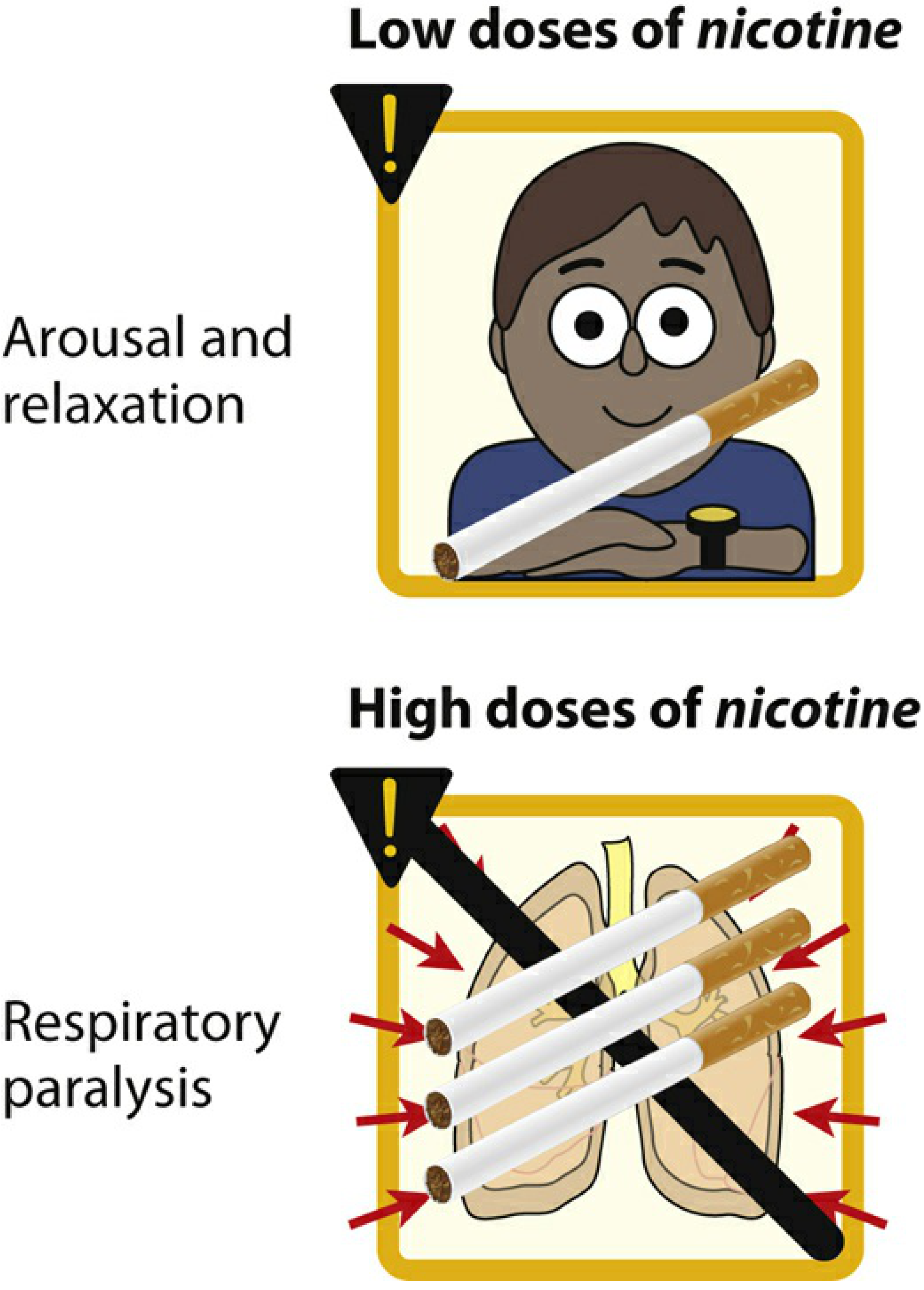
Peripheral Effects
- Cardiovascular: Stimulation of sympathetic ganglia + adrenal medulla → increased blood pressure and heart rate
- GI tract: Stimulation of parasympathetic ganglia → increased GI tone and motility (nausea, vomiting, diarrhea at high doses)
- Adrenal medulla stimulation → catecholamine release
(Lippincott Pharmacology; Goodman & Gilman's, Ch. 13)
Therapeutic Uses of Nicotine (Ganglionic Stimulant)
Nicotine itself has no direct therapeutic use in clinical practice as a ganglionic stimulant. Its therapeutic applications are limited to:
-
Smoking cessation - via nicotine replacement therapy (NRT):
- Transdermal patch
- Nicotine gum / lozenges
- Nasal spray
- Inhaler NRT reduces craving and withdrawal symptoms while the patient quits smoking.
-
Related drugs for smoking cessation:
- Varenicline - partial agonist at α4β2 nicotinic receptors; more effective than nicotine patch or bupropion alone
- Cytisine - plant alkaloid partial agonist, similar efficacy to NRT
- Bupropion - CNS-active nicotinic antagonist used adjunctively
(Goodman & Gilman's, Ch. 13)
Side Effects / Toxicity of Nicotine
Acute poisoning (e.g., insecticide exposure, ingestion):
- Nausea, salivation, abdominal pain, vomiting, diarrhea
- Cold sweats, headache, dizziness
- Disturbed hearing and vision, mental confusion
- Marked weakness, faintness, prostration
- Blood pressure falls; pulse weak, rapid, irregular
- Respiratory failure → death (within 1-2 minutes in severe cases)
Chronic use (smoking):
- Addiction and dependence
- Increased risk of atherosclerotic cardiovascular disease
- Lung cancer and other cancers (combined with tars/CO in smoke)
- Vasoconstriction, hypertension
Treatment of nicotine poisoning:
- Induce vomiting or gastric lavage (avoid alkaline solutions)
- Activated charcoal
- Respiratory support, shock management
- Atropine for parasympathetic symptoms
- Hexamethonium chloride (ganglionic blocker) as antidote
(Goodman & Gilman's; Forensic Medicine & Toxicology, 36th ed.)
PART 2 - GANGLIONIC BLOCKERS
Prototype Drugs
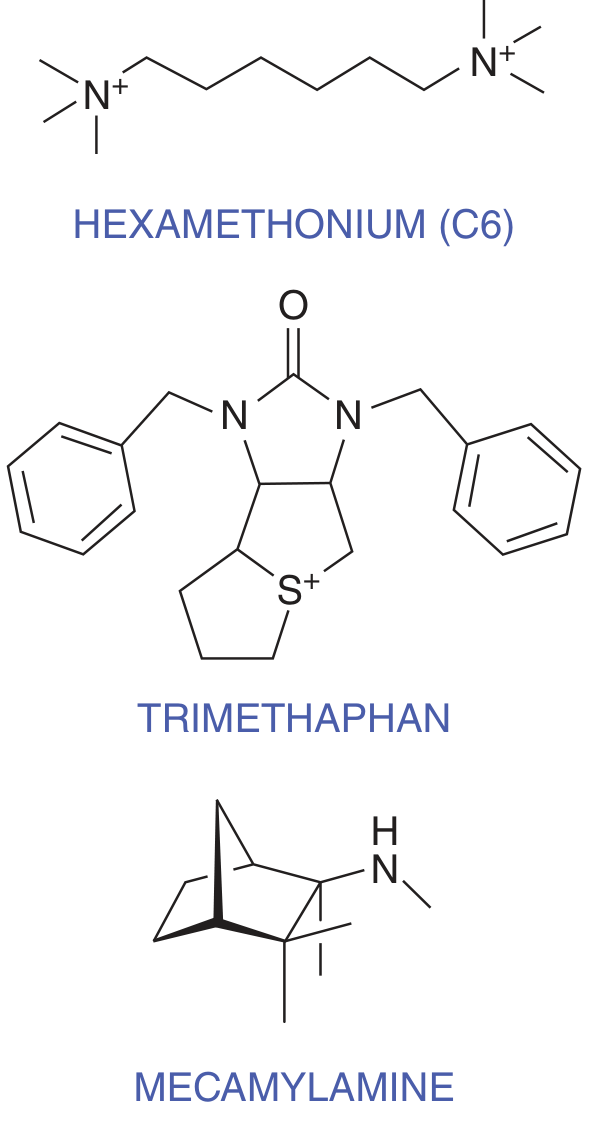
| Drug | Class | Route |
|---|---|---|
| Hexamethonium | Quaternary ammonium | IV only (not absorbed orally) |
| Trimethaphan | Sulfonium compound | IV infusion |
| Mecamylamine | Secondary amine | Oral (good bioavailability) |
| Pentolinium | Quaternary ammonium | IV |
Mechanism of Action
Two mechanisms exist:
- Depolarization block (nicotine at high doses): Persistent depolarization desensitizes the receptor.
- Competitive/Channel block (hexamethonium, trimethaphan, mecamylamine): These compounds block nicotinic receptors at autonomic ganglia - trimethaphan competes with ACh at the receptor, analogous to curare at the neuromuscular junction. Hexamethonium blocks the ion channel after it opens, shortening the duration of current flow - the open channel becomes occluded or closes.
Because these drugs block both sympathetic and parasympathetic ganglia simultaneously, the net effect at each organ depends on which division normally dominates that organ.
(Goodman & Gilman's, Ch. 13)
Effects of Ganglionic Blockade (by organ)
| Organ/System | Normal Dominant Tone | Effect of Ganglionic Blockade |
|---|---|---|
| Arterioles | Sympathetic (adrenergic) | Vasodilation; increased peripheral blood flow; hypotension |
| Veins | Sympathetic (adrenergic) | Dilation; peripheral blood pooling; decreased venous return; decreased cardiac output |
| Heart | Parasympathetic (cholinergic) | Tachycardia |
| Iris | Parasympathetic (cholinergic) | Mydriasis |
| Ciliary muscle | Parasympathetic (cholinergic) | Cycloplegia (fixed far focus) |
| GI tract | Parasympathetic (cholinergic) | Reduced tone and motility; constipation; decreased gastric and pancreatic secretions |
| Urinary bladder | Parasympathetic (cholinergic) | Urinary retention |
| Salivary glands | Parasympathetic (cholinergic) | Xerostomia (dry mouth) |
| Sweat glands | Sympathetic (cholinergic) | Anhidrosis (no sweating) |
| Genital tract | Both | Decreased stimulation; impotence |
(Goodman & Gilman's, Table 13-5)
Therapeutic Uses of Ganglionic Blockers
Ganglionic blockers were the first effective drugs for hypertension, but have largely been replaced due to extensive side effects. Remaining/historical uses:
- Hypertensive emergencies - Trimethaphan by IV infusion was used for rapid blood pressure reduction (no longer marketed in the US)
- Controlled hypotension during surgery - Trimethaphan was used to reduce surgical bleeding
- Moderate to severe hypertension - Mecamylamine (oral): starting dose 2.5 mg twice daily, titrated up in 2.5 mg increments every 2+ days
- Aortic dissection - Trimethaphan (historically, now replaced by other agents)
- Nicotine poisoning - Hexamethonium as antidote
(Goodman & Gilman's, Ch. 13; Lippincott Pharmacology)
Side Effects of Ganglionic Blockers
These are essentially the expected consequences of blocking both divisions of the ANS (see table above):
Cardiovascular:
- Postural (orthostatic) hypotension - most serious limiting side effect
- Tachycardia
- Decreased cardiac output
GI:
- Constipation, paralytic ileus
- Nausea, anorexia
- Decreased gastric secretions
- Reduced bowel motility
Urinary:
- Urinary retention
Ophthalmologic:
- Mydriasis (dilated pupils)
- Cycloplegia (blurred near vision)
Other:
- Xerostomia (dry mouth)
- Anhidrosis (inability to sweat)
- Impotence / sexual dysfunction
- Reduced bowel activity can impair absorption of the drugs themselves (quaternary ammonium compounds have erratic oral absorption)
ADME note: Quaternary compounds (hexamethonium, pentolinium) have poor and unpredictable oral absorption due to ionization and the very GI atony they cause. Mecamylamine (secondary amine) has reliable oral absorption but is excreted slowly and can accumulate.
Quick Comparison Summary
| Feature | Ganglionic Stimulants | Ganglionic Blockers |
|---|---|---|
| Prototype | Nicotine (low dose) | Hexamethonium, Trimethaphan, Mecamylamine |
| Receptor action | Agonist (depolarization) | Antagonist (channel block or competitive) |
| BP effect | Increases (sympathetic stimulation) | Decreases (sympathetic block) |
| Heart rate | Increases | Increases (vagal block) |
| Main use | Smoking cessation (NRT) | Hypertensive emergencies (historical) |
| Limiting problem | Addiction, toxicity | Extensive side effects from dual ANS blockade |
Sources:
- Lippincott Illustrated Reviews: Pharmacology, Ch. 22 (Nicotine section)
- Goodman & Gilman's Pharmacological Basis of Therapeutics, Ch. 13 (Ganglionic Blocking Agents)
- Essentials of Forensic Medicine and Toxicology, 36th ed. (Nicotine poisoning/treatment)
This is a shared conversation. Sign in to Orris to start your own chat.