
Type of fracture
Reading File
Fractures are classified in several ways based on their pattern, displacement, and cause. Let me pull the full details from the medical library.
Searching sources...
Finding Sources
Searching the Web
types of bone fractures classification orthopedics
Finding Sources
Reading File
Reading File
Finding Sources
Finding Sources
Reading File
Reading File
Finding Sources
Loading Image
Reading File
Finding Sources
Reading File
Reading File
Loading Image
Here is a complete, well-organized overview of the types of fractures, drawn from multiple authoritative surgery and emergency medicine textbooks.
Types of Fractures
Fractures are classified across several dimensions: the skin integrity, the fracture line pattern, the displacement, the cause, and the patient's age/bone maturity.
1. Based on Skin/Environment
| Type | Description |
|---|---|
| Closed (Simple) | Skin and soft tissue over the fracture site are intact |
| Open (Compound) | Fracture communicates with the outside environment (bone may or may not pierce the skin) |
When in doubt, always assume open and treat as such. - ROSEN's Emergency Medicine
2. Based on Fracture Line Pattern
These are the most tested and clinically described types:
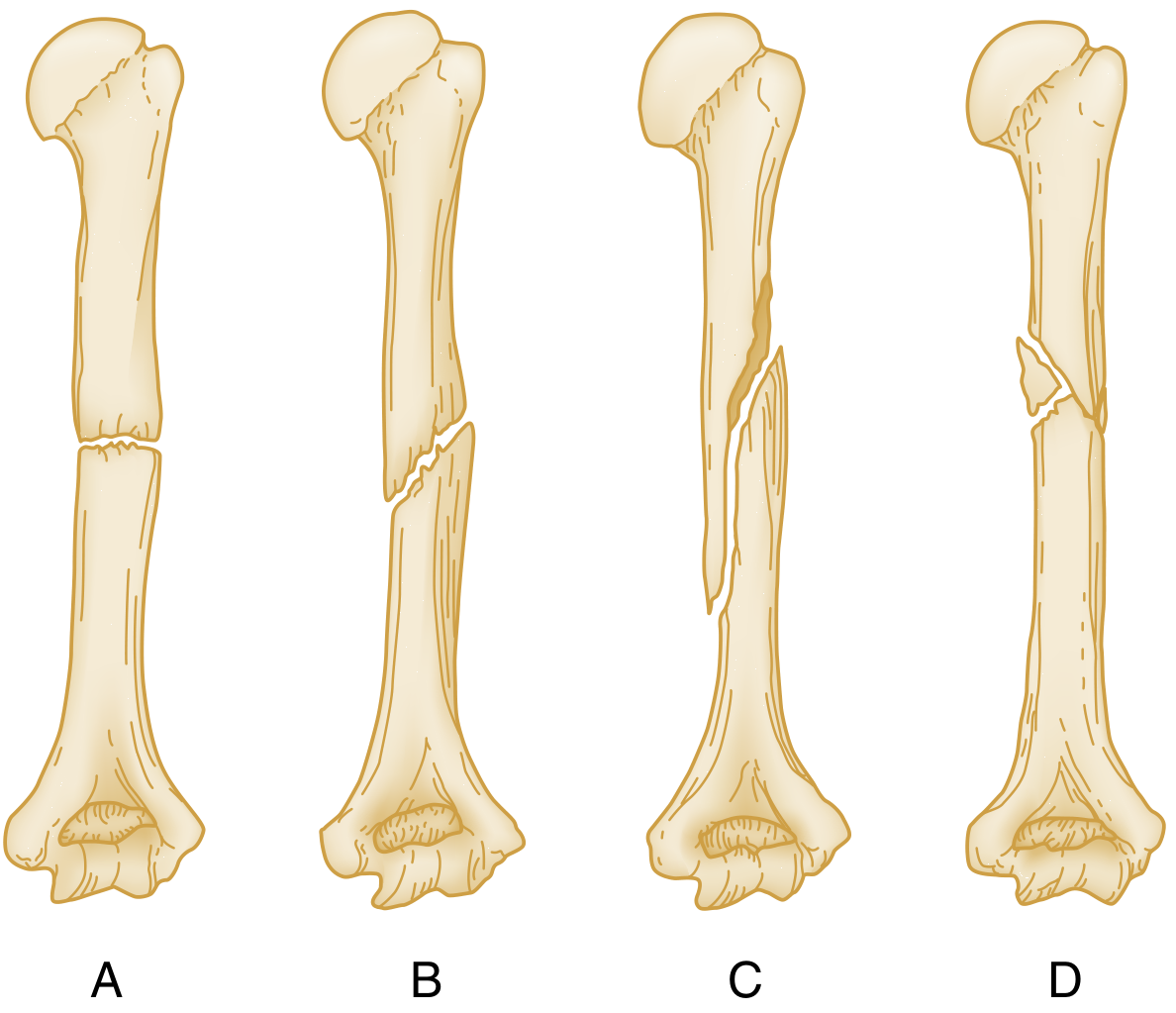
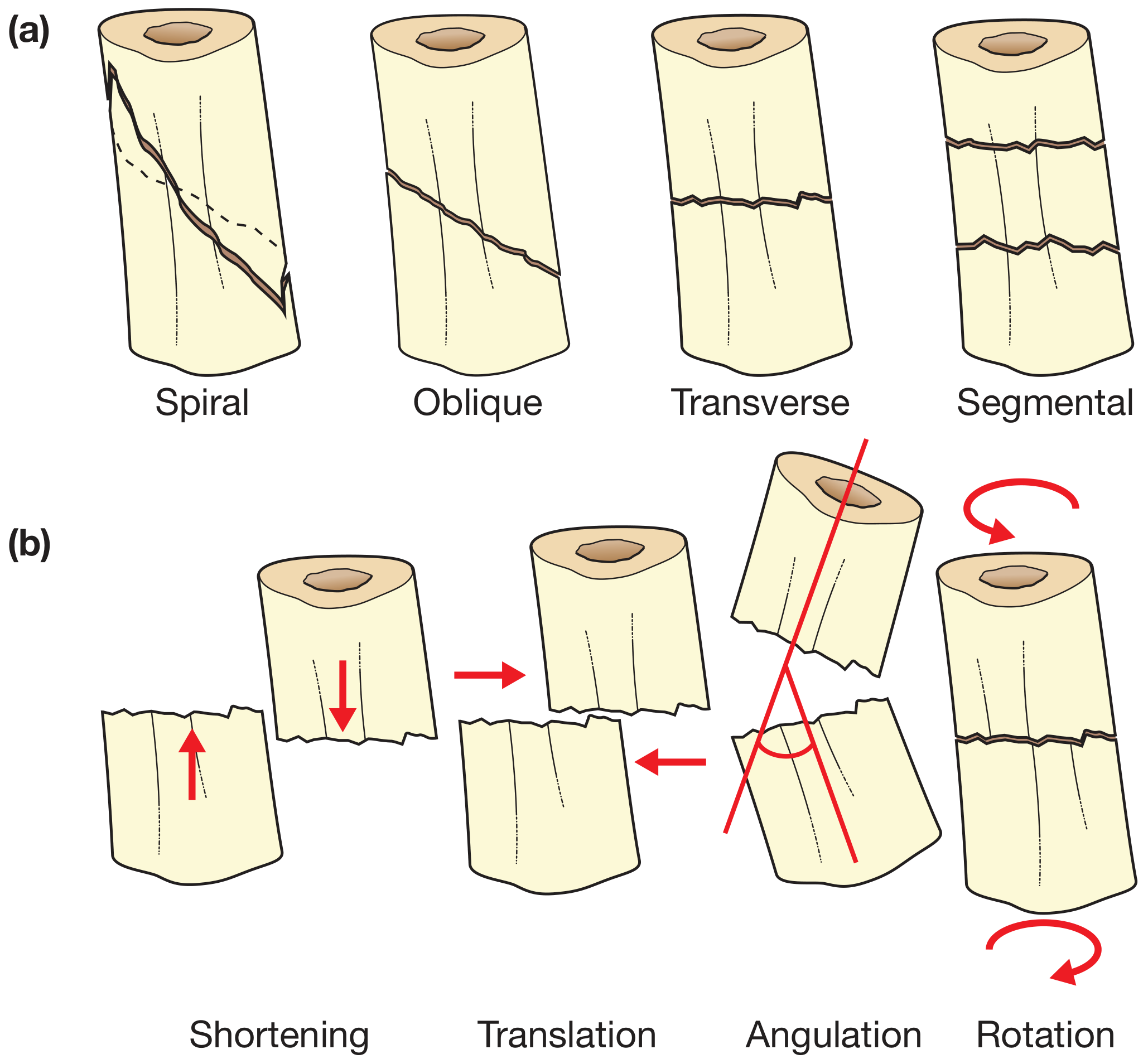
| Pattern | Mechanism | Description |
|---|---|---|
| Transverse | Direct tapping force / bending | Fracture line at right angles to the long axis of the bone |
| Oblique | Bending / angulation | Fracture line runs at an angle to the long axis |
| Spiral | Rotational/twisting (torsion) | Encircles the shaft in a spiral; important in child abuse evaluation |
| Comminuted | High-energy crushing force | More than two fragments; significant soft tissue injury common |
| Segmental | High energy | Two separate fracture lines isolate a "floating" segment of bone |
| Butterfly | Bending + compression | A separate wedge-shaped fragment at the fracture site |
3. Based on Completeness
| Type | Description |
|---|---|
| Complete | Both cortices of the bone are interrupted |
| Incomplete | One cortex remains intact |
4. Based on Displacement
Displacement is described by the position of the distal fragment relative to the proximal. The mnemonic STAR is used:
- Shortening
- Translation (sideways shift)
- Angulation (varus/valgus)
- Rotation
5. Based on Cause / Special Types
| Type | Key Feature |
|---|---|
| Pathological | Fracture through diseased bone (e.g., osteoporosis, Paget's, metastatic carcinoma). Even trivial force can cause it |
| Stress (March) fracture | No single severe injury; result of repeated mechanical loading (e.g., 2nd metatarsal in soldiers) |
| Avulsion | Bone fragment pulled off by forceful muscle contraction or ligament/tendon resistance |
| Impaction | One fragment is forcefully driven into another (common in proximal humerus, tibial plateau, vertebrae) |
| Compression | Cancellous bone collapses (e.g., vertebral wedge fracture) |
| Depression | Depressed fragment driven inward (e.g., skull, tibial plateau) |
6. Fractures Specific to Children
Children's bones are less dense, more plastic, and have open physes (growth plates), giving rise to unique fracture patterns:
| Type | Description |
|---|---|
| Greenstick | Incomplete cortical disruption with plastic deformation; one tension cortex fails |
| Torus / Buckle | Axial compressive force causes the cortex to buckle without breaking through |
| Plastic deformation | Bone bends without a visible fracture line (commonly the ulna) |
| Physeal (Salter-Harris) | Involves the growth plate; classified I-V based on extent |
7. Based on Fracture Location on the Bone
| Region | Description |
|---|---|
| Diaphysis | Shaft (thick cortical bone) |
| Metaphysis | Flared zone between shaft and joint (thin outer cortex) |
| Epiphysis | End of bone forming the joint surface |
| Intra-articular | Extends into the joint; requires anatomic restoration to prevent post-traumatic arthritis |
| Supracondylar | Just proximal to the epicondyles (e.g., distal humerus in children) |
Summary of Mechanism → Fracture Type
| Violence | Type of Fracture |
|---|---|
| Direct tapping | Transverse |
| Direct crushing | Comminuted |
| Twisting (indirect) | Spiral |
| Bending (indirect) | Transverse or oblique |
| Bending + axial compression | Double oblique / butterfly fragment |
| Muscular pull | Avulsion (patella, olecranon, lesser trochanter) |
| Repeated stress | Stress/march fracture |
Sources: ROSEN's Emergency Medicine, Bailey & Love's Short Practice of Surgery 28th Ed, Sabiston Textbook of Surgery, S Das Manual on Clinical Surgery 13th Ed, Forensic Anthropology 2nd Ed
This is a shared conversation. Sign in to Orris to start your own chat.