
Houseflies indetail from spm
Houseflies - Park's Textbook of Preventive and Social Medicine
Introduction
- Musca domestica (common housefly)
- M. vicinia
- M. nebulo
- M. sorbens
Houseflies should be regarded as a sign of insanitation, and their number as an index of that insanitation.
General Characters
(1) Head
- Bears a pair of antennae, a pair of large compound eyes, and a retractile proboscis (adapted for sucking liquid foods).
- In males, the eyes are close together; in females, they are set widely apart.
(2) Thorax
- Marked with 2 to 4 dark longitudinal stripes - characteristic of the genus Musca.
- Bears one pair of wings and three pairs of legs.
- Each leg has a pair of pads (enabling walking on polished surfaces).
- Legs and body are covered with tenent hairs which secrete a sticky substance - important in disease transmission.
(3) Abdomen
- Segmented and shows light and dark markings.
Life History (Complete Metamorphosis)
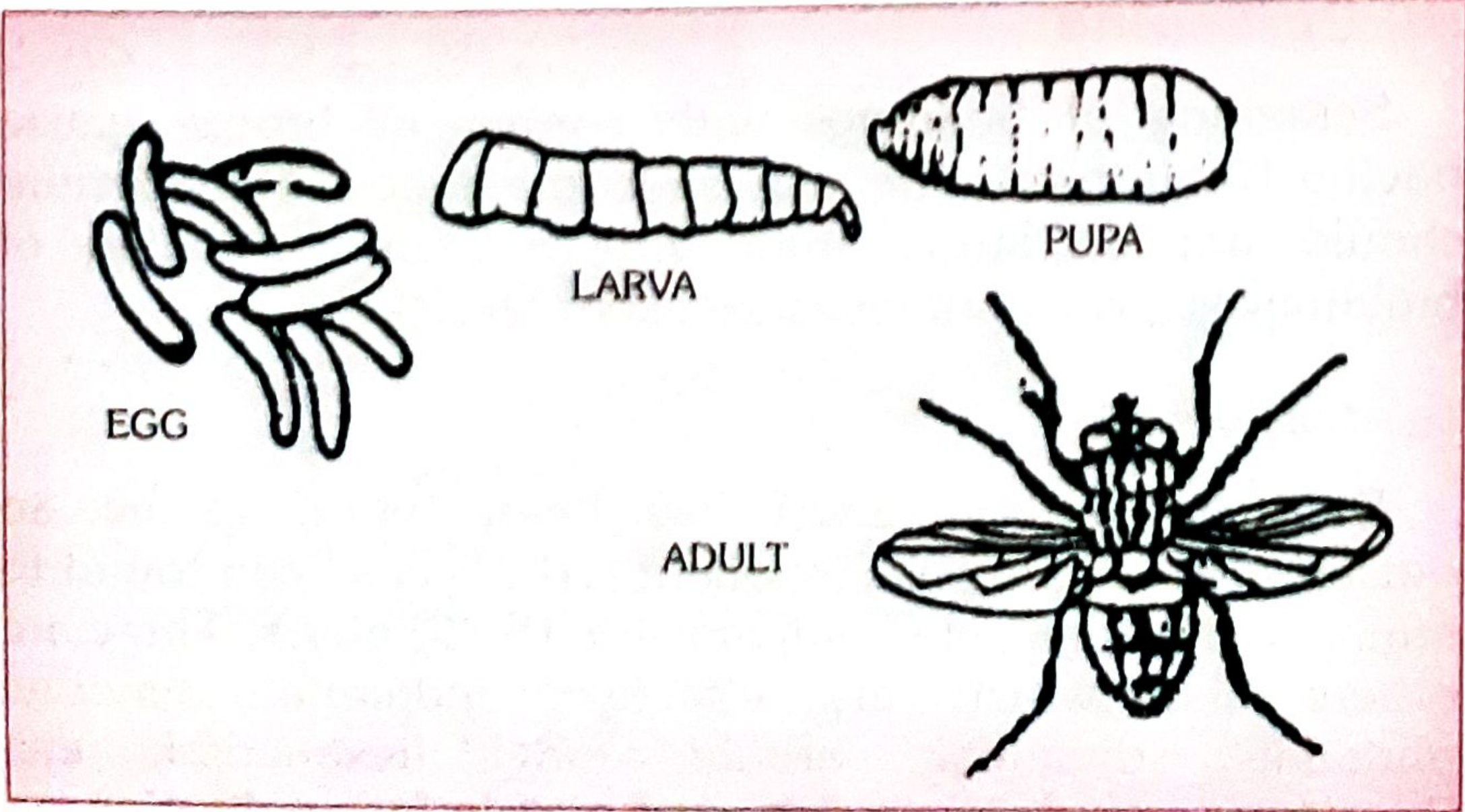
(1) Egg
- Female lays 120 to 150 eggs at one sitting in moist decaying organic matter (human/animal excreta, manure heaps, garbage, vegetable refuse).
- Indian M. domestica and M. vicinia breed profusely in human excreta.
- Eggs are pearly-white, about 1 mm long, visible to the naked eye.
- Total eggs in lifetime: 600 to 900.
- Hatching time: 8 to 24 hours; in summer in India, may hatch within 3 hours.
(2) Larva (Maggot)
- Measures 1 to 2 mm at birth; full-grown larva up to 12 mm.
- White, segmented, footless with a narrow anterior end and broad posterior end.
- Eat voraciously; moult twice during development.
- Resent light - bury themselves under manure heaps.
- When about to pupate, they migrate to dry outer regions.
- Larval period: 2 to 7 days (prolonged in cold weather).
(3) Pupa
- Dark-brown, barrel-shaped, measuring about one-quarter of an inch.
- Pupal stage in tropics: 3 to 6 days (considerably prolonged in winter).
(4) Adult
- Complete life cycle (egg to adult): 5 to 6 days in summer in India; 8 to 20 days at other times.
- Lifespan: not longer than 15 days in summer and 25 days in winter.
Habits
| Habit | Details |
|---|---|
| Breeding | Fresh horse manure > human excreta > other animal manure > garbage > decaying fruits/vegetables > rubbish dumps > liquid waste ground |
| Feeding | Does not bite. Attracted to food by smell. Cannot eat solid food - vomits on it to liquefy it, then sucks it up. Adults are attracted to sputum, faeces, wounds, and open sores. |
| Restlessness | Moves back and forth between food and filth - facilitates mechanical spread of infection. |
| Vomit Drop | Vomits frequently; the "vomit drop" is often a culture of disease agents. |
| Defecation | Defecates constantly all day, depositing countless bacteria on exposed food. |
| Resting | Tends to rest on vertical surfaces and hanging objects; flies toward light. |
| Dispersal | Normally stays close to breeding places, but can disperse up to 4 miles (sometimes more) from origin. |
Transmission of Disease
- Typhoid and paratyphoid fevers
- Diarrhoeas and dysenteries
- Cholera and gastroenteritis
- Amoebiasis
- Helminthic infestations
- Poliomyelitis
- Conjunctivitis and trachoma
- Anthrax, yaws
Mechanisms of Transmission
- Flies transport microorganisms on their feet and hairy legs (tenent hairs).
- Pathogenic organisms, ova, and cysts have been recovered from the bodies of houseflies.
- Hence called "porters of infection".
- The regurgitated stomach contents ("vomit drop") is a rich bacterial culture.
- By frequent vomiting on food, the fly transmits disease.
- Excrement contains numerous microorganisms as well as cysts and ova of intestinal parasites.
- Constant defecation spreads these organisms onto food.
Fly Control Measures
1. Environmental Control (Most Important)
- Store garbage, kitchen wastes in bins with tight lids pending disposal.
- Efficient collection, removal, and disposal by incineration, composting, or sanitary landfill.
- Provision of sanitary latrines (pit privies, septic tanks, water-seal latrines).
- Stop open-air defecation.
- Sanitary disposal of animal excreta.
- Step up general sanitation.
A clean house with clean surroundings is the best answer to the fly problem.
2. Insecticidal Control
| Method | Insecticides Used |
|---|---|
| Residual sprays | DDT 5%, methoxychlor 5%, lindane 0.5%; for resistant flies: diazinon 2%, dimethoate 2.5%, fenthion 2.5%, malathion 5%, ronnel 5% |
| Baits (solid/liquid) | Diazinon, malathion, dichlorvos, ronnel, dimethoate (1-2%); liquid baits with 10% sugar water |
| Cords and ribbons | Diazinon, fenthion, dimethoate impregnated strips hung from ceilings (effective 1-6 months) |
| Space sprays | Pyrethrin + DDT or HCH; no residual action, temporary effect only |
| Larvicides | 0.5% diazinon, 2% dichlorvos, 2% dimethoate, 1% ronnel at breeding places |
Note on resistance: M. domestica first showed resistance to DDT in 1948, and has since developed resistance to organo-chlorine, organophosphorus, and carbamate pesticides.
Insecticides, at best, are only a supplement - not a substitute for sanitation.
3. Fly Papers
- Sticky fly papers are useful adjuncts.
- Made by mixing 2 lbs resin + 1 pint castor oil (heated together), smeared on paper.
- Only a slight, non-lasting reduction in fly numbers.
4. Protection Against Flies (Screening)
- Screening of houses, hospitals, food markets, restaurants.
- Screens with 14 meshes to the inch keep out houseflies.
- Finer screens also exclude other insects.
- Expensive but effective.
5. Health Education
- Fly control without public cooperation is difficult.
- A "fly consciousness" should be created through health education.
- Fly control campaigns require organized individual and community effort.
| Feature | Detail |
|---|---|
| Scientific name | Musca domestica |
| Colour | Mouse-grey |
| Type of metamorphosis | Complete (holometabolous) |
| Stages | Egg → Larva → Pupa → Adult |
| Eggs per sitting | 120-150 |
| Lifetime eggs | 600-900 |
| Egg hatching | 8-24 hrs (3 hrs in Indian summer) |
| Total life cycle | 5-6 days (summer); 8-20 days otherwise |
| Adult lifespan | 15 days (summer); 25 days (winter) |
| Primary breeding place | Fresh horse manure |
| Mode of transmission | Mechanical (feet/hairs, vomit drop, defecation) |
| Dispersal range | Up to 4 miles |
| DDT resistance first noted | 1948 |
| Called | "Porters of infection" |
| Best control | Environmental sanitation |
- Park's Textbook of Preventive and Social Medicine, pp. 876-877
Sand flies tsetse fly indetail from spm in the form of images
Medical SPM study card: SANDFLIES (Phlebotomus) - Park's Textbook of Preventive and Social Medicine. Clean educational infographic with sections: 1) INTRODUCTION: Small insects, light/dark-brown, 1.5-2.5mm, smaller than mosquitoes, densely hairy body and wings. Indian species: P. argentipes, P. papatasi, P. sergenti, S. punjabensis. 2) GENERAL CHARACTERS - Head: long slender hairy antennae, palpi, proboscis. Only females bite. Thorax: upright lanceolate densely hairy wings, second longitudinal vein branches TWICE (characteristic). Long slender legs out of proportion to body. Abdomen: 10 segments, hairy, female tip rounded, male has claspers. 3) DIFFERENCES FROM MOSQUITO table: Size (smaller), Wings (upright, lanceolate, vein branches twice at middle), Legs (longer), Hairs (very hairy), Movement (hop, do not fly by choice). 4) LIFE CYCLE - Egg: torpedo-shaped with longitudinal wavy lines, laid in damp dark places near cattle/poultry, hatch in 7 days. Larva: hairy maggots, last segment has 2 pairs long stout hairs, feeds on decaying matter, 2 weeks. Pupa: 1 week. Adult: lives ~2 weeks. 5) HABITS: Nocturnal, bite irritating, shelter in crevices/dark rooms/stables during day. Females bite every 3-4 days for oviposition. Cannot fly long distances - hop only. Confined within 50 yards of breeding place. 6) DISEASES TABLE: P. argentipes → Kala-azar | P. papatasi → Sandfly fever + Oriental sore | P. sergenti → Oriental sore | S. punjabensis → Sandfly fever. 7) CONTROL: Insecticides (DDT 1-2g/m2, lindane 0.25g/m2, NO resistance to DDT). Sanitation: remove shrubs within 50 yards, fill cracks/crevices, cattle sheds away from dwellings. Use bright colors, dark blue background, white text boxes, clear headings.
Medical SPM study card: TSETSE FLY (Glossina) - Park's Textbook of Preventive and Social Medicine. Clean educational infographic with sections: 1) INTRODUCTION: Bloodsucking flies, yellow or dark-brown, ~half inch long. Wings fold overlapping like scissor blades. Rigid non-retractile proboscis for piercing and sucking blood. Found ONLY in Africa. Infested regions called "fly belts". Ravaged vast areas of tropical Africa for centuries. 2) LIFE HISTORY - UNIQUE/ABNORMAL: Viviparous - female gives birth to LIVING LARVA (not eggs). One larva at a time, every 10-day intervals. Few offspring in lifetime. Larva crawls away, buries in earth (~1 inch deep). Pupation within hours. Pupal stage: 20-40 days. Adult lives less than 100 days. 3) SPECIES AND HABITS - 30+ species, 4 dangerous to man: G. palpalis (riverine) | G. tachinoides (riverine) | G. morsitans (savannah) | G. pallidepes (savannah). Riverine species: near water courses, attract man. Savannah species: prefer game animals. Both sexes bite, mainly during DAY. Rarely enter houses. Follow travellers by road/rail for blood meal. 4) DISEASE TRANSMITTED: Trypanosomiasis / Sleeping Sickness - affects man, domestic animals, wild game. Lethal to man and domestic stock. 5) CONTROL - 4 main techniques: (1) Insecticides: NO resistance reported. DDT 25%, Dieldrin 18-20%, applied by aircraft for large areas. (2) Clearing Vegetation: most widely adopted, slow alone but fast with insecticides. (3) Game Destruction: large tracts cleared by destroying wild game - NOW GIVEN UP. (4) Genetic Control: sterile male release technique. Use bright colors, dark green background, white text boxes, clear bold headings.
400, message: Got more than 4194304 bytes when reading: b'data: {"candidates": [{"content": {"role": "model","parts": [{"inlineData": {"mimeType": "image/png"...'.
We encountered an error while processing your request. Please try again or reach out to us for help.