
Diuretics pharmacology in details
Reading File
Now let me search the library for diuretics pharmacology content in parallel:
Finding Sources
Finding Sources
Excellent! I found great sources. Let me now read the key pharmacology sections in parallel — Goodman & Gilman's (the gold standard for pharmacology) and Katzung, plus search for images:
Reading File
Finding Sources
Searching Images
diuretics mechanism of action nephron site
Now let me read the core diuretics pharmacology section from Goodman & Gilman's and fetch the key images in parallel:
Reading File
Loading Image
Loading Image
I have rich content. Let me now read the specific diuretic drug classes in more detail:
Reading File
Searching Images
carbonic anhydrase inhibitor proximal tubule collecting duct aldosterone diuretic
Let me fetch the collecting duct image and read the core diuretic drug sections:
Loading Image
Reading File
Loading Image
Reading File
I now have the master diagram showing all diuretic classes. Let me read the loop diuretics and thiazide sections, and also the K+-sparing diuretics:
Reading File
Reading File
Reading File
Reading File
Reading File
I now have comprehensive content from Goodman & Gilman's across all diuretic classes. Let me compile the complete, detailed pharmacology answer:
Diuretics: Detailed Pharmacology
Overview
Diuretics increase the rate of urine flow and Na⁺ excretion and are used to adjust the volume or composition of body fluids. The kidney filters ~120 mL of plasma/min (≈180 L/day), reabsorbing >99% of glomerular ultrafiltrate. Diuretics exploit the specific transport proteins distributed along the nephron to selectively inhibit sodium reabsorption at different tubular segments.
Three cardinal principles (Goodman & Gilman's):
- Transport of solute across renal epithelial cells involves highly specialized apical and basolateral membrane proteins.
- Diuretics target and block these transport proteins.
- The site and class of diuretic action are determined by which specific protein is inhibited.
Master Diagram — Sites of Action
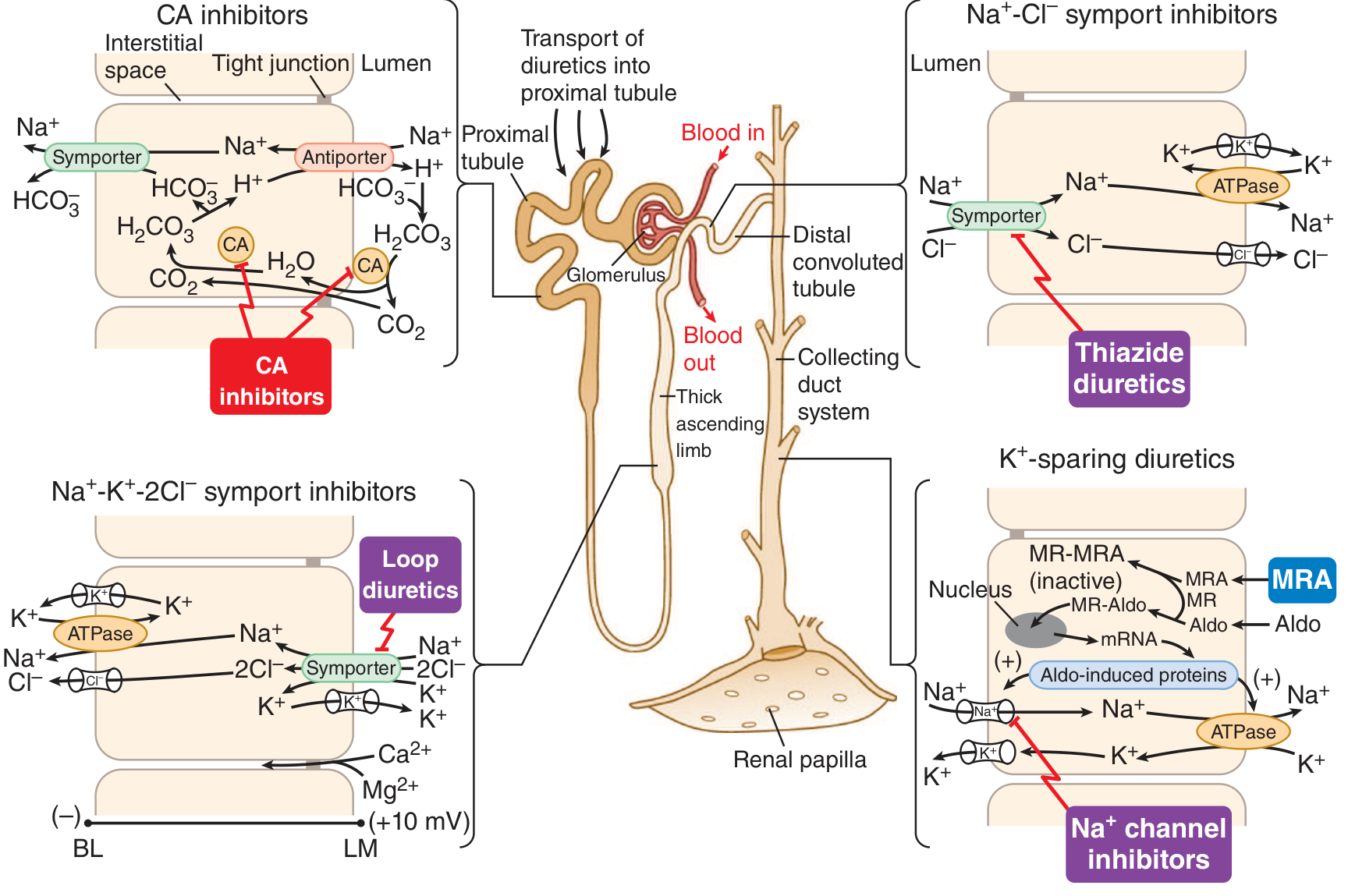
Class 1: Carbonic Anhydrase Inhibitors (CAIs)
Site
Proximal tubule (luminal and cytoplasmic carbonic anhydrase)
Mechanism
In the proximal tubule, CO₂ diffuses into epithelial cells and reacts with water — catalyzed by carbonic anhydrase — to form H₂CO₃, which dissociates into H⁺ and HCO₃⁻. H⁺ is secreted into the lumen via the Na⁺-H⁺ antiporter, allowing NaHCO₃ reabsorption. CAIs block both membrane-bound and cytoplasmic carbonic anhydrase, suppressing H⁺ secretion, thereby inhibiting Na⁺-H⁺ exchange and NaHCO₃ reabsorption.
Drugs & Pharmacokinetics
| Drug | Relative Potency | Oral Bioavailability | t½ (h) | Elimination |
|---|---|---|---|---|
| Acetazolamide | 1 | ~100% | 6–9 | Renal |
| Dichlorphenamide | 30 | ID | ID | ID |
| Methazolamide | >1; <10 | ~100% | ~14 | 25% R, 75% M |
Urinary Effects
- ↑↑ HCO₃⁻ excretion (up to 35% of filtered load)
- ↑ Na⁺, K⁺, H₂PO₄⁻ excretion
- Urine pH rises to ~8 → metabolic acidosis (self-limiting due to decreased filtered HCO₃⁻ load)
- Fractional excretion of Na⁺ up to 5%; K⁺ up to 70%
Extrarenal Actions
- Eye: Inhibit CA in ciliary processes → ↓ aqueous humor formation → ↓ intraocular pressure
- CNS: Anticonvulsant effects (direct CNS action + metabolic acidosis)
- Erythrocytes: ↑ CO₂ in peripheral tissues
- Vasodilation via Ca²⁺-activated K⁺ channels
Clinical Uses
- Open-angle glaucoma (dorzolamide, brinzolamide — topical; acetazolamide — oral)
- Acute-angle closure glaucoma (preoperative IOP reduction)
- Absence seizures (acetazolamide)
- High-altitude sickness (mountain sickness)
- Familial periodic paralysis
- Augmenting loop/thiazide diuretics in severe diuretic resistance
Adverse Effects
- Metabolic acidosis (dose-limiting)
- Hypokalemia, paresthesias, somnolence, renal stones (alkaline urine precipitates calcium phosphate)
- Sulfonamide hypersensitivity reactions
Class 2: Osmotic Diuretics
Site
Proximal tubule and loop of Henle (descending thin limb primarily)
Mechanism
Freely filtered but non-reabsorbable solutes raise luminal osmolality, opposing water reabsorption in the proximal tubule. They also expand extracellular fluid volume, decrease blood viscosity, inhibit renin release, and increase renal medullary blood flow — washing out NaCl and urea from the medullary interstitium (reduces medullary tonicity) → limits passive NaCl reabsorption in the ascending thin limb. Inhibit Mg²⁺ reabsorption in the TAL.
Drugs
- Mannitol (IV only) — most commonly used
- Glycerin, Isosorbide (oral)
- Urea (IV only)
Urinary Effects
Increase excretion of nearly all electrolytes: Na⁺, K⁺, Ca²⁺, Mg²⁺, Cl⁻, HCO₃⁻, phosphate
Clinical Uses
- Dialysis disequilibrium syndrome
- ↓ Intraocular pressure (acute glaucoma, perioperative)
- ↓ Intracranial pressure (traumatic brain injury, cerebral edema)
- Cystic fibrosis (inhaled mannitol — improves mucus clearance)
- Diagnosis of bronchial hyperreactivity
Adverse Effects
- Initial volume expansion (dangerous in heart failure)
- Dehydration and hypernatremia (if water replacement is inadequate)
- Headache, nausea, vomiting
Class 3: Loop Diuretics (High-Ceiling Diuretics)
Site
Thick ascending limb (TAL) of the loop of Henle
Mechanism
Inhibit the Na⁺-K⁺-2Cl⁻ (NKCC2) symporter on the apical membrane of TAL cells — bringing salt transport in this segment to a virtual standstill. The drug attaches to the Cl⁻ binding site in the symporter's transmembrane domain. Blockade of NKCC2:
- Eliminates the lumen-positive transepithelial potential difference normally created by K⁺ recycling back into the lumen
- This positive luminal potential drives passive paracellular reabsorption of Ca²⁺ and Mg²⁺ → both are markedly increased in urine
- Abolishes the medullary concentration gradient → impairs both diluting and concentrating ability
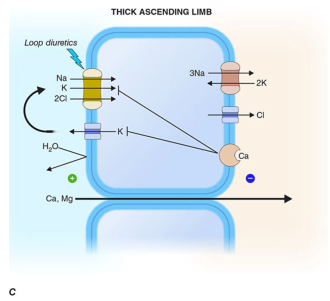
Why loop diuretics are highly efficacious: TAL normally reabsorbs ~25% of filtered Na⁺, and nephron segments distal to the TAL cannot rescue the flood of unabsorbed material, unlike the proximal tubule where the TAL compensates.
Drugs & Pharmacokinetics
| Drug | Relative Potency | Oral Bioavailability | t½ (h) | Elimination |
|---|---|---|---|---|
| Furosemide | 1 | ~60% | ~1.5 | 65% R, 35% M |
| Bumetanide | 40× | ~80% | ~0.8 | 62% R, 38% M |
| Torsemide | 3× | ~80% | ~3.5 | 20% R, 80% M |
| Ethacrynic acid | 0.7× | ~100% | ~1 | 67% R, 33% M |
- Furosemide and bumetanide: sulfonamide moiety
- Ethacrynic acid: phenoxyacetic acid derivative (only non-sulfonamide — use in sulfonamide allergy)
- Torsemide: sulfonylurea — longest half-life, mostly hepatic metabolism (preferred in liver disease)
- All secreted into the proximal tubule via OAT1/OAT3 on basolateral membrane → require tubular secretion to reach their site of action
Urinary Effects
- ↑↑ Na⁺, Cl⁻, K⁺, H⁺, Ca²⁺, Mg²⁺, HCO₃⁻
- Fractional Na⁺ excretion can reach 20–25%
- Produce dilute urine (abolish medullary gradient)
Additional Pharmacological Effects
- Venodilation: Furosemide increases venous capacitance within minutes of IV injection (before significant diuresis) — PGE₂ and NO mediated — beneficial in acute pulmonary edema
- ↑ Renal blood flow acutely (via PGs)
- May activate renin–angiotensin–aldosterone system with prolonged use
Clinical Uses
- Acute pulmonary edema (IV furosemide — immediate venodilation, then diuresis)
- Chronic heart failure — volume overload
- Hypertensive urgency/emergency
- Hypercalcemia (with IV saline infusion)
- Acute kidney injury — (to maintain urine output, though benefit unproven)
- Nephrotic syndrome, cirrhosis (with aldosterone antagonist)
- Forced diuresis for drug overdose
Adverse Effects
- Hypokalemia (most common) → metabolic alkalosis
- Hypomagnesemia
- Hypocalcemia (chronic use)
- Ototoxicity — dose-dependent, reversible (especially with rapid IV infusion or in renal failure; worst with ethacrynic acid — may be irreversible)
- Hyperuricemia (competes with uric acid for tubular secretion; also volume contraction → uric acid reabsorption)
- Hyperglycemia (less than thiazides)
- Hypovolemia, hypotension, pre-renal azotemia
- Sulfonamide allergy cross-reactivity (furosemide, bumetanide)
Class 4: Thiazide Diuretics
Site
Distal convoluted tubule (DCT) — cortical diluting segment
Mechanism
Inhibit the Na⁺-Cl⁻ cotransporter (NCC/SLC12A3) on the apical membrane of DCT cells. This reduces Na⁺ and Cl⁻ reabsorption. The lower intracellular Na⁺ concentration enhances the basolateral Na⁺-Ca²⁺ exchanger and increases apical Ca²⁺ channel expression → hypocalciuria (thiazides reduce urinary Ca²⁺). The DCT is not involved in generating the medullary concentration gradient, so thiazides do not impair urine concentration (unlike loop diuretics).
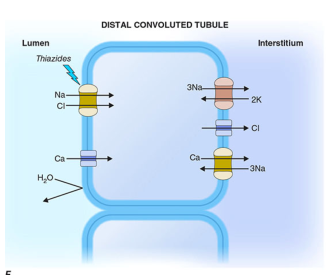
Drugs & Key Pharmacokinetics
- Hydrochlorothiazide (HCTZ): most prescribed (though evidence favors chlorthalidone)
- Chlorthalidone: longer t½ (~40–60 h vs. 6–15 h for HCTZ) → better 24-h BP control
- Indapamide: thiazide-like; also has direct vasodilatory effects
- Metolazone: effective even at GFR <30 mL/min (synergistic with loop diuretics)
- All secreted into the proximal tubule via OAT1/OAT3 and MRP-4
Urinary Effects
- ↑ Na⁺, Cl⁻, K⁺, H⁺, HCO₃⁻
- ↓ Ca²⁺ excretion (unique among diuretics)
- Mild ↑ Mg²⁺ excretion (hypomagnesemia with long-term use)
- Attenuates ability to produce dilute urine; does NOT impair concentrating ability
Clinical Uses
- Hypertension — first-line; additive/synergistic with most antihypertensives. Chlorthalidone preferred over HCTZ for cardiovascular outcomes
- Edema — heart failure, cirrhosis, nephrotic syndrome (less potent than loop diuretics; ineffective if GFR <30 mL/min, except metolazone/indapamide)
- Nephrolithiasis (calcium stones) — ↓ urinary Ca²⁺ excretion
- Osteoporosis — reduction in urinary calcium loss
- Nephrogenic diabetes insipidus — paradoxically ↓ urine volume by ~50% (mild volume depletion → compensatory proximal Na⁺ reabsorption → less water reaches collecting duct)
Adverse Effects
- Hypokalemia → metabolic alkalosis (dose-dependent)
- Hypomagnesemia (especially elderly)
- Hyperuricemia → gout precipitation
- Hyperglycemia (↓ insulin secretion, ↑ insulin resistance) — avoid in diabetes
- Hyperlipidemia (mild — ↑ LDL, ↑ triglycerides; less with indapamide)
- Hypercalcemia (due to ↓ urinary Ca²⁺; may precipitate in hyperparathyroidism)
- Hyponatremia (elderly women at highest risk — thiazide impairs free water excretion)
- Erectile dysfunction
- Sulfonamide allergy cross-reactivity
Class 5: Potassium-Sparing Diuretics
5A: ENaC Blockers (Na⁺ Channel Inhibitors)
Site
Late distal tubule and collecting duct (cortical collecting duct)
Mechanism
Amiloride and triamterene directly block the epithelial Na⁺ channel (ENaC) on the apical membrane of principal cells. ENaC blockade:
- Hyperpolarizes the luminal membrane
- Reduces the lumen-negative transepithelial potential
- ↓ K⁺, H⁺, Ca²⁺, Mg²⁺ secretion → these are retained
| Drug | Relative Potency | Oral Bioavailability | t½ (h) | Elimination |
|---|---|---|---|---|
| Amiloride | 1 | 15–25% | ~21 | Renal (intact) |
| Triamterene | 0.1 | ~50% | ~4 | Hepatic (active metabolite → renal) |
Urinary Effects
Mild natriuresis only (~2% of filtered Na⁺); significant K⁺ retention
Clinical Uses
- Combined with thiazide or loop diuretics to prevent hypokalemia
- Liddle syndrome (constitutive ENaC activation → hypertension + hypokalemia)
- Amiloride inhaled — cystic fibrosis (improves mucociliary clearance)
- Amiloride — lithium-induced nephrogenic DI (blocks Li⁺ transport into collecting duct cells)
Adverse Effects
- Hyperkalemia (life-threatening — most important adverse effect)
- Contraindicated: renal failure, concurrent ACEi/ARB/K⁺ supplements, other K⁺-sparing diuretics
- Triamterene: weak folic acid antagonist (megaloblastosis in cirrhotics), renal stones, interstitial nephritis
5B: Mineralocorticoid Receptor Antagonists (Aldosterone Antagonists)
Site
Late distal tubule and collecting duct (cortical collecting duct) — act on cytosolic mineralocorticoid receptor (MR)
Mechanism
Aldosterone binds cytosolic MR → MR-aldosterone complex translocates to nucleus → transcription of aldosterone-induced proteins (AIPs) → upregulation of ENaC, Na⁺/K⁺-ATPase → ↑ Na⁺ reabsorption + ↑ K⁺/H⁺ secretion.
MR antagonists (spironolactone, eplerenone, finerenone) competitively inhibit aldosterone binding → MR-antagonist complex cannot induce AIP synthesis → no ENaC upregulation.
Key distinction: MR antagonists are the only diuretics that do NOT require access to the tubular lumen to induce diuresis — they act on a cytosolic receptor.
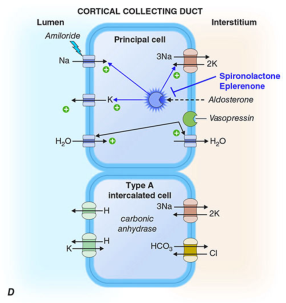
| Drug | Oral Bioavailability | t½ (h) | Elimination | Notes |
|---|---|---|---|---|
| Spironolactone | ~65% | ~1.6 (active metabolites: 10–35 h) | Hepatic | Steroidal; anti-androgenic |
| Eplerenone | — | ~5 | Hepatic | Steroidal; selective (fewer sex-hormone effects) |
| Finerenone | — | ~3 | Hepatic | Non-steroidal MR antagonist (FDA approved 2021) |
Clinical Uses
- Primary hyperaldosteronism (Conn's syndrome) — diagnosis and treatment
- Heart failure (HFrEF) — spironolactone/eplerenone reduce mortality (RALES, EMPHASIS-HF trials)
- Cirrhosis with ascites — first-line (with furosemide)
- Resistant hypertension — add-on therapy
- Spironolactone: PCOS, hirsutism, acne (anti-androgenic)
- Finerenone: CKD with type 2 diabetes (reduces CKD progression and cardiovascular events — FIDELIO-DKD, FIGARO-DKD)
Adverse Effects
- Hyperkalemia (most dangerous — monitor K⁺ closely)
- Spironolactone (anti-androgenic/progestogenic): gynecomastia, menstrual irregularities, impotence, decreased libido (less with eplerenone/finerenone)
- Metabolic acidosis (type IV RTA)
- GI upset (spironolactone)
Class 6: SGLT2 Inhibitors (Gliflozins) — Emerging Diuretic Class
Site
Proximal tubule (S1–S2 segment)
Mechanism
Inhibit sodium-glucose cotransporter 2 (SGLT2), which normally reabsorbs ~90% of filtered glucose (linked with Na⁺ reabsorption). This produces glucosuria and osmotic natriuresis. They also cause tubuloglomerular feedback (TGF) restoration — increased NaCl delivery to macula densa reduces hyperfiltration.
Clinical Uses
- Type 2 diabetes (primary indication)
- Heart failure (HFrEF and HFpEF) — reduce CV mortality and HF hospitalization
- CKD — slow progression, reduce end-stage renal disease
- Overcome diuretic resistance (sequential nephron blockade combined with loop diuretics)
Adverse Effects
- Urogenital infections (mycotic, UTIs)
- DKA (rare, including euglycemic DKA)
- Bone fractures, ↓ bone density
- Hyperkalemia, hypovolemia, hypotension
- Contraindicated in severe renal impairment / ESRD
Summary Table: Diuretic Classes at a Glance
| Class | Site | Transporter Blocked | Na⁺ Effect | K⁺ Effect | Ca²⁺ Effect | Key Use | Key Toxicity |
|---|---|---|---|---|---|---|---|
| CA inhibitors | PCT | Carbonic anhydrase | ++ | ↑ loss | NC | Glaucoma, altitude sickness | Metabolic acidosis |
| Osmotic | PCT/LoH | None (osmotic) | ++ | ↑ loss | ↑ loss | ↑ ICP, IOP | Volume overload |
| Loop | TAL | NKCC2 | ++++ | ↑↑ loss | ↑↑ loss | Acute pulm edema, HF, hypercalcemia | Hypokalemia, ototoxicity |
| Thiazide | DCT | NCC | ++ | ↑ loss | ↓ loss | HTN, Ca-stones, nephrogenic DI | Hypokalemia, hyperuricemia, hyperglycemia |
| ENaC blockers | CCD | ENaC | + | ↓ (sparing) | ↓ | K⁺ conservation adjunct | Hyperkalemia |
| MR antagonists | CCD | Mineralocorticoid receptor | + | ↓ (sparing) | — | HF, cirrhosis, Conn's | Hyperkalemia, gynecomastia |
| SGLT2 inhibitors | PCT | SGLT2 | + | ↓ (mild) | — | DM2, HF, CKD | UTI, DKA |
Diuretic Resistance
Occurs when patients fail to respond adequately to diuretic therapy. Key mechanisms include:
- ↓ Oral bioavailability (gut edema in HF impairs furosemide absorption — switch to IV or torsemide/bumetanide)
- Impaired apical drug delivery — albumin binding of furosemide in nephrotic syndrome (→ use bumetanide, which is less protein-bound)
- Braking phenomenon — compensatory upregulation of proximal tubule transporters between doses
- Distal tubular remodeling — chronic loop diuretic use hypertrophies DCT/CCD cells → more NaCl reabsorption distally
Management: IV administration, continuous infusion, sequential nephron blockade (loop + thiazide + SGLT2i), dietary sodium restriction, correct RAAS activation, treat underlying cause.
Sources: Goodman & Gilman's The Pharmacological Basis of Therapeutics, 14th ed.; Harrison's Principles of Internal Medicine, 21st ed.; Guyton & Hall Textbook of Medical Physiology
This is a shared conversation. Sign in to Orris to start your own chat.