
Pericarditis
Reading File
Finding Sources
Searching PubMed
"pericarditis" AND "management"
Reading File
Reading File
Reading File
Now let me get the main pericarditis content from Braunwald's and Rosen's:
Finding Sources
Reading File
Reading File
Reading File
Reading File
Searching Images
pericarditis ECG electrocardiogram diffuse ST elevation
Now I have comprehensive information. Let me compile a thorough response.
Pericarditis
Definition & Epidemiology
Pericarditis is inflammation of the pericardium — the fibroserous sac surrounding the heart — caused by granulocytic and lymphocytic infiltration. It is the most common pericardial disease encountered clinically, accounting for approximately 5% of all non-ischemic chest pain presentations. Incidence is roughly 27.7 cases/100,000 population/year, with men aged 16–65 at higher risk (RR ~2.0 vs. women).
Etiology
| Category | Examples |
|---|---|
| Idiopathic/Viral (most common in developed world, 80–90%) | Coxsackievirus B, echovirus, EBV, CMV, HIV, influenza |
| Bacterial | TB (most common cause in developing countries), Staphylococcus, Streptococcus |
| Autoimmune/Connective tissue disease | SLE, RA, systemic sclerosis |
| Post-cardiac injury | Dressler syndrome (post-MI, weeks later), post-pericardiotomy |
| Early post-MI pericarditis | 2–4 days after transmural MI (~20%) |
| Uremia | Most common systemic disorder associated |
| Malignancy | Metastatic (lung, breast, lymphoma), primary |
| Radiation | Mediastinal irradiation |
| Drugs | Hydralazine, procainamide, isoniazid, clozapine |
| Other | Sarcoidosis, amyloidosis, aortic dissection |
In SLE, pericarditis associates with disease flare and polyserositis; clinically significant pericarditis develops in <30% overall, but necropsy studies show involvement in 40–80% of SLE patients. — Braunwald's Heart Disease
Pathology
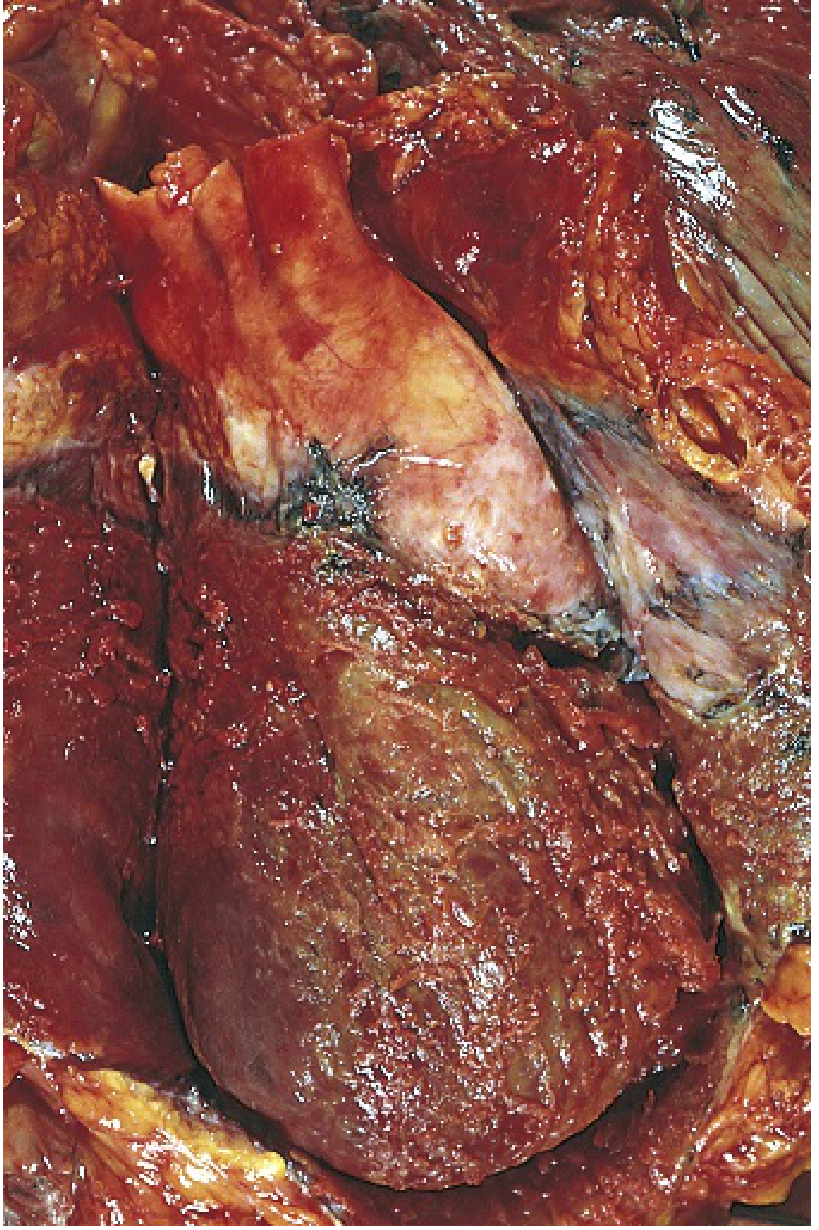
Acute: Fibrinous exudate gives the pericardial surface a characteristic shaggy, "bread-and-butter" appearance. Bacterial infection produces fibrinopurulent (suppurative) exudate; TB may show caseation; malignancy produces hemorrhagic effusion.
Chronic/Constrictive: Healing with fibrosis and scar formation can obliterate the pericardial space. In extreme cases, dense encasement prevents normal diastolic expansion — constrictive pericarditis.
Clinical Features
Symptoms
- Chest pain: Sharp, pleuritic; relieved by sitting forward, worsened by lying supine, deep inspiration, or swallowing. Radiates to trapezius ridge or shoulder (pathognomonic of diaphragmatic pleural involvement via phrenic nerve).
- Fever (usually low-grade <38°C), myalgias, malaise
- Dyspnea if effusion is present
Signs
- Pericardial friction rub — pathognomonic; heard in ~1/3 of cases. Best heard at the lower left sternal border with the patient leaning forward in full expiration. Classic rub has 3 components: ventricular systole, early diastole, and atrial contraction. Evanescent and migratory — requires repeated auscultation.
- Sinus tachycardia
- Atrial fibrillation in ~5% of cases
ECG Changes (4 Stages)
| Stage | Findings |
|---|---|
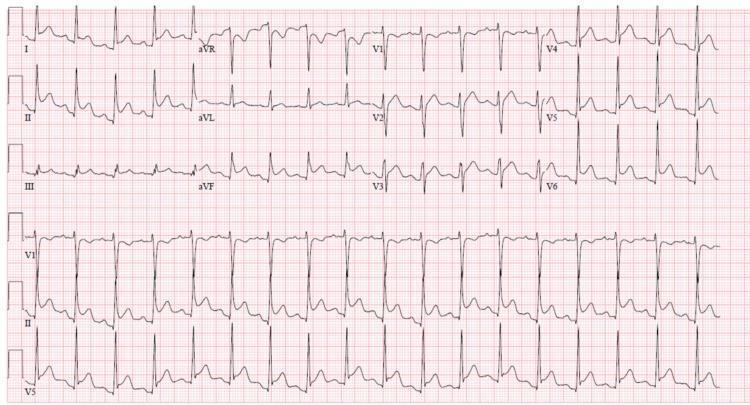
| Stage I | Diffuse concave ("saddle-shaped") ST elevation in most leads; PR depression (except aVR, which shows PR elevation); Spodick's sign (downsloping TP segment) |
| Stage II | ST returns to baseline; T waves flatten |
| Stage III | T-wave inversions |
| Stage IV | ECG normalizes |
Key differentiator from STEMI: diffuse ST elevation across multiple vascular territories (not localized), concave morphology, PR depression, no reciprocal changes (except aVR).
Diagnosis
Diagnostic criteria — at least 2 of 4 required:
- Pericarditic chest pain
- Pericardial friction rub
- New widespread ST elevation or PR depression on ECG
- New or worsening pericardial effusion
Investigations
| Test | Findings |
|---|---|
| ECG | Diffuse ST elevation, PR depression (Stage I) |
| CRP/ESR/WBC | Elevated (CRP used to monitor treatment response and guide tapering) |
| Troponin | Elevated in ~30% (myopericarditis) |
| Echocardiography | Pericardial effusion; rule out tamponade; baseline recommended |
| CXR | Enlarged cardiac silhouette if effusion >250 mL ("water-bottle" heart) |
| CT/CMR | Pericardial thickening, enhancement; CMR best for myocardial involvement |
High-Risk Features (Warrant Hospitalization)
- Fever >38°C
- Subacute onset
- Large effusion
- Cardiac tamponade
- Failure of initial NSAID treatment
- Immunosuppressed state
- Trauma
- Anticoagulant therapy
Treatment
First-Line (Acute Idiopathic/Viral)
| Drug | Dose | Duration | Taper |
|---|---|---|---|
| Aspirin | 750–1000 mg q8h | 1–2 weeks | Decrease every 1–2 weeks over 2–3 weeks |
| Ibuprofen | 600–800 mg q8h | 1–2 weeks | Decrease every week for 2–3 weeks |
| Colchicine (adjunct — reduces recurrences by ~50%) | 0.5 mg once daily (<70 kg) or 0.5 mg bid (≥70 kg) | 3 months | Taper not usually required |
| Gastroprotection (PPI) | With all NSAID regimens | — | — |
- CRP-guided duration: taper once patient is asymptomatic and CRP normalized
- Corticosteroids: reserved for cases refractory to NSAIDs + colchicine, or when NSAIDs are contraindicated (e.g., pregnancy); avoid as first-line — associated with higher recurrence rates
Recurrent Pericarditis
- Repeat NSAIDs + colchicine
- Corticosteroids if refractory (low-dose prednisone, slow taper)
- Anakinra (IL-1β receptor antagonist): promising for colchicine-refractory cases
- Pericardiectomy: last resort
A 2024 meta-analysis confirmed efficacy and safety of IL-1 inhibitors (including anakinra and rilonacept) in recurrent pericarditis management [PMID: 38809412].
Specific Etiologies
- Uremia: Intensive dialysis + NSAIDs (indomethacin 25 mg TID); pericardial window if refractory
- Bacterial/TB: Pathogen-specific antibiotics; TB requires full anti-tuberculous therapy
- Post-MI (Dressler): NSAIDs or aspirin; avoid NSAIDs in early post-MI (impair healing)
- Autoimmune: Treat underlying disease; hydroxychloroquine for SLE
Complications
| Complication | Features |
|---|---|
| Pericardial effusion | Variable size; assess hemodynamic significance |
| Cardiac tamponade | Beck's triad: hypotension, JVD, muffled heart sounds; pulsus paradoxus >10 mmHg; requires urgent pericardiocentesis |
| Constrictive pericarditis | Late sequela; right-sided venous congestion + low CO; similar to restrictive cardiomyopathy; definitive Rx = pericardiectomy |
| Recurrence | Up to 30% of patients; risk factors: fever, large effusion, subacute course, initial NSAID failure |
Prognosis & Disposition
- 60% full recovery within 1 week; ~80% within 3 weeks
- Up to 30% recurrence rate
- Nonviral/non-idiopathic cases have higher rates of progression to constrictive pericarditis
- Athletes should avoid competitive sports until asymptomatic (expert consensus)
- Outpatient management is appropriate for low-risk, uncomplicated cases; hospitalization for high-risk features
Sources: Braunwald's Heart Disease (11e), Rosen's Emergency Medicine, Robbins & Kumar Basic Pathology
Recent evidence note: A 2024 systematic review/meta-analysis [PMID: 38809412] supports IL-1 inhibitors (anakinra, rilonacept) as effective and safe in recurrent pericarditis refractory to conventional therapy. A 2026 systematic review [PMID: 41276190] catalogued drug-induced pericarditis cases — clozapine, hydralazine, and procainamide among the most frequently implicated agents.
This is a shared conversation. Sign in to Orris to start your own chat.