
Treatment of hydrocephalus
I'll start with a quick overview while I pull from the medical library.
Hydrocephalus is treated primarily by diverting or absorbing excess CSF. The main options are ventriculoperitoneal (VP) shunt, ventriculoatrial (VA) shunt, and endoscopic third ventriculostomy (ETV). Medical management is limited and mostly temporizing. Choice depends on the type (communicating vs. obstructive), patient age, and underlying cause.
Searching sources...
Reading File
Now let me search the library and PubMed in parallel.
Finding Sources
Searching PubMed
"hydrocephalus"[MeSH Terms] AND "treatment"[MeSH Terms]
Two excellent sections found. Let me read both in parallel, plus search for more specific content.
Reading File
Reading File
Finding Sources
Good data. Let me read more of the Bailey & Love section and the Bradley & Daroff section on ETV/management, and fetch the shunt valve image.
Reading File
Finding Sources
Loading Image
Now let me get more on NPH treatment and IIH management, plus a quick web search for current guidelines.
Finding Sources
Finding Sources
Searching the Web
hydrocephalus treatment guidelines 2024 2025 ETV vs shunt
I now have comprehensive material. Let me compile the full answer.
Treatment of Hydrocephalus
Overview
Hydrocephalus management depends on whether it is obstructive (non-communicating) or communicating, and on the acuity of presentation. Acute obstructive hydrocephalus is a neurosurgical emergency - rapid progression to coma and death ("hydrocephalic attack") can occur without prompt CSF diversion. - Bailey & Love's Short Practice of Surgery, 28th Ed.
1. Emergency / Temporary Measures
External Ventricular Drain (EVD)
The first-line bridge for acute or perioperative hydrocephalus.
- Inserted through a burr hole at Kocher's point (right of midline, anterior to coronal suture), perpendicular to brain surface
- Catheter tip sits at the foramen of Monro in the lateral ventricle
- Can also deliver intrathecal antibiotics
- Lumbar drains are an alternative for communicating hydrocephalus
Treating the Underlying Cause
When an obstructive tumour is resectable, surgery may resolve hydrocephalus directly without permanent CSF diversion.
2. Long-Term Surgical Treatment
A. Ventriculoperitoneal (VP) Shunt - The Mainstay
The VP shunt is the most widely used definitive treatment. It consists of:
- Proximal (ventricular) catheter - inserted into the lateral ventricle
- Shunt valve - regulates CSF flow by opening at a predetermined pressure; includes a CSF reservoir for percutaneous sampling
- Distal catheter - tunnelled subcutaneously to the peritoneal cavity
Additional features:
- Anti-siphon device - prevents excess drainage in the upright position
- Programmable (adjustable) valves - opening pressure can be changed non-invasively using an external magnetic device
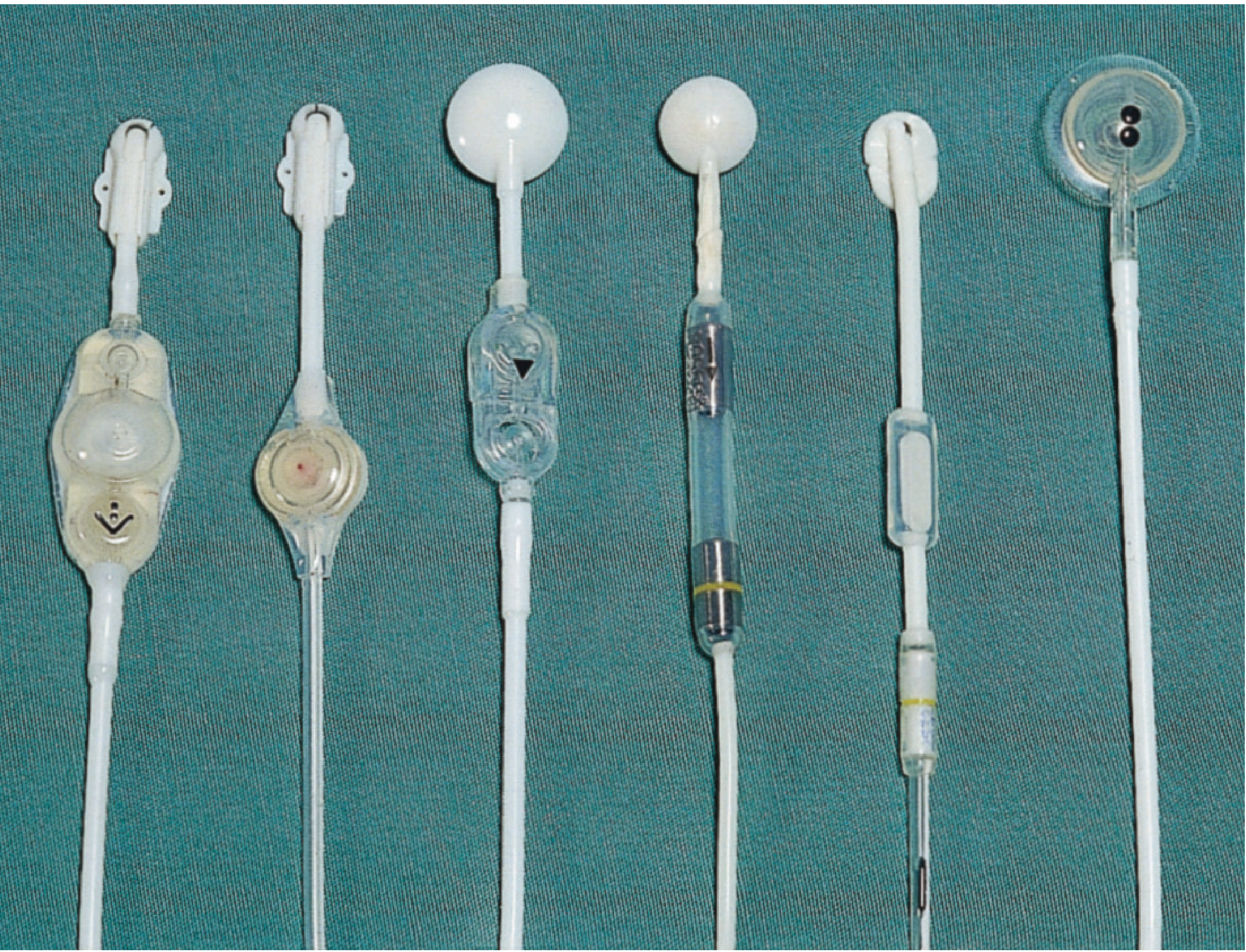
Alternative shunt sites (less common):
| Type | Distal Location | Notes |
|---|---|---|
| Ventriculoatrial (VA) | Right atrium | Rare complications: pulmonary HTN, embolism, VA nephritis (Staph) |
| Ventriculopleural | Pleural space | Risk of pleural effusion |
| Lumboperitoneal | Peritoneum (lumbar) | For communicating hydrocephalus |
B. Endoscopic Third Ventriculostomy (ETV)
Best for: obstructive hydrocephalus due to aqueduct stenosis - avoids indwelling hardware entirely.
Procedure:
- Neuroendoscope inserted into the frontal horn of the lateral ventricle
- Advanced into the third ventricle via the foramen of Monro
- Floor of the third ventricle is fenestrated between the mammillary bodies and the pituitary recess
- Creates free drainage into adjacent subarachnoid cisterns
Advantages: No implanted tubing, no infection risk from hardware
Limitations:
- Re-blockage is common - many patients eventually require a shunt
- Serious rare complications: basilar artery injury, fornix damage causing permanent memory impairment
ETV/CPC (ETV + Choroid Plexus Cauterization): Used particularly in infants under 2 years with non-communicating hydrocephalus (e.g., post-infectious, myelomeningocele-associated). Reduces CSF production by cauterizing the choroid plexus, improving ETV success rates.
ETV vs VP Shunt (current evidence): ETV shows lower infection rates and shunt dependency, especially in patients >1 year with obstructive hydrocephalus. A recent RCT (Surgical Neurology Int.) found ETV success 77% vs VPS 91%, though VPS had more complications overall. The ETV Success Score (ETVSS) helps predict who will benefit.
3. Shunt Complications (15-20% require revision within 3 years)
| Complication | Features | Management |
|---|---|---|
| Infection | Fever, headache, meningism; 75% within 1 month of insertion | Remove shunt + EVD or serial LPs, antibiotics; reinsert shunt at new site when CSF clears |
| Blockage | Symptoms/signs of raised ICP; reservoir hard to compress or slow to refill | Emergency in obstructive hydrocephalus; CT confirms ventricular enlargement; shunt replacement |
| Overdrainage | Postural headaches (worse on standing), subdural hygroma/haematoma | Programmable valve adjustment, anti-siphon device |
| Slit ventricle syndrome | Children; tiny non-compliant ventricles; ICP spikes with coughing/straining | Raise valve opening pressure or add antisiphon device |
| VA-specific | Pulmonary HTN, pulmonary embolism, immune nephritis | Due to chronic Staph colonization |
4. Special Conditions
Normal Pressure Hydrocephalus (NPH)
Classic triad: gait disturbance, urinary incontinence, cognitive decline in elderly patients.
- Treatment of choice: VP shunt - ventricular size often normalises within weeks, gait improves fastest
- Predicting responders is difficult; large-volume LP tap test (improvement in gait after removing ~40 mL CSF) helps select patients
- Acetazolamide has been tried but clinical benefit is minimal
- Goldman-Cecil Medicine, Bradley & Daroff's Neurology
Idiopathic Intracranial Hypertension (IIH / Pseudotumor Cerebri)
No true ventricular enlargement; raised ICP with normal CSF.
- Weight loss (most effective long-term in obese patients)
- Acetazolamide 250-500 mg twice daily, up to 4 g/day - reduces CSF production via carbonic anhydrase inhibition
- Serial lumbar punctures - temporizing measure
- CSF diversion (VP/LP shunt or optic nerve sheath fenestration) - reserved for visual loss or refractory cases
- Bailey & Love; Tintinalli's Emergency Medicine
Post-Hemorrhagic Hydrocephalus (Neonatal/Preterm)
- Early CSF removal may reduce need for VP shunt and attenuate neurodevelopmental impairment
- Guidelines are locale-specific
- Bradley & Daroff's Neurology
Childhood/Infantile Hydrocephalus
- Catheter placed in anterior horn (avoids choroid plexus) to reduce blockage
- Complications unique to children: peritoneal pseudocysts, slit ventricle syndrome, skull growth failure
- Controversial whether to shunt all hydrocephalic infants immediately - outcomes for normal IQ (70-100) in ~72% of shunted children in one series
- Adams & Victor's Principles of Neurology
Summary
| Situation | Preferred Treatment |
|---|---|
| Acute obstructive hydrocephalus | EVD (emergency), then definitive treatment |
| Communicating / long-term | VP shunt (mainstay) |
| Obstructive (aqueduct stenosis, >1 yr) | ETV (first choice to avoid hardware) |
| Infants <2 yr with obstructive | ETV/CPC |
| NPH | VP shunt |
| IIH | Weight loss + acetazolamide; shunt/fenestration for refractory/visual loss |
| Shunt infection | Remove shunt + antibiotics, reinsert when CSF clear |
Sources: Bailey & Love's Short Practice of Surgery 28th Ed. | Adams & Victor's Principles of Neurology 12th Ed. | Bradley & Daroff's Neurology in Clinical Practice | Goldman-Cecil Medicine | Tintinalli's Emergency Medicine
This is a shared conversation. Sign in to Orris to start your own chat.