
Development of thyroid gland for 4 amrsks and associated congenital anomalies for 2 marks
Reading File
Now let me search the medical library for thyroid development content.
Finding Sources
Finding Sources
Excellent findings. Let me read the most relevant sources in parallel.
Reading File
Reading File
Reading File
Let me get the congenital anomalies section from Scott-Brown and more from The Developing Human.
Reading File
Reading File
Let me get the rest of the congenital anomalies section from The Developing Human.
Reading File
I now have comprehensive information from the textbooks. Let me also fetch the developmental diagram image to include visually.
Loading Image
Reading File
I now have all the information needed for a complete, exam-oriented answer. Here is the full response:
Development of Thyroid Gland (4 Marks)
Origin and Timing
The thyroid gland is the first endocrine gland to develop in the embryo. Under the influence of Notch and Hedgehog signaling pathways, it begins to form at approximately day 24 after fertilization (around the end of the 4th week) from a median endodermal thickening in the floor of the primordial pharynx (posterior one-third of the tongue). This thickening soon forms a small outpouching - the thyroid primordium.
(- The Developing Human: Clinically Oriented Embryology)
Diagram of Development
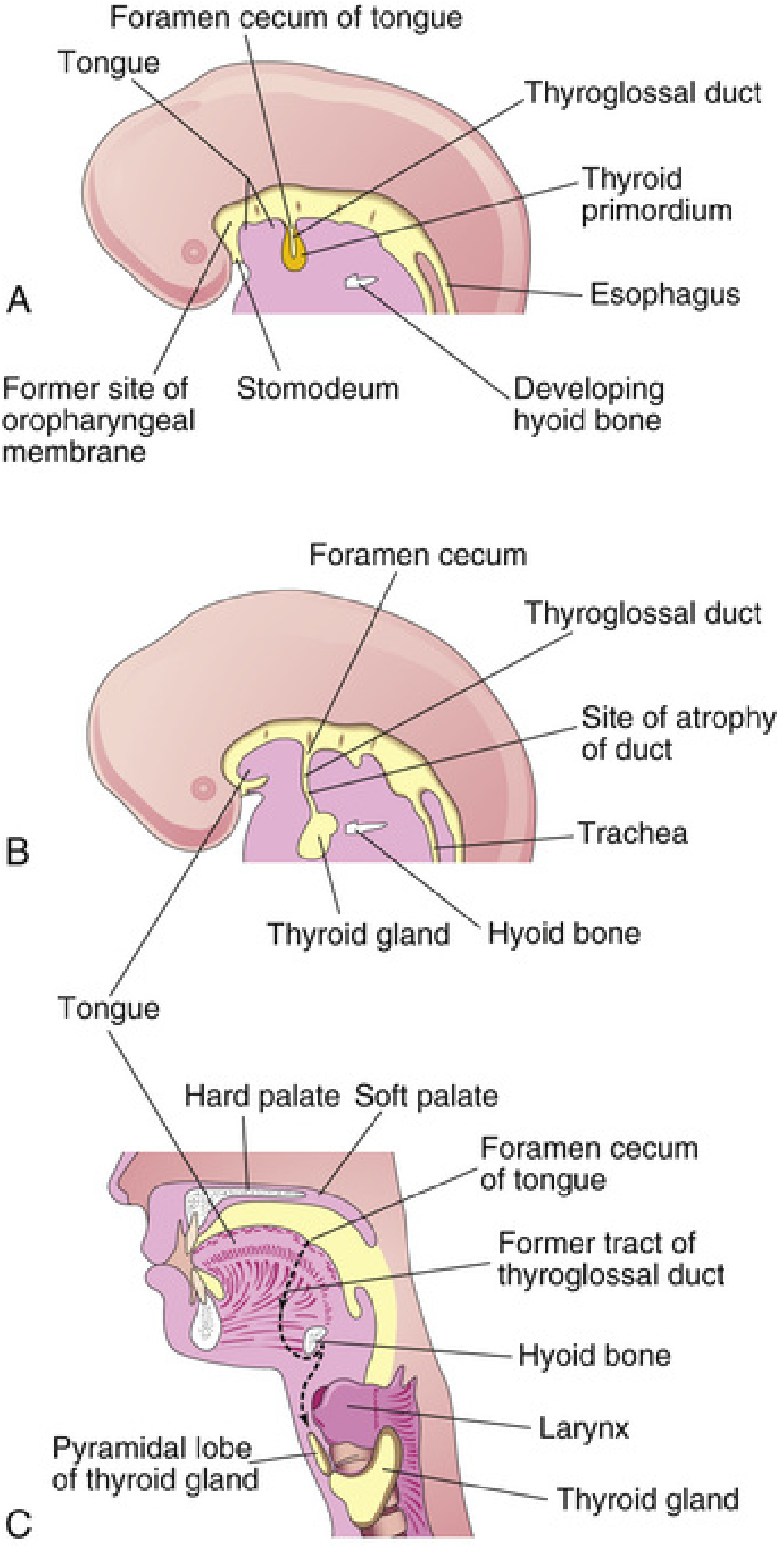
Steps of Development
1. Formation of the Thyroid Primordium (Day 24 / ~4th week)
- A median endodermal thickening forms at the foramen cecum (floor of the primordial pharynx, at the junction of the anterior two-thirds and posterior one-third of the tongue).
- This thickening forms a bilobed diverticulum - the thyroid primordium.
2. Descent (4th-7th weeks)
- As the embryo and tongue grow, the developing thyroid descends in the neck, passing ventral to the developing hyoid bone and laryngeal cartilages.
- During descent, it remains connected to the tongue by a narrow tube - the thyroglossal duct.
- At first the primordium is hollow; it soon becomes a solid mass of cells.
3. Formation of Lobes and Lateral Contribution
- Two lateral primordia arise from the 4th pharyngeal pouch (ultimobranchial body) and fuse with the midline primordium.
- The lateral components (neural crest-derived) primarily contribute parafollicular C cells (calcitonin-secreting).
- The midline component provides the majority of follicular cells (thyroglobulin-synthesizing).
- The gland divides into right and left lobes connected by the isthmus, lying anterior to the 2nd and 3rd tracheal rings.
4. Reaching Final Position (7th week)
- By 7 weeks, the thyroid reaches its definitive position in the anterior neck, just inferior to the cricoid cartilage, anterior to the trachea.
- The thyroglossal duct degenerates and disappears; its proximal opening persists as the foramen cecum on the dorsum of the tongue.
- A pyramidal lobe extending superiorly from the isthmus is present in ~50% of people (represents a persistent inferior portion of the thyroglossal duct that has formed thyroid tissue).
5. Histogenesis (Weeks 10-11)
- The thyroid primordium breaks into epithelial cords invaded by vascular mesenchyme.
- By week 10-11, cords divide into small cellular clusters; a lumen forms in each - these become thyroid follicles.
- Colloid appears at week 11; iodine concentration and thyroid hormone synthesis begin.
- Genes involved: TTF1, FOXE1, PAX8, TSHR, DUOX2; the sodium/iodine symporter (NIS) drives onset of function.
- By week 20, fetal TSH and thyroxine levels begin to rise, reaching adult levels by 35 weeks.
Associated Congenital Anomalies (2 Marks)
| Anomaly | Mechanism | Key Features |
|---|---|---|
| Thyroglossal Duct Cyst | Failure of thyroglossal duct to degenerate | Most common - midline neck cyst, usually below hyoid bone (60-80%); moves on swallowing and tongue protrusion; may become infected and form a sinus |
| Ectopic Thyroid | Arrest of descent anywhere along the migration path | Lingual thyroid is most common ectopic site; also sublingual, high cervical, mediastinal; in 70% of cases, ectopic tissue is the ONLY functioning thyroid tissue - removal is dangerous |
| Agenesis / Hemiagenesis | Failure of thyroid primordium to form | Complete absence (agenesis) or unilateral lobe absence (hemiagenesis - left lobe more often absent 5:1); leads to congenital hypothyroidism |
| Congenital Hypothyroidism | Various mutations (TSH receptor, TTF1, TTF2, PAX8) | Most common metabolic disorder in neonates; causes neurodevelopmental disorders and infertility if untreated; associated with renal/urinary tract defects |
| Lateral Aberrant Thyroid | Incomplete fusion of ultimobranchial body | Follicular thyroid tissue lateral to the internal jugular vein; most cases represent metastatic thyroid carcinoma |
Key Exam Points to Remember:
- Thyroid = first endocrine gland to develop
- Origin = foramen cecum (endoderm of pharyngeal floor)
- Thyroglossal duct connects it to tongue during descent; normally disappears by week 7
- C cells come from ultimobranchial body (4th pharyngeal pouch / neural crest)
- Functional by weeks 10-12; structurally mature by week 17.5
Sources: The Developing Human: Clinically Oriented Embryology; Scott-Brown's Otorhinolaryngology Head & Neck Surgery; Cummings Otolaryngology Head and Neck Surgery
This is a shared conversation. Sign in to Orris to start your own chat.