
E xplain diarrhoea
Reading File
Now let me search the medical library for comprehensive content on diarrhoea in parallel.
Finding Sources
Searching PubMed
"diarrhea"[MeSH Terms] AND pathophysiology
Excellent results. Now let me read the main diarrhoea sections from the top sources in parallel.
Reading File
Reading File
Reading File
Good - I have the physiology content. Now let me get the main dedicated diarrhoea section from Sleisenger (the GI textbook) and also look for clinical features, causes, and management.
Reading File
Finding Sources
Finding Sources
Excellent content! Let me read more from the Sleisenger chapter on diarrhoea (the core GI textbook) and also grab the Harrison's chronic diarrhoea section.
Reading File
Reading File
Reading File
Let me get more content on the pathophysiology details, treatment, and also fetch the classification diagram image.
Reading File
Reading File
Loading Image
I now have extensive content to write a comprehensive answer. Let me also get the treatment/management section and the Cl- secretion diagram.
Reading File
Loading Image
I now have rich, comprehensive content. Let me compile the full answer.
Diarrhoea
Definition
Diarrhoea is a symptom, not a disease, defined as the passage of abnormally loose or watery stools, typically three or more times per day. Objectively, stool output exceeding 200 g/day is generally accepted as the upper limit of normal in Western countries. It is classified as:
- Acute - lasting < 4 weeks (most cases resolve within days)
- Chronic - lasting ≥ 4 weeks, which warrants investigation to exclude serious pathology
- Sleisenger and Fordtran's Gastrointestinal and Liver Disease, p. 204
Epidemiology
- 7.5% of Americans have acute gastroenteritis symptoms in any given month
- Over 3.5 million outpatient visits for diarrhoea occur annually in the USA, with >180,000 hospital admissions and ~3,000 deaths per year
- Chronic diarrhoea affects ~6.6% of the general population per year
- In developing countries, acute infectious diarrhoea remains a leading cause of death, especially in children
- Sleisenger and Fordtran's, p. 204
Pathophysiology
Normally, the small intestine and colon absorb 99% of the ~9-10 litres of fluid that passes the ligament of Treitz daily (from oral intake plus secretions from salivary glands, stomach, liver, and pancreas). A reduction in net water absorption of as little as 1% is sufficient to cause diarrhoea.
Three fundamental mechanisms disrupt this:
- Altered rate of mucosal water/electrolyte transport in the small intestine or colon
- Rapid transit - less time available for water absorption, especially in the colon
- Altered stool solids composition - changing stool consistency independent of water content
- Sleisenger and Fordtran's, p. 205
Classification of Diarrhoea by Mechanism
The four general pathophysiological mechanisms are:
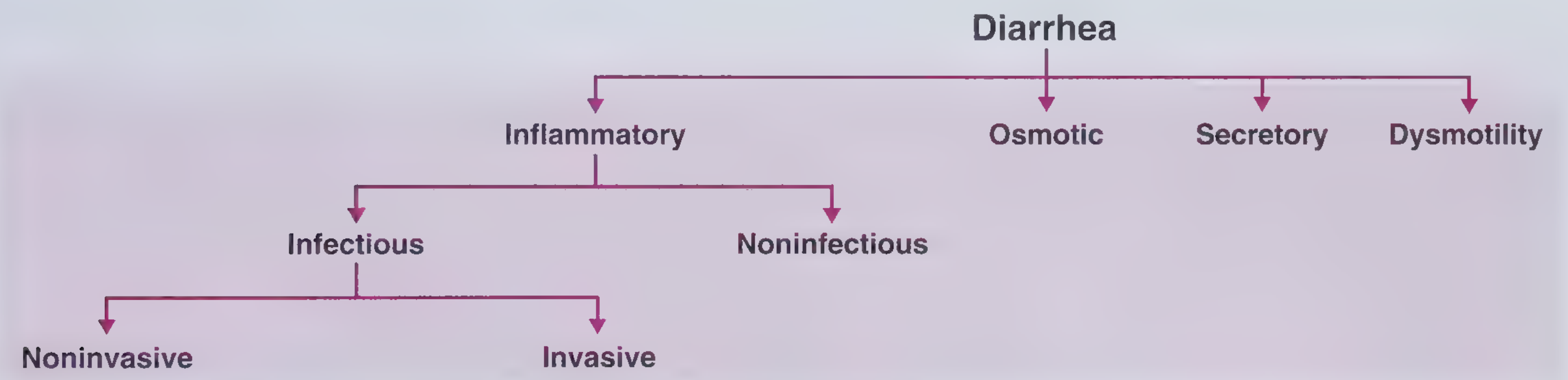
Frameworks for Internal Medicine
1. Osmotic Diarrhoea
Caused by non-absorbable solutes in the intestinal lumen that retain water osmotically.
- Classic example: lactase deficiency - undigested lactose stays in the lumen, retains water, and colonic bacteria degrade it into more osmotically active particles
- Other causes: osmotic laxatives (Mg²⁺, phosphate, sulphate), fructose/sorbitol ingestion, FODMAPs (fermentable oligosaccharides, disaccharides, monosaccharides, and polyols), polyethylene glycol
- Key feature: resolves with fasting - stops when the offending substance is removed
- Stool electrolytes are low; there is a measurable fecal osmotic gap
2. Secretory Diarrhoea
Caused by net secretion of anions (Cl⁻ or HCO₃⁻), net secretion of K⁺, or net inhibition of Na⁺ absorption by the enterocolonic mucosa.
The diagram below shows the mechanism at crypt epithelial cells - cholera toxin activates adenylyl cyclase (AC) via a G-protein (Gs), raising intracellular cAMP, which opens CFTR Cl⁻ channels in the apical membrane. Na⁺ and water follow passively into the lumen:
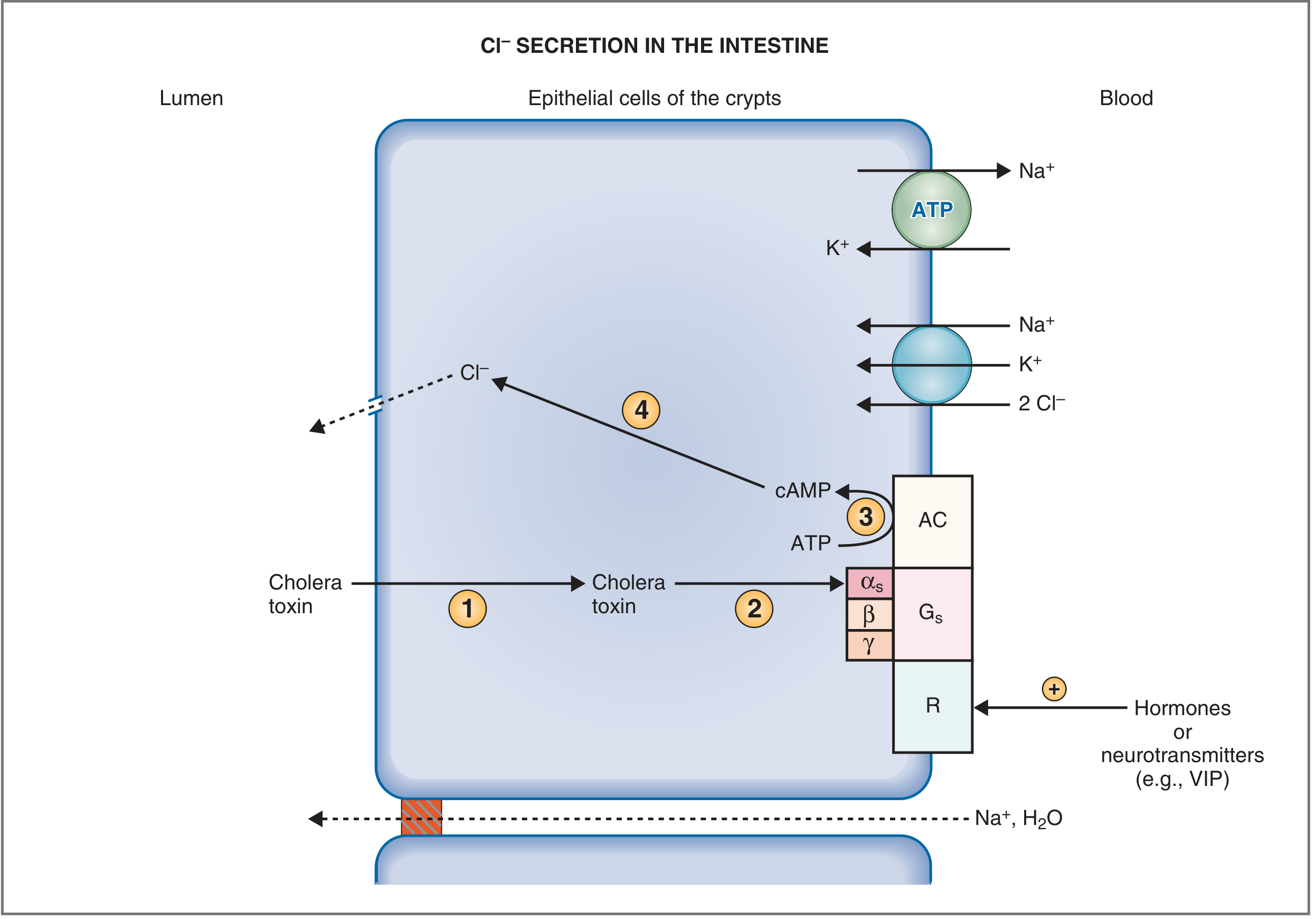
Costanzo Physiology, Fig. 8.36
Key features of secretory diarrhoea:
- Large volume, watery stools that are typically painless
- Persists with fasting (unlike osmotic)
- No fecal osmotic gap
- Caused by: bacterial enterotoxins (E. coli, V. cholerae), VIP-secreting tumours (VIPoma), carcinoid, gastrinoma, medullary thyroid cancer, bile acid malabsorption, drugs/laxatives, congenital transport defects
The most common cause is infection. E. coli heat-stable enterotoxin acts on guanylate cyclase C receptors, raising cGMP and stimulating Cl⁻ secretion via CFTR. Many enterotoxins also block Na⁺-H⁺ exchange, reducing absorption.
- Sleisenger and Fordtran's, p. 206
3. Inflammatory (Exudative) Diarrhoea
Mucosal disruption results in exudation of serum, blood, and mucus into the intestinal lumen; destruction of absorptive epithelium also causes malabsorption.
- Associated with: abdominal pain, fever, tenesmus, bloody/mucoid stools
- Stool shows polymorphonuclear leukocytes or inflammatory proteins (calprotectin, lactoferrin)
- Causes: invasive bacterial infections (Salmonella, Shigella, Campylobacter, C. difficile), IBD (Crohn's disease, ulcerative colitis), radiation injury, GI malignancies, ischaemic colitis
- Life-threatening complication: toxic megacolon (fever, tachycardia, abdominal distension, delirium)
4. Dysmotility Diarrhoea
Altered intestinal motility reduces contact time between luminal contents and the absorptive mucosa.
- Causes: irritable bowel syndrome (IBS), hyperthyroidism, prokinetic drugs, postvagotomy, visceral neuropathies
Electrolyte Consequences
Diarrhoeal fluid is rich in:
- HCO₃⁻ (from salivary, pancreatic, and intestinal secretions) → loss causes hyperchloremic normal anion-gap metabolic acidosis
- K⁺ (via flow-rate-dependent colonic K⁺ secretion) → loss causes hypokalaemia
- Water/Na⁺ → hypovolaemia, reduced intravascular volume, and circulatory collapse in severe cases
Baroreceptor and renin-angiotensin-aldosterone mechanisms attempt to restore blood pressure but are overwhelmed if losses are large or rapid.
- Costanzo Physiology, p. 392
Major Causes by Duration
Acute Diarrhoea (< 4 weeks)
| Category | Examples |
|---|---|
| Viral | Norovirus, rotavirus, adenovirus |
| Bacterial (non-invasive/toxin) | E. coli (ETEC), V. cholerae, S. aureus, Bacillus cereus |
| Bacterial (invasive) | Salmonella, Shigella, Campylobacter, C. difficile |
| Protozoal | Giardia, Cryptosporidium, Entamoeba histolytica |
| Drugs | Antibiotics, NSAIDs, antacids, laxatives |
| Dietetic | Excessive FODMAPs, alcohol |
Chronic Diarrhoea (≥ 4 weeks) by Mechanism
Secretory causes: stimulant laxatives, chronic ethanol, bile acid malabsorption (BAD - accounts for ~40% of unexplained chronic diarrhoea), hormone-producing tumours (VIPoma, carcinoid, gastrinoma), Addison's disease, congenital electrolyte transport defects
Osmotic causes: lactase/disaccharide deficiency, non-absorbable carbohydrates, FODMAPs, osmotic laxatives
Steatorrheal/malabsorptive: pancreatic exocrine insufficiency, celiac disease, Whipple's disease, bacterial overgrowth, short bowel syndrome
Inflammatory: IBD (Crohn's, ulcerative colitis), microscopic colitis, lymphocytic/collagenous colitis, eosinophilic gastroenteritis, radiation enteritis
Dysmotility: IBS, hyperthyroidism, postvagotomy, prokinetics
Iatrogenic: post-cholecystectomy, ileal resection, bariatric surgery
- Harrison's Principles of Internal Medicine 22E, Table 49-3
Clinical Evaluation
History
- Duration, frequency, volume, consistency, presence of blood/mucus
- Associated symptoms: fever, weight loss, abdominal pain, tenesmus
- Dietary history, travel history, medications, family history
- Epidemiologic context (immunosuppression, HIV, hospitalisation)
Physical Examination
- Signs of dehydration: tachycardia, hypotension, reduced skin turgor, dry mucous membranes
- Abdominal examination: distension, tenderness, bowel sounds
- Perianal inspection
Investigations
For acute diarrhoea:
- Most resolve without investigation
- Stool cultures + microscopy if: fever, bloody stool, immunosuppression, symptoms > 3-4 days
- Stool for C. difficile toxin in hospital-acquired or post-antibiotic diarrhoea
For chronic diarroea:
- Stool characterisation: watery vs. fatty vs. inflammatory
- Basic bloods: FBC, CRP, ESR, LFTs, TFTs, coeliac antibodies (anti-tTG)
- Stool osmotic gap = 290 - 2×(stool Na + stool K): gap >50 mOsm/kg = osmotic; gap <50 = secretory
- Faecal calprotectin (screens for organic vs. functional cause)
- Colonoscopy + biopsy for inflammatory or neoplastic causes
- CT/MRI enterography for small bowel disease
- SeHCAT scan or serum FGF-19 for bile acid malabsorption
Treatment
Acute Diarrhoea
- Oral rehydration therapy (ORT) is the cornerstone - glucose-coupled Na⁺ transport is preserved even in secretory diarrhoea
- Antimotility agents: loperamide (reduces stool frequency, does not use in bloody/febrile diarrhoea)
- Antibiotics only for specific organisms (Shigella, Campylobacter, C. difficile, cholera), traveller's diarrhoea, or immunocompromised patients
- Bismuth subsalicylate has antisecretory and antimicrobial effects
Chronic Diarrhoea
- Treatment directed at the underlying cause wherever possible
- Bile acid sequestrants (cholestyramine, colesevelam) for BAD
- Pancreatic enzyme replacement for exocrine insufficiency
- Gluten-free diet for coeliac disease
- 5-aminosalicylates, steroids, biologics for IBD
- Budesonide for microscopic colitis
- Somatostatin analogues (octreotide) for VIPoma/carcinoid diarrhoea
- Low-FODMAP diet for IBS-diarrhoea
Complications
| Complication | Mechanism |
|---|---|
| Dehydration | Volume loss (up to 9+ L/day in severe cases) |
| Metabolic acidosis | HCO₃⁻ loss in stool |
| Hypokalaemia | K⁺ loss in diarrhoeal fluid |
| Hypovolaemic shock | Circulatory collapse if losses are massive/rapid |
| Malnutrition | Chronic malabsorptive diarrhoea |
| Toxic megacolon | Inflammatory diarrhoea complication |
Special Populations
- HIV/AIDS: Diarrhoea occurred in up to 90% of patients pre-HAART. Common organisms: Cryptosporidium (most frequent protozoa), CMV, MAC, Microsporidium. Now more often HAART-induced or from unrelated disorders.
- Hospitalized patients: C. difficile toxin-mediated colitis, overflow diarrhoea from faecal impaction, ischaemic colitis, tube feeding
- Diabetics: Autonomic neuropathy (altered motility), associated coeliac disease, pancreatic exocrine insufficiency, metformin/acarbose side effects
- Children: Rotavirus is the leading cause worldwide; oral rehydration is the mainstay of management
Sources: Sleisenger and Fordtran's Gastrointestinal and Liver Disease; Harrison's Principles of Internal Medicine 22E; Costanzo Physiology 7th Ed.; Frameworks for Internal Medicine
This is a shared conversation. Sign in to Orris to start your own chat.