
Explain dentinogenesis
Reading File
Now let me search the library for dentinogenesis content in parallel:
Finding Sources
Finding Sources
Good. Now let me search specifically for dentin formation content and look up the most relevant textbook sources in parallel:
Finding Sources
Finding Sources
Finding Sources
Excellent — strong hits from Histology, Junqueira's, Langman's, and the Color Atlas. Let me read those key sections in parallel:
Reading File
Reading File
Reading File
Reading File
Good content. Now let me get the rest of the Histology dentin section (types of dentin, tubules, etc.) and search for images:
Reading File
Reading File
Finding Sources
Now let me get the tooth development/dentinogenesis section from Langman's and the Histology textbook's dentin section:
Reading File
Reading File
I now have comprehensive content. Let me also fetch the key histology image of dentin and get the Langman's dentinogenesis passage:
Reading File
Loading Image
Loading Image
I now have comprehensive information to write a thorough explanation. Let me compose the answer.
Dentinogenesis
Dentinogenesis is the process by which dentin — the calcified tissue forming the bulk of a tooth — is synthesized and mineralized. It is initiated during tooth development and, uniquely among hard dental tissues, continues in a modified form throughout the life of the tooth.
1. Developmental Context: Stages of Tooth Formation
Tooth development (odontogenesis) proceeds through three classic stages, and dentinogenesis begins during the bell stage:
| Stage | Timing | Key Events |
|---|---|---|
| Bud stage | ~8 weeks gestation | Dental lamina gives rise to 10 tooth buds per jaw |
| Cap stage | ~10 weeks | Outer/inner dental epithelium + stellate reticulum form; dental papilla indents |
| Bell stage | ~3 months | Inner dental epithelium differentiates into ameloblasts; dental papilla cells differentiate into odontoblasts |
The neural crest-derived mesenchyme of the dental papilla is the direct source of odontoblasts, making dentin a product of ectomesenchyme. — Langman's Medical Embryology
The enamel knot — a cluster of cells in the inner dental epithelium — acts as a signaling center regulating tooth morphogenesis at the cap stage. Molecular signals including WNTs, BMPs, FGFs, and SHH, along with transcription factors MSX1 and MSX2, regulate the epithelial-mesenchymal interactions that drive differentiation. — Langman's Medical Embryology
2. Odontoblast Differentiation
The key cellular event of dentinogenesis is the differentiation of odontoblasts from undifferentiated mesenchymal cells at the periphery of the dental papilla.
As they mature, odontoblasts become:
- Tall, columnar, highly polarized cells
- Rich in rough endoplasmic reticulum (rER) and a large Golgi apparatus — organelles for high-volume protein secretion
- Linked to each other by junctional complexes that separate the dentinal compartment from the pulp chamber
Each odontoblast develops an apical (odontoblastic) process that extends away from the pulp into the forming dentin. This process is critical: as the cell body retreats pulp-ward, the process remains embedded, eventually occupying a narrow channel called the dentinal tubule. — Histology: A Text and Atlas with Correlated Cell and Molecular Biology
3. Matrix Secretion — Predentin
Dentinogenesis begins with secretion of the unmineralized organic matrix called predentin:
- Secreted from the apical pole of odontoblasts (toward the future dentin surface)
- Composed mainly of type I collagen and proteoglycans
- Contains two unique proteins not found in bone:
- Dentin phosphoprotein (DPP) — a 45 kDa highly phosphorylated protein rich in aspartic acid and phosphoserine that binds large amounts of calcium; critical for initiating mineralization and controlling crystal size and shape
- Dentin sialoprotein (DSP) — a 100 kDa proteoglycan rich in aspartic and glutamic acids, involved in the mineralization process
The outermost layer of dentin, mantle dentin, is formed first by subodontoblastic cells that produce von Korff fibers (small collagen bundles with a different orientation from subsequent dentin). — Histology: A Text and Atlas
4. Mineralization
Within approximately 24 hours of secretion, predentin mineralizes to form dentin. The process resembles osteoid mineralization in bone:
- Matrix vesicles (membrane-bound packages released by odontoblasts) initiate mineral deposition
- Hydroxyapatite crystals nucleate and propagate through the collagen matrix
- The mineralization front advances from the dentinoenamel junction (DEJ) toward the pulp, following the retreating odontoblast layer
- As the mineralized wave advances, odontoblast processes become enclosed within the nascent dentinal tubules
A notable secretory peculiarity: Golgi vesicles contain preformed filamentous collagen precursors with calcium-bearing granules attached, forming structures called abacus bodies, which mature into secretory granules before release. — Histology: A Text and Atlas
Dentin ultimately contains approximately 70% hydroxyapatite (less than enamel's 96%, more than bone's ~60%), with the remainder being organic matrix and water. — Junqueira's Basic Histology
5. Dentinal Tubules and Odontoblast Processes
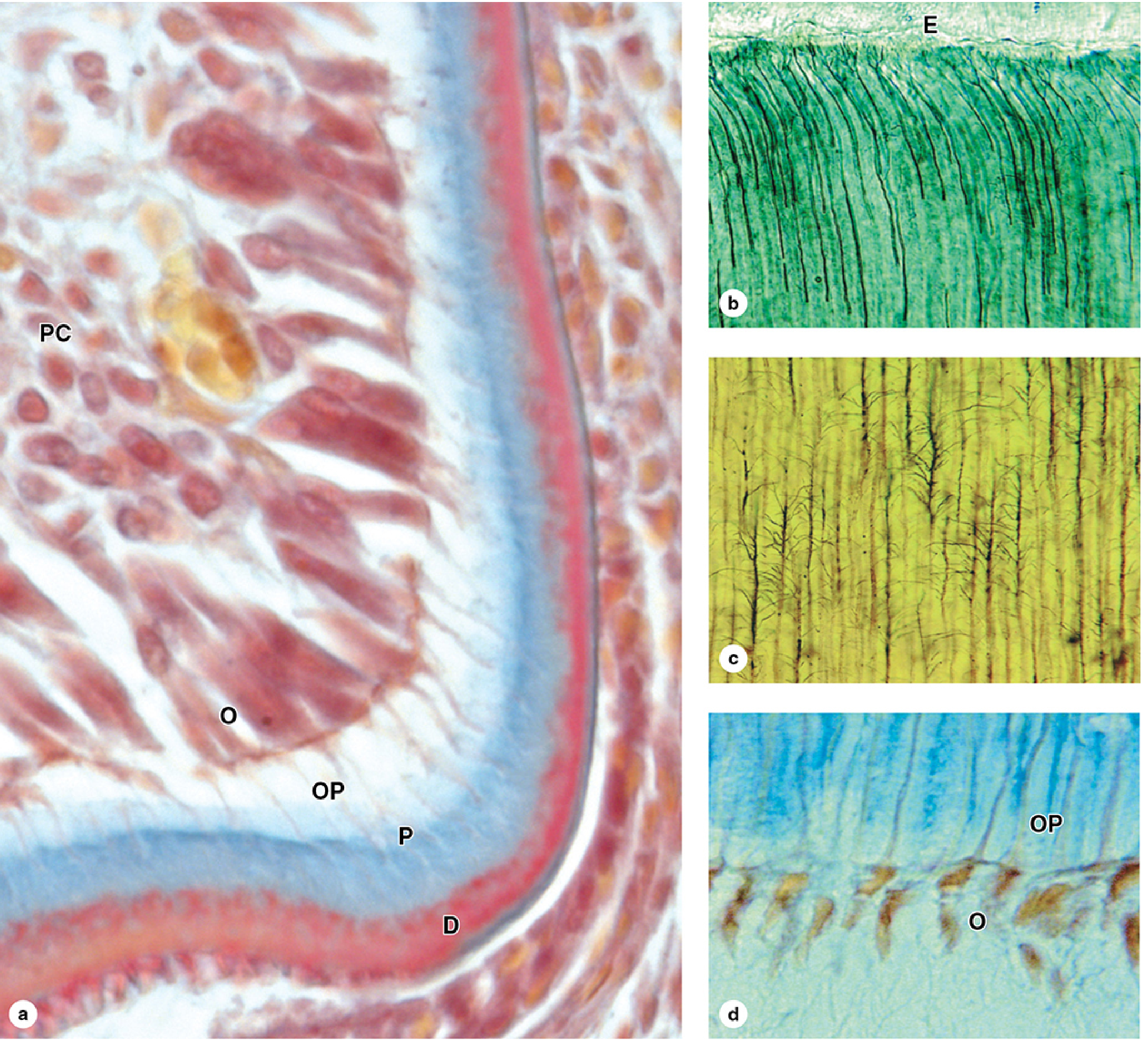
As the odontoblast layer retreats centrally, each cell leaves behind its elongating process in a dentinal tubule:
- Tubules run the full thickness of the dentin from the predentin border to the DEJ (crown) or DCJ (root)
- Near the DEJ, processes branch extensively (seen with silver staining)
- The tubule wall is initially simply the edge of mineralized dentin; over time, peritubular dentin forms — a hypermineralized cuff surrounding each tubule
- The region between tubules is intertubular dentin (less mineralized)
Unmyelinated nerve fibers from the pulp accompany odontoblast processes in the tubules. These nerves respond to thermal, osmotic, and mechanical stimuli — explaining dentin hypersensitivity. — Junqueira's Basic Histology
6. Types of Dentin Deposited Sequentially
| Type | Timing | Features |
|---|---|---|
| Mantle dentin | First-formed | Outermost; von Korff fibers; thin layer |
| Primary (circumpulpal) dentin | During tooth formation | Bulk of dentin; rhythmic deposition |
| Secondary dentin | After root completion | Continues slowly throughout life; gradually narrows pulp |
| Tertiary (reparative) dentin | Response to injury/caries | Formed rapidly by surviving or newly recruited odontoblasts; irregular; may occlude tubules |
The odontoblast layer persists throughout life, remaining capable of producing secondary and tertiary dentin in response to slow attrition or injury. — Junqueira's Basic Histology
7. Incremental Growth Lines
Dentin grows rhythmically, leaving structural markers:
- Incremental lines of von Ebner — fine lines reflecting daily growth rhythm (~4–8 µm/day)
- Lines of Owen — broader, less regular accentuation lines
- Neonatal line — a prominent line marking the abrupt change in dentin quality at birth, seen in both deciduous teeth and first permanent molars
These lines are studied in forensic dentistry for age estimation. — Histology: A Text and Atlas
8. Root Formation and Cementum
Root dentin formation occurs when the epithelial root sheath (Hertwig's sheath) grows apically, inducing dental papilla cells to differentiate into more odontoblasts. Dentin laid down by these cells is continuous with crown dentin. Mesenchymal cells on the outer root surface then differentiate into cementoblasts, which deposit cementum over the root dentin. — Langman's Medical Embryology
9. Clinical Correlate: Dentinogenesis Imperfecta
Dentinogenesis imperfecta (DI) is an autosomal dominant disorder localized to chromosome 4q21 (mutation in the DSPP gene encoding dentin sialophosphoprotein):
- Teeth appear translucent gray to yellow-brown with an opalescent sheen
- Affects both primary and permanent dentition
- Odontoblasts fail to differentiate normally → poorly calcified dentin
- Enamel wears down rapidly, exposing and abrading the soft dentin
- Relatively common among white children (~1/6,000–8,000)
- Can occur as an isolated finding or in association with osteogenesis imperfecta (type I, III, IV)
— The Developing Human: Clinically Oriented Embryology
Summary
Dentinogenesis is an epithelial-mesenchymal process in which neural crest-derived odontoblasts differentiate, polarize, and secrete predentin (type I collagen + unique dentin proteins DPP and DSP), which rapidly mineralizes with hydroxyapatite via matrix vesicles. The retreating odontoblasts leave processes in dentinal tubules, and dentin formation continues lifelong as secondary dentin. The process is tightly regulated by molecular signals (BMPs, WNTs, FGFs) and produces a uniquely sensitive, self-maintaining calcified tissue.
This is a shared conversation. Sign in to Orris to start your own chat.