
Why is subdural hemorrhage more common in elderly
Reading File
Finding Sources
Searching PubMed
subdural hematoma elderly risk factors aging
Finding Sources
Reading File
Reading File
Finding Sources
Reading File
Loading Image
Here is a thorough, textbook-grounded answer:
Why Subdural Hemorrhage is More Common in the Elderly
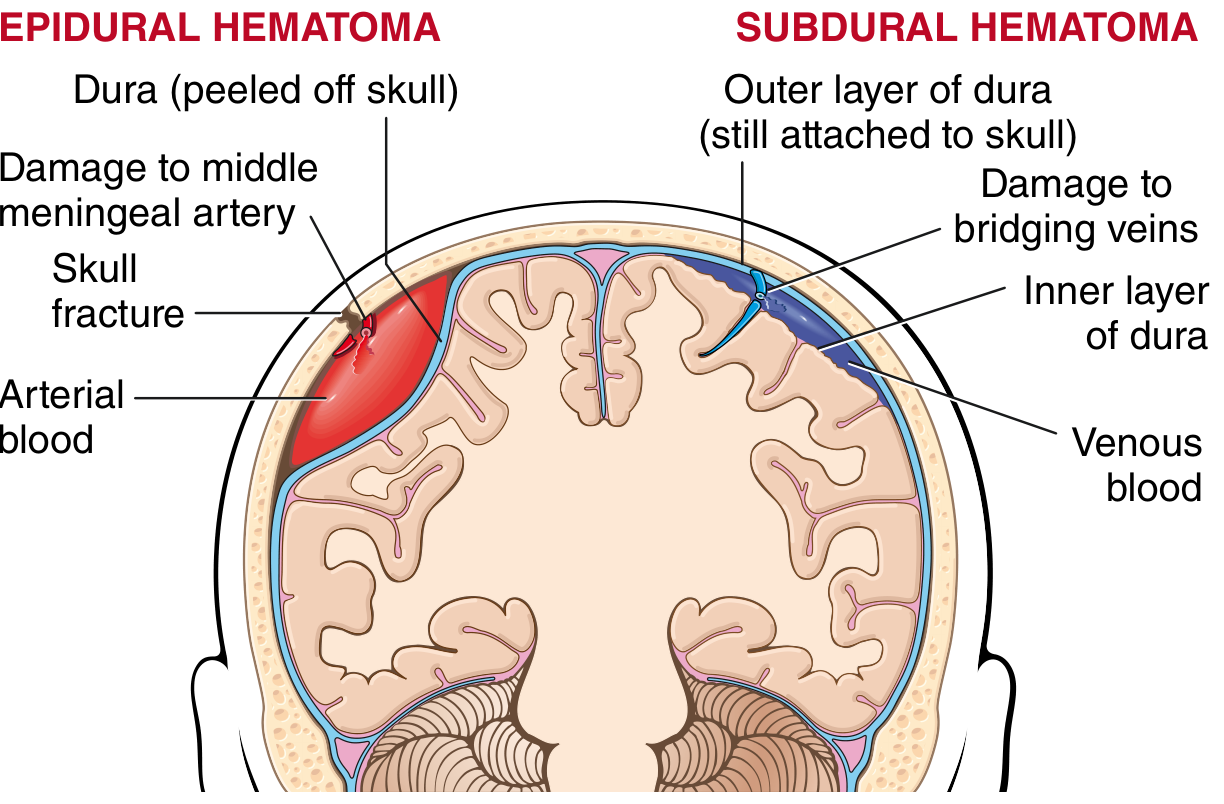
The Core Anatomy
Subdural hematomas arise from damage to the bridging veins - veins that travel from the convexities of the cerebral hemispheres, through the subarachnoid space and dura, to empty into the dural sinuses (e.g., the superior sagittal sinus). The brain is suspended in CSF and moves freely, but the venous sinuses are fixed to the skull. When the head accelerates or decelerates, the brain shifts relative to the fixed dura, and the bridging veins can tear at the point where they penetrate the dura. The extravasated venous blood then dissects between the two layers of the dura, forming a subdural hematoma.
Why the Elderly Are at Higher Risk
1. Brain Atrophy - The Primary Reason
As people age, the brain gradually shrinks (atrophies), which increases the distance between the cortical surface and the inner table of the skull. This stretches the bridging veins over a greater span. Stretched veins are under chronic tension and far more vulnerable to tearing, even with trivial or minor head trauma - sometimes so minor that the patient doesn't recall any injury at all. This is the single most important anatomical reason.
"In older individuals with brain atrophy, the bridging veins are stretched, hence the increasing incidence of subdural hematoma with aging."
- Robbins, Cotran & Kumar Pathologic Basis of Disease, p. 1162
2. Enlarged Subdural Space
Brain atrophy also enlarges the subdural space itself. More space means there is room for a larger collection to accumulate before symptoms appear. This is why elderly patients can harbor a significant chronic subdural hematoma with minimal or non-specific symptoms (confusion, headache, subtle personality change), leading to delayed diagnosis.
3. Anticoagulant and Antiplatelet Use
The elderly are disproportionately on anticoagulants (warfarin, DOACs) and antiplatelet agents (aspirin, clopidogrel) for atrial fibrillation, stroke prevention, or coronary artery disease. These medications impair clot formation, turning what would otherwise be a self-limited venous bleed into a larger, expanding, or recurrent hematoma. Tintinalli's Emergency Medicine notes that clopidogrel users had a 12% rate of intracranial hemorrhage after blunt head trauma, versus 5.1% with warfarin.
4. Falls - A Geriatric Syndrome
Falls are far more common in the elderly due to gait instability, orthostatic hypotension, polypharmacy, and impaired proprioception. Falls are the most common mechanism of subdural hematoma, and even low-energy falls (from standing height) are sufficient to tear the already-stretched bridging veins.
5. Alcoholism (Comorbid Factor)
Chronic alcohol misuse, which is not uncommon in the elderly, causes additional cerebral atrophy and also impairs coagulation (liver disease, thrombocytopenia), independently raising the risk.
Acute vs. Chronic Subdural - Both More Prevalent in Elderly
| Type | Key Features in Elderly |
|---|---|
| Acute SDH | From higher-energy trauma; worse prognosis - as few as 5% of elderly with low GCS regain functional recovery |
| Chronic SDH | Often no clear trauma history; presents insidiously weeks later with headache, confusion, hemiparesis; very common in elderly |
Chronic SDH often begins as a small acute bleed that reorganizes. The hematoma forms vascularized membranes that can re-bleed, expanding the collection further. The atrophied brain also exerts less outward pressure to tamponade the bleeding, allowing accumulation to continue.
Summary
The key mechanism is a combination of structural vulnerability (stretched bridging veins from brain atrophy) and systemic risk factors (anticoagulation, falls). Brain atrophy widens the subdural space, places the bridging veins under constant tension, and removes the CSF cushioning effect - all working together to make the elderly brain uniquely susceptible to subdural hemorrhage even from minor trauma.
- Robbins, Cotran & Kumar Pathologic Basis of Disease, p. 1162
- Schwartz's Principles of Surgery, 11th Ed.
- Tintinalli's Emergency Medicine, 9th Ed.
This is a shared conversation. Sign in to Orris to start your own chat.