
physics related to anaesthesia
Reading File
Physics related to anaesthesia covers several key areas - gas laws, fluid dynamics, pressure, electricity, and optics. This is a broad topic that I'll research thoroughly from the medical library.
Searching sources...
Finding Sources
Finding Sources
Finding Sources
Finding Sources
Finding Sources
Finding Sources
Finding Sources
Reading File
Reading File
Reading File
Finding Sources
Reading File
Reading File
Finding Sources
Finding Sources
Reading File
Reading File
Reading File
Reading File
Reading File
Searching the Web
physics principles in anaesthesia gas laws pressure flow electricity ultrasound overview
Loading Image
Reading Web Page
https://aneskey.com/basic-physics-for-the-anaesthetist
Here is a comprehensive overview of the physics principles relevant to anaesthesia, drawn from Miller's Anesthesia (10e), Barash's Clinical Anesthesia (9e), and Morgan & Mikhail's Clinical Anesthesiology (7e).
Physics Related to Anaesthesia
1. PRESSURE
Pressure = Force / Area
- 1 Pascal = 1 Newton per m²
- Clinical pressure units: mmHg (blood pressure, gas partial pressures), cmH₂O (airway pressures), bar/kPa (cylinder pressures)
- Gauge pressure = measured relative to atmospheric pressure (used for blood pressure and airway measurements)
- Absolute pressure = gauge pressure + atmospheric pressure
A full oxygen cylinder contains gas at 137 bar (~2000 lb/in²) gauge pressure. As the cylinder empties at constant temperature, pressure falls linearly (Boyle's law). In practice, temperature also drops due to adiabatic expansion - a process where gas state changes with no heat exchange with surroundings.
2. THE GAS LAWS
Boyle's Law
At constant temperature, volume and pressure of a fixed mass of gas are inversely proportional:
PV = k (constant)
Clinical use: Explains how gas cylinders work; predicts gas volume from cylinder pressure.
Charles' Law
At constant pressure, volume is directly proportional to absolute temperature (in Kelvin):
V = k₂T
Clinical use: Gas expands when warmed (relevant to humidifiers and gas delivery systems).
Gay-Lussac's / Third Gas Law
At constant volume, pressure is directly proportional to absolute temperature:
P = k₃T
Clinical use: Relevant to closed cylinders - if heated, pressure rises dangerously.
Combined (Ideal) Gas Law
PV = nRT
where R = universal gas constant, n = number of moles.
This is the master equation governing the behaviour of anaesthetic gases inside vaporizers, delivery equipment, and the pulmonary alveolus. Key assumption: gas molecules are point masses with perfectly elastic collisions - valid for dilute anaesthetic gases under normal operating conditions. - Miller's Anesthesia, 10e
Dalton's Law of Partial Pressures
P_total = P₁ + P₂ + P₃ + ...
Each gas in a mixture exerts its own partial pressure, equal to its volume fraction × total pressure.
Example: Air is 21% O₂ by volume, so at sea level: P(O₂) = 0.21 × 760 mmHg = ~160 mmHg
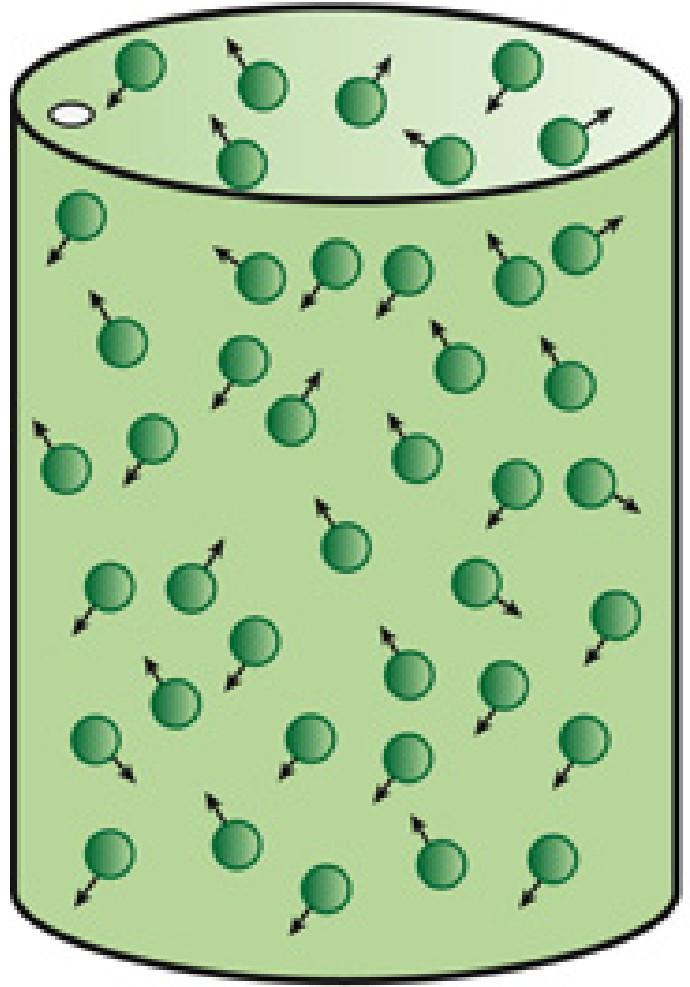
Miller's Anesthesia explains this elegantly - when oxygen alone fills a container at 1 atm, 760 mmHg is entirely from oxygen molecules. Replace with air, and nitrogen, oxygen, and trace gases each contribute proportionally.
3. VAPOUR PRESSURE AND VAPORIZATION
Saturated Vapour Pressure (SVP)
When a volatile liquid is in a closed container, molecules enter the vapour phase until equilibrium is reached. These molecules bombard the walls, creating saturated vapour pressure (SVP). SVP:
- Increases with temperature
- Is independent of atmospheric pressure
- Depends only on temperature and the physical properties of the liquid
Latent Heat of Vaporization
Energy must be absorbed from surroundings to vaporize a liquid. This energy comes from the liquid itself in the absence of external heat - causing evaporative cooling, which reduces SVP and vaporizer output. Modern vaporizers are designed to compensate for this (e.g., copper construction has high specific heat and thermal conductivity). - Morgan & Mikhail, 7e
Boiling Point
The temperature at which SVP = atmospheric pressure. Key point: boiling point falls with decreasing atmospheric pressure (relevant at altitude).
| Agent | Boiling Point (°C) | SVP at 20°C (mmHg) | MAC (%) |
|---|---|---|---|
| Halothane | 50.2 | 243 | 0.75 |
| Isoflurane | 48.5 | 238 | 1.15 |
| Sevoflurane | 58.5 | 160 | 1.7 |
| Desflurane | 22.8 | 669 | 6.0-7.25 |
| Enflurane | 56.5 | 175 | 1.68 |
Desflurane's near-room-temperature boiling point and very high SVP (669 mmHg) require a specially heated, pressurized vaporizer (the Tec 6). All other agents use variable bypass vaporizers.
Minimum Alveolar Concentration (MAC)
MAC is expressed in volume percent (v/v%) - the percentage of the alveolar gas that is the anaesthetic. It is the concentration preventing movement in response to surgical stimulus in 50% of subjects. However, it is the partial pressure (mmHg) in the brain that determines anaesthetic depth. The corresponding value is called MAPP (Minimum Alveolar Partial Pressure). - Miller's Anesthesia, 10e
4. FLUID DYNAMICS - FLOW, RESISTANCE, PRESSURE
Ohm's Law Analogy
Flow = Pressure Difference / Resistance
This applies to both electrical circuits and fluid flow (blood, gas). - Morgan & Mikhail, 7e
| Electrical | Fluid/Haemodynamic |
|---|---|
| Voltage (V) | Pressure gradient (ΔP) |
| Current (I) | Flow (F) |
| Resistance (R) | Vascular/airway resistance (R) |
Laminar Flow - Hagen-Poiseuille Equation
In laminar (streamlined) flow:
- Flow is directly proportional to driving pressure
- Resistance:
R = [8 × length × viscosity] / [π × radius⁴]
The 4th power of radius is the most important relationship. Halving the airway radius increases resistance 16-fold. This is why even small amounts of oedema can dramatically increase airway resistance in infants.
Turbulent Flow
- Flow is proportional to the square root of driving pressure
- Occurs at high flow rates, at branch points, and where airway diameter changes suddenly
- Resistance increases with flow rate
- Density (not viscosity) becomes the dominant property
Reynolds Number
Predicts whether flow is laminar or turbulent:
Re = (velocity × diameter × gas density) / gas viscosity
- Re < 2000: laminar flow predominates
- Re > 4000: turbulent flow predominates
- 2000-4000: transitional
Clinical application: Helium has a lower density than air or N₂O, so it decreases Reynolds number and promotes laminar flow. This is why Heliox (helium-oxygen) is useful in upper airway obstruction (croup, subglottic stenosis) - it converts turbulent to laminar flow, reducing the work of breathing. - Barash, 9e
Critical Flow
For anaesthetic gases, the critical flow rate (above which flow becomes turbulent) numerically approximates the airway diameter in mm:
- A 9 mm ETT: critical flow ≈ 9 L/min
- Air (lower density than N₂O) - laminar flow prevails
- Smaller airways: slower flow, so laminar flow predominates peripherally
5. LAW OF LAPLACE
For a cylinder (e.g., blood vessel, lung alveolus):
T = P × r
where T = wall tension, P = transmural pressure, r = radius.
For a sphere:
T = P × r / 2
Clinical applications:
- Aneurysms: As radius increases, tension increases - explaining why aneurysms progressively enlarge and rupture
- Atelectasis: Small alveoli (small r) tend to collapse into adjacent larger alveoli - prevented by surfactant
- LV hypertrophy: Dilated failing ventricles require greater wall tension for the same pressure generation
6. ELECTRICITY AND ELECTRICAL SAFETY
Ohm's Law
V = I × R (Voltage = Current × Resistance)
Power
P = V × I = I² × R
Capacitance and Capacitors
Capacitors store electrical charge. The body itself has capacitance - relevant in understanding why current can flow through a patient to earth even without direct connection.
Electrical Hazards in the OR
- Macroshock: Current passing through intact skin; thresholds - sensation: 1 mA, ventricular fibrillation: >100 mA
- Microshock: Current applied directly to the heart (via central line or pacing wire); VF can occur at just 50-100 µA - 2000× lower threshold
- Isolated (floating) circuits: Used in modern anaesthetic machines to reduce risk; the isolated power system has neither conductor referenced to earth, preventing a single fault from causing current flow through a patient
- Diathermy (electrosurgery): Uses high-frequency AC current (0.5-3 MHz) to cut/coagulate. High frequency bypasses the neuromuscular threshold. The large dispersive electrode means current density at the return pad is too low to cause burns (unlike at the small active electrode).
- Earth leakage current and line isolation monitors protect against inadvertent current paths through patients
7. PHYSICS OF ULTRASOUND
Sound Wave Properties
- Ultrasound: sound waves with frequency >20,000 Hz (20 kHz); clinical US uses 1-20 MHz
- Wavelength (λ) = velocity / frequency
- Higher frequency = better resolution, less penetration
- Lower frequency = poorer resolution, deeper penetration
Reflection and the Doppler Effect
- US reflects at tissue interfaces (impedance mismatch) - the basis of all US imaging
- Doppler principle: Frequency shift in reflected US from moving structures (e.g., red blood cells). Shift is proportional to velocity of movement - used in echo to measure blood flow velocity and cardiac output
Clinical applications
- Regional anaesthesia (nerve blocks)
- Vascular access
- Transoesophageal echocardiography (TOE/TEE) - uses both B-mode imaging and Doppler
- Lung ultrasound, focused cardiac ultrasound (POCUS)
8. HEAT AND TEMPERATURE
| Concept | Anaesthetic relevance |
|---|---|
| Specific heat | Copper's high specific heat stabilises vaporizer temperature |
| Thermal conductivity | Determines how quickly vaporizer re-equilibrates after temperature drop |
| Latent heat | Energy needed to convert liquid anaesthetic to vapour |
| Temperature scales | Kelvin (K) must be used in gas law calculations; K = °C + 273 |
Hypothermia under anaesthesia results from redistribution of heat (core to periphery from vasodilation), radiation, convection, evaporation, and conduction. Forced-air warming blankets counter convective and radiative losses.
9. PRINCIPLES OF PRESSURE GAUGES AND FLOWMETERS
Bourdon Gauge
Used to measure cylinder pressures. A coiled metal tube straightens proportionally to applied pressure, moving a pointer. For oxygen cylinders (gas under pressure), the gauge reading directly reflects remaining contents (Boyle's law applies).
Rotameters (Variable-Orifice Flowmeters)
A bobbin floats in a tapered tube; flow is read from the top of the bobbin. At low flows the annular orifice is narrow (tube-like) and viscosity governs flow. At high flows the orifice is wide (orifice-like) and density governs flow. Rotameters are gas-specific because each gas has unique viscosity and density characteristics.
Oxygen Analyser
Uses a fuel cell (Clark electrode) or paramagnetic properties of oxygen (oxygen is uniquely paramagnetic due to unpaired electrons) to measure O₂ concentration.
Key Summary Table
| Law / Principle | Formula | Anaesthetic Application |
|---|---|---|
| Boyle's Law | PV = k | Cylinder contents, gas compression |
| Charles' Law | V ∝ T | Gas expansion in warm circuits |
| Third Gas Law | P ∝ T | Closed system pressure changes |
| Ideal Gas Law | PV = nRT | Vaporizer & alveolar gas behaviour |
| Dalton's Law | P_total = ΣP_i | Partial pressure of gases/anaesthetics |
| Hagen-Poiseuille | R ∝ 1/r⁴ | Airway resistance; ETT size |
| Reynolds Number | Re = vdρ/η | Laminar vs turbulent flow; Heliox |
| Ohm's Law | V = IR / ΔP = FR | Haemodynamics; electrical safety |
| Laplace's Law | T = Pr | Alveolar stability; vascular wall stress |
| Doppler | Δf ∝ velocity | Echo flow measurement; POCUS |
Sources: Miller's Anesthesia, 2-Volume Set (10e); Barash, Cullen, and Stoelting's Clinical Anesthesia (9e); Morgan and Mikhail's Clinical Anesthesiology (7e); supplemented by Anesthesia Key: Basic Physics for the Anaesthetist and Physics of Anaesthesia Made Easy, Gupta & Gupta, GJAPM 2019.
This is a shared conversation. Sign in to Orris to start your own chat.