
Kshar sutra all must know with images
Kshar Sutra treatment fistula piles complete guide procedure mechanism
https://www.pristyncare.com/blog/kshar-sutra-for-piles-fissu…
kshar sutra kshara sutra fistula ano treatment
kshara sutra ayurvedic fistula hemorrhoids clinical trial
Kshar Sutra preparation 21 coatings snuhi apamarga turmeric steps diagram
🧵 Kshar Sutra - Everything You Must Know
What is Kshar Sutra?

Historical Background
- First described by Acharya Sushruta in the Sushruta Samhita under the chapter on Bhagandara (fistula-in-ano)
- Re-popularized in modern times by Prof. P.J. Deshpande at Banaras Hindu University (BHU) in the 1960s-70s
- Validated by the Indian Council of Medical Research (ICMR) through multicentre trials
- Recognized by the Ministry of AYUSH as a standard treatment protocol
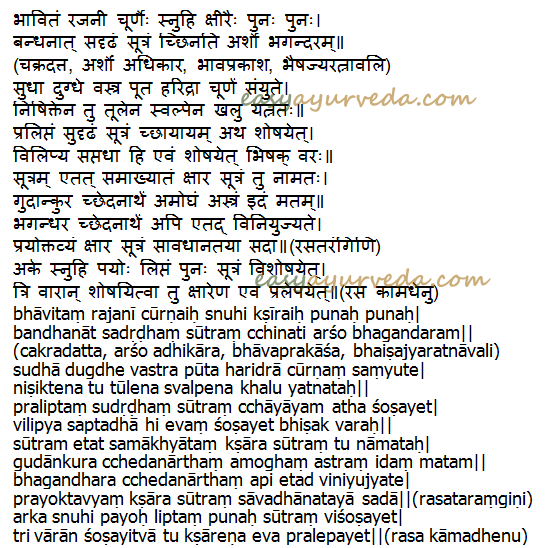
The Thread: Composition & Preparation
Three Key Ingredients
| Ingredient | Sanskrit Name | Botanical Name | Role |
|---|---|---|---|
| Euphorbia latex | Snuhi Ksheera | Euphorbia neriifolia | Binding agent, vehicle for other drugs |
| Palash ash (alkali) | Apamarga Kshar | Achyranthes aspera | Main caustic/cutting agent (pH ~10-12) |
| Turmeric powder | Haridra Churna | Curcuma longa | Antibacterial, anti-inflammatory, healing |
21-Coating Protocol
Coats 1-11:   Snuhi Ksheera alone (11 coats)
Coats 12-18:  Snuhi Ksheera + Apamarga Kshar (7 coats)
Coats 19-21:  Snuhi Ksheera + Haridra Churna (3 coats)
- Wet the linen thread with Snuhi latex
- Roll/pass through the powdered drug
- Ensure uniform adherence, shake off excess
- Place in UV-sterilized Kshar Sutra cabinet for drying
- Repeat after complete drying
- Final thread: cut to 30-32 cm, packed in sterilized packaging
Mechanism of Action (Trividha Karma)
1. Chedana (Cutting)
2. Lekhana (Scraping/Curetting)
3. Ropana (Healing)
- Antibacterial activity (inhibits E. coli, S. aureus)
- Promotes fibroblast proliferation
- Reduces inflammation
- Enables simultaneous healing as the tract is being cut
Indications
| Condition | Description |
|---|---|
| Fistula-in-ano (Bhagandara) | Primary indication - all types |
| Hemorrhoids/Piles (Arsha) | Internal piles, grades II and III |
| Anal Fissure (Parikartika) | Chronic fissure with hypertrophied anal papilla |
| Pilonidal Sinus | Coccygeal pilonidal sinus/abscess |
| Sentinel Tag | Associated with chronic fissure |

Step-by-Step Procedure
For Fistula-in-Ano (Most Common)
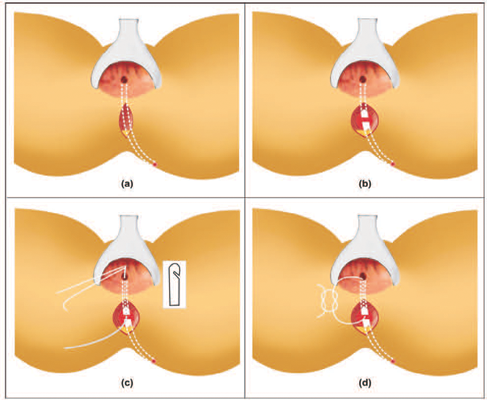
- Anesthesia: Local/spinal/general anesthesia given
- Proctoscopy: Assess the fistula tract - determine internal and external openings
- Probe insertion: A malleable metal probe (Shalaka) is passed through the external opening, traversing the tract to the internal opening
- Thread passage: The Kshar Sutra is inserted into the groove of the probe and pulled through the tract
- Tying: Both ends of the thread are tied together with a moderate amount of tension to form a loop through the tract
- Weekly change: The thread is changed every 7 days with a new Kshar Sutra using the rail-road technique (Lekhana method) - old thread tied to new thread, pulled through
- Duration: Continues until the entire tract is cut and healed - typically 6-8 weeks for simple fistulas, longer for complex ones
Length of tract (cm) ÷ UTS (cm/week) = approximate treatment duration in weeks
For Hemorrhoids (Piles)
- Patient placed in lithotomy position under anesthesia
- Pile mass held with forceps, prolapsed from anal orifice
- Episiotomy at the mucocutaneous junction
- Pile mass gently pulled; Kshar Sutra transfixed at its base
- Ligated pile mass repositioned into rectum
- Yastimadhu taila (licorice oil) or ghrita applied for soothing
- The thread strangulates and sloughs off the pile mass within 5-7 days
For Pilonidal Sinus
- Thread passed through the sinus tract opening to skin surface
- Tied together in a loop
- Changed weekly - same cutting and healing mechanism applies
For Anal Fissure
- Done under local anesthesia
- Kshar Sutra placed at the appropriate location to release hypertonic internal anal sphincter
- In some cases, used to excise the hypertrophied anal papilla or sentinel tag
- Releases sphincter spasm while chemically healing the fissure edge
Advantages Over Conventional Surgery
| Parameter | Kshar Sutra | Conventional Fistulectomy |
|---|---|---|
| Sphincter damage | Minimal - gradual cutting | Risk of incontinence (up to 30-40%) |
| Recurrence rate | ~3.3% | 12-15% |
| Anesthesia needed | Local/minimal | General/spinal often needed |
| Hospital stay | Day-care procedure | 3-5 days admission |
| Wound healing | Simultaneous with cutting | Sequential |
| Cost | Low | Moderate-high |
| Complex/high fistula | Excellent for supra/extrasphincteric | Very risky |
| Infection risk | Low (alkaline environment bacteriostatic) | Moderate |
Contraindications
- Acute anorectal sepsis/abscess (treat first, then Kshar Sutra)
- Active inflammatory bowel disease (Crohn's, UC) - relative contraindication
- Immunocompromised patients (HIV, uncontrolled diabetes)
- Coagulation disorders
- Pregnancy (relative)
- Malignant fistula
Post-Procedure Care & Do's/Don'ts
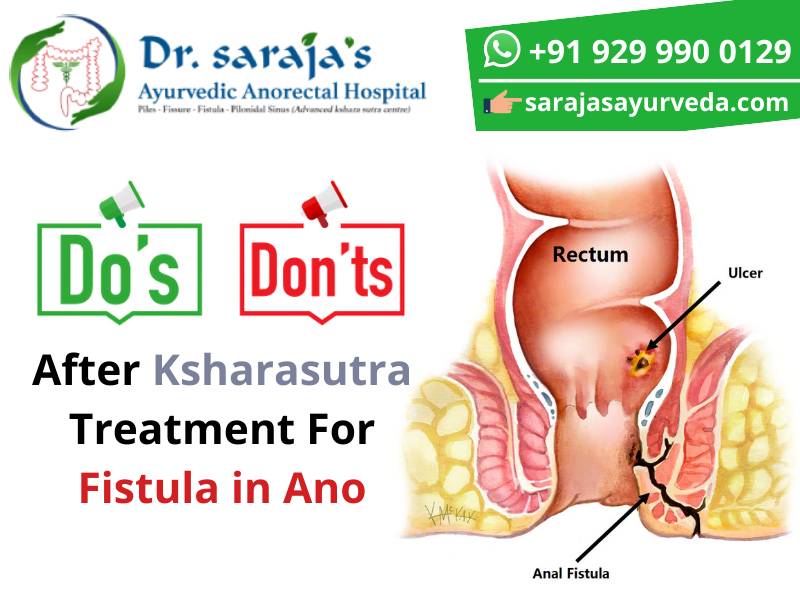
Do's
- Sitz bath (warm water) twice daily
- High-fiber diet to avoid constipation
- Adequate hydration (2-3 liters/day)
- Regular Triphala churna / mild laxatives as advised
- Keep the area clean and dry
- Report promptly if the thread falls out
Don'ts
- Avoid spicy, fried, non-vegetarian food
- Avoid straining during defecation
- Avoid prolonged sitting on hard surfaces
- Avoid strenuous exercise for initial 2-3 weeks
- Do not miss weekly thread changes
Complications
| Complication | Frequency | Management |
|---|---|---|
| Pain/burning (after each change) | Common | Sitz bath, local analgesia, paracetamol |
| Thread breakage | Uncommon | Repass the thread |
| Delayed healing | Occasional | Check diet, infection, diabetes |
| Skin tag formation | Occasional | Excision if symptomatic |
| Bleeding | Rare | Compression, silver nitrate |
| Incontinence | Very rare (<1%) | Advantage over surgery |
Key Pharmacological Properties of Ingredients
Snuhi Ksheera (Euphorbia latex)
- Contains diterpene esters (phorbol esters) - caustic
- Binds the drugs to the thread
- Enhances penetration of Kshar into tissue
Apamarga Kshar (Achyranthes aspera ash)
- Main active agent: potassium carbonate + potassium hydroxide
- pH ~10-12 (strongly alkaline)
- Causes protein denaturation and chemical cutting
- Bacteriostatic due to high pH
Haridra (Turmeric / Curcuma longa)
- Active constituent: Curcumin
- Anti-inflammatory (inhibits COX-2, NF-kB pathway)
- Antibacterial (gram +ve and -ve organisms)
- Promotes fibroblast activity and collagen synthesis
- Antioxidant
Classification of Kshar Sutra
- Standard Kshar Sutra - 21 coatings as above (most used)
- Haridra Sutra - additional turmeric coatings for more healing emphasis
- Nimba Sutra - neem-based (antibacterial emphasis)
- API (Ayurvedic Pharmacopoeia of India) grade Kshar Sutra - standardized preparation
Evidence Base
- ICMR multicentre trial (1991) - landmark study showing 96.7% success rate in fistula-in-ano vs. 87.5% with conventional surgery, with significantly lower recurrence (3.3% vs 11.4%)
- Studies in journals like Ancient Science of Life, Journal of Ayurveda and Integrative Medicine, and International Surgery
- Pilonidal sinus trials showing 95%+ cure rates
- Recognized in national surgical guidelines by Ministry of AYUSH
Quick Clinical Summary
Kshar Sutra = alkaline medicated thread | 21 coats | snuhi + apamarga kshar + haridra | primary use: fistula-in-ano | mechanism: cuts + scrapes + heals simultaneously | changed weekly | ~1 cm/week cutting rate | minimal sphincter damage | recurrence <4%
Type of bandage according to Ayurveda with morden with each image compare
14 types of bandage Ayurveda Sushruta Bandha with images comparison modern
https://ijirt.org/publishedpaper/IJIRT152752_PAPER.pdf
Kosha bandha Mandal bandha Sthagika Swastika Pratoli Anuvellita Dama Vibandhya Khincha Vitana Yamaka Khatwa Chhindika images Ayurveda
spiral bandage roller bandage figure of eight spica bandage triangular sling modern types images
Kosha bandage finger bandage Swastika spica bandage Gophana T-bandage Khatva fracture cot bandage Vitana eye pad images
https://ijmpronline.com/download/article/376/1614402932.pdf
🩹 Types of Bandage - Ayurveda (Bandha Vidhi) vs Modern: Complete Comparison with Images
Introduction
- Sushruta Samhita, Sutrasthana, Chapter 18 - describes 14 types of Bandha
- Ashtanga Hridayam (Vagbhata) - adds 1 more (Utsangi Bandha) making a total of 15 types
Purposes of Bandaging (Bandha Prayojana)
- Vrana Dharana (holding dressing in place)
- Shonita Sthapana (hemostasis)
- Samhanana (compression/approximation of wound edges)
- Sheeta Vata Raksha (protection from cold air)
- Kleda Shosha (absorption of discharge)
- Vedana Shaman (pain relief)
- Dosha Samshodhana (removing toxic material)
- Vrana Ropana (wound healing)
- Bala Vardhana (strengthening the part)
- Manorama Darshana (cosmetic appeal)
Bandhana Dravya (Materials for Bandaging)
| Ayurvedic Material | Modern Equivalent |
|---|---|
| Karpasa (cotton cloth) | Cotton gauze |
| Kshauma (linen) | Linen bandage |
| Avika (wool/flannel) | Flannel bandage |
| Kashtha (bark strips) | Splint |
| Charma (leather strips) | Leather orthotic |
| Valkala (tree bark) | Cast material |
| Kosha (silk) | Silk suture/dressing |
Classification of Bandha (Sites/Types)
- Dridha Bandha (firm bandage) - for extremities and fractures
- Mridhu Bandha (soft bandage) - for face, eyes
- Shithila Bandha (loose bandage) - for joints and eyes
The 14 Types of Bandha - Detailed Comparison
1. KOSHA BANDHA (Sheath/Finger Bandage)

| Feature | Ayurveda (Kosha Bandha) | Modern Equivalent |
|---|---|---|
| Sanskrit reference | कोशमङ्गुष्ठाङ्गुलिपर्वसु Su.Su.18/18 | - |
| Shape | Sheath/scabbard (sword case) shape | Tubular/finger cot bandage |
| Site | Thumb, fingers, phalanges, toes, penis (tip) | Finger, toe, digit injuries |
| Modern name | Finger Bandage / Digit Bandage | Finger stall / Tubular gauze |
| Use | Fractures of fingers, amputations, disarticulations | Post-op finger dressings, fractures |
| Alternate | Sthagika bandha used alternatively | Rubber finger stall |
"Kosha means pocket or purse - the finger is slipped into it like a sword into its sheath"
2. DAMA BANDHA (Sling/Four-Tailed Bandage)
| Feature | Ayurveda (Dama Bandha) | Modern Equivalent |
|---|---|---|
| Sanskrit reference | दाम सम्बाधेऽङ्गे Su.Su.18/18 | - |
| Shape | Four-tailed bandage (wide center + 4 long tails) | Four-tailed / Tailed bandage |
| Site | Parts where direct bandaging is difficult: chin, nose, cheek, forehead, occiput | Chin, nose, perineum |
| Modern name | Four-Tailed Bandage / Capeline Bandage | Many-tailed / T-binder |
| Use | Securing dressings to chin, jaw, forehead | Post-op chin surgeries, jaw fractures |
| Key feature | Central wide cloth covers wound, 4 tails cross and tie | Same design retained in modern surgery |
3. SWASTIKA BANDHA (Cross/Spica Bandage)
| Feature | Ayurveda (Swastika Bandha) | Modern Equivalent |
|---|---|---|
| Shape | Swastika (cross/X) shape | Spica / Figure-of-8 |
| Site | Joints - knee, ankle, elbow, forehead, ear, eyebrow, back | Any joint - knee, shoulder, hip, ankle |
| Modern name | Spica Bandage / Figure-of-8 Bandage | - |
| Use | Securing joints, sprains, post-op joint care | Hip spica, shoulder spica |
| Technique | Bandage crosses in an X-pattern over the joint | Alternating ascending and descending circles crossing at the joint |
4. ANUVELLITA BANDHA (Spiral Bandage)
| Feature | Ayurveda (Anuvellita Bandha) | Modern Equivalent |
|---|---|---|
| Shape | Spiral (winding upward like a vine) | Spiral roller bandage |
| Site | Upper and lower limbs (cylindrical parts) | Arms, legs, forearms, thighs |
| Modern name | Simple Spiral Bandage | Roller bandage - spiral technique |
| Use | Wounds of limbs, securing dressings | Limb wounds, varicose veins |
| Technique | Each turn covers half the previous turn, from narrow to wider part | Each turn overlaps preceding turn by 2/3 |
5. PRATOLI / MUTOLI BANDHA (Winding/Circular Bandage)

| Feature | Ayurveda (Pratoli/Mutoli Bandha) | Modern Equivalent |
|---|---|---|
| Sanskrit reference | ग्रीवामेढ्रयोः मु(प्र)तोलीं Su.Su.18/18 | - |
| Shape | Wide cloth netted bandage applied circularly | Circular/tubular bandage |
| Site | Neck and penis | Neck, penis |
| Modern name | Circular Bandage / Scarf Neck Brace | Cervical collar / Penile bandage |
| Use | Wounds of neck and penis, allows urination/defecation without removing | Post-circumcision dressing, cervical support |
| Key feature | Loosely woven netting - patient comfort maintained | Mesh dressings |
6. MANDALA BANDHA (Circular/Abdominal Binder)
| Feature | Ayurveda (Mandala Bandha) | Modern Equivalent |
|---|---|---|
| Shape | Circular (mandala = circle) | Circular/Abdominal binder |
| Site | Buttocks, abdomen, back, axillary region; also used on head | Abdomen, head |
| Modern name | Abdominal Binder / Circular Head Bandage | Abdominal support binder |
| Use | Post-surgical abdominal support, head wounds | Post-laparotomy binder, circular head bandage |
| Technique | Circular whirling motion while applying | Circular turns |
7. STHAGIKA BANDHA (Stump Bandage)
| Feature | Ayurveda (Sthagika Bandha) | Modern Equivalent |
|---|---|---|
| Shape | Wide base (broad) tapering to narrow end - like a cone/stump | Stump bandage |
| Site | Terminal parts of fingers, toes, penis; alternative to Kosha bandha | Amputation stumps |
| Modern name | Stump Bandage / Conical Bandage | Post-amputation stump sock |
| Use | Post-amputation, disarticulation, fingertip injuries | Residual limb after amputation |
| Key feature | Broad end covers stump, narrow end tied | Shrinks/shapes the stump for prosthesis |
8. YAMAKA BANDHA (Twin Bandage)
| Feature | Ayurveda (Yamaka Bandha) | Modern Equivalent |
|---|---|---|
| Sanskrit meaning | Yamaka = twin/double | Double/Y bandage |
| Shape | One continuous bandage dressing two adjacent wounds | Y-shaped / H-bandage |
| Site | Two wounds close together on any part | Adjacent wounds, e.g., two fingers |
| Modern name | Twin Bandage / Double Bandage | - |
| Use | When two wounds are near each other - first wound bandaged then without tying, second wound covered | Adjacent surgical wounds |
| Key feature | No knot between the two - single continuous roll | Saves material, maintains continuity |
9. KHATVA BANDHA (Fracture-Cot/Splint Bandage)
| Feature | Ayurveda (Khatva Bandha) | Modern Equivalent |
|---|---|---|
| Sanskrit meaning | Khatva = bed/cot/frame | Splint frame |
| Shape | Like legs of a bed/cot arranged around the part | Splint bandage |
| Site | Fractured limbs, joints | Fractures |
| Modern name | Splint Bandage / Skeletal traction | POP splint / Back-slab |
| Use | Immobilization of fractures, dislocations | Plaster of Paris slab, Thomas splint |
| Research note | ICMR study confirmed Kosha Bandha for fractures similar to modern splint bandages |
10. CHEENA BANDHA (Chinese/Eye Bandage)
| Feature | Ayurveda (Cheena Bandha) | Modern Equivalent |
|---|---|---|
| Shape | Round oval piece of cloth over eyes; long tails tied behind head | Monocular/binocular eye pad |
| Site | Eyes exclusively | Eyes |
| Modern name | Eye Bandage / Eye Pad | Eye patch / post-cataract dressing |
| Use | After eye surgery, eye injuries, keratitis | Post-cataract surgery, corneal abrasion |
| Origin note | Believed to have been learned from Chinese physicians (hence "Cheena") | - |
| Key feature | Same shape as Vitana bandha but applied only over eyes | Eye pad with adhesive tape |
11. VIBANDHA BANDHA (Broad/Suspensory Bandage)
| Feature | Ayurveda (Vibandha Bandha) | Modern Equivalent |
|---|---|---|
| Shape | Broad expansive bandage | Many-tailed / Scultetus bandage |
| Site | Extremities, mouth, ears, throat, penis, scrotum, back, flanks, abdomen, chest | Thorax, abdomen, perineum |
| Modern name | Scultetus (Many-tailed) Bandage | Scultetus bandage |
| Use | Large area coverage, supporting heavy body parts | Post-abdominal surgery, thoracic support |
| Key feature | Multiple tails overlap each other in a shingle fashion | Tails applied in overlapping sequence |
12. VITANA BANDHA (Canopy/Tent Bandage)
| Feature | Ayurveda (Vitana Bandha) | Modern Equivalent |
|---|---|---|
| Sanskrit meaning | Vitana = canopy/tent/umbrella | Cap/Turban bandage |
| Shape | Like a tent/canopy covering from above | Capeline / Turban bandage |
| Site | Head, chin | Scalp wounds, head injuries |
| Modern name | Capeline Bandage / Turban Bandage | Turban bandage |
| Use | Scalp wounds, head surgery, chin support | Post-neurosurgery scalp dressing |
| Technique | Central piece covers crown, tails brought forward and tied at chin | Similar cap technique |
13. GOPHANA BANDHA (T-Bandage / Sling)
| Feature | Ayurveda (Gophana Bandha) | Modern Equivalent |
|---|---|---|
| Sanskrit meaning | Gophana = sling (for a sling weapon) | T-bandage |
| Shape | T-shaped: a central deep piece where the body part rests, plus two arms | T-bandage / Perineal bandage |
| Site | Chin, heel, occiput, perineum, nose | Perineum, chin |
| Modern name | T-Bandage / Perineal Bandage | T-binder for perineum |
| Use | Perineal wounds post-surgery, scrotal support, chin injuries | Post-hemorrhoidectomy, orchidectomy |
| Key feature | Middle piece cradles the body part; two horizontal tails wrap around | Same design in modern surgical wards |
14. PANCHANGI BANDHA (Five-Tailed Bandage)
| Feature | Ayurveda (Panchangi Bandha) | Modern Equivalent |
|---|---|---|
| Sanskrit meaning | Pancha = five, Anga = limbs/parts | Stump bandage / Hip spica |
| Shape | Five-tailed bandage - central piece + 5 tails | Complex many-tailed arrangement |
| Site | Hip joint, shoulder, complex joints | Hip, shoulder, complex fractures |
| Modern name | Hip Spica / Shoulder Spica | Hip spica cast |
| Use | Hip fractures, dislocations, post-hip arthroplasty | Post-hip replacement, shoulder injuries |
BONUS: UTSANGI BANDHA (Vagbhata's addition - 15th type)
| Feature | Ayurveda | Modern |
|---|---|---|
| Site | Armpit (axilla) and groin (inguinal region) | Axillary/inguinal dressing |
| Shape | Cradle-like to support the part without pressure | Axillary pad + triangular sling |
| Modern name | Velpeau Bandage / Axillary pad | Velpeau sling |
Master Comparison Table: All 14+1 Bandhas
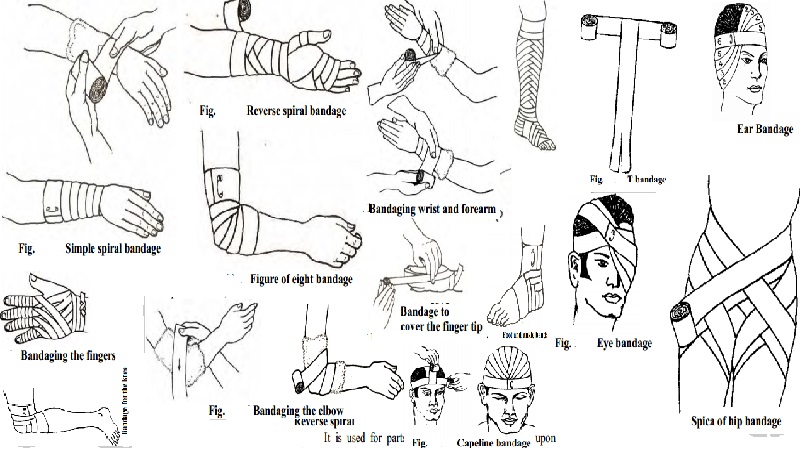
| # | Ayurvedic Bandha | Shape | Site | Modern Equivalent |
|---|---|---|---|---|
| 1 | Kosha Bandha | Sheath/Finger cot | Fingers, thumb, toes | Finger/Tubular bandage |
| 2 | Dama Bandha | Four-tailed | Chin, nose, forehead | Four-tailed/Capeline |
| 3 | Swastika Bandha | Cross/X | Joints (knee, elbow, hip) | Spica / Figure-of-8 |
| 4 | Anuvellita Bandha | Spiral | Limbs (arm, leg) | Spiral roller bandage |
| 5 | Pratoli/Mutoli Bandha | Circular winding | Neck, penis | Circular/Cervical collar |
| 6 | Mandala Bandha | Circular | Abdomen, head, buttock | Abdominal binder |
| 7 | Sthagika Bandha | Conical/Stump | Finger/toe tips, stumps | Stump bandage |
| 8 | Yamaka Bandha | Twin/Double | Two adjacent wounds | Y / Double bandage |
| 9 | Khatva Bandha | Frame/Splint | Fractures | Splint/POP back-slab |
| 10 | Cheena Bandha | Oval pad + tails | Eyes | Eye pad/Eye patch |
| 11 | Vibandha Bandha | Many-tailed | Large areas, trunk | Scultetus bandage |
| 12 | Vitana Bandha | Canopy/Cap | Head, scalp | Turban/Capeline |
| 13 | Gophana Bandha | T-shape | Perineum, chin, heel | T-binder |
| 14 | Panchangi Bandha | Five-tailed | Hip, shoulder | Hip/Shoulder spica |
| 15 | Utsangi Bandha* | Cradle | Axilla, groin | Velpeau / Axillary pad |
Key Insights: Ayurveda vs Modern
| Aspect | Ayurvedic Bandha | Modern Bandage |
|---|---|---|
| Basis | Shape-based + site-based classification | Function-based + material-based |
| Material | Natural: cotton, linen, bark, leather, wool | Synthetic: elastic crepe, POP, adhesive |
| Healing philosophy | Bandage as part of Vrana Chikitsa (wound healing system) | Bandage primarily as mechanical support/dressing |
| Herb integration | Medicated cloth with herbs (e.g., Nimba, Haridra) | Impregnated dressings (silver, iodine) |
| Number of types | 14-15 precisely named | Dozens of types, less systematically named |
| Documentation | Described in 600 BCE (Sushruta Samhita) | Formalized 17th-19th century AD |
| Relevance | Almost every Ayurvedic type has exact modern counterpart | Modern bandages are refinements of ancient types |
Practical Shloka Reference (Sushruta Samhita 18/18)
"कोशमङ्गुष्ठाङ्गुलिपर्वसु विदध्यात्" (Kosha bandage for thumb, fingers and their joints)
"दाम सम्बाधेऽङ्गे" (Dama bandage for congested/difficult-to-bandage parts)
"स्वस्तिकं सन्धिषु" (Swastika bandage for joints)
Spherical and cylindrical all viva question with images details explain and diffrent lance consept and trial frame ka bi concept kitne lence lagte he sab kuch bta must know
spherical cylindrical lens optometry viva questions trial frame concept types lenses ophthalmology
https://uomus.edu.iq/img/lectures21/MUCLecture_2024_11193867…
trial frame trial lens box set components spherical cylindrical prism accessory lenses diagram images ophthalmology
spherical lens convex concave diagram cylindrical lens axis plano-convex types optical cross ray diagram ophthalmology
https://theeyecareadvocate.co.uk/2024/11/22/navigating-the-c…
trial lens set box 266 lenses complete components Jackson cross cylinder occluder pinhole stenopaeic slit images
👁️ Spherical & Cylindrical Lenses + Trial Frame - Complete Viva Guide
Guyton & Hall Textbook of Medical Physiology, Ch. 50 + Clinical Optometry references
PART 1: LENS - DEFINITION & BASICS
What is a Lens?
D = 1 / f(in meters) A lens of focal length 1 meter = 1 Dioptre
PART 2: SPHERICAL LENSES - Complete Viva
Definition
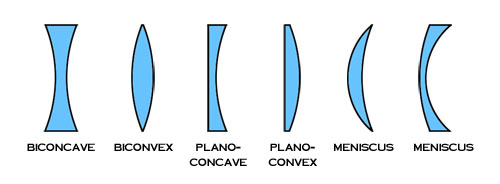
Types of Spherical Lenses
1. CONVEX (Positive / Plus) Spherical Lens
| Feature | Detail |
|---|---|
| Symbol | + (plus) |
| Shape | Thicker at centre, thinner at edges |
| Action | CONVERGING - brings rays to a focus |
| Focal point | Real, on the opposite side of incident light |
| Sub-types | Biconvex, Plano-convex, Convexo-concave (converging meniscus) |
| Use | Hypermetropia (farsightedness), Presbyopia |
| Power range in trial box | +0.12 D to +20.00 D |
2. CONCAVE (Negative / Minus) Spherical Lens
| Feature | Detail |
|---|---|
| Symbol | - (minus) |
| Shape | Thinner at centre, thicker at edges |
| Action | DIVERGING - spreads rays apart |
| Focal point | Virtual, on the same side as incident light |
| Sub-types | Biconcave, Plano-concave, Concavo-convex (diverging meniscus) |
| Use | Myopia (nearsightedness) |
| Power range in trial box | -0.12 D to -20.00 D |
Viva Q&A - Spherical Lenses
A lens that has equal curvature in all meridians; it refracts light uniformly to produce a single point focus.
D = 1/0.5 = +2.00 D (convex) or -2.00 D (concave)
One surface is flat (plano) and the other is convex. Power is less than biconvex of the same diameter but creates less aberration.
Has one convex and one concave surface. Converging meniscus (convex > concave) and diverging meniscus (concave > convex). Used in spectacles to reduce aberrations.
Its focal length = 1/3 = 33.3 cm. It converges parallel rays to a point 33.3 cm behind the lens.
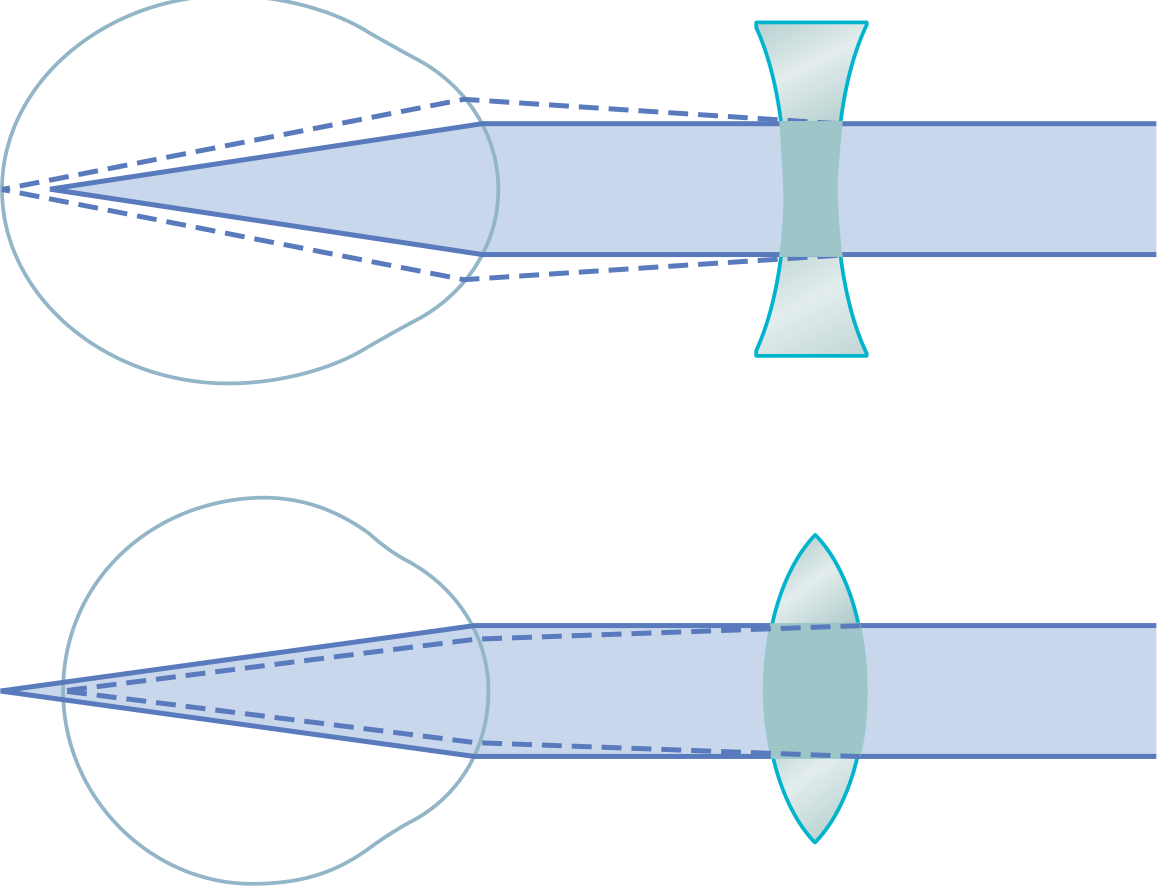
By a concave (minus) spherical lens that diverges rays, moving the focal point backward onto the retina.
By a convex (plus) spherical lens that converges rays, bringing the focal point forward onto the retina.
The point through which a ray passes without any deviation. It is the geometric centre of the lens.
The bending of light rays by a lens. Expressed in dioptres. Positive vergence = converging; negative vergence = diverging.
Approximately 7 mm behind the cornea (near the posterior lens surface). Light rays passing through the nodal point are not deviated.
PART 3: CYLINDRICAL LENSES - Complete Viva
Definition
The KEY Difference: Sphere vs Cylinder
| Feature | Spherical Lens | Cylindrical Lens |
|---|---|---|
| Curvature | Same in all meridians | Curvature only in ONE meridian (power meridian) |
| Focus | Single point | Line focus |
| Power | Equal in all meridians | Maximum in power meridian, zero in axis meridian |
| Effect on light | Converges/diverges uniformly | Converges in one plane only |
| Clinical use | Myopia, hypermetropia | Astigmatism |
Axis and Power Meridian
       90°
        |
180° ---+--- 0°  (axis marking: 0°-180°)
        |
       270°
- Axis meridian = direction along which there is NO power (no curvature)
- Power meridian = 90° to the axis = maximum curvature = where lens acts
- No power along 90° direction
- +2D power along 0° (horizontal) direction
Types of Cylindrical Lenses
1. CONVEX (Plus) Cylinder
- Thicker in the middle along the power meridian
- Converges light in the power meridian
- Creates a focal line parallel to the axis
- Used to correct: simple hyperopic astigmatism, compound astigmatism
2. CONCAVE (Minus) Cylinder
- Thinner in the middle along the power meridian
- Diverges light in the power meridian
- Used to correct: simple myopic astigmatism, compound astigmatism
- Preferred in UK/many countries (minus cylinder convention)
3. PLANO-CYLINDRICAL Lens
- One flat surface + one cylindrical surface
- Used in trial lens sets
- The flat (plano) surface faces outward; curved surface faces the eye
Astigmatism - The Clinical Basis of Cylindrical Lenses
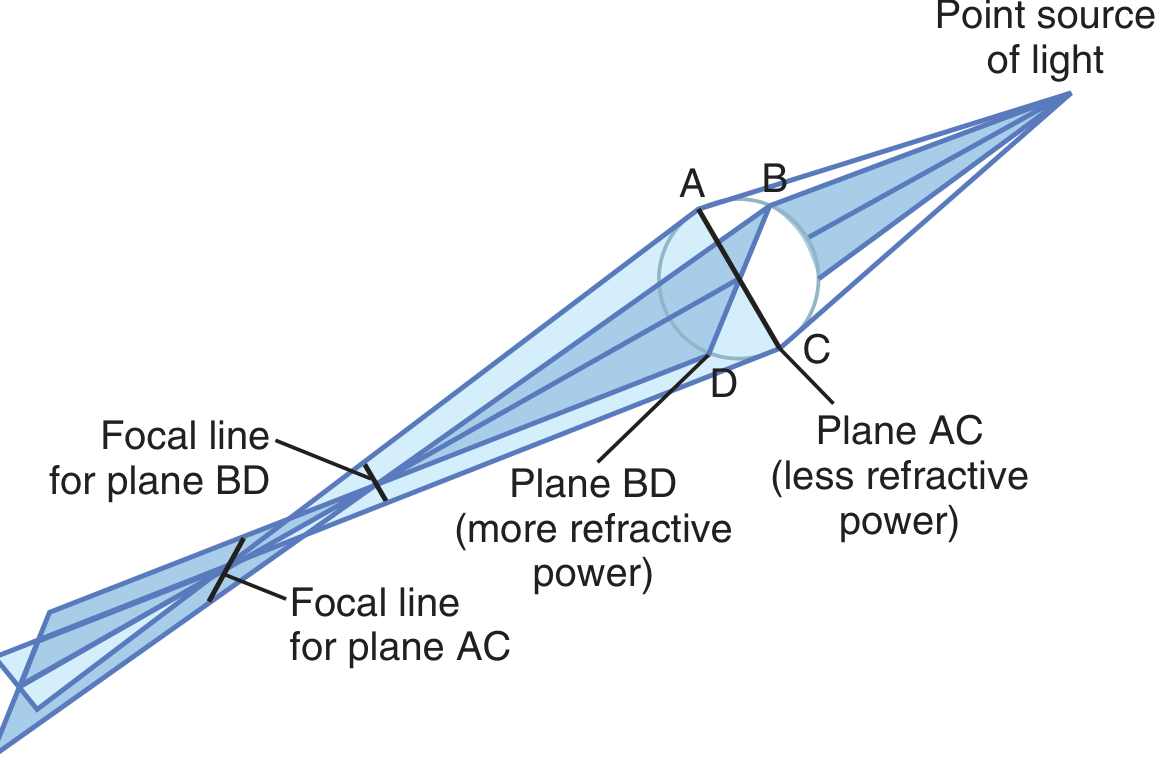
- The cornea curves more steeply in one meridian than another (like the surface of an egg)
- This means two different focal planes exist
- A cylindrical lens corrects the power difference between the two meridians
Viva Q&A - Cylindrical Lenses
A lens curved in one meridian only; it acts as a prism in the power meridian and as a flat glass in the axis meridian. It creates a line focus instead of a point focus.
The axis is the meridian along which the cylindrical lens has NO power (zero curvature). Marked from 0° to 180°. It determines the orientation of the cylinder correction.
Because a spherical lens corrects equally in all meridians. In astigmatism, different meridians need different corrections - only a cylindrical lens can selectively correct one meridian without affecting the other.
A combination of a spherical and cylindrical lens in one - it has different curvatures in different meridians, like the surface of a torus (donut shape). Used for astigmatism correction in spectacles and contact lenses.
A combined lens that has both spherical and cylindrical components. Written as: Sphere / Cylinder × Axis. Example: -2.00 / -1.00 × 90°
Transposition rule:
- Add sphere + cylinder = new sphere
- Change sign of cylinder (plus → minus or vice versa)
- Axis: add or subtract 90° (stay between 0-180°)
Example: +2.00 / +1.00 × 90° → becomes +3.00 / -1.00 × 180°
Vertical meridian has greater curvature (more power). Plus cylinder axis at 90° (or minus cylinder axis at 180°). Most common in young patients.
Horizontal meridian has greater curvature. Plus cylinder axis at 180° (or minus cylinder axis at 90°). More common in older patients (corneal changes with age).
A cylindrical lens with multiple parallel cylinders arranged side by side. Converts a point source of light into a streak/line - used to detect and measure heterophoria (latent squint).
A special lens consisting of two cylinders of equal power but opposite sign (e.g., +0.25 DC and -0.25 DC) with their axes at 90° to each other. Used to:
- Refine the axis of astigmatism
- Refine the power of the cylindrical correction
- Marked with a red dot (minus axis) and white dot (plus axis)
Optical Cross Concept
For a -2.00 / -1.00 × 90°:

           90°
           |
     -3.00 D (power at 180° meridian)
    _________|_________
           |
     -2.00 D (power at 90° meridian)
           |
          180°
PART 4: TRIAL FRAME - Complete Concept
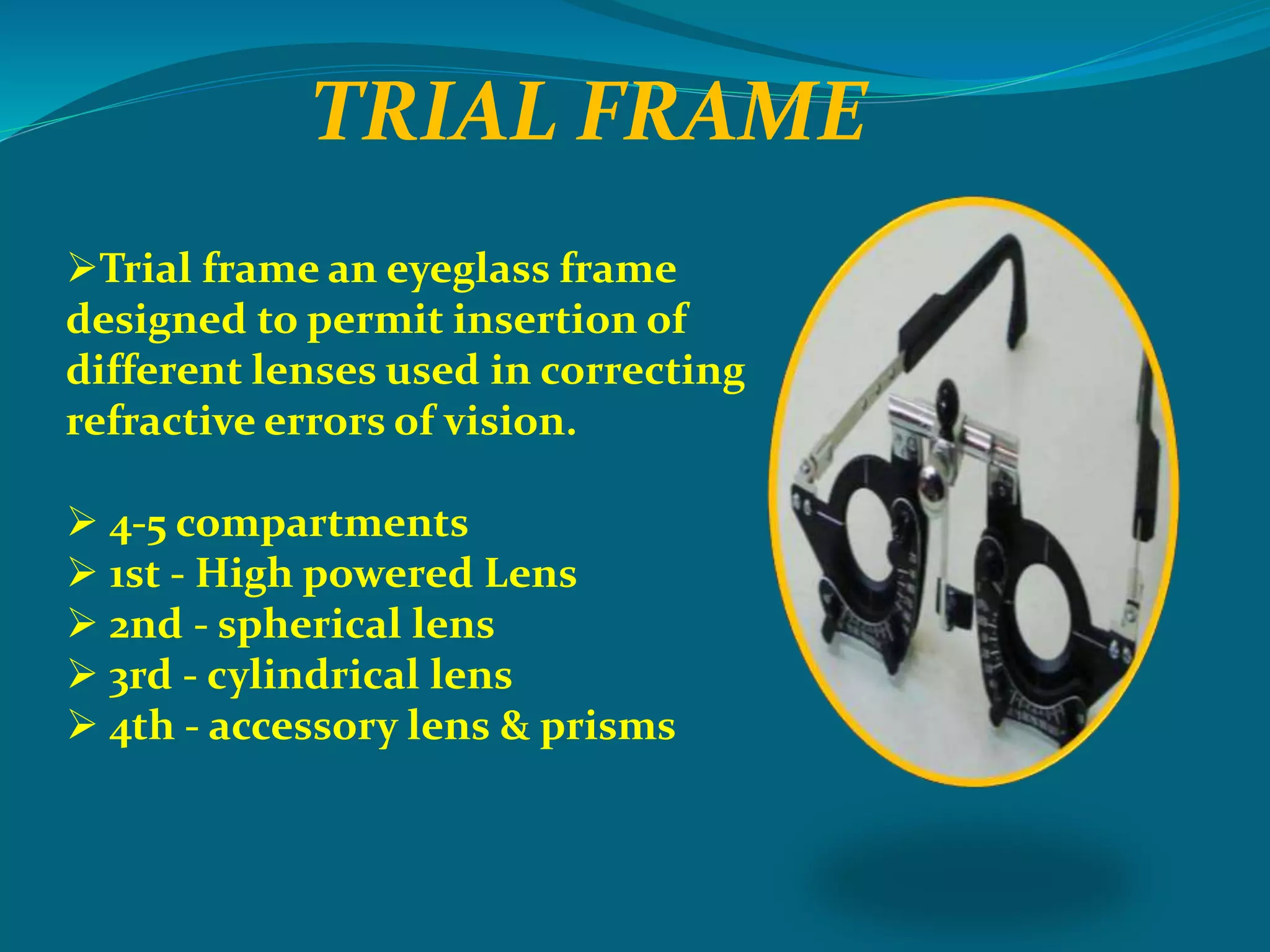
What is a Trial Frame?
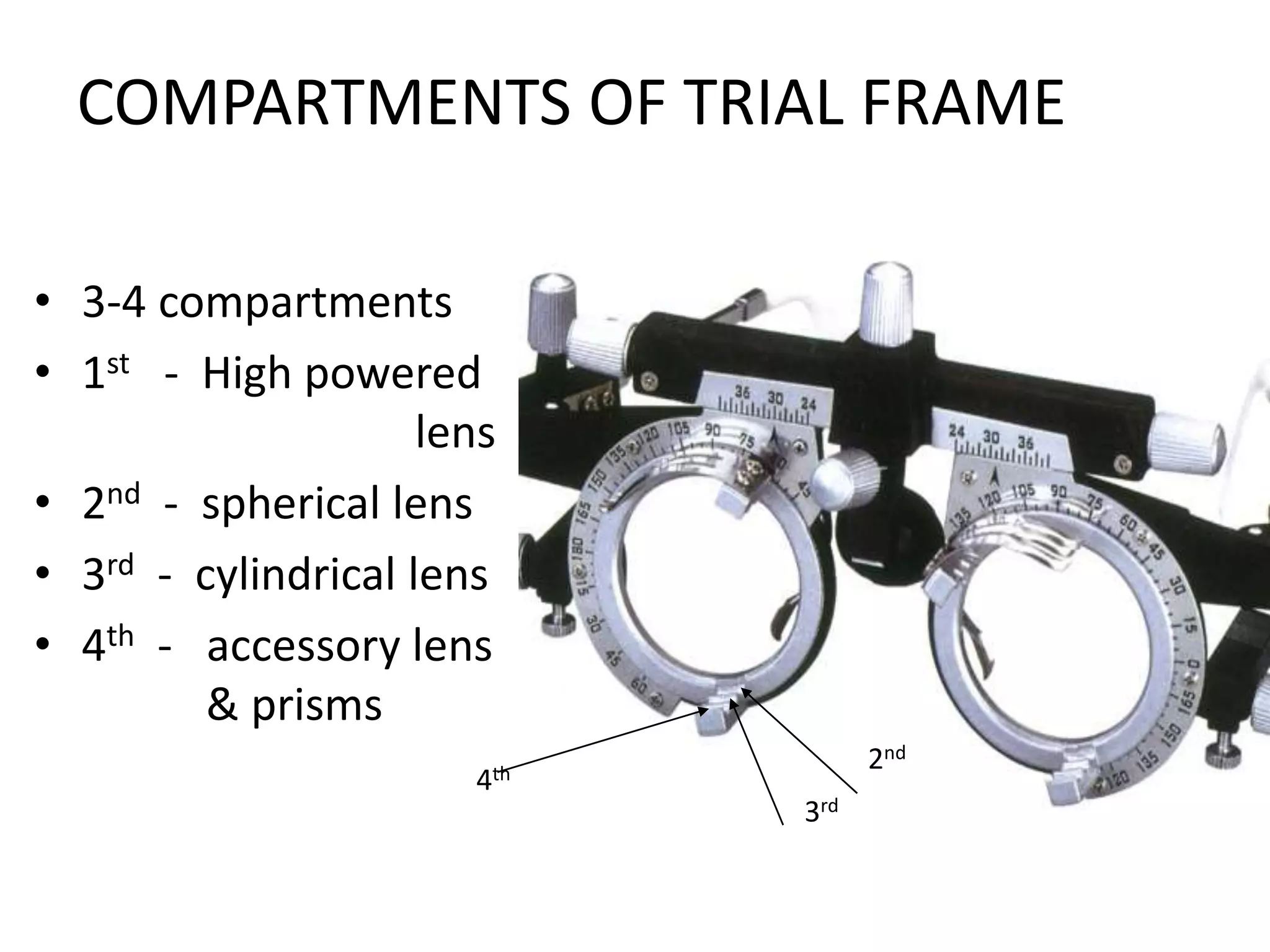
Parts of a Trial Frame
| Adjustable Part | Purpose |
|---|---|
| Nose bridge/pad | Adjust vertical height of frame |
| Interpupillary distance (PD) scale | Adjust horizontal lens centration (range: 48-80 mm) |
| Temple arms | Adjust length for different head sizes |
| Temple angle | Adjust angle of arms for comfort |
| Axis rotation knob | Rotate cylindrical lens to set axis (marked 0°-180°) |
| Lens cells/compartments | Hold the trial lenses |
Compartments of the Trial Frame
| Cell | Position | Lens Type |
|---|---|---|
| 1st (innermost, closest to eye) | Back cell | High-powered spherical lens (large jumps first) |
| 2nd | Second cell | Spherical lens (fine-tuning sphere) |
| 3rd | Third cell | Cylindrical lens (has axis markings) |
| 4th | Outermost | Accessory lenses & prisms |
Why innermost = high powered? Because vertex distance errors are minimized when the strongest lens is closest to the eye (Vertex Distance compensation)
Types of Trial Frames
| Type | Features |
|---|---|
| Full Aperture Frame | Holds up to 5 lenses per eye; PD 48-80 mm; best for standard refraction |
| Reduced Aperture Frame | 20 mm lens aperture; lighter; holds 4 lenses; less aberration |
| Half-Eye Trial Frame | PD 54-58 mm; for children and near vision testing |
| Children's Trial Frame | Fixed bridge; smaller PD; adjustable nosepiece |
PART 5: TRIAL LENS BOX - Complete Breakdown
The Standard 266-Piece Trial Lens Set


How Many Lenses? - Breakdown by Category
| Category | Number | Power Range | Steps |
|---|---|---|---|
| Convex (Plus) Spherical | 40 pairs = 80 lenses | +0.12 to +20.00 D | Various (see below) |
| Concave (Minus) Spherical | 40 pairs = 80 lenses | -0.12 to -20.00 D | Various |
| Total Spherical | 160 lenses | ±0.12 to ±20.00 D | - |
| Convex (Plus) Cylindrical | 19 pairs | +0.12 to +6.00 D | 0.25 D steps |
| Concave (Minus) Cylindrical | 19 pairs | -0.12 to -6.00 D | 0.25 D steps |
| Total Cylindrical | ~80 lenses (38 pairs + 2 JCC) | ±0.12 to ±6.00 D | - |
| Prisms | 12 lenses | 1Δ to 10Δ | Various |
| Accessories | 12-14 lenses | Special types | - |
| Jackson Cross Cylinders | 2 | ±0.25 D | - |
| TOTAL | ~266 lenses | - | - |
Spherical Lens Power Steps (Increments)
+0.12 D and +0.25 D (just these two at the lowest end)
+0.25 → +4.00 D:   in 0.25 D steps
+4.00 → +6.00 D:   in 0.50 D steps
+6.00 → +14.00 D:  in 1.00 D steps
+14.00 → +20.00 D: in 2.00 D steps
(Same increments for minus spheres)
Types of Trial Lenses: Optical vs Accessory
A. OPTICAL LENSES (for refractive error correction)
- Biconvex or biconcave
- Larger, heavier
- Can cause prismatic errors if not well-centered
- Used in most standard refractions
- Plano-convex or plano-concave
- Lighter, thinner
- Less prismatic error
- For refraction: curved surface faces the eye
- For neutralization: curved surface faces the other lens
B. ACCESSORY LENSES / TOOLS
| Accessory | Appearance | Use |
|---|---|---|
| Occluder (Black disc) | Opaque black disc | Cover one eye during monocular testing |
| Pinhole disc | Disc with multiple small holes | Differentiates refractive error from organic pathology (VA improves with pinhole = refractive; no improvement = organic/retinal) |
| Stenopaeic slit | Disc with narrow slit | Determine axis of astigmatism; test one meridian at a time |
| Maddox rod | Multiple parallel red/white glass cylinders | Detect and measure heterophoria (latent deviation) |
| Red lens | Red-colored glass | Dissociate the two eyes (diplopia tests) |
| Frosted/diffusion lens | Frosted glass | Diffuse/blur vision in one eye |
| Polariscope | Polarized disc | Binocular vision testing |
| Prism | Wedge-shaped glass | Measure tropias and phorias; marked in prism dioptres (Δ) with base direction |
| Jackson Cross Cylinder (JCC) | Lens with red dot (-) and white dot (+) | Refine cylinder power and axis |
| Plain glass (Plano) | Clear glass disc | Placebo testing; check monocular VA |
Prism Lenses - Quick Viva Points
| Feature | Detail |
|---|---|
| Unit | Prism Dioptre (Δ) |
| Definition | 1Δ deviates a ray 1 cm at 1 meter distance |
| Base directions | Base-In (BI), Base-Out (BO), Base-Up (BU), Base-Down (BD) |
| Use | Measuring angle of squint; treating phorias; Fresnel prisms for diplopia |
| Range in trial set | 1Δ to 10Δ |
| Prentice's rule | Prism effect = Power × decentration in cm |
PART 6: SUMMARY VIVA TABLE
| Question | Answer |
|---|---|
| Unit of lens power | Dioptre (D) = 1/f(m) |
| Spherical lens focus | Point |
| Cylindrical lens focus | Line |
| Convex lens for which error | Hypermetropia, Presbyopia |
| Concave lens for which error | Myopia |
| Cylinder lens for which error | Astigmatism |
| Toric lens = | Sphere + Cylinder combined |
| Total lenses in standard trial set | 266 |
| Spherical lenses in trial set | 160 (80 plus + 80 minus) |
| Cylindrical lenses in trial set | ~80 (including 2 JCC) |
| Prisms in trial set | 12 |
| Accessories in trial set | 12-14 |
| Compartments in trial frame | 3-4 (innermost = high power sphere) |
| Axis range on trial frame | 0° to 180° |
| PD range of trial frame | 48-80 mm |
| JCC use | Refine cylinder axis and power |
| Pinhole improves VA = | Refractive error |
| Pinhole does NOT improve VA = | Organic/retinal pathology |
| Maddox rod detects | Heterophoria (latent squint) |
| Jackson Cross Cylinder | ±0.25 D combined (red dot = minus axis; white = plus axis) |
PART 7: QUICK CLINICAL FORMULA CARDS
LENS POWER:   D = 1/f     (f in metres)

TRANSPOSITION (Plus to Minus Cyl):
  New sphere = Old sphere + Old cylinder
  New cylinder = same power, opposite sign
  New axis = Old axis ± 90°

PRENTICE'S RULE:   Δ = D × d
  (Δ = prism dioptres; D = lens power; d = decentration in cm)

VERTEX DISTANCE CORRECTION (>±4D needs correction):
  F_corrected = F_spectacle / (1 - d × F_spectacle)
  d = vertex distance in metres
High-yield exam tip: The most commonly asked viva triad is:
- What corrects myopia? - Concave spherical (minus)
- What corrects hypermetropia? - Convex spherical (plus)
- What corrects astigmatism? - Cylindrical lens (with correct axis and power)