
What is thyrotoxixosis
Reading File
Now let me search the medical library and PubMed in parallel.
Finding Sources
Searching PubMed
thyrotoxicosis
Good results. Let me read the most comprehensive sources - Goldman-Cecil Medicine and the Family Medicine textbook in parallel.
Reading File
Reading File
Excellent content from the Family Medicine textbook. Let me also read the Bailey & Love surgery section for a complete clinical picture, and search for a detailed endocrinology section.
Reading File
Finding Sources
I have Harrison's and Tietz with signs/symptoms. Let me read those and fetch the Graves disease image.
Reading File
Reading File
Loading Image
I now have comprehensive information from multiple authoritative textbooks. Let me compile the full answer.
Thyrotoxicosis
Definition
Thyrotoxicosis is a physiologic syndrome of hypermetabolism and hyperactivity caused by high serum concentrations of T4, T3, or both. Importantly, it is not synonymous with hyperthyroidism - it refers to the clinical state of excess thyroid hormone action regardless of the source, which may or may not reflect overproduction by the thyroid gland. - Textbook of Family Medicine 9e
The term "thyrotoxicosis" is preferred over "hyperthyroidism" precisely because raised circulating thyroid hormone levels are not responsible for all manifestations of the disease. - Bailey & Love's Short Practice of Surgery 28e
Causes and Classification
With Hyperthyroidism (excess thyroid hormone production)
| Cause | Details |
|---|---|
| Graves' disease | Most common; accounts for 60-90% of all cases. Autoimmune - TSH receptor antibodies (TRAb/TSI) stimulate the thyroid |
| Toxic multinodular goitre (TMNG) | Middle-aged/elderly; secondary thyrotoxicosis |
| Toxic adenoma | Solitary autonomous nodule; TSH suppressed |
| Iodine excess | Jod-Basedow phenomenon |
| TSH-secreting pituitary adenoma | Secondary hyperthyroidism (rare) |
| Chorionic gonadotropin-secreting tumors | hCG cross-reacts with TSH receptor |
| Gestational thyrotoxicosis | Driven by high hCG in pregnancy |
Without Hyperthyroidism (hormone release without overproduction)
| Cause | Details |
|---|---|
| Subacute thyroiditis | Acute onset; painful thyroid |
| Silent/postpartum thyroiditis | Transient T4 spike; common postpartum |
| Thyrotoxicosis factitia | Exogenous thyroid hormone ingestion |
| Drug-induced destruction | Amiodarone, cytokines, tyrosine kinase inhibitors, immune checkpoint inhibitors (e.g., nivolumab, pembrolizumab) |
| Radiation/infarction of adenoma | Release of preformed hormone |
Sources: Harrison's Principles of Internal Medicine 22e; Textbook of Family Medicine 9e
Pathophysiology (Graves' Disease - the most common cause)
Graves' disease is driven by thyroid-stimulating immunoglobulins (TSIs), synthesized by lymphocytes in the thyroid, bone marrow, and lymph nodes. These antibodies bind TSH receptors and produce a disproportionate, prolonged stimulatory effect - leading to thyroid hypertrophy and excess hormone production.
- TPO and thyroglobulin antibodies co-exist in up to 80% of Graves' cases
- Ophthalmopathy results from T-cell infiltration of extraocular muscles, cytokine-driven (IFN-γ, TNF, IL-1) glycosaminoglycan accumulation, and fat expansion in the retro-orbital space. The TSH receptor is expressed in orbital tissues, and aberrant IGF-1R signaling on orbital fibroblasts is also implicated - the basis for teprotumumab (monoclonal antibody treatment).
Source: Harrison's Principles of Internal Medicine 22e
Signs and Symptoms
Thyrotoxicosis can affect virtually every organ system:
Cardiovascular (most important for morbidity/mortality)
- Palpitations, tachycardia, wide pulse pressure
- Systolic hypertension, atrial fibrillation
- Increased cardiac output (reduced peripheral vascular resistance + increased heart rate)
- Congestive heart failure, exercise intolerance, dyspnea
- In elderly: AF occurs in 5-15% of cases
- Embolic stroke (from AF)
Metabolic
- Weight loss (increased basal metabolic rate)
- Heat intolerance, sweating, warm moist skin
- Hypercalcemia (mild, <12 mg/dL) from increased bone turnover
Neuromuscular
- Fine tremor (especially hands)
- Anxiety, irritability, restlessness, insomnia
- Proximal muscle weakness (thyrotoxic myopathy)
- Hyperreflexia
Gastrointestinal
- Hyperphagia, weight loss
- Increased bowel motility, hyperdefecation
- Nausea/vomiting (can precede thyrotoxic crisis)
- Mild elevated liver transaminases
Skin/Hair
- Warm, moist, smooth skin
- Hair loss (diffuse)
- Pretibial myxedema (Graves' specific)
Eyes (Graves' specific)
- Proptosis / exophthalmos
- Lid lag, lid retraction
- Periorbital edema
- Diplopia, optic neuropathy in severe cases
Sources: Tietz Textbook of Laboratory Medicine 7e; Textbook of Family Medicine 9e
Graves' Disease - Classic Appearance
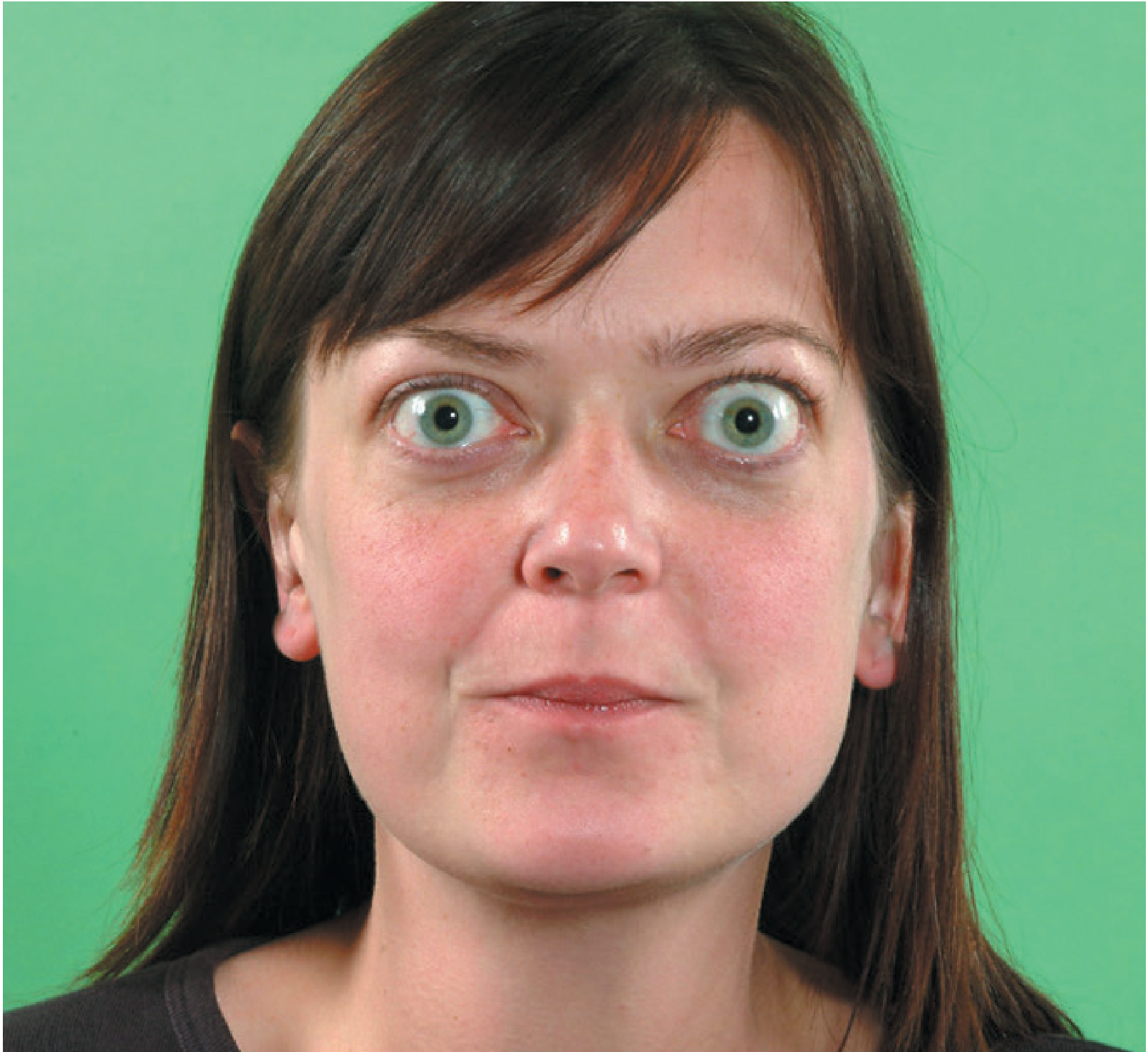
Bilateral exophthalmos with the characteristic wide, startled appearance in Graves' disease - Bailey & Love's Short Practice of Surgery 28e
Special Presentations
Apathetic thyrotoxicosis - seen in the elderly; presents with apathy, lethargy, pseudodementia, weight loss, and depressed mood - WITHOUT the typical tachycardia, hyperphagia, or sweating. Easily confused with depression or dementia. Always check TSH in elderly with unexplained cognitive/mood change. - Textbook of Family Medicine 9e
Thyroid storm (thyrotoxic crisis) - life-threatening extreme thyrotoxicosis; features include hyperpyrexia, extreme tachycardia, agitation, confusion, and cardiovascular collapse.
Diagnosis
- TSH: suppressed (low/undetectable) in primary thyrotoxicosis
- Free T4 / Free T3: elevated
- T3 toxicosis: 2-4% of cases have elevated T3 with normal T4
- TRAb (TSH receptor antibodies): positive in Graves' disease; important in monitoring pregnant patients (antibodies can cross placenta causing neonatal thyrotoxicosis)
- Radioiodine uptake scan: differentiates causes (high uptake = Graves'/toxic nodule; low uptake = thyroiditis/factitia)
Treatment Overview
| Approach | Examples |
|---|---|
| Symptom control | Beta-blockers (propranolol) - block adrenergic effects rapidly |
| Antithyroid drugs | Carbimazole, propylthiouracil (PTU) |
| Radioiodine (RAI) | Definitive treatment for Graves'/toxic nodule |
| Surgery | Thyroidectomy (subtotal/total) |
| Adjuncts | Bile acid sequestrants (cholestyramine) reduce T4 enterohepatic recirculation - supported by a 2026 meta-analysis (PMID 41467975) |
| Ophthalmopathy | Teprotumumab (anti-IGF-1R monoclonal antibody) |
Beta-blockers address tachycardia, tremor, anxiety, and even the mild hypercalcemia of thyrotoxicosis rapidly. Antithyroid drugs lower hormone levels over weeks to months.
Key distinction to remember: Thyrotoxicosis = excess thyroid hormone effect (any cause). Hyperthyroidism = specifically overproduction by the thyroid. All hyperthyroidism causes thyrotoxicosis, but not all thyrotoxicosis is hyperthyroidism (e.g., thyroiditis, factitia).
This is a shared conversation. Sign in to Orris to start your own chat.