

inbound750907483589792870.jpg
Write a short note on it
Reading File
Finding Sources
Searching the Web
superior sagittal sinus anatomy tributaries clinical significance
Reading File
Searching Images
superior sagittal sinus dural venous sinuses anatomy diagram
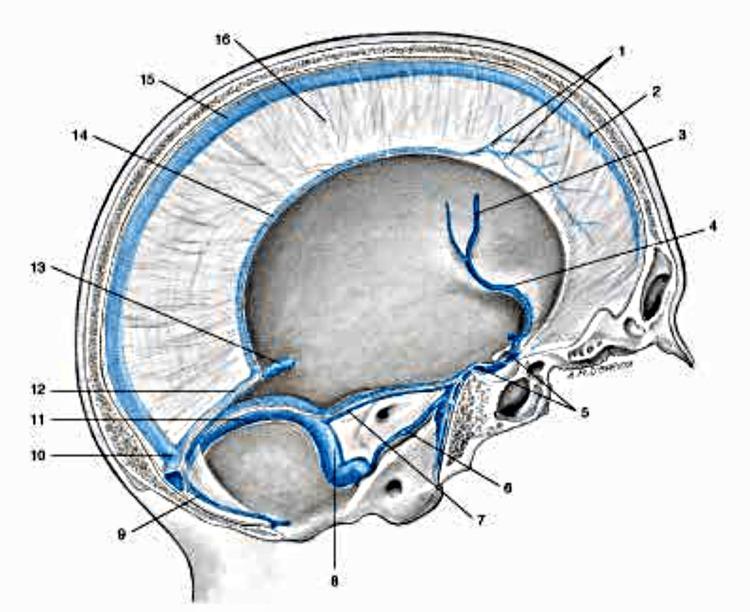
Superior Sagittal Sinus — Short Note
Definition & Location
The superior sagittal sinus (SSS) is the largest unpaired dural venous sinus. It lies within the superior (attached) border of the falx cerebri, running from front to back along the midline of the cranial vault.
Course
- Origin: Begins anteriorly at the crista galli (or foramen caecum), where it may communicate with tiny meningeal veins or, if the foramen caecum is patent, with a vein from the nose.
- Direction: Runs upward and backward in the superior border of the falx cerebri, becoming progressively larger (triangular on cross-section) as it passes posteriorly.
- Termination: Ends near the internal occipital protuberance, typically deviating to the right to become continuous with the right transverse sinus. The meeting point of multiple sinuses here is called the confluence of sinuses (torcular Herophili).
Interior of the Sinus
The inner wall contains:
- Openings of the superior cerebral veins
- Venous lacunae (lateral extensions) — usually three on each side — which first receive diploic and meningeal veins
- Arachnoid villi and granulations projecting into the lacunae and the sinus itself (key sites of CSF absorption)
- Numerous fibrous bands crossing the angle of the sinus
- Openings of venous lacunae, usually on the lateral side
Tributaries
The SSS receives blood from:
- Superior cerebral veins — 8–12 veins draining the superolateral surface of the cerebral hemispheres; they open into the lateral lacunae (never directly)
- Parietal emissary veins — connect the scalp veins to the sinus
- Diploic veins — from the diploe of the skull bones
- Venous lacunae — which drain diploic and meningeal veins before opening into the sinus
- Occasionally, a nasal vein via the foramen caecum
Functional Significance
- Primary drainage channel for the cerebral cortex (superior and medial surfaces of both hemispheres)
- Critical site of CSF reabsorption via arachnoid granulations projecting into the lateral lacunae
- Communicates with the opposite transverse sinus (via the confluence), ensuring collateral drainage
Clinical Relevance
| Condition | Key Points |
|---|---|
| Superior sagittal sinus thrombosis (SSST) | Commonest form of cerebral venous thrombosis; causes raised ICP, headache, papilloedema, seizures, and cortical venous infarcts (often bilateral, parasagittal) |
| Causes | Pregnancy/puerperium, oral contraceptives, dehydration, hypercoagulable states, local sepsis spreading via emissary veins |
| Imaging | MRI/MRV: "empty delta sign" on contrast CT; loss of normal flow void on MRI |
| Treatment | Anticoagulation (heparin → warfarin); thrombolysis in severe cases |
| Surgical relevance | Must be avoided during midline cranial surgery; ligation in its anterior third is generally tolerated; posterior ligation is fatal |
Sources: Gray's Anatomy for Students (Gray's, p. 1025); BD Chaurasia's Human Anatomy (as shown in the image)
Venous lacunae
Finding Sources
Searching the Web
venous lacunae superior sagittal sinus anatomy arachnoid granulations CSF absorption
This is a shared conversation. Sign in to Orris to start your own chat.