
receptors present in vomiting centre and CTZ. 2. ANTIMETIC DRUGS AND HOW THEY WORK(receptor blockers)
Reading File
Now let me search the medical library for both topics in parallel.
Finding Sources
Finding Sources
Finding Sources
Finding Sources
Reading File
Finding Sources
Finding Sources
Finding Sources
Excellent - found the key sources. Let me read the detailed pharmacology sections now.
Reading File
Reading File
Reading File
Reading File
Reading File
Loading Image
I now have all the information needed for a thorough answer. Let me also fetch the detailed antiemetic diagram.
Searching Images
antiemetic drugs receptor sites vomiting center CTZ mechanism diagram
I now have all the information needed. Here is the complete answer:
Receptors in the Vomiting Centre and CTZ - Plus Antiemetic Drugs
Overview Diagram
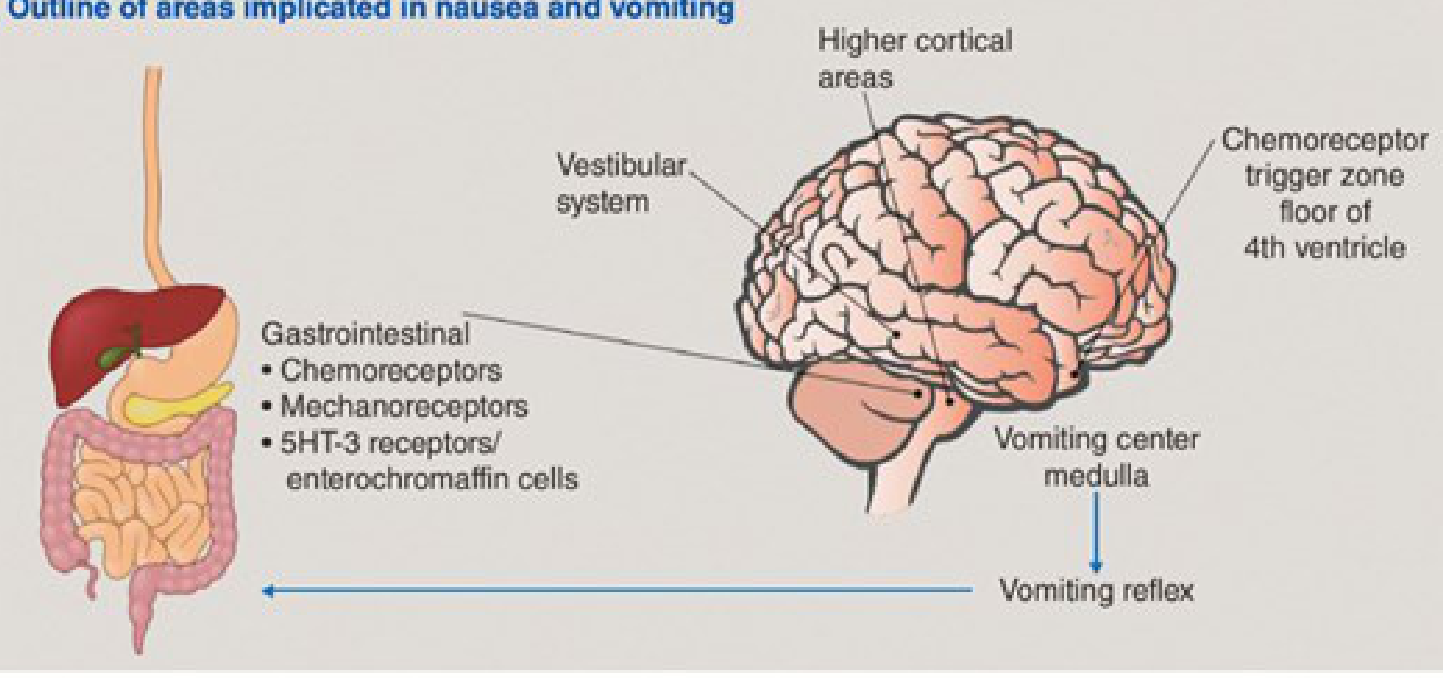
PART 1: Receptors at Each Site
Vomiting Centre (VC)
- Location: Lateral medullary reticular formation (loosely organized neuronal network); interacts with cranial nerves VIII and X and the nucleus tractus solitarius
- Receptors present:
Receptor Type Muscarinic M1 Cholinergic Histamine H1 Histaminergic Neurokinin 1 (NK1) Substance P receptor Serotonin 5-HT3 Serotonergic
Chemoreceptor Trigger Zone (CTZ) / Area Postrema
- Location: Caudal end of the 4th ventricle (floor); circumventricular organ - outside the blood-brain barrier, so it directly samples blood and CSF for emetogenic chemicals
- Receptors present:
Receptor Type Dopamine D2 Dopaminergic (predominant) Opioid receptors mu, delta, kappa Serotonin 5-HT3 Serotonergic Neurokinin 1 (NK1) Substance P
Vestibular System (inputs to VC)
- Muscarinic M2 receptors
- Histamine H1 receptors
- (Key in motion sickness)
GI Tract / Vagal Afferents (peripheral inputs to VC and CTZ)
- Serotonin 5-HT3 receptors on vagal and splanchnic afferent nerves
- Enterochromaffin cells release 5-HT in response to mucosal damage, chemotherapy, radiation, distension
PART 2: Antiemetic Drugs and Their Receptor Mechanisms
1. 5-HT3 Receptor Antagonists (Setrons)
Drugs: Ondansetron, Granisetron, Dolasetron, Palonosetron (2nd gen), Tropisetron, Ramosetron
Mechanism: Block 5-HT3 receptors both centrally (VC + CTZ) and peripherally (vagal afferents in GI tract). The peripheral action is actually the dominant antiemetic effect - they prevent serotonin released from enterochromaffin cells from activating vagal afferents.
Uses: Chemotherapy-induced nausea & vomiting (CINV), post-operative N&V, radiation-induced N&V
Key facts:
- Do NOT block dopamine or muscarinic receptors
- 1st-gen agents (ondansetron, granisetron, dolasetron): half-life 4-9 hours; can prolong QT interval
- Palonosetron: half-life 40 hours, greater 5-HT3 affinity, effective for both acute and delayed CINV, does not prolong QT
2. Dopamine D2 Antagonists
Drugs: Metoclopramide, Domperidone (peripheral), Prochlorperazine, Haloperidol, Droperidol
Mechanism: Block D2 receptors in the CTZ, reducing CTZ stimulation of the vomiting centre. Metoclopramide also acts peripherally as a D2 antagonist (prokinetic). Domperidone acts only peripherally (does not cross BBB - fewer CNS side effects).
Uses: Medication-induced N&V, toxin-induced N&V, metabolic causes, gastroparesis
Adverse effects: Extrapyramidal symptoms (EPS) - dystonia, akathisia, tardive dyskinesia (from D2 blockade in basal ganglia)
3. H1 Antihistamines
Drugs: Dimenhydrinate, Meclizine, Cyclizine, Promethazine
Mechanism: Block H1 receptors in the vomiting centre and vestibular system. These agents are most effective when the emetic stimulus comes via the vestibular pathway.
Uses: Motion sickness, labyrinthine disorders (vestibular neuritis, Meniere's disease)
Limitation: Ineffective against substances that directly activate the CTZ
4. Muscarinic (M1/M2) Antagonists (Anticholinergics)
Drugs: Scopolamine (hyoscine), Hyoscine hydrobromide
Mechanism: Block muscarinic receptors in the vomiting centre (M1) and vestibular system (M2), reducing afferent input from the vestibular apparatus to the VC.
Uses: Motion sickness (transdermal patch is very effective), post-operative N&V
Limitation: Ineffective against CTZ-mediated vomiting
5. NK1 (Neurokinin-1) Receptor Antagonists
Drugs: Aprepitant, Fosaprepitant (IV prodrug), Netupitant, Rolapitant
Mechanism: Block NK1 receptors (substance P receptors) centrally in the area postrema (CTZ) and the vomiting centre. They cross the BBB and occupy brain NK1 receptors. Have NO affinity for serotonin, dopamine, or corticosteroid receptors.
Uses: Acute AND delayed CINV (especially with highly emetogenic chemotherapy); added to 5-HT3 antagonist + dexamethasone triple-drug regimen
Key facts: Combined NK1 + 5-HT3 + dexamethasone prevents acute emesis in 80-90% vs <70% without NK1 antagonist. Metabolized by CYP3A4 (important drug interactions).
6. Corticosteroids
Drugs: Dexamethasone, Methylprednisolone
Mechanism: Unknown - but they enhance the efficacy of 5-HT3 antagonists. Possibly involve prostaglandin inhibition or direct CNS effects.
Uses: Chemotherapy-induced N&V (combined with 5-HT3 antagonists and NK1 antagonists)
7. Cannabinoids
Drugs: Dronabinol (THC), Nabilone
Mechanism: Act on CB1 cannabinoid receptors in the CNS (brainstem and higher cortical areas), suppressing emetic pathways.
Uses: Chemotherapy-induced N&V (second-line)
8. Atypical Antipsychotics
Drugs: Olanzapine (blocks D2, 5-HT2, H1, muscarinic receptors), Mirtazapine
Mechanism: Broad receptor blockade across multiple pathways - D2, 5-HT2, H1, and muscarinic.
Uses: CINV (olanzapine 10 mg days 1-4 added to triple therapy reduces delayed emesis by 15-30%), chronic nausea/vomiting syndrome
Quick Summary Table
| Drug Class | Receptor Blocked | Key Site | Clinical Use |
|---|---|---|---|
| 5-HT3 antagonists (setrons) | 5-HT3 | CTZ + vagal afferents | CINV, PONV, radiation |
| D2 antagonists (metoclopramide, prochlorperazine) | Dopamine D2 | CTZ | Drug/toxin/metabolic N&V |
| H1 antihistamines (meclizine, dimenhydrinate) | H1 | VC + vestibular | Motion sickness |
| Anticholinergics (scopolamine) | M1/M2 | VC + vestibular | Motion sickness |
| NK1 antagonists (aprepitant) | NK1 | CTZ + VC | Delayed CINV |
| Corticosteroids (dexamethasone) | Unknown | CNS | Adjunct in CINV |
| Cannabinoids (dronabinol) | CB1 | CNS | CINV (2nd line) |
| Olanzapine | D2, 5-HT2, H1, M | Multiple | CINV |
Sources: Katzung's Basic & Clinical Pharmacology 16th Edition; Lippincott Illustrated Reviews Pharmacology; Harrison's Principles of Internal Medicine 22E; Rosen's Emergency Medicine
explain and summarize
Your credits are exhausted. You can purchase a top-up or subscribe to a plan to continue using Orris. If you're already subscribed, your daily credits will reset tomorrow.
This is a shared conversation. Sign in to Orris to start your own chat.