
Pilonidal sinus a complete detail
Reading File
Finding Sources
Searching PubMed
"pilonidal sinus" AND treatment
Good — four textbook sections found. Let me read all of them in parallel for comprehensive coverage.
Reading File
Reading File
Reading File
Reading File
Now let me fetch the clinical image and search for additional images to enrich the answer.
Loading Image
Finding Sources
Let me get the GI textbook's detailed section on pilonidal disease, which had a very relevant snippet on pathogenesis.
Reading File
I now have comprehensive content from four authoritative textbooks. Let me compile a thorough, well-structured answer.
Pilonidal Sinus — Complete Overview
Definition & Etymology
A pilonidal sinus (from Latin pilus = hair, nidus = nest) is an acquired epithelium-lined sinus tract in the skin, classically located in the sacrococcygeal region (natal/gluteal cleft), formed by the penetration and entrapment of shed hair shafts into the subcutaneous tissue, triggering a chronic foreign body reaction.
— Tintinalli's Emergency Medicine, p. 591 | Sabiston Textbook of Surgery, p. 2170
Epidemiology
| Feature | Detail |
|---|---|
| Prevalence | ~70,000 cases/year in the USA |
| Age group | Predominantly young adults (mid-to-late 20s) |
| Sex ratio | 3:1 male predominance (males more hirsute) |
| Peak activity | Becomes symptomatic during/after adolescence |
Risk factors: obesity, excessive sweating, sedentary occupation, local trauma/irritation, deep gluteal cleft anatomy.
— Sabiston Textbook of Surgery, p. 2183 | Sleisenger & Fordtran's GI and Liver Disease, p. 1558
Pathogenesis (Acquired Theory)
The modern consensus is that pilonidal disease is entirely acquired, not congenital:
- Hair in the gluteal cleft (shed or growing nearby) accumulates at the base of the natal cleft
- The vacuum effect created by buttock movement propels loose hair into the skin through cutaneous pits
- Barbs on the hair shafts prevent expulsion — the hair buries itself deeper
- Trapped hair incites a granulomatous foreign body reaction
- Progressive inflammation → sinus tract formation → potential superinfection → abscess
"Pilonidal disease is essentially a foreign-body reaction. Histopathology demonstrates foreign-body giant cells associated with hair shafts within a background of chronic granulation tissue lining the sinus tracts." — Sleisenger & Fordtran's GI and Liver Disease, p. 1558
Anatomical Locations
| Location | Notes |
|---|---|
| Sacrococcygeal (most common) | Midline, overlying lower sacrum and coccyx |
| Umbilical | Rare |
| Interdigital (barber's hand/foot) | In barbers, hairdressers, dog groomers — from penetration of cut hair |
— Dermatology 2-Volume Set 5e, p. 2834
Clinical Presentations
Pilonidal disease exists on a spectrum:
1. Asymptomatic Pit
- Small midline pit(s), found incidentally; no inflammation
2. Acute Pilonidal Abscess (~50% of presentations)
- Tender, fluctuant, erythematous swelling in the natal cleft
- Fever ± systemic features if large
- Key: located cephalad to the anus, not communicating with the anorectum (distinguishes it from perianal/perirectal abscess)
3. Chronic Pilonidal Sinus
- Draining sinus(es), often off the midline
- Intermittent discharge (serous or purulent)
- Recurrent episodes of infection
4. Complex/Recurrent Disease
- Multiple branching sinus tracts
- Extension laterally from the midline
- Chronic non-healing wounds
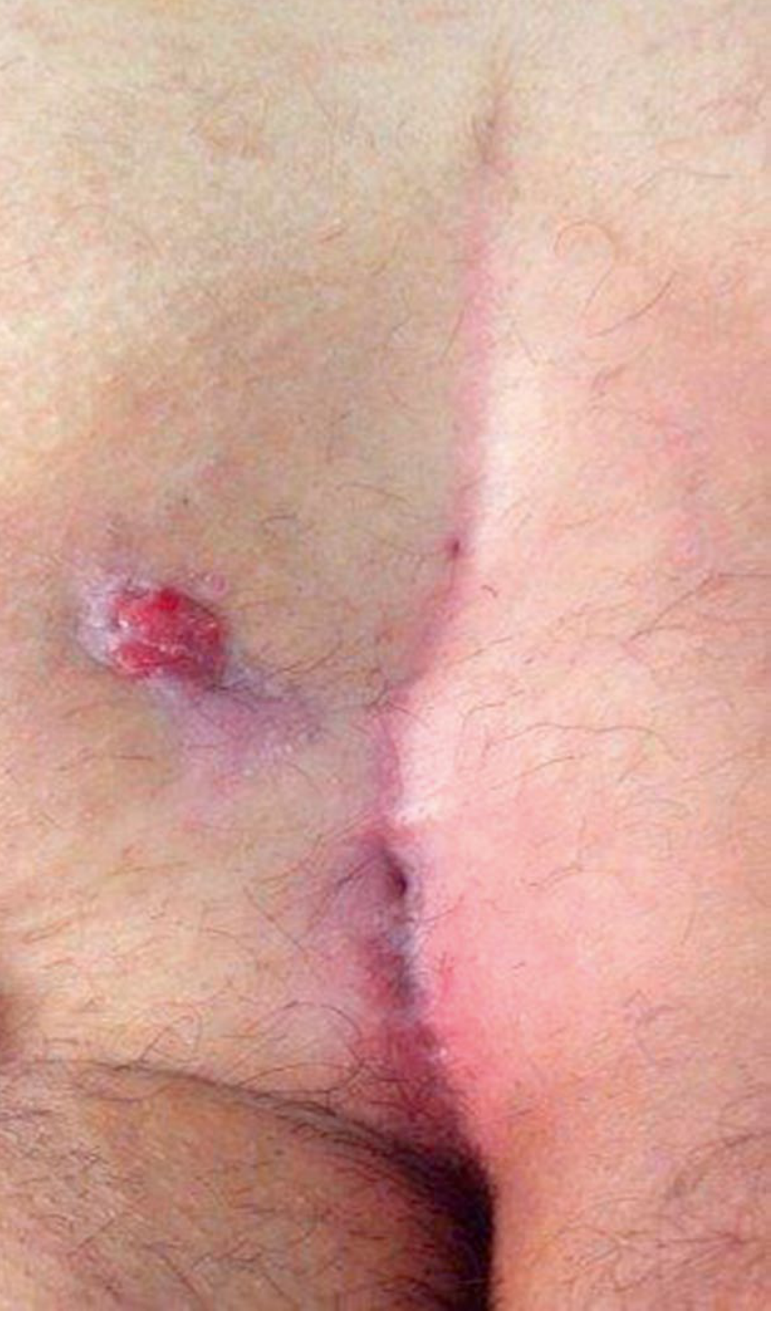
— Sabiston Textbook of Surgery, p. 2174 | Tintinalli's Emergency Medicine, p. 591
Diagnosis
Diagnosis is clinical:
- Identify the midline pits (typically <2 mm) in the sacrococcygeal region
- Assess for lateral secondary openings (sinus tracks off midline)
- Palpate for induration, fluctuance
- Ultrasonography can delineate the extent of an abscess cavity when needed
- Differential diagnosis includes: perirectal abscess, anal fistula, furuncle, syphilitic/tuberculous granuloma, fungal infection, sacral osteomyelitis
Carcinoma (typically well-differentiated squamous cell carcinoma) is a rare but recognized complication of long-standing chronic pilonidal disease.
— Tintinalli's Emergency Medicine, p. 1457 | Andrews' Diseases of the Skin, p. 4375
Histopathology
- Sinus tract lining: stratified squamous epithelium (like normal epidermis or follicular infundibulum); below the dermis — granulation tissue
- Hair shafts (broken) found in the cavity in ≥50% of cases
- Foreign body giant cells, chronic inflammatory infiltrate, fibrosis
- Occasionally the epithelium keratinizes without a granular cell layer (analogous to outer root sheath)
Some pilonidal cysts/sinuses are also associated with the acne tetrad: nodulocystic acne, dissecting cellulitis, hidradenitis suppurativa, and pilonidal sinus.
— Andrews' Diseases of the Skin, p. 4375 | Dermatology 2-Volume Set 5e, p. 2836
Microbiology
Bacterial colonization is found in 50–70% of cases. Typical isolates:
- Staphylococcus aureus
- Anaerobes: Bacteroides spp.
- Mixed flora common
— Sabiston Textbook of Surgery, p. 2185
Treatment
Treatment is tailored to severity.
Preventive / Conservative
- Regular hair removal: shaving, waxing, laser depilation — reduces recurrence significantly
- Hygiene, weight loss, loose-fitting clothing
- Shaving the gluteal cleft to prevent new hair embedding
Acute Pilonidal Abscess
- Incision and drainage (I&D) — primary treatment
- Use a lateral incision (avoid midline) over the most fluctuant area
- Thoroughly curette the cavity: remove all embedded hair and devitalized tissue
- Pack the wound open
- Antibiotics: only if cellulitis is present; otherwise not routinely required
- Refer to surgery for definitive management after ED drainage
Chronic / Recurrent Disease — Surgical Options
| Procedure | Description |
|---|---|
| Gips procedure | Minimally invasive; excision of pits + debridement of sinus tracts (pit-picking) |
| Wide excision | Complete excision of all pits and sinus tracts |
| Open healing (secondary intention) | Simple but slow; high recurrence |
| Negative-pressure wound therapy (NPWT/VAC) | Accelerates healing after excision |
| Bascom procedure | Lateral incision over cavity + excision of midline pits; avoids midline closure |
| Bascom cleft lift | Asymmetric excision and closure; flattens the cleft; low recurrence |
| Z-plasty | Reconstructive flap; flattens the natal cleft |
| V-to-Y advancement flap | Fills the defect with adjacent tissue |
| Limberg flap (rhomboid flap) | Transposes well-vascularized tissue; low recurrence, suitable for complex disease |
Key surgical principle: Avoid midline closure — midline wounds in the natal cleft have high breakdown and recurrence rates. Off-midline techniques (Bascom, Limberg) are preferred.
Antibiotics (perioperative) are an important adjunct given 50–70% bacterial colonization.
--- Sabiston Textbook of Surgery, pp. 2185–2187 | Sleisenger & Fordtran's GI and Liver Disease, p. 1562
Barber's Interdigital Pilonidal Sinus
- Usually self-limited
- Complicated or recurrent cases → surgical excision of the involved interdigital web space
Complications
| Complication | Notes |
|---|---|
| Recurrent abscess | Most common complication |
| Complex branching sinuses | Multiple secondary tracts |
| Wound dehiscence | Especially with midline closure |
| Squamous cell carcinoma | Rare; arises in long-standing chronic/neglected disease; usually well-differentiated |
Summary Table
| Feature | Detail |
|---|---|
| Type | Acquired foreign-body sinus |
| Location | Sacrococcygeal natal cleft (primarily) |
| Cause | Hair entrapment → foreign body granuloma |
| Demographics | Young men, hirsute, obese, sedentary workers |
| Presentation | Asymptomatic pit / acute abscess / chronic draining sinus |
| Diagnosis | Clinical ± ultrasound |
| Acute Rx | I&D ± antibiotics if cellulitis |
| Definitive Rx | Surgical — off-midline excision ± flap reconstruction |
| Prevention | Hair depilation, hygiene |
| Rare complication | SCC in chronic disease |
Sources:
- Sabiston Textbook of Surgery, 21st ed. — pp. 2170–2187
- Sleisenger & Fordtran's GI and Liver Disease — pp. 1556–1562
- Tintinalli's Emergency Medicine — pp. 590–591
- Andrews' Diseases of the Skin — p. 4375
- Dermatology 2-Volume Set 5e — pp. 2834–2840
This is a shared conversation. Sign in to Orris to start your own chat.