
Allergic reaction after mutton chicken eat
allergic reaction after eating mutton chicken meat symptoms treatment
food allergy urticaria hives skin reaction
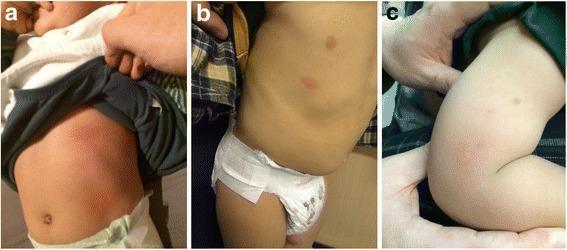
This composite of three clinical photographs documents a case of amoxicillin-induced immediate hypersensitivity in a pediatric patient. Figure 3a shows a pediatric abdomen with widespread, confluent, erythematous urticarial plaques (hives) that developed on day 3 of treatment. The rash exhibits characteristic raised, edematous morphology with poorly defined borders due to coalescence. Figure 3b displays the torso 15 minutes after an oral provocation challenge with a low dose of amoxicillin, demonstrating discrete, localized, circular erythematous wheals. Figure 3c illustrates a positive intradermal skin test on the forearm, showing a diagnostic wheal-and-flare reaction (measured at 8x16 mm) indicating IgE-mediated sensitization. The images collectively demonstrate the clinical manifestations of drug-induced urticaria and the subsequent diagnostic evaluation using oral challenge and skin prick testing in an allergy and immunology context. Educational focus includes recognizing the difference between confluent drug eruptions and discrete wheals, as well as the visual presentation of a positive skin test result.
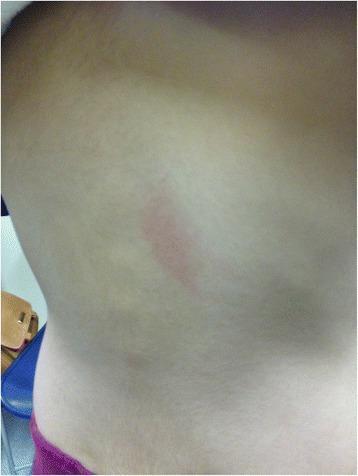
This clinical photograph displays a focal skin lesion on the mid-back of a pediatric patient. The primary finding is a single, vertically-oriented, erythematous plaque or wheal. The lesion is characterized by distinct borders, central redness, and a slightly raised morphology relative to the surrounding healthy skin, which appears otherwise smooth and normochromic. This clinical presentation is characteristic of urticaria (hives), specifically an immediate hypersensitivity reaction. The image demonstrates a localized cutaneous manifestation of a Type I allergic reaction, which in this clinical context occurred 20 minutes following an oral challenge with amoxicillin. This visual serves as an educational example of drug-induced immediate-type allergy in pediatric dermatology and immunology, highlighting the characteristic appearance of a positive oral provocation test result.
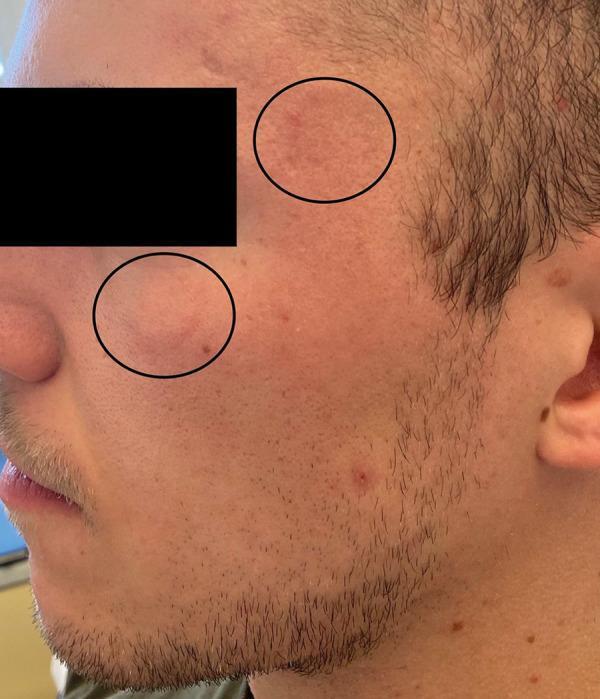
This clinical photograph displays a lateral view of a male patient's face, demonstrating a localized allergic reaction during a double-blind placebo-controlled food challenge (DBPCFC). Two black circles highlight facial wheals (urticaria) located on the upper cheek/zygomatic region and the mid-cheek near the nasolabial fold. These wheals appear as edematous, erythematous, and slightly elevated plaques. The lesion on the upper cheek shows a more irregular border and uneven texture, while the lower lesion is more discrete and circular. The surrounding skin also exhibits scattered, smaller erythematous papules and blemishes. This image illustrates the dermatological manifestations of an immediate IgE-mediated hypersensitivity reaction to cow's milk occurring despite omalizumab therapy. It serves as a pedagogical example for identifying facial urticaria and monitoring clinical responses during allergen provocation tests in an immunology or allergy-immunology educational context.
Allergic Reaction After Eating Mutton / Chicken
What Is Happening?
Key Types of Meat Allergy
1. Chicken / Poultry Allergy
- Caused by sensitivity to proteins in chicken (and sometimes turkey, quail)
- Symptoms often appear within minutes to 2 hours after eating
- People with chicken allergy may also react to eggs (bird-egg syndrome)
- Reactions: skin rash (urticaria/hives), runny nose (allergic rhinitis), swelling, and in severe cases, anaphylactic shock
2. Mutton (Red Meat) Allergy - Alpha-Gal Syndrome
- Mutton, like lamb, beef, and pork, contains a sugar molecule called alpha-gal (galactose-α-1,3-galactose)
- Alpha-gal syndrome is unique: it is often triggered by tick bites, which sensitize the immune system to this sugar
- Key feature: delayed reaction - symptoms appear 3-6 hours after eating, making it harder to identify the cause
- This delayed pattern is different from most food allergies
Symptoms (Can Range from Mild to Severe)
| Body System | Symptoms |
|---|---|
| Skin | Hives (urticaria), itching, redness, swelling of lips/face/tongue |
| Gut | Nausea, vomiting, stomach cramps, diarrhea, indigestion |
| Respiratory | Wheezing, shortness of breath, cough, throat tightness, hoarse voice |
| Cardiovascular | Drop in blood pressure, weak pulse, dizziness, fainting |
| Severe | Anaphylaxis - life-threatening, requires immediate treatment |
When Is It an Emergency?
- Difficulty breathing or swallowing
- Severe throat swelling
- Loss of consciousness or fainting
- Sudden drop in blood pressure
- Severe widespread hives with any of the above (anaphylaxis)
What To Do Right Now
- Stop eating the food immediately
- Mild symptoms (skin rash, mild itching): antihistamines like cetirizine or loratadine can help
- Moderate symptoms (vomiting, significant swelling): seek a doctor promptly
- Severe symptoms (breathing difficulty, throat tightness, fainting): go to emergency immediately
- If you have a prescribed epinephrine auto-injector (EpiPen), use it now for severe reactions
Diagnosis & Testing
- Skin prick test - small amount of allergen placed on skin
- Specific IgE blood test - measures antibodies to chicken, mutton proteins, or alpha-gal
- Oral food challenge - supervised test under medical monitoring
- For alpha-gal: specific alpha-gal IgE blood test
Long-Term Management
- Strict avoidance of the offending meat is the mainstay of treatment
- Read food labels carefully - meat extracts can be hidden in processed foods, broths, sauces
- Carry an epinephrine auto-injector if prescribed
- Medic alert bracelet is recommended for those with a history of severe reactions
- Chicken-allergic individuals may need to avoid turkey, quail, and possibly eggs
- Mutton/red-meat-allergic individuals can usually eat chicken and fish safely
- Avoid further tick bites if you have alpha-gal syndrome (use repellents, protective clothing)
- Follow up regularly with an allergist
What to give him now
What symptoms does he have RIGHT NOW?
Immediate Steps
1. Give an Antihistamine NOW
| Medicine | Adult Dose | Child Dose |
|---|---|---|
| Cetirizine (Cetzine, Alerid) | 10 mg once | 5 mg (age 6-12) |
| Loratadine (Lorfast, Loratab) | 10 mg once | 5 mg (age 6-12) |
| Levocetirizine (Levocet, Xyzal) | 5 mg once | 2.5 mg (age 6-12) |
| Chlorpheniramine (Piriton) | 4 mg every 4-6 hrs | 2 mg (age 6-12) |
2. Cool the Skin
- Apply a cool, damp cloth on itchy areas - reduces inflammation and itching
- Do NOT scratch - it makes hives spread
3. No More of That Food
- Make sure he stops eating and does not take any more mutton or chicken today
Watch Him for the Next 2 Hours
- 🚨 Swelling of lips, tongue, or throat
- 🚨 Difficulty swallowing or breathing
- 🚨 Wheezing or tightness in chest
- 🚨 Vomiting, severe stomach pain
- 🚨 Feeling faint or confused
What to Expect
- Itching usually eases within 30-60 minutes
- Hives typically fade within a few hours
- He may feel a little drowsy - that is normal
Avil primacort given or not
Avil (Pheniramine Maleate) - Antihistamine
- Avil is a first-generation antihistamine - works well for hives and itching
- It is one of the most commonly used medicines for acute allergic reactions in India
| Form | Adult Dose | Child (6-12 yrs) |
|---|---|---|
| Avil 25mg tablet | 1 tablet (25mg) now | Half tablet |
| Avil syrup | 10 ml (25mg/10ml) | 5 ml |
- Can repeat every 4-6 hours if itching continues
- Side effect: Makes him sleepy - that is normal and expected
Primacort (Methylprednisolone) - Steroid
- Avil alone is usually sufficient
- Primacort is not routinely needed for simple hives/itching
- Hives spreading rapidly all over the body
- Swelling (face, lips)
- Not responding to Avil after 30-60 minutes
- If prescribed by a doctor specifically
- Primacort 4mg (Methylprednisolone): 4-8mg once orally with food
- Do NOT give steroids repeatedly without a doctor's advice
Recommended Right Now
9 yr allergy after mutton chicken
What symptoms does the child have RIGHT NOW? · Approximately how much does the child weigh?
30kg
Give RIGHT NOW
✅ Avil (Pheniramine) - YES, Give It
| Form | Dose for 30 kg child |
|---|---|
| Avil 25mg tablet | Half tablet (12.5 mg) |
| Avil syrup (25mg/10ml) | 5 ml |
- Give now, can repeat after 6 hours if still itching
- Will cause drowsiness - normal and expected
- Dose rule: 0.35-0.5 mg/kg = ~10-15 mg for 30 kg child
Primacort (Methylprednisolone) - Only If Needed
- Dose: 1-2 mg/kg/day = 30-60 mg/day
- Practical: Primacort 4mg tablet - give 2 tablets (8mg) once with food
- Hives are spreading rapidly
- Face or lips are swelling
- Avil alone is not working after 45-60 minutes
- Rash is very widespread over the body
Watch the Child Closely For Next 2 Hours
- Throat tightening or difficulty swallowing
- Wheezing or breathing difficulty
- Vomiting repeatedly
- Face/tongue becoming puffy
- Child becomes drowsy or unresponsive (beyond normal Avil drowsiness)
Summary - Simple Protocol
RIGHT NOW → Avil syrup 5 ml (or half Avil 25mg tablet)
AFTER 1 HOUR → Still bad? Add Primacort 8mg (2 x 4mg tablets)
ANY BREATHING ISSUE → Emergency immediately, do not wait
Avil injection half ampule ok
For 9-year-old, 30 kg child:
Dose calculation:
- Standard dose: 0.35 mg/kg = ~10-12 mg for 30 kg
- Full ampule = 45.5 mg
- Half ampule = ~22.75 mg → this is slightly high but acceptable for a child with active allergic reaction
✅ Half ampule is OK - but with conditions:
| Route | Half Ampule OK? |
|---|---|
| IM (into muscle) | ✅ Yes - safe |
| Slow IV | ✅ Yes - give slowly over 2-3 minutes |
| Fast IV push | ❌ No - can cause sudden drop in BP |
Important Points:
- Give IM (thigh or upper arm) - safest route at home or clinic
- After injection, keep child lying down for 15-20 minutes - Avil can drop BP suddenly
- Watch for excessive drowsiness, pale face, or limpness after injection
- Do NOT give IV unless you are a trained healthcare professional with monitoring
After Injection - Watch For:
- ✅ Itching reducing within 20-30 minutes = working well
- 🚨 Child becomes very pale, limp, or unresponsive = go to emergency NOW
- 🚨 Breathing worsens despite injection = emergency NOW
Levocetrizine 2.5mg/5ml how much ml
Levocetirizine 2.5mg/5ml for 9-year-old, 30 kg
Dose calculation:
- Standard dose: 0.125 mg/kg
- 30 kg × 0.125 = ~2.5 mg to 5 mg (max for children)
- For 9 years old: 5 mg is the standard dose
✅ Give 10 ml
2.5 mg per 5 ml
5 mg = 10 ml
Quick Reference:
| Dose needed | ml to give |
|---|---|
| 2.5 mg (minimum) | 5 ml |
| 5 mg (recommended for 9 yr) | 10 ml ✅ |
- Give once daily, preferably in the evening (causes mild drowsiness)
- Much less sedating than Avil
- Works within 1 hour
- Safe to give alongside Primacort if needed
- Do not exceed 5 mg (10 ml) per day in children