
Microscopic features of paraganglioma
Reading File
Paragangliomas are neuroendocrine tumors characterized by the Zellballen pattern - nests of chief cells surrounded by sustentacular cells, with a rich vascular stroma. They stain positive for chromogranin, synaptophysin, and S-100 (sustentacular cells).
Searching sources...
Finding Sources
Finding Sources
Reading File
Reading File
I have a rich set of data. Let me fetch the histology image and check for any additional details on malignancy criteria.
Reading File
Finding Sources
Loading Image
Here is a thorough summary of the microscopic features of paraganglioma, drawn from Robbins, Cotran & Kumar Pathologic Basis of Disease and Cummings Otolaryngology.
Microscopic Features of Paraganglioma
Gross Appearance (context)
Tumor tissue is red-pink to brown. Most tumors are well-circumscribed, rarely exceeding 6 cm (e.g., carotid body tumors).
Hallmark Architecture: Zellballen Pattern
The defining microscopic feature is the Zellballen (German: "cell balls") pattern - discrete nests or clusters of tumor cells separated by a delicate fibrovascular stroma with prominent capillaries (Fig. 16.17A above).
Cell Types
| Cell Type | Location | Morphology | Staining |
|---|---|---|---|
| Chief cells (type I) | Within the nests | Round to oval, abundant clear or granular eosinophilic cytoplasm; round to ovoid, sometimes vesicular nuclei | Chromogranin +, Synaptophysin +, INSM1 +, CD56 + |
| Sustentacular cells (type II) | Periphery/edges of nests | Spindle-shaped stromal cells forming a supporting network | S-100 protein + |
Cytological Details
- Cellular pleomorphism: Little to absent in most tumors
- Mitoses: Scant
- Nuclei: Round to ovoid, uniform; sometimes with vesicular (open) chromatin
- Cytoplasm: Abundant, clear or finely granular eosinophilic
Vascularity
- Tumor nests are separated by delicate vascular septae marked by capillaries (the septae contain red cells, visible on H&E)
- Tumors are highly vascular - this is why biopsy can cause excessive hemorrhage
Immunohistochemistry Summary
| Marker | Chief Cells | Sustentacular Cells |
|---|---|---|
| Chromogranin | Positive | Negative |
| Synaptophysin | Positive | Negative |
| INSM1 | Positive | Negative |
| CD56 | Positive | Negative |
| S-100 | Negative | Positive |
| Keratins (AE1/AE3) | Negative | Negative |
Keratin negativity is important for distinguishing paraganglioma from carcinoid/neuroendocrine carcinoma, which are keratin-positive.
Electron Microscopy
- Well-demarcated neuroendocrine (dense-core) granules are found in the cytoplasm of chief cells, especially in paravertebral (sympathetic) tumors
- These granules are variable in number and tend to be scant in non-functioning tumors
Histologic Features and Malignancy
This is a key point: standard histologic features do NOT reliably predict malignancy.
- Mitoses, pleomorphism, and even vascular invasion are not reliable indicators of malignant behavior
- Malignancy is defined only by the presence of metastases (to lymph nodes or distant sites)
- SDHB gene mutation is the strongest predictor of malignancy, with metastasis rates of 30-50%
Histology Image (Carotid Body Tumor - Robbins Pathology)
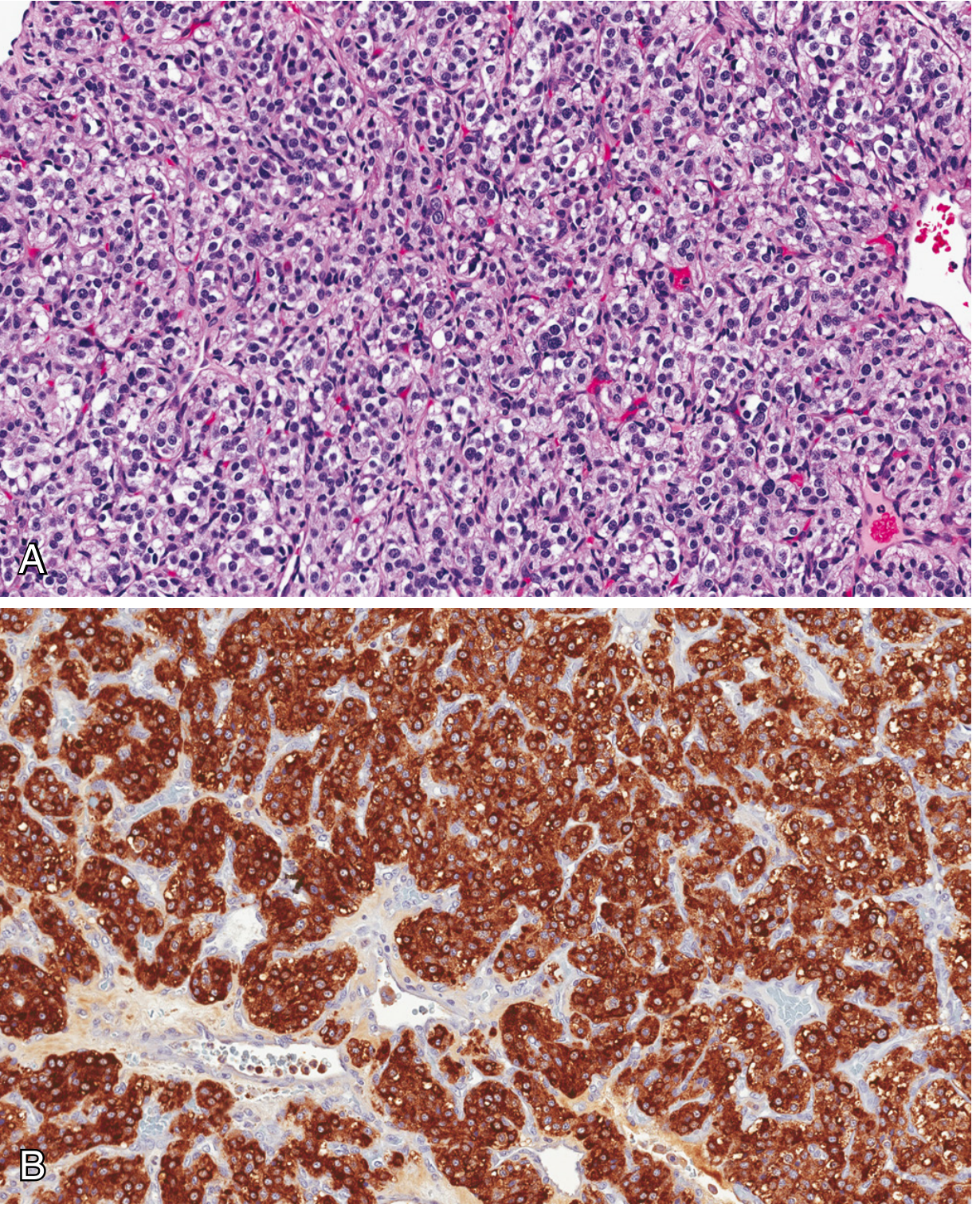
Fig. 16.17 - Carotid body tumor. (A) Low-power H&E view showing tumor clusters (zellballen) separated by capillary-containing septa. (B) Chromogranin immunohistochemistry showing strong positivity in the chief cell nests.
Key Points Summary
- Zellballen - nests of chief cells in a rich vascular stroma - is the hallmark pattern
- Two cell populations: neuroendocrine chief cells (chromogranin/synaptophysin/INSM1+) and peripheral sustentacular cells (S-100+)
- Minimal pleomorphism and rare mitoses despite occasional aggressive behavior
- Dense-core neurosecretory granules visible on EM
- Histologic features alone cannot predict malignancy - only metastasis confirms it
- SDHB mutation = highest metastatic risk
Sources: Robbins, Cotran & Kumar Pathologic Basis of Disease, p. 1049-1058; Cummings Otolaryngology Head and Neck Surgery, p. 528-529
This is a shared conversation. Sign in to Orris to start your own chat.