
How to do ecg
Here's a quick overview of how to perform a 12-lead ECG:
Patient prep: Position supine, expose chest and limbs, clean/dry skin, attach electrodes, ensure patient is relaxed and still.
Limb leads (4): RA (right arm), LA (left arm), RL (right leg - ground), LL (left leg). Chest leads (6): V1-V6 placed across the precordium.
Standard chest lead placement: V1 = 4th intercostal space, right sternal border; V2 = 4th ICS, left sternal border; V3 = between V2 and V4; V4 = 5th ICS, midclavicular line; V5 = anterior axillary line (same level as V4); V6 = midaxillary line (same level as V4/V5).
Searching sources...
Reading File
Finding Sources
Searching the Web
how to perform 12-lead ECG electrode placement technique steps
Finding Sources
Reading File
Reading File
Finding Sources
Finding Sources
Reading File
Reading File
Reading File
Loading Image
Here is a complete, step-by-step guide to performing a 12-lead ECG, drawn from Roberts and Hedges' Clinical Procedures in Emergency Medicine and Pfenninger and Fowler's Procedures for Primary Care.
How to Perform a 12-Lead ECG
Overview
A 12-lead ECG records the heart's electrical activity from 12 different perspectives using 10 electrodes - 4 on the limbs and 6 on the chest. The 12 leads are divided into:
- Frontal/limb leads: I, II, III, aVR, aVL, aVF (from the 4 limb electrodes)
- Precordial leads: V1-V6 (the 6 chest electrodes)
Step 1 - Patient Preparation
- Position the patient supine (flat). If they need the head elevated for comfort, note the angle so future ECGs match.
- Arms at sides, legs flat and not touching each other.
- Expose the chest and distal extremities; keep the rest covered to maintain dignity and prevent shivering (shivering causes tremor artifact).
- Clean the skin at electrode sites with an alcohol swab. Shave hair if needed. Gentle abrasion with fine-grit sandpaper can reduce noise and improve contact quality.
Step 2 - Machine Settings
- Turn on the ECG machine. Standard settings:
- Paper speed: 25 mm/sec
- Amplitude: 1 mV = 10 mm
- Perform the ECG away from powerful electrical equipment (motors, X-ray machines) to avoid interference.
Step 3 - Limb Electrode Placement
Each electrode is color-coded:
| Location | Label | Color |
|---|---|---|
| Right arm | RA | White |
| Left arm | LA | Black |
| Left leg | LL | Red |
| Right leg (ground) | RL | Green |
Traditionally placed on wrists and ankles, but placing more proximally (upper arms/thighs) reduces motion artifact - both are acceptable.
Step 4 - Precordial (Chest) Electrode Placement
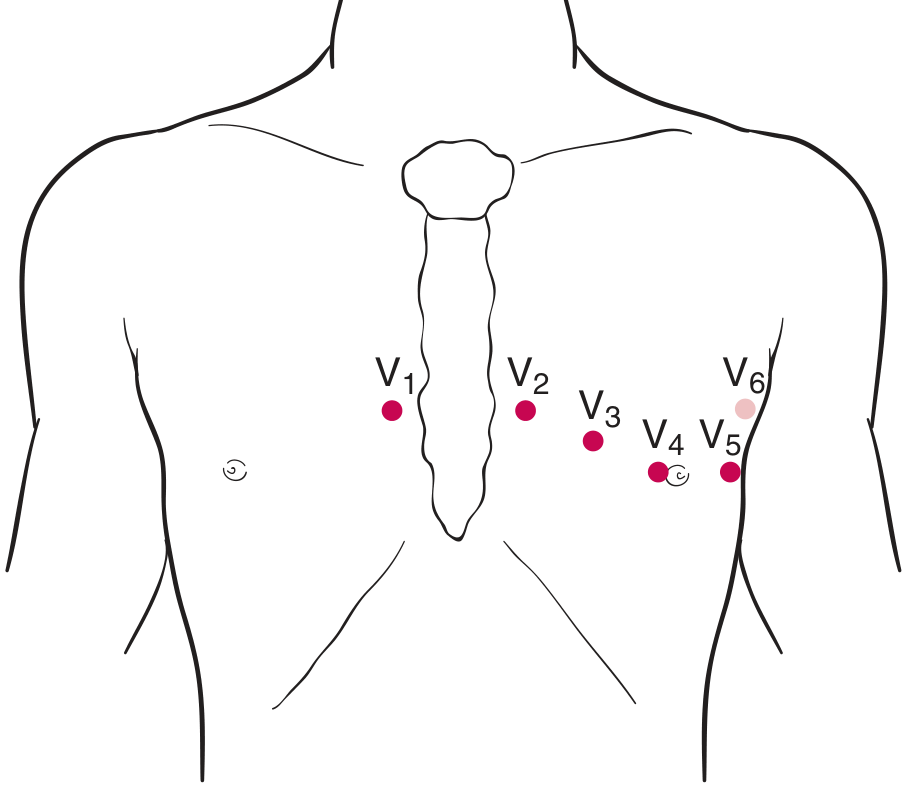
Place in this order:
| Lead | Color | Position |
|---|---|---|
| V1 | Red | 4th intercostal space (ICS), right sternal border |
| V2 | Yellow | 4th ICS, left sternal border |
| V4 | Blue | 5th ICS, mid-clavicular line (place V4 before V3) |
| V3 | Green | Halfway between V2 and V4 |
| V5 | Orange/Tan | Anterior axillary line, same horizontal level as V4 |
| V6 | Violet | Mid-axillary line, same horizontal level as V4 and V5 |
Landmark tip: Find the sternal angle (junction of manubrium and sternum body) - this is just above the 2nd ICS. Count down from there to the 4th ICS. In men, the nipple typically overlies the 4th ICS at the mid-clavicular line. V4, V5, and V6 must all be in the same horizontal plane.
Use only bony landmarks for consistent, reproducible placement. - Pfenninger and Fowler's Procedures for Primary Care
Step 5 - Acquire the Tracing
- Ensure the patient is relaxed and still (muscle movement causes artifact).
- Press record. The machine prints leads I through aVF (frontal) and V1-V6 (precordial).
- If dysrhythmia is suspected, obtain an extended rhythm strip.
- Best leads for monitoring:
- Ischemia: V5 (most sensitive)
- Rhythm: Lead II
- If 3 channels available: aVF, V2, V5
Step 6 - Remove Electrodes and Document
- Remove electrodes and dispose of them.
- Clean the skin where electrodes were attached.
- Label the ECG with patient name, date, time, and any relevant clinical notes (e.g., chest pain onset time, patient position if not flat).
Common Errors to Avoid
- Limb lead reversal (most common error): RA/LA swap causes inverted lead I and abnormal axis. Suspect it when the computer flags new right axis deviation.
- V1/V3 reversal: Causes abnormal R-wave progression and T-wave inversion in V3.
- Incorrect ICS counting: Always count from the sternal angle (2nd ICS) down - never estimate.
- Poor skin contact: Leads to a noisy, artifact-ridden tracing. Re-clean and re-apply.
- Movement/shivering: Ensure patient is comfortable and warm.
Sources: Roberts and Hedges' Clinical Procedures in Emergency Medicine; Pfenninger and Fowler's Procedures for Primary Care, 3rd ed.
This is a shared conversation. Sign in to Orris to start your own chat.