
Difference between gluconeogenesis and glucogenolysis.
Gluconeogenesis is the synthesis of new glucose from non-carbohydrate precursors (lactate, amino acids, glycerol), while glycogenolysis is the breakdown of stored glycogen to release glucose. Both raise blood glucose but from completely different sources and pathways.
Searching sources...
Reading File
Finding Sources
Finding Sources
Reading File
Reading File
Reading File
Reading File
Reading File
Now I have solid textbook content. Let me also fetch the key diagram image.
Loading Image
Loading Image
Here is a thorough comparison of the two pathways, drawn from authoritative biochemistry and physiology textbooks.
Gluconeogenesis vs. Glycogenolysis
Both pathways raise blood glucose and are activated during fasting, but they are mechanistically distinct.
Overview
| Feature | Gluconeogenesis | Glycogenolysis |
|---|---|---|
| Definition | Synthesis of new glucose from non-carbohydrate precursors | Breakdown of stored glycogen to release glucose |
| Substrate/Source | Lactate, amino acids, glycerol, propionate | Glycogen polymer (stored in liver and muscle) |
| Product | Free glucose (released into blood) | Glucose-1-phosphate → Glucose-6-phosphate → glucose (in liver) |
| Location | Mainly liver; kidney cortex in prolonged starvation | Liver (releases glucose to blood); muscle (uses glucose locally) |
| Energy cost | Expensive - requires ATP, GTP, NADH | Cheap - essentially phosphorolytic cleavage |
| Speed | Slow (hours) | Fast (minutes) |
| Duration of action | Long-term glucose maintenance | Short-term glucose maintenance (2-3 hrs post-meal) |
1. Gluconeogenesis
Definition: The synthesis of glucose from non-carbohydrate precursors. It occurs mainly in the liver under fasting conditions. In prolonged starvation, the kidney cortex also participates. - Basic Medical Biochemistry, 6e, p.1007
Substrates (precursors):
- Lactate - from anaerobic glycolysis in RBCs and exercising muscle (Cori cycle)
- Glucogenic amino acids - released from muscle protein (e.g., alanine, glutamine)
- Glycerol - from lipolysis of adipose triacylglycerols
- Propionate - from odd-chain fatty acid oxidation
Pathway:
- Mostly the reverse of glycolysis, but differs at 3 irreversible steps:
- Pyruvate → OAA (by pyruvate carboxylase) → PEP (by PEPCK) - bypasses pyruvate kinase
- Fructose-1,6-bisphosphate → Fructose-6-phosphate (by fructose-1,6-bisphosphatase) - bypasses PFK-1
- Glucose-6-phosphate → Glucose (by glucose-6-phosphatase) - bypasses hexokinase/glucokinase
Hormonal regulation:
- Stimulated by: glucagon, cortisol, epinephrine (stress/starvation)
- Inhibited by: insulin (fed state)
- Cortisol mobilizes amino acids from peripheral tissues for use as gluconeogenic substrates. - Guyton and Hall Medical Physiology, p.840
2. Glycogenolysis
Definition: The breakdown of stored glycogen to re-form glucose. It does NOT occur by simple reversal of glycogen synthesis. - Guyton and Hall Medical Physiology, p.834
Key enzyme: Glycogen phosphorylase - cleaves glucose units from glycogen branches by phosphorylation, yielding glucose-1-phosphate. A debranching enzyme also acts at branch points.
Pathway:
- Glycogen → Glucose-1-phosphate (via phosphorylase)
- Glucose-1-phosphate → Glucose-6-phosphate (via phosphoglucomutase)
- Glucose-6-phosphate → Glucose (via glucose-6-phosphatase, present only in liver, kidney, and intestinal epithelial cells)
- This is why muscle glycogen cannot directly donate glucose to the blood - muscle lacks glucose-6-phosphatase. - Mulholland & Greenfield's Surgery, 7e, p.75
Hormonal regulation:
- Stimulated by: glucagon (liver), epinephrine (liver + muscle) via cAMP cascade → protein kinase A → phosphorylase kinase → activates glycogen phosphorylase
- Inhibited by: insulin (promotes glycogen synthesis instead)
Temporal relationship during fasting
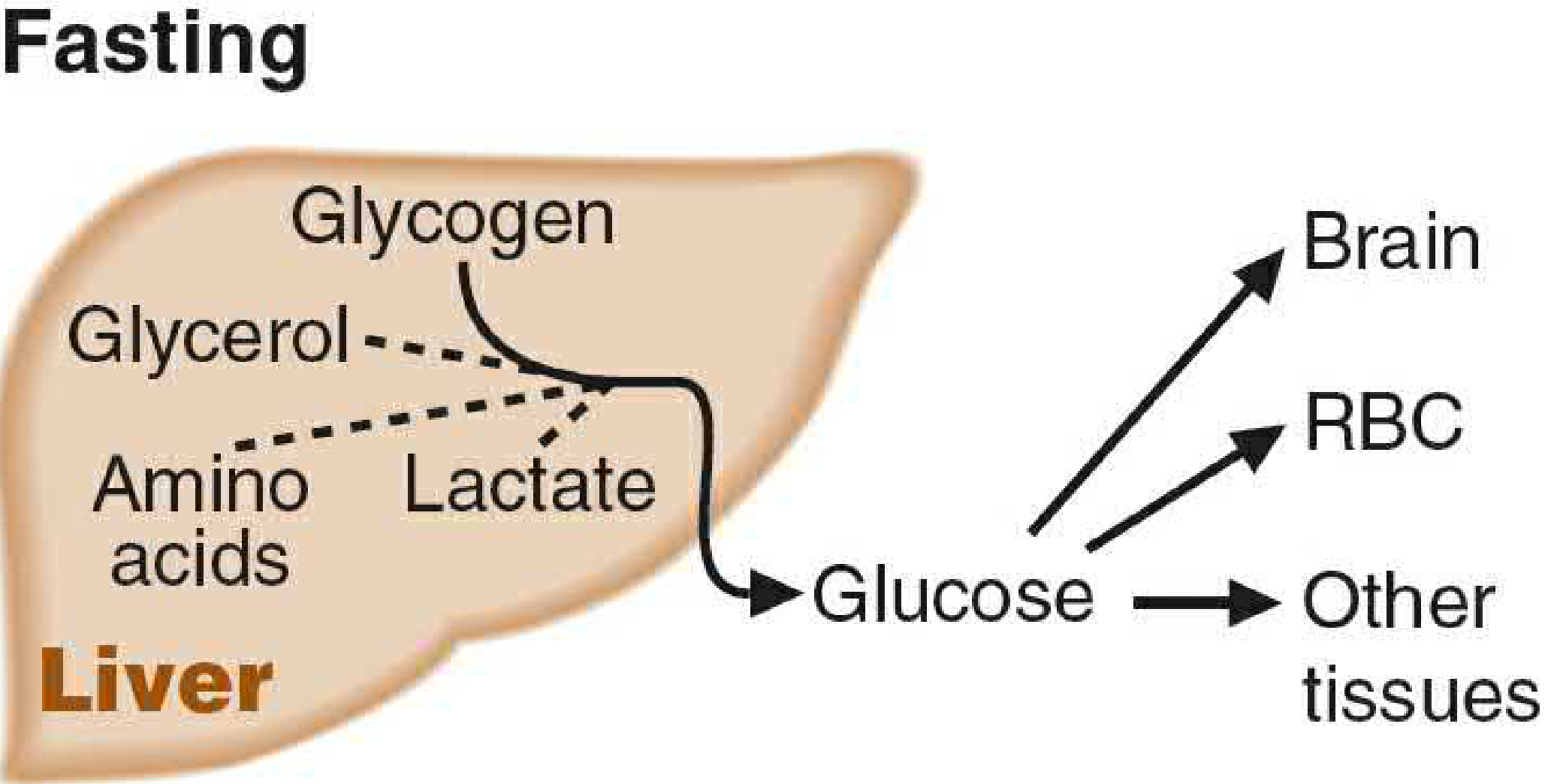
During fasting: the liver mobilizes both glycogen (via glycogenolysis) and non-carbohydrate precursors (via gluconeogenesis) to supply glucose to brain, RBCs, and other tissues. - Basic Medical Biochemistry, 6e
The sequence during a fast:
- 0-2 hrs: Dietary glucose absorbed from gut
- 2-6 hrs: Glycogenolysis predominates - liver glycogen is degraded rapidly
- >6-8 hrs: As glycogen stores deplete, gluconeogenesis takes over as the primary source
- Prolonged starvation (days): Gluconeogenesis is the sole glucose source; kidney also contributes
Key Differences at a Glance
| Gluconeogenesis | Glycogenolysis | |
|---|---|---|
| Type of process | Anabolic (synthesis) | Catabolic (degradation) |
| Substrate type | Non-carbohydrate | Carbohydrate (glycogen) |
| Rate-limiting enzyme | Pyruvate carboxylase / PEPCK | Glycogen phosphorylase |
| Key unique enzymes | Pyruvate carboxylase, PEPCK, FBPase-1, Glc-6-Pase | Glycogen phosphorylase, debranching enzyme |
| Onset | Hours | Minutes |
| Capacity | Virtually unlimited (substrates from body proteins/fat) | Limited by glycogen stores (~70-100g in liver) |
| Occurs in muscle? | No (lacks PEPCK + Glc-6-Pase) | Yes, but glucose stays local (no Glc-6-Pase) |
| Hormonal trigger | Glucagon + cortisol (long fast/stress) | Glucagon + epinephrine (short fast/acute stress) |
| Clinical relevance | Metformin inhibits hepatic gluconeogenesis; targeted in T2DM | Von Gierke disease (Glc-6-Pase deficiency) impairs both pathways |
Sources: Basic Medical Biochemistry - A Clinical Approach, 6e, pp. 1007-1011 | Guyton and Hall Textbook of Medical Physiology, pp. 834, 840 | Mulholland and Greenfield's Surgery, 7e, p. 75
This is a shared conversation. Sign in to Orris to start your own chat.