
Artificial insemination fmt 5 marks reddy and gautam biswas
Reading File
Artificial insemination is a reproductive technique where semen is deposited into the female reproductive tract by non-coital means. Let me search the textbooks for detailed content from Reddy and Gautam Biswas.
Searching sources...
Finding Sources
Finding Sources
The user is asking about "Reddy and Gautam Biswas" - these are K.S. Narayan Reddy and Gautam Biswas, authors of "The Essentials of Forensic Medicine and Toxicology." Let me search that book specifically, and also read the Parikh and Dikshit sections.
Finding Sources
Reading File
Good content from Parikh. Now let me read the Reddy & Biswas (Essentials of FMT) block and also get more from Parikh.
Reading File
Reading File
Good. Now let me get the Reddy & Biswas full section and more of PC Dikshit for the complete picture.
Reading File
Reading File
I now have rich content from Reddy & Biswas (Essentials of FMT) and PC Dikshit. Let me get the rest of the Reddy & Biswas section and the legal aspects/procedure from Dikshit.
Reading File
Reading File
I now have comprehensive content from both Reddy & Biswas (Essentials of FMT, 36th edition) and supporting textbooks. Let me compile the complete answer.
Artificial Insemination
(Forensic Medicine & Toxicology - 5 Marks Answer)
Source: K.S. Narayan Reddy & Gautam Biswas, "The Essentials of Forensic Medicine and Toxicology" 36th edition
Definition
Artificial insemination (AI) is the artificial introduction of semen into the vagina, cervix, or uterus to produce pregnancy. It is resorted to when pregnancy cannot be achieved through normal sexual intercourse.
- Essentials of Forensic Medicine and Toxicology, 36th ed., p. 379
Types
| Type | Full Form | Description |
|---|---|---|
| AIH | Artificial Insemination Homologous (Husband) | Semen of the woman's own husband is used |
| AID | Artificial Insemination Donor | Semen of an unrelated donor is used |
| AIHD | Pooled Donor | Husband's semen is mixed with donor semen ("pooled") - maintains technical possibility that husband is the father |
Indications
- Husband is impotent (sexual intercourse impossible)
- Husband is unable to deposit semen due to anatomical defects - hypospadias, epispadias, etc.
- Husband is sterile (azoospermia, oligospermia)
- Rh incompatibility between husband and wife (husband is homozygous Rh+ve causing erythroblastosis foetalis)
- Husband is suffering from a hereditary disease (to prevent transmission)
- Husband undergoing radiotherapy or chemotherapy for cancer
- Premature or retrograde ejaculation
- Female factors: hostile cervical mucus, mild endometriosis, anatomical defects of cervix/uterus
Procedure (Biological Aspects)
- Semen is obtained by masturbation, preferably after 3 days of abstinence
- Approximately 1 mL of semen is deposited into the top of vagina, cervix, or uterus through a thin plastic tube/syringe
- Timing is critical - insemination is performed close to ovulation (14th day after menstruation), as maximum fertility coincides with it
- The ovum survives for only 12-24 hours after leaving the ovary; sperms travel from vagina to tubes in 6-24 hours and retain fertilizing power for about 48 hours
- Insemination on several successive days increases the chance of success
Two main techniques:
- Intracervical Insemination (ICI): Semen deposited at top of vagina/cervix; a plastic cap may be placed to keep sperms near cervix for ~6 hours
- Intrauterine Insemination (IUI): Sperms placed near fallopian tubes via a thin tube passed through cervix; higher success rate, may be combined with hormonal ovulation induction
Frozen semen for AID is stored by adding glycerol, slow cooling, rapid freezing and storage at -196°C (liquid nitrogen).
Success rate: 30-40% pregnancies within 3-4 months of starting treatment.
Precautions / Ethical Guidelines (for AID)
- Written consent of both husband and wife (and donor's wife) is essential
- Identity of donor must be kept secret from the recipient couple; donor must not know the result of insemination
- Donor must be below 40 years of age, unrelated to either spouse, and should have children of his own
- Donor must be mentally and physically healthy - screened for hereditary/genetic diseases, chromosomal studies, HIV and other STDs
- Race and physical characteristics of donor should resemble the husband as closely as possible
- Donor should be of the same blood group as the husband; no Rh incompatibility
- Pooled semen (AIHD) is preferred so there is a technical possibility that the husband may be the father
- A nurse as witness must be present during the procedure
- Physician must maintain relevant records to prevent a single donor fathering too many children (risk of future consanguineous marriages)
Legal Aspects (India)
-
Adultery: AID does not constitute adultery under Indian law, as Section 497 IPC requires sexual intercourse as a necessary element. It has been decriminalized; however, it can be a ground for divorce.
-
Legitimacy: In AID, the husband is not the biological father. The child is technically illegitimate and cannot inherit property unless adopted. If parents do not declare AID, the child is treated as natural.
-
Nullity of marriage / Divorce: AI alone is not a ground for nullity. If AI was necessitated by the husband's impotence, the wife may seek nullity or divorce. If AI was done without the husband's consent, he can sue his wife for divorce and the doctor for damages.
-
Unmarried woman / Widow: May have a child from AI, but the child would be illegitimate.
-
Incest: Risk of incest between children born by AI and children of the donor exists, but this is not a statutory offence in India.
Complications
- The husband may feel humiliation and develop psychiatric symptoms
- If the child is physically or mentally deformed, the father may have bitter feelings
- The mother may develop neurosis and an obsession to know the donor or have another child from the same donor
- The child may suffer mental trauma if they learn of their origin
Delhi Artificial Insemination (Human) Act, 1995
This Act was enacted to: (1) allow issueless couples to have children; (2) regulate the practice; (3) define the status of children born through AI; and (4) protect all parties involved.
Sources: Reddy KS Narayan & Gautam Biswas, The Essentials of Forensic Medicine and Toxicology, 36th ed.; Parikh's Textbook of Medical Jurisprudence, Forensic Medicine and Toxicology; PC Dikshit Textbook of Forensic Medicine and Toxicology
Exhumation and second autopsy
Exhumation is the lawful disinterment of a buried body for medico-legal examination. It is ordered when cause of death is disputed or suspected to be unnatural after burial.
Searching sources...
Finding Sources
Reading File
Reading File
Reading File
Reading File
Reading File
I have all the information needed for a comprehensive answer. Let me also fetch the exhumation site image from Reddy & Biswas for visual support.
Loading Image
Now I have everything needed for a complete answer.
Exhumation and Second Autopsy
(Forensic Medicine & Toxicology - 5 Marks Answer)
Source: K.S. Narayan Reddy & Gautam Biswas, "The Essentials of Forensic Medicine and Toxicology" 36th ed.; P.C. Dikshit; Parikh's Textbook
Definition
Exhumation is the digging out (disinterment) of an already buried body from the grave for medico-legal purposes. The burial of a dead body is called inhumation; its opposite is exhumation.
- There is no time limit for exhumation in India.
- In France: 10 years; Germany: 30 years.
Indications
Criminal Cases
- Homicide, or suspected homicide when death has been wrongly labelled as natural/suicide
- Suspicious poisoning (most common reason)
- Deaths due to criminal abortion
- Criminal negligence by a doctor or other person
- Cases where proper autopsy was not done or body was disposed of without autopsy and foul play is suspected
Civil Cases
- Accidental death claims and insurance disputes
- Workmen's Compensation claims
- Liability for professional/medical negligence
- Survivorship, inheritance and property claims
- Disputed identity cases
Authorization (Legal Requirement)
- Exhumation is done only on a written order from the Executive Magistrate or Judicial Magistrate [Section 196(4), BNSS / S.176(4) CrPC]
- The Magistrate should inform the relatives of the deceased and allow them to be present throughout [Section 196(5), BNSS]
- It is carried out under the supervision of a Medical Officer in the presence of a Magistrate and Police Officer
Procedure
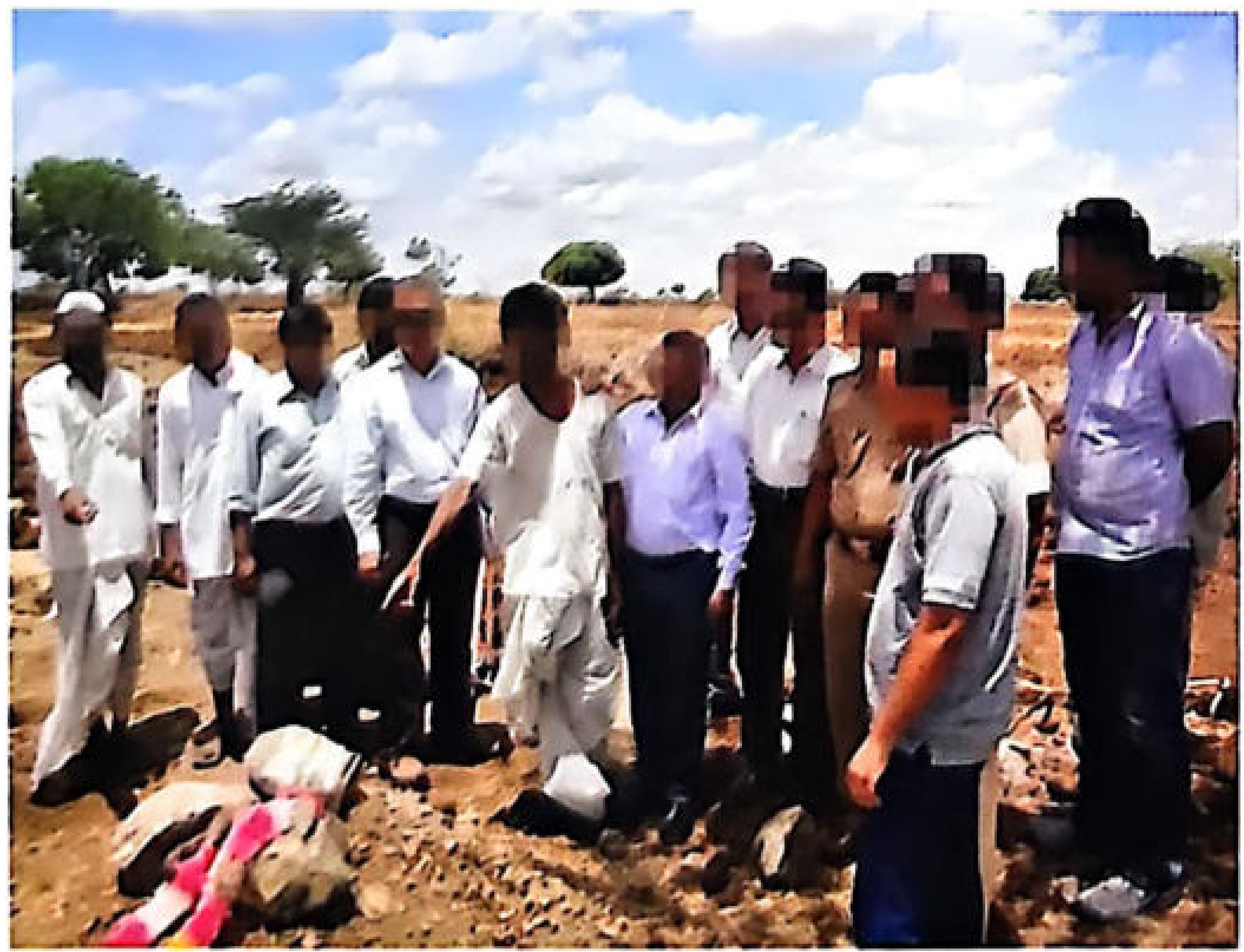
- Preliminary information - Detailed information about the alleged deceased and the clothes worn at burial is obtained before starting
- Identification of the grave - The grave site is positively identified using:
- Location of burial plot, headstone, and grave marker
- Distance from fixed/permanent objects (trees, rocks, roads, fences)
- Register entries; relatives, coffin-maker can help identify the coffin
- Enclosure of the area from the public; conducted in natural daylight (preferably early hours)
- The grave is dug 10-15 cm at a time; condition of soil, water content, and vegetable growth are noted
- The burial pit is opened up 30 cm on all sides of the body
- Expose the body with a soft brush or whisk broom; no shovels directly on the body
- Photograph the body in situ; draw a sketch of the grave and position of the body
- No disinfectant should be sprinkled on the body
- A plastic sheet or plank is lowered to the level of the corpse and it is carefully lifted out to avoid artefacts
- The body is identified by close relatives
- All personal effects, clothing, hair, nails are collected for examination
- If skeletonized: the grave soil is searched for smaller objects - bullets, teeth, hyoid bone, metallic objects
Collection of Samples for Suspected Poisoning
- Viscera must be preserved for chemical analysis
- If organs are converted to mass - loose masses are preserved
- If nothing remains - hair, soil, teeth, and bones are preserved
- Approximately ½ kg of earth from above, below, and each side of the body is collected in clean dry bottles
- A portion of the coffin and burial clothes must be removed to exclude contamination from external sources
- Any fluid or debris in the coffin should also be collected
Autopsy on Exhumed Body
- Disinfectants must NOT be sprinkled on the body before autopsy
- If body is recently buried - postmortem examination is conducted in the usual manner
- Various artefacts of decomposition and burial must be correctly interpreted
- In highly putrefied bodies - attempt to establish identity
- All viscera should be preserved for chemical analysis
- If reduced to skeleton - bones are examined for age, sex, stature, cause of death
- If the body cannot be transported or mortuary is far - autopsy may be conducted at the site
Second Autopsy
A second autopsy may be ordered when:
- Relatives are not satisfied with the first autopsy report
- The first autopsy was not performed in light of the circumstances now available
- The investigating authority demands a second examination
- Suspicion of inadequate or incorrect first autopsy
Steps Before Second Autopsy
The doctor must first obtain all available documents:
- The first autopsy report
- Photographs of the scene of death and body taken during the first autopsy
- Inquest papers of the first PM
- Hospital records, police investigative reports
- X-rays and other investigations
- If possible, the first autopsy pathologist should be called to correlate findings
Key Challenges of Second Autopsy
| Challenge | Explanation |
|---|---|
| Decomposition artefacts | Progressive putrefaction blurs, distorts, and merges injuries |
| Contusion visibility | Contusions may become more visible after first autopsy as blood drains from tissues; however, decomposition later causes merger with blurring of patterns |
| Previous dissection | Viscera already removed and dissected in first autopsy; organs may be absent or replaced |
| Burial artefacts | Changes produced by soil, moisture, insect activity, and chemicals during burial |
| Exhumation artefacts | Mechanical injuries during digging, lifting, and transport of body |
Documentation
- The autopsy should be videographed
- Findings must be documented in detail, whether confirmatory or contradictory to the first autopsy
- Even if no new information is obtained, the second autopsy serves to put an end to rumours or suspicions
Benefits / Advantages of Exhumation
- Confirmation whether the person has actually died
- Determination of the cause of death
- Determination of the manner of death (homicide/suicide/accident/natural)
- Puts an end to public rumours and suspicions
- Sends a message to society that crime cannot go uninvestigated - deterrent effect
- Settling insurance claims and civil responsibilities
Sources: Reddy KS Narayan & Gautam Biswas, The Essentials of Forensic Medicine and Toxicology, 36th ed., pp. 138-139; P.C. Dikshit Textbook of Forensic Medicine and Toxicology, pp. 133-134; Parikh's Textbook of Medical Jurisprudence, Forensic Medicine and Toxicology
Magistrate inquest superior than police inquest
Magistrate inquest is a higher form of inquiry conducted by a judicial/executive magistrate in specific serious cases, as opposed to police inquest which is a routine preliminary inquiry. Let me get the detailed textbook content.
Searching sources...
Finding Sources
Finding Sources
Finding Sources
Reading File
Reading File
Reading File
Reading File
Now let me get the Parikh content which typically has the best comparison/distinction table:
Reading File
Reading File
Reading File
I now have comprehensive content from all three textbooks. Let me compile the full answer.
Magistrate's Inquest vs. Police Inquest
(Forensic Medicine & Toxicology - 5 Marks Answer)
Source: Reddy & Biswas, Essentials of FMT 36th ed.; P.C. Dikshit; Parikh's Textbook
Definition of Inquest
An inquest is an inquiry or investigation into the cause of death. It is conducted in cases of suicide, murder, accidental deaths, suspicious deaths, deaths due to torture/ill-treatment, custodial deaths, criminal abortion, medical negligence, or unidentified bodies.
In India, two types of inquests are held:
- Police Inquest - Under Section 194, BNSS (formerly S. 174, CrPC)
- Magistrate's Inquest - Under Section 196, BNSS (formerly S. 176, CrPC)
A. Police Inquest [Sec. 194 BNSS / S. 174 CrPC]
Conducted by: An officer-in-charge of the police station (usually a Sub-Inspector; not below the rank of Head Constable) known as the Investigating Officer (I.O.)
Indications - Held when a person:
- Has committed suicide
- Has been killed by another person (suspected homicide)
- Has been killed by an animal or machinery
- Has died in an accident
- Has died under suspicious circumstances raising reasonable suspicion that some other person has committed an offence
Procedure:
- On receipt of information of an unnatural/suspicious death, the police officer immediately informs the nearest Executive Magistrate empowered to hold inquest
- Proceeds to the place where the dead body is found
- Conducts investigation in the presence of two or more respectable persons (Panchas) of the neighbourhood
- Prepares the Panchanama (Inquest Report) describing:
- Apparent cause of death
- Wounds, fractures, bruises, and other marks of injury found on the body
- Manner/weapon by which injuries appear to have been inflicted
- Report is signed by the Investigating Officer and the Panchas
- If foul play is suspected: the body is sent for postmortem examination to the nearest authorized government doctor, along with a dead body challan (requisition) and a copy of the inquest report - without removing clothes
- If no foul play suspected: body is released to relatives for disposal
- The entire case record is later transferred to the Magistrate
B. Magistrate's Inquest [Sec. 196 BNSS / S. 176 CrPC]
Conducted by: District Magistrate (Collector/Deputy Commissioner), Sub-Divisional Magistrate (RDO), Tahsildar, or any Executive Magistrate especially empowered by the State Government
Indications - Mandatory in the following cases:
- Dowry death (death of a woman due to dowry harassment)
- Death of a woman within 7 years of marriage, when:
- She commits suicide
- Death raises a reasonable suspicion that some other person committed an offence in relation to her
- Any relative of the woman makes a request
- Any doubt exists regarding the cause of death
- Exhumation of a dead body
- Death of any person in police custody or in any other custody authorized by court
- Death of a person while rape is alleged to have been committed on any woman in custody
The Magistrate may also hold an inquest in any other case instead of, or in addition to, the police inquest [BNSS S.196].
Procedure:
- The Magistrate proceeds to the scene
- During investigation, informs the relatives and allows them to remain present throughout
- Conducts a thorough inquiry into the cause and manner of death
- The inquest papers must be handed over to the autopsy surgeon for information
- Body is sent for postmortem examination
- The proceedings are not judicial proceedings - their only aim is to find out the cause of death
Why Magistrate's Inquest is Superior to Police Inquest
| Feature | Police Inquest | Magistrate's Inquest |
|---|---|---|
| Conducted by | Police Officer (not a judicial officer) | Executive/Judicial Magistrate (higher authority) |
| Authority | Limited - only investigative | Greater judicial authority and powers |
| Objectivity | Police may have conflict of interest (e.g., in custodial deaths) | Independent of police - ensures impartiality |
| Cases | All unnatural/suspicious deaths | Specific serious cases - custodial deaths, dowry deaths, deaths in police firing |
| Presence of relatives | Not mandatory | Mandatory - relatives must be informed and allowed to remain |
| Legal weight | Panchanama - an investigative report | Carries greater legal weight and credibility |
| Independence | Police investigating their own peers in custodial deaths | Independent authority investigating police actions |
| Inquest papers | Prepared by police | Must be handed to the autopsy surgeon |
| Can override | Cannot override magistrate | Can hold inquest instead of, or in addition to, police inquest |
| Custodial deaths | Conflict of interest if police are involved | Mandatory - ensures accountability |
Key Points on Superiority
-
Independence and impartiality: A police officer investigating a death, especially in cases where police themselves may be involved (custodial death, police firing), creates an obvious conflict of interest. The Magistrate is an independent authority, making the inquiry far more credible and fair.
-
Mandatory in sensitive cases: Magistrate's inquest is compulsory in dowry deaths, custodial deaths, and deaths in police custody - exactly the cases where police investigation would be biased.
-
Relatives' right to be present: The Magistrate is legally obligated to inform relatives and allow their presence - a protection not mandated in police inquest.
-
Greater powers: The Magistrate can hold the inquest instead of or in addition to the police inquest, meaning the magistrate's authority supersedes that of the police.
-
Protection against cover-up: In cases of police firing or custodial deaths, a police inquest would be tantamount to the accused investigating themselves. Magistrate's inquest prevents this.
-
Higher accountability: The inquest papers of the Magistrate are handed directly to the autopsy surgeon, ensuring better coordination and less chance of tampering or omission of facts.
Other Systems (Not in India)
| System | Country | Description |
|---|---|---|
| Coroner's Inquest | UK, some US states (abolished in India) | Coroner - qualified in law - holds inquest with jury; has some judicial powers |
| Medical Examiner's System | USA, Japan, Canada | A forensic pathologist visits the scene of crime, performs autopsy, and correlates all findings. Superior to all other systems as it combines medical expertise with legal investigation. Has no judicial functions |
The Medical Examiner's System is considered the most superior form of inquest as it is conducted by a board-certified forensic pathologist who personally visits the scene, performs autopsy, and determines cause and manner of death.
Sources: Reddy KS Narayan & Gautam Biswas, The Essentials of Forensic Medicine and Toxicology, 36th ed., pp. 23-25; P.C. Dikshit, Textbook of FMT, pp. 10-11; Parikh's Textbook of Medical Jurisprudence, Forensic Medicine and Toxicology, pp. 29-32
Abrasion importan than bruise medicolegally
Abrasions are more important than bruises medicolegally because they mark the exact point of contact, retain foreign material, and help determine the direction of force - features that bruises cannot provide.
Searching sources...
Finding Sources
Finding Sources
Finding Sources
Finding Sources
Reading File
Reading File
Reading File
Reading File
Now let me get the Reddy & Biswas section on abrasion medicolegal importance and bruise medicolegal significance:
Finding Sources
Finding Sources
Finding Sources
Reading File
Excellent! I found a key passage from Reddy & Biswas directly stating "Why Bruises are Less Forensically Reliable than Abrasions." Now let me get the full Reddy & Biswas ABRASIONS section:
Reading File
Reading File
Reading File
Reading File
I now have all the content needed. Let me also fetch the key abrasion image from Reddy & Biswas showing direction of force:
Loading Image
I now have all the content needed for a complete, well-structured answer.
Abrasion is More Important than Bruise Medicolegally
(Forensic Medicine & Toxicology - 5 Marks Answer)
Source: Reddy & Biswas, Essentials of FMT 36th ed.; P.C. Dikshit; Parikh's Textbook
Definitions
Abrasion (Gravel rash): Destruction or discontinuity of the superficial layers of the epidermis only, caused by friction against a rough surface or by compression (glancing blow, fall, dragging, fingernails, teeth bite).
Bruise (Contusion): Effusion or extravasation of blood into the tissues due to rupture of blood vessels (veins, venules, arterioles) caused by a blunt object, without necessarily breaking the skin surface.
Why Abrasion is More Important than Bruise Medicolegally
Reddy & Biswas directly state: "Bruises are of less forensic value than abrasions" and enumerate four specific reasons. This makes abrasion the superior medicolegal injury. The reasons are as follows:
1. Abrasion Marks the Exact Point/Site of Contact; Bruise Does NOT
- An abrasion occurs exactly at the site of impact - the skin surface is directly damaged at that precise location
- A bruise, however, may appear away from the actual site of injury due to gravitational movement of blood through tissue planes
- Example: A blow to the scalp may produce bruising appearing at the eye (periorbital); a bruise on the thigh may track down to appear at the knee
- Abrasion = reliable marker of impact site; Bruise = unreliable
2. Abrasion Indicates the Direction of Force; Bruise Does NOT
- In a graze/sliding abrasion: the injury is wider and deeper at the beginning and thinner at the end; heaping of epithelium at the terminal end indicates the direction of the force applied
- In a scratch/linear abrasion: it is wider at the start and epithelium heaps at the end, indicating direction
- This helps reconstruct how the assault/accident occurred and the relative position of victim and assailant
- A bruise gives no directional information whatsoever
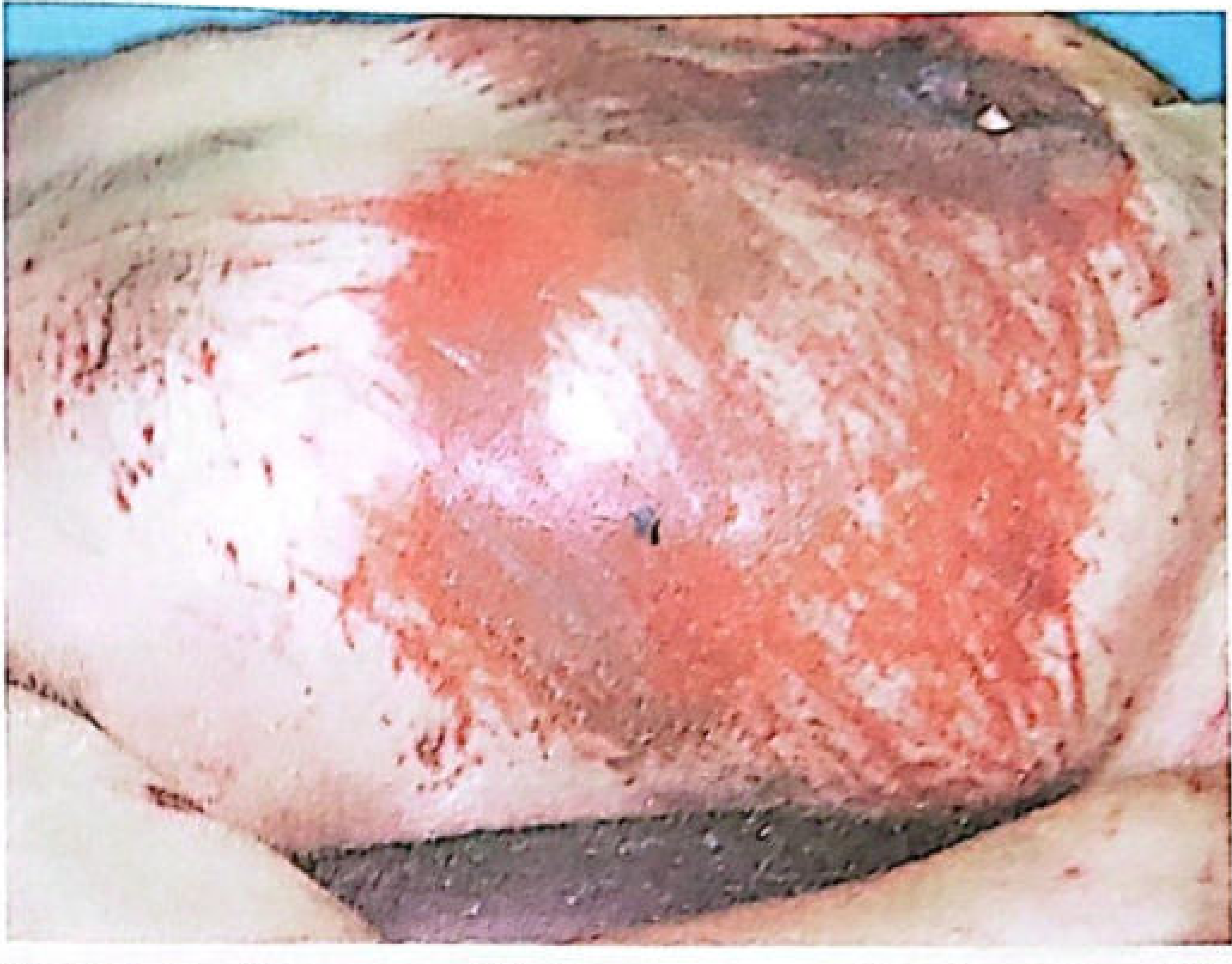
3. Abrasion Appears Immediately; Bruise May Be Delayed
- An abrasion is visible immediately after the injury at the moment of examination
- A bruise may not become visible for several hours or even 1-2 days after the injury (as blood slowly extravasates and diffuses through tissue planes to reach the skin surface)
- This delay makes bruising unreliable for determining the time of assault, while abrasion gives a more immediate and accurate picture
4. Size of Bruise Does Not Correspond to Size of Weapon; Abrasion (Patterned) Reproduces Weapon Pattern
- The size of a bruise may not correspond to the size of the weapon - a large bruise may result from a small weapon and vice versa, depending on tissue laxity, vessel fragility, depth of injury etc.
- Patterned/imprint abrasions, however, faithfully reproduce the shape and pattern of the weapon - e.g., tyre tread marks, radiator grill, rope/ligature pattern, teeth bite marks
- This allows identification and matching of the weapon to the injury
Medicolegal Importance of Abrasion (Point-by-Point)
| Medicolegal Point | Abrasion | Bruise |
|---|---|---|
| Site of impact | Always at exact site | May migrate away |
| Direction of force | Indicated by tailing/heaping | Not indicated |
| Time of appearance | Immediate | Delayed (hours to days) |
| Weapon pattern | Reproduced faithfully | Size may not correspond |
| Age estimation | Reliable (scab changes) | Less reliable (colour changes variable) |
| Foreign material | Retains dirt, grit, paint, grease | Does not retain surface material |
| Nature of offence | Specific sites indicate offence type | Less specific |
| Self-infliction | Possible; must exclude | Difficult to self-inflict |
Detailed Medicolegal Importance of Abrasion
-
Site of impact: Marks the exact point of contact with the weapon/surface - the most reliable indicator of where force was applied
-
Direction of force: The tailing (heaping of epithelium) at one end shows the direction of the blow or movement - important for reconstructing the incident
-
Age estimation: The progression of scab changes allows approximate dating of the injury:
| Age | Appearance of Abrasion |
|---|---|
| Fresh | Bright red (no scab) |
| 8-12 hours | Reddish scab forms |
| 2-3 days | Reddish-brown scab |
| 4-7 days | Dark brown to brownish-black scab; epithelium growing underneath |
| After 7 days | Scab dries, shrinks and falls off; leaves depigmented area |
-
Weapon identification: Patterned abrasions reproduce the weapon - tyre marks, rope marks, radiator grill, teeth bite marks, ligature marks in hanging/strangulation
-
Nature of offence:
- Abrasions on neck → strangulation/throttling
- Abrasions on breasts, inner thighs, genitalia, perianal region → sexual assault/rape
- Abrasions on the face of the assailant → indicate a struggle (from victim's nails)
- Nails of victim may show fingernails of assailant were long, irregular or broken
-
Retains foreign material: Dirt, grit, road dust, paint flakes, grease embedded in abrasion can connect the victim to the scene of crime or to a specific weapon
-
Antemortem vs. postmortem: Antemortem abrasions show vital reaction (redness, scab, inflammation); postmortem abrasions are yellowish, parchment-like - helps determine if injury was inflicted before or after death
-
Self-infliction: Abrasions can be self-inflicted for leveling false charges against enemies - the doctor must be alert to this (shape, depth, location, pattern inconsistent with alleged history)
Why Bruise Falls Short Medicolegally (Direct Quote - Reddy & Biswas)
"Bruises are of less value than abrasions because: (1) Their size may not correspond to the size of the weapon. (2) They may become visible for several hours or even one to two days after the injury. (3) They may appear away from the actual site of injury. (4) They do not indicate the direction in which the force was applied." — Reddy & Biswas, Essentials of FMT, 36th ed., p. 193
Summary (Memory Aid)
"SWAP-D" - Why abrasion is superior:
- Site - marks exact impact site
- Weapon - pattern reproduced
- Appearance - immediate, not delayed
- Placement - stays at injury site (doesn't migrate)
- Direction - indicates direction of force
Sources: Reddy KS Narayan & Gautam Biswas, The Essentials of Forensic Medicine and Toxicology, 36th ed., pp. 185-193; P.C. Dikshit, Textbook of FMT, pp. 177-179; Parikh's Textbook of Medical Jurisprudence, Forensic Medicine and Toxicology
Abrasion importan than bruise medicolegally
This was covered in detail in the previous answer. Here is a clean, exam-ready version:
Abrasion is More Important than Bruise Medicolegally
(Forensic Medicine & Toxicology - 5 Marks)
Source: Reddy & Biswas, Essentials of FMT 36th ed.
Definitions
Abrasion: Destruction/discontinuity of the superficial layers of the epidermis only, caused by friction or compression against a rough surface.
Bruise (Contusion): Extravasation of blood into the tissues due to rupture of blood vessels by a blunt force, without necessarily breaking the skin.
Direct Quote - Reddy & Biswas (The Core Answer)
"Bruises are of less value than abrasions because: (1) Their size may not correspond to the size of the weapon. (2) They may become visible for several hours or even one to two days after the injury. (3) They may appear away from the actual site of injury. (4) They do not indicate the direction in which the force was applied."
Point-by-Point Comparison
| Feature | Abrasion | Bruise |
|---|---|---|
| Site of impact | Always at the exact site of contact | May migrate away from actual site of injury |
| Direction of force | Clearly indicated by tailing/heaping of epithelium | Not indicated at all |
| Time of appearance | Immediate - visible at once | Delayed - may appear hours to 1-2 days later |
| Weapon size | Patterned abrasion faithfully reproduces weapon | Size of bruise may NOT correspond to weapon size |
| Foreign material | Retains dirt, grit, paint, grease - links to scene | Does not retain surface material |
| Age estimation | Reliable (scab appearance changes) | Less reliable (colour changes are variable) |
| Self-infliction | Possible - must be excluded | Difficult to self-inflict convincingly |
Medicolegal Importance of Abrasion (Detailed)
1. Marks the Exact Point of Contact
- Abrasion occurs precisely at the site where the weapon or surface struck the body
- Bruise may appear at a distant site due to blood tracking through loose tissue planes
- Example: A blow to the scalp may show bruising around the eye; the abrasion stays at the scalp
2. Indicates Direction of Force
- In graze/sliding abrasion: wider and deeper at the start, tailing/heaping of epithelium at the terminal end indicates the direction of force
- In scratch/linear abrasion: wider at start, epithelium heaps at end
- Helps reconstruct the dynamics of assault and the relative position of victim and assailant
- Bruise gives absolutely no directional information
3. Weapon Identification (Patterned Abrasions)
- Patterned/imprint abrasions faithfully reproduce the surface pattern of the weapon:
- Tyre tread → run-over accidents
- Radiator grill/headlamp rim → vehicular accidents
- Ligature mark → hanging/strangulation
- Teeth bite marks → sexual assault, struggle
- Rope/cord pattern → binding injuries
- Bruise size often does NOT correspond to weapon size
4. Age Estimation of Abrasion
| Approximate Age | Appearance |
|---|---|
| Fresh | Bright red, moist, no scab |
| 8-12 hours | Reddish scab forms |
| 2-3 days | Reddish-brown scab |
| 4-7 days | Dark brown to brownish-black scab; epithelium growing underneath |
| After 7 days | Scab dries, shrinks, falls off; leaves depigmented area |
Age of bruise by colour change is far less reliable due to variability in tissue type, depth, age of victim, and disease states.
5. Nature of Offence
- Neck → strangulation/throttling/attempt to strangle
- Breasts, inner thighs, genitalia, perianal region → sexual assault/rape
- Face of assailant → indicates struggle (victim's nail marks)
- Wrists/ankles → restraint/binding
- Abrasion location is diagnostically specific; bruise location is less so
6. Retains Foreign Material
- Dirt, road dust, grit, paint flakes, grease, glass fragments may be embedded in the abrasion
- Connects the victim to the scene of crime or to a specific weapon/surface
- Bruises do not retain any external material
7. Antemortem vs. Postmortem Distinction
- Antemortem abrasion: shows vital reaction - redness, scab formation, inflammatory infiltrate, epithelial regeneration
- Postmortem abrasion: yellowish, parchment-like, dry - no vital reaction
- This distinction is critical in determining whether injury was inflicted before or after death
8. Self-Infliction
- Abrasions can be self-inflicted to level false charges of assault
- Pattern, depth, direction and location inconsistent with alleged history raise suspicion
- The doctor must exclude this possibility
Age of Bruise (Colour Changes - for Comparison)
| Colour | Pigment | Time |
|---|---|---|
| Red | Oxyhemoglobin | Immediate |
| Blue | Deoxygenated Hb | 1-3 days |
| Bluish-black to brown | Hemosiderin | 4th day |
| Greenish | Hematoidin | 5-6 days |
| Yellow | Bilirubin | 7-12 days |
| Normal | - | ~2 weeks |
These colour changes are highly variable and unreliable in old age, disease, deep bruises, and CO poisoning (bruise stays bright red).
Memory Aid - "SWAP-D"
Why abrasion is superior medicolegally:
- S - Site: marks exact point of impact
- W - Weapon: pattern reproduced faithfully
- A - Appearance: immediate, not delayed
- P - Placement: stays at injury site, does not migrate
- D - Direction: indicates direction of force
Sources: Reddy KS Narayan & Gautam Biswas, The Essentials of Forensic Medicine and Toxicology, 36th ed., pp. 185-193; P.C. Dikshit, Textbook of FMT, pp. 177-179
This is a shared conversation. Sign in to Orris to start your own chat.