
Achlasia cardia
Reading File
Finding Sources
Searching PubMed
achalasia cardia treatment
Reading File
Reading File
Reading File
Finding Sources
Reading File
Reading File
Loading Image
Reading File
Reading File
I now have enough content for a comprehensive answer. Let me compile everything:
Achalasia Cardia
Definition
Achalasia (from Greek "does not relax") is a primary esophageal motility disorder characterized by two cardinal manometric features:
- Impaired / absent lower esophageal sphincter (LES) relaxation with swallowing
- Aperistalsis in the smooth muscle esophagus
It is the best-understood and most clinically significant esophageal motor disorder. - Sleisenger and Fordtran's Gastrointestinal and Liver Disease
Etiology and Pathophysiology
The fundamental defect is loss of ganglion cells within the myenteric (Auerbach) plexus of the smooth muscle esophagus and LES. This is associated with mononuclear inflammatory infiltration around surviving ganglion cells.
Neurochemical basis:
- Normal LES relaxation is mediated by inhibitory neurons secreting nitric oxide (NO) and vasoactive intestinal peptide (VIP)
- In achalasia, NO synthase activity is absent and VIP-staining neurons are markedly reduced
- The result: deglutitive inhibition fails - LES does not relax when swallowing occurs
- CCK paradox: Normally CCK stimulates inhibitory neurons to reduce LES pressure; in achalasia it increases LES pressure (pathognomonic finding)
Disease progression (by Chicago Classification subtypes):
- Type II (compression) → Type I (classic/dilated) → End-stage mega-esophagus
- Type III (spastic achalasia) has a distinct pathogenesis: myenteric inflammation and dysfunction without destruction
Underlying cause - autoimmune theory:
An autoimmune attack on genetically susceptible individuals is the leading hypothesis. Majority of myenteric infiltrate = cytotoxic T cells. Antibodies against myenteric neurons have been found in patients' sera, especially those with specific HLA alleles. The suspected trigger is chronic/latent HSV-1 infection combined with genetic predisposition. - Sleisenger and Fordtran's
Chicago Classification of Achalasia Subtypes (HRM-Based)
High-resolution manometry (HRM) is the gold standard for diagnosis and subtyping:
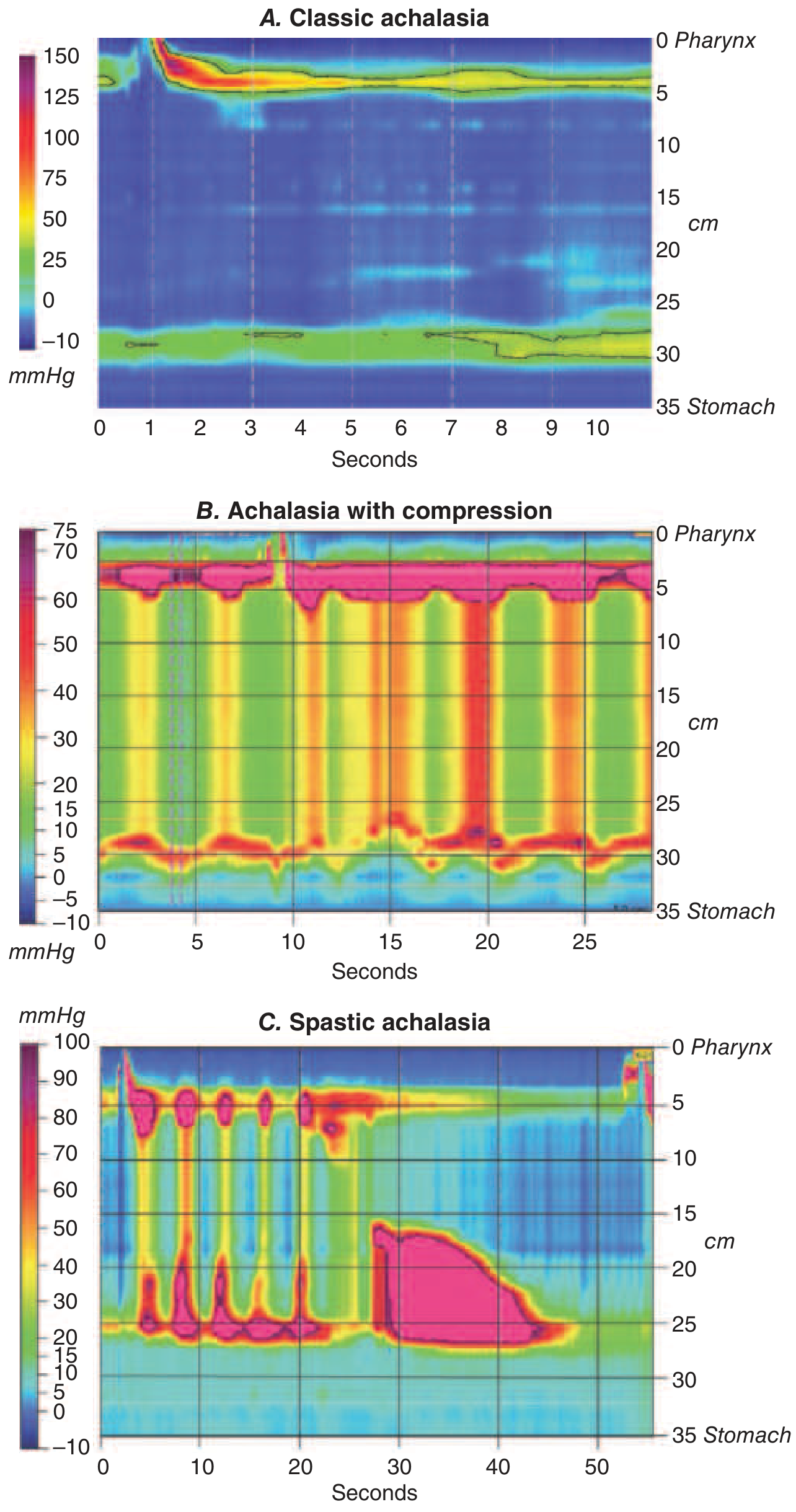
| Subtype | Features | Response to Treatment |
|---|---|---|
| Type I - Classic | Minimal pressurization, esophageal dilatation | Moderate |
| Type II - With compression | Panesophageal pressurization/compression | Best - ~100% to pneumatic dilation |
| Type III - Spastic | Premature/spastic contractions in esophageal body | Lowest - ~40% to dilation; better with myotomy |
Clinical Features
Symptoms:
- Dysphagia - universal; present for solids in all patients; most also have liquid dysphagia; gradual onset, fluctuates then plateaus
- Regurgitation - undigested food eaten hours or days earlier; nonbilious, nonacid, mixed with saliva
- Chest pain - ~2/3 of patients early in disease; may spontaneously resolve over time; responds less well to treatment than dysphagia
- Weight loss - progressive
- Heartburn - paradoxical complaint; actually caused by bacterial fermentation of retained food, NOT true acid reflux
- Hiccups, halitosis
Complications:
- Bronchopulmonary complications - up to 10% of advanced cases (aspiration pneumonia, chronic cough)
- Airway compromise / stridor - rare; dilated esophagus compresses membranous trachea
- Squamous cell carcinoma - 17-fold increased risk vs. age-matched controls; 0.15% cumulative incidence; develops after many years in a dilated, stasis-inflamed esophagus
Diagnosis
1. Barium Swallow (Upper GI Series)
- Classic "bird's beak" or "rat-tail" appearance at the gastroesophageal junction
- Esophageal dilatation, stasis of contrast, "jet stream" sign
2. High-Resolution Manometry (Definitive)
- Gold standard - most sensitive, detects early disease before dilatation
- Mandatory findings: elevated integrated relaxation pressure (IRP) + absent peristalsis
- Enables Chicago Classification subtyping
3. Endoscopy (EGD)
- Typically shows dilated esophagus with retained food/secretions
- LES may feel tight on intubation ("pop" on passage)
- Required to rule out pseudoachalasia (carcinoma at EGJ mimicking achalasia)
4. Functional Luminal Imaging Probe (FLIP)
- Identifies a poorly distensible sphincter even when HRM shows adequate relaxation
Treatment
Principle: The neuropathology cannot be corrected. All treatments aim to reduce LES pressure to enable gravity-assisted esophageal emptying. - Harrison's 22nd Ed.
Pharmacologic (Temporizing Only)
| Drug | Mechanism | Notes |
|---|---|---|
| Isosorbide dinitrate / sublingual nitroglycerin | Smooth muscle relaxation via NO | Headache, tolerance; given before meals |
| Nifedipine (sublingual, 30-40 mg/day) | Calcium channel blocker | Flushing, dizziness, peripheral edema; limited benefit |
| Sildenafil (50 mg) | PDE-5 inhibitor, blocks cGMP degradation | Significant LES pressure reduction but limited by cost and side effects |
| Botulinum toxin injection | Inhibits ACh release from presynaptic terminals; eliminates neurogenic LES pressure | 66% response at 6 months; minimal efficacy at 1 year; repeat injections cause fibrosis; best for elderly/frail patients unfit for definitive therapy |
Pneumatic (Balloon) Dilation
- Noncompliant cylindrical Rigiflex balloon (3.0, 3.5, or 4.0 cm) placed fluoroscopically across LES
- Inflated to disrupt circular muscle of sphincter
- Efficacy: 60-90%; ~100% for Type II achalasia
- Major complication: esophageal perforation ~1% (range 0.5-5%)
- Considered preferred initial therapy for Type II achalasia given its lower cost vs. surgery with equivalent outcomes
Laparoscopic Heller Myotomy (LHM)
- Surgical division of LES circular muscle
- Always combined with partial (Dor or Toupet) antireflux fundoplication to prevent post-myotomy GERD
- Success rate: 62-90%
- A landmark multicenter European RCT showed ~90% efficacy at 5 years for both LHM and pneumatic dilation
- Preferred for Type III achalasia (86% success vs. 40% for dilation)
Peroral Endoscopic Myotomy (POEM)
- Endoscopic procedure: mucosal incision → submucosal tunnel → circular muscle transection with electrocautery
- Particularly advantageous for Type III (spastic) achalasia due to ability to extend myotomy to distal esophageal body
- A RCT showed 92% remission at 1 year for POEM vs. 70% for pneumatic dilation (p<0.01)
- GERD is common after POEM (managed with PPIs); no antireflux procedure is created
- Advantages: endoscopic approach, shorter hospital stay, can tailor myotomy length
Temporary Self-Expanding Metal Stents (SEMS)
- Retrievable stents as a bridge/alternative when surgery is not possible
- Limited evidence; may be considered in patients unfit for definitive therapy
Esophagectomy (Last Resort)
- For refractory/end-stage achalasia: esophageal resection with gastric pull-up or colonic/small bowel interposition
- Indications: obstructive symptoms unresolvable by other means, malnutrition, chronic aspiration, perforation, cancer
- Mortality ~4%
Treatment Selection by Subtype
Type I or II Achalasia:
  → First choice: Pneumatic dilation (especially Type II) OR Laparoscopic Heller Myotomy
  → Type II: 100% response to dilation; equal to myotomy

Type III (Spastic) Achalasia:
  → First choice: POEM or Laparoscopic Heller Myotomy
  → Pneumatic dilation less effective (~40%)

Elderly/high surgical risk:
  → Botulinum toxin injection (repeated PRN)

Refractory/failed all above:
  → Esophagectomy
Cancer Surveillance
Achalasia confers a 17-fold increased risk of squamous cell carcinoma of the esophagus. Despite this, the ASGE guidelines do not recommend routine endoscopic surveillance, as the absolute incidence is only ~0.15%. If surveillance is considered, it is reasonable to begin 15 years after symptom onset. - Sleisenger and Fordtran's
Key Points Summary
| Feature | Detail |
|---|---|
| Pathology | Myenteric plexus ganglion cell loss; inhibitory neuron (NO/VIP) deficiency |
| Etiology | Autoimmune (HSV-1 trigger + genetic predisposition) |
| Gold standard diagnosis | High-resolution esophageal manometry |
| Classic radiology | "Bird's beak" / "rat-tail" narrowing at LES |
| Best subtype for dilation | Type II (100% response) |
| Best subtype for POEM | Type III (spastic) |
| Definitive surgeries | Laparoscopic Heller Myotomy, POEM |
| Cancer risk | 17x squamous cell carcinoma risk |
| Surveillance start | 15 years after symptom onset |
Sources: Sleisenger and Fordtran's Gastrointestinal and Liver Disease; Harrison's Principles of Internal Medicine 22nd Ed. (2025); Current Surgical Therapy 14e
This is a shared conversation. Sign in to Orris to start your own chat.