Tell me about jwara chikitsa in ayurveda
jwara chikitsa ayurveda treatment fever classical texts
https://www.easyayurveda.com/charaka-jwara-chikitsa
https://www.lakshmiayurveda.com.au/blogs/news-from-the-clini…
Jwara Chikitsa - Ayurvedic Management of Fever
What is Jwara?
"Jvarayati samtapayati iti jvara" - Jwara is an elevation of body temperature combined with a burning sensation throughout the body AND affliction of the mind and senses.
- Mrityu - death
- Atanka - terror
- Ojoshana - depletion of Ojas (vital life essence)
Hetu (Causative Factors)
| Category | Examples |
|---|---|
| Dosha vitiation | Imbalance of Vata, Pitta, or Kapha |
| Exogenous/Agantuja | Trauma (Abhighata), poisoning (Visha), seasonal changes (Kala) |
| Lifestyle | Excessive physical exertion (Shrama), emaciation (Kshaya) |
| Iatrogenic | Improper Panchakarma therapies |
| Psychological | Fear, grief, anger, lust, psychological trauma |
| Obstetric | During labor (Prasuti) |
| Supernatural (classical) | Shapa (curse), Abhichara (black magic), Bhuta, Abhishanga |
Samprapti (Pathogenesis)
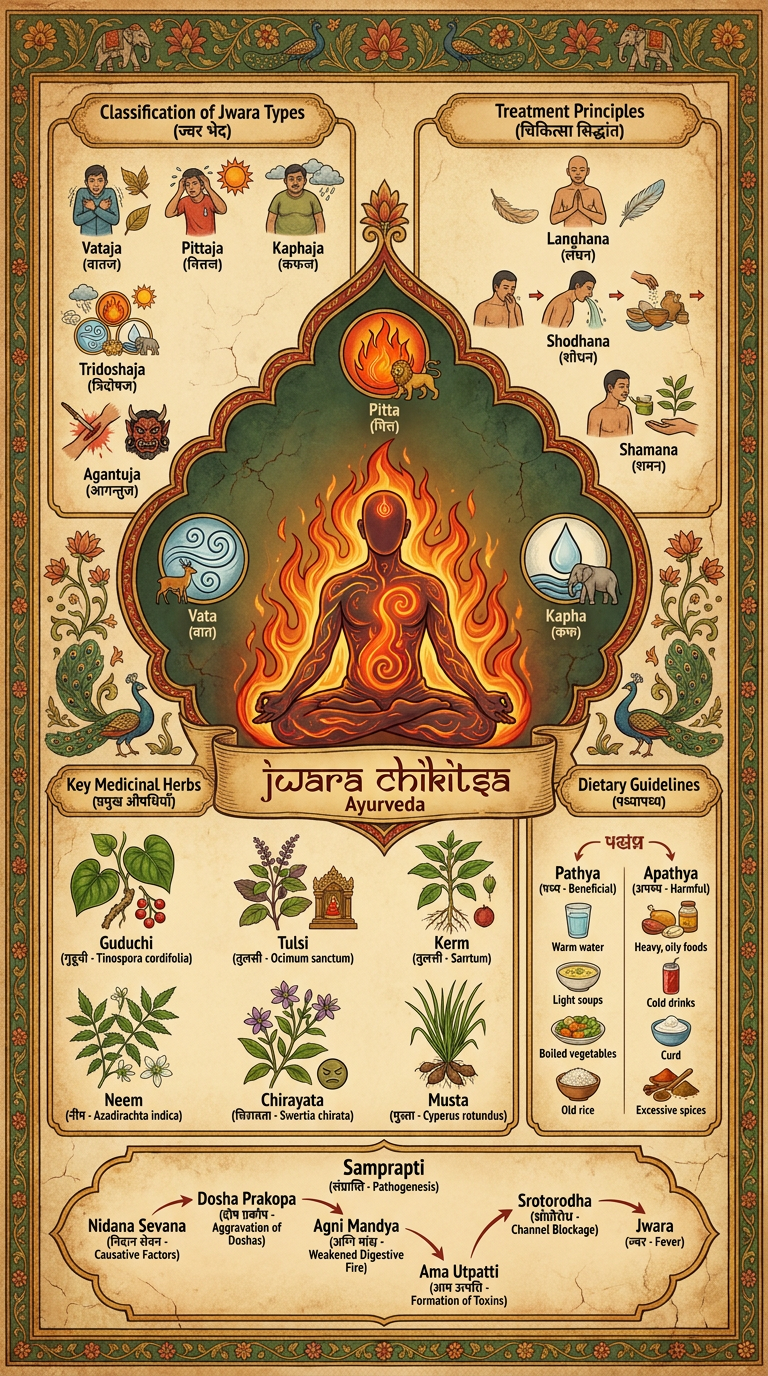
Classification (Jwara Bheda)
By Dosha (Primary classification - 8 types)
- Vataja Jwara - dry skin, pain in joints, variable fever, headache, trembling
- Pittaja Jwara - high burning fever, thirst, yellow discoloration, sweating, delirium
- Kaphaja Jwara - low-grade fever, heaviness, cold and clammy skin, nausea
- Vata-Pittaja (dual)
- Vata-Kaphaja (dual)
- Pitta-Kaphaja (dual)
- Tridoshaja (all three vitiated - serious prognosis)
- Agantuja Jwara - exogenous origin (external trauma, psychological, supernatural)
By Physical vs. Mental origin
- Sharira Jwara - originates in the body
- Manasa Jwara - originates in the mind
By Temperature source
- Agneya - caused by heat (Pitta predominant)
- Saumya - caused by cold factors (Kapha/Vata predominant)
By Pattern (Vishama Jwara - 5 types)
| Type | Pattern |
|---|---|
| Satata | Continuous fever |
| Santata | Persistent without remission |
| Anyedyuska | Alternate day fever (like tertian malaria) |
| Trtiyaka | Every third day fever |
| Chaturthaka | Every fourth day fever (like quartan malaria) |
By Dhatu (tissue involvement - 7 types)
By Prognosis
- Sadhya - curable
- Asadhya - incurable (difficult)
Chikitsa (Treatment Principles)
Stage-based approach
- Upavasa (fasting or very light diet) is the cornerstone
- Do NOT give oil, heavy foods, or oleation in this stage - it worsens Ama
- Deepana-Pachana (digestive stimulant herbs) to burn off Ama
- Tepid water sipping, light Yavagu (rice gruel)
Shodhana and Shamana Therapies
By Dosha
- Snehana (oleation with medicated ghee)
- Swedana (sudation/sweating therapy)
- Basti (medicated enema) - the key treatment for Vata
- Milk preparations, Ashwagandha, Bala
- Virechana (therapeutic purgation) - primary Pitta-clearing treatment
- Tikta Ghrita (bitter ghee preparations)
- Cooling herbs: Chandana (Sandalwood), Ushira (Vetiver), Guduchi, Amalaka
- Avoid sweating and hot therapies
- Vamana (therapeutic emesis)
- Ruksha (dry) therapies, Udvartana (dry powder massage)
- Dipana herbs: Trikatu (ginger, black pepper, long pepper), Musta
Dhatugata Jwara Treatment (Tissue-level fever)
| Dhatu affected | Treatment |
|---|---|
| Rasa Dhatu | Vamana (emesis) + Upavasa (fasting) |
| Rakta Dhatu | Seka (fomentation) + Pradeha (medicated ointments) |
| Mamsa & Medas | Virechana (purgation) + Upavasa |
| Asthi & Majja | Niruha + Anuvasana Basti (both types of enema) |
Key Herbs and Formulations
Single Herbs
| Herb | Sanskrit name | Primary action in Jwara |
|---|---|---|
| Tinospora cordifolia | Guduchi / Amrita | Immunomodulant, antipyretic |
| Ocimum sanctum | Tulsi | Antipyretic, antimicrobial |
| Swertia chirata | Kiratatikta / Chirayata | Bitter tonic, antipyretic |
| Cyperus rotundus | Musta | Digestive, antipyretic |
| Azadirachta indica | Nimba (Neem) | Antipyretic, antimicrobial |
| Picrorhiza kurroa | Katukarohini | Liver-protective, antipyretic |
| Zingiber officinale | Shunthi (dry ginger) | Deepana, anti-Ama |
| Hemidesmus indicus | Sariva | Cooling, blood-purifying |
| Santalum album | Chandana (Sandalwood) | Cooling, Pitta-pacifying |
| Fumaria parviflora | Parpataka | Tridoshahara, antipyretic |
| Glycyrrhiza glabra | Yashtimadhu (Licorice) | Anti-inflammatory |
| Terminalia chebula | Haritaki | Tridoshahara |
Classical Decoctions for Vishama Jwara (5 types)
- Kalingaka + Patola leaf + Katukarohini
- Patola + Sariva + Musta + Patha + Katukarohini
- Nimba + Patola + Triphala + Draksha + Musta + Vatsaka
- Kiratatikta + Amruta + Chandana + Shunthi (ginger)
- Guduchi + Amalaka + Musta
Classic Formulations
- Sudarshana Churna - a famous poly-herbal antipyretic powder for all types of Jwara
- Amritarishta - Guduchi-based fermented preparation
- Shadanga Paniya - six-herb decoction drunk as a cooling drink
- Tikta Ghrita - bitter medicated ghee for Pittaja fever
Agantuja Jwara (Exogenous Fever) - Special Treatment
- Fever from external injury: ghee massage, blood-letting, light meat soups
- Fever from psychological causes (fear, grief): Sattvavajaya Chikitsa (psycho-spiritual therapy)
- Fever from supernatural causes (classical context): Daiva Vyapashraya Chikitsa - religious rites, mantras, offering oblations (Homa), visiting saints, recitation of Vedas, prayer, celibacy, penance (Tapa)
Dietary Management (Pathya-Apathya)
- Yavagu (thin rice gruel/congee) - especially in early stages
- Yusha (vegetable soup) and Rasa (light meat soup from Jangala/arid-zone animals)
- Warm water (Ushna Jala) sipping throughout illness
- Old rice (Purana Shali), moong dal (green gram)
- Pomegranate juice (cooling, especially in Pittaja)
- Heavy (Guru), cold (Sheeta), oily (Snigdha) foods
- Abhishyandi foods (channel-blocking foods like yogurt, cheese)
- Day sleep (Divasvapna) - especially in Kaphaja fever
- Exposure to cold wind and rain (especially in Kaphaja)
- Sexual activity, anger, excessive physical exertion
Prognosis Indicators (Sadhya vs. Asadhya)
Modern Relevance
Create image
What should the image be about?
Jwara Chikitsa Ayurveda concept diagram. A detailed, visually rich educational poster about Jwara (fever) in Ayurveda. The center shows a human figure with flames representing fever and the three doshas (Vata, Pitta, Kapha) around it with their symbols. Surrounding sections include: classification of Jwara types (Vataja, Pittaja, Kaphaja, Tridoshaja, Agantuja), treatment principles (Langhana, Shodhana, Shamana), key medicinal herbs (Guduchi, Tulsi, Neem, Chirayata, Musta shown as botanical illustrations), dietary guidelines (Pathya and Apathya), and the Samprapti (pathogenesis) flow. Traditional Indian aesthetic with earthy tones, Sanskrit labels alongside English, decorative borders inspired by Indian manuscript art.